Preservation or National Necessity? Gettysburg National Military Park During the World Wars

By Jonathan Tracey ’19

The great battle in 1863 was not the only time that soldiers occupied Gettysburg. As a National Military Park, the land was administered by the War Department for decades before becoming part of the National Park Service in 1933. As such, the department could use the land for whatever purpose was deemed necessary. During both World Wars the government made use of the historic landscape where Pickett’s Charge took place, and mandated the registration of monuments for potential removal as scrap metal for the war effort. The government saw the threats posed by 20th century warfare to outweigh the value of a preserved landscape.

A Renault tank cresting a dirt hill near the Bliss Farm in 1918. Courtesy of Eisenhower National Historic Site.

In 1917, the fields briefly hosted a mass mobilization camp, but that was short lived. The more major encampment came in 1918. The fields of Pickett’s Charge had become home to Camp Colt, a training camp for the newly formed Tank Corps. Soldiers under the command of Dwight D. Eisenhower ensured that the sounds of war again echoed through Gettysburg. Infantry carried out drill, and trucks with machine guns and 3 inch naval guns used the Round Tops for target practice. Once tanks arrived, drivers honed their skills on the battlefield, accidentally plowing through dirt as they maneuvered over historic landscapes, including the remnants of the Bliss family’s farm. After the war, the buildings were demolished, but the camp still left a physical mark on the landscape. Years later, William Redding, a farmer who had leased his farm from the government prior to the war, filed a complaint that, despite the fact the government had promised to return the land to the original condition, “sewers, water courses, trenches, and other excavations” remained in the fields.

In 1944, enemy soldiers again arrived in Gettysburg. Instead of invading Confederates, these new soldiers were German prisoners of war, mostly captured in North Africa. Chosen for the isolated location, local labor deficiencies, and remaining infrastructure, the former grounds of Camp Colt became home to an unnamed POW camp. Many Gettysburgians were angered by this, but not necessarily because of the use of the battlefield. Instead, their complaints primarily focused on fears of violent German escapees or anger that jobs vacated by their loved ones in the armed forces would be filled by the enemies the former workers had gone off to fight. These prisoners worked in businesses around Gettysburg, filling American soldiers’ vacant jobs by cutting wood, picking apples, and working in canning plants. Interestingly, many of the work crews also helped clear brush from the battlefield, helping to restore the historic landscape that their camp was intruding upon.
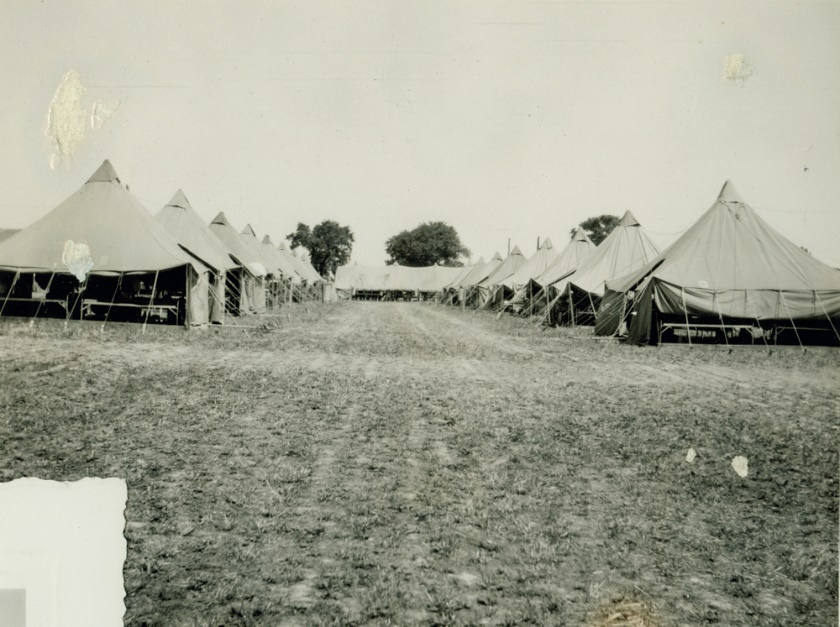
The tents that comprised the WWII prisoner of war camp on the fields of Pickett’s Charge in 1944. Courtesy of Gettysburg National Military Park.

During the Second World War, Gettysburg’s landscape also paid a price during the scrap drives. Fences, markers, and even parts of monuments were split into categories based off “importance.” These categories would determine at what pace they would be removed if the situation became so desperate that the government absolutely needed the metal. Luckily, the situation never became so desperate to call for the removal of monuments, but Gettysburg did sacrifice “750 spherical shells, 14 iron guns, 1 bronze gun, 8 bronze howitzers, 26 bronze siege guns, and 38 bronze guns.” These were of post-Civil War manufacture, and deemed expendable. Modern visitors can still see the places where the spherical shells were once placed, such as the concrete foundations next to Cushing’s Battery at the Angle.

Ultimately, Gettysburg sacrificed parts of the historic and commemorative landscape during the World Wars. Fields were occupied by soldiers, weapons were discharged towards the Round Tops, military vehicles drove over previously preserved fields, and commemorative objects were removed for scrap drives. Were these sacrifices worth it? Should the government have found different places for military camps and different sources of metal, or was the integrity of Gettysburg’s landscape worth partially sacrificing in order to achieve military success? Imagine if modern prisoners from the War on Terror were brought to live on the fields of Pickett’s Charge today. During the World Wars, Gettysburg and the historical community were willing to consent to sacrifices for the war effort, but it is far less likely that these sacrifices would be accepted today.
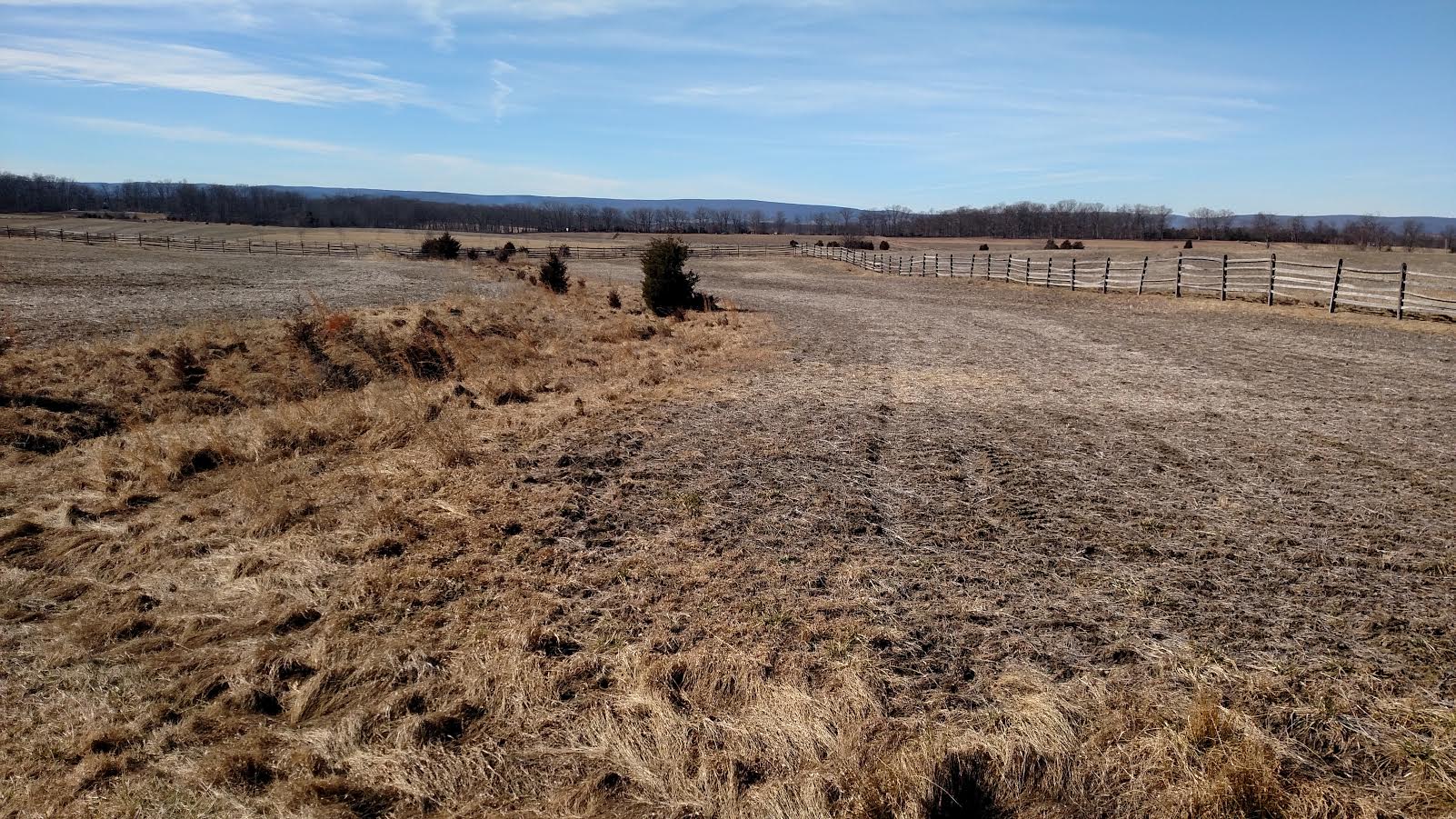
The fields near Emmitsburg Road as they appear today, having mostly recovered from military occupation. Photo by author, 2017.

Sources:

“Camp Colt Damages.” Gettysburg Compiler, May 1, 1926.

Eisenhower, Dwight D. At Ease: Stories I Tell to Friends. Garden City, NY: Doubleday, 1967.

Hartwig, D. Scott. “Scrap Drive 1942.”

Murray, Jennifer. On A Great Battlefield: The Making, Management, and Memory of Gettysburg National Military Park, 1933-2013. (Knoxville: University of Tennessee Press, 2014).

A Record of Service: The logbook of the 28th Indiana Infantry

By Danielle Jones ‘18

This post comes from the exhibit catalog for “Right to Serve, Right to Lead:  Lives and Legacies of the USCT,” an exhibition in Special Collections and College Archives at Musselman Library, Gettysburg College. During the spring of 2017, we asked the CWI Fellows to select a item on exhibit and discuss its history and context. The resulting exhibit catalog is available at Special Collections, where the exhibit will run through December 18, 2017.

28th USCT. Descriptive logbook. Every regiment kept a descriptive log of the “special orders” issued by its colonel to the regiment, and “general orders” from higher up the command chain that affected the regiment in some way. Courtesy of Special Collections and College Archives, Gettysburg College.

The 28th Indiana Infantry Regiment—officially the 28th Regiment United States Colored Troops—was Indiana’s first and only all-black regiment during the Civil War. Mustered into service on January 12, 1864, the 28th formed in response to fears sparked by Confederate General John Hunt Morgan’s raid into Indiana in the summer of 1863. Morgan hoped to rouse Copperheads in the North and inspire them to rise up against the Union. The raiders ransacked Corydon, Salem, Dupont, Versailles, and other small towns in southern Indiana, burned and looted property, and stole over 4,000 horses. All told, the raid caused over one million dollars in damage. Thousands of Hoosiers enlisted in response to the raid, including the men of the 28th. The raid ultimately failed; Morgan was chased out of southern Indiana by state troops and kept out by the United States Navy. Although the 28th was recruited to help prevent future rebel violence, state officials feared that raising more than one African American regiment would provoke another Confederate raid.

Continue reading “A Record of Service: The logbook of the 28th Indiana Infantry”

The 75th Anniversary of the Battle of Gettysburg: Healing the Divide? 

By Savannah Labbe ‘19

This post comes from the exhibit catalog for “Right to Serve, Right to Lead:  Lives and Legacies of the USCT,” an exhibition in Special Collections and College Archives at Musselman Library, Gettysburg College. During the spring of 2017, we asked the CWI Fellows to select a item on exhibit and discuss its history and context. The resulting exhibit catalog is available at Special Collections, where the exhibit will run through December 18, 2017.

Larkin Woodruff, 50th USCT. 75th Anniversary of Gettysburg medals. Veterans attending 75th Anniversary commemorations wore medals like these full of symbolism. The bundle of wooden rods surrounding an axe is a classical symbol called a “fasces.” In Roman times, it stood for martial strength through unity and brotherhood and brotherhood. Sadly, Larkin Woodruff died just weeks before the 75th Anniversary Commemoration in Gettysburg, PA. Courtesy of Special Collections and College Archives, Gettysburg College.

Between June 29 and July 6, 1938, approximately 1,870 Union and Confederate veterans gathered at that fateful battlefield where many of them had fought 75 years earlier. The veterans stayed in camps and took part in various ceremonies and parades, including a parade of veterans from all wars since 1863, as well as a military flyover. The highlight of the ceremonial events, however, was the dedication of the Eternal Light Peace Memorial on Oak Hill outside of town. President Franklin Roosevelt made the dedication speech on July 3, 1938, around the same time Pickett made his charge 75 years before. More than 200,000 people attended, watching the friendly reunion of men who had once been enemies. Together, two men—92-year-old Union veteran George N. Lockwood of Los Angeles, CA, and 91-year-old Confederate veteran A.G. Harris of McDonough, GA—undraped the flag covering the memorial.

Continue reading “The 75th Anniversary of the Battle of Gettysburg: Healing the Divide? “

Commanding the African Brigade: A Portrait of Union Officer Edward Wild

By Savannah Rose ‘17

This post comes from the exhibit catalog for “Right to Serve, Right to Lead:  Lives and Legacies of the USCT,” an exhibition in Special Collections and College Archives at Musselman Library, Gettysburg College. During the spring of 2017, we asked the CWI Fellows to select a item on exhibit and discuss its history and context. The resulting exhibit catalog is available at Special Collections, where the exhibit will run through December 18, 2017.

Brigadier General Edward Wild. Carte de visite. Brigadier General Wild was a USCT commander of some note. Serving from First Bull Run, the first major battle of the Civil War, to the end, he suffered multiple wounds and lost his left arm. Courtesy of Special Collections and College Archives, Gettysburg College.

Edward Augustus Wild grew up in Massachusetts at a time when abolitionist fervor ran rampant within New England society. A doctor by profession and an adventurer by choice, Wild became a military officer out of a strong sense of personal honor, writing his wife Frances Ellen Wild that he did not enlist “to be elevated, but simply from a sense of duty.” At the outbreak of the war, Wild fulfilled the twin drives of duty and adventure by raising a company of volunteers and becoming a captain in the 1st Massachusetts Infantry.

Continue reading “Commanding the African Brigade: A Portrait of Union Officer Edward Wild”

“The Colored Volunteers”: A Recruiting Tune for the USCT

By Jen Simone ‘18

This post comes from the exhibit catalog for “Right to Serve, Right to Lead:  Lives and Legacies of the USCT,” an exhibition in Special Collections and College Archives at Musselman Library, Gettysburg College. During the spring of 2017, we asked the CWI Fellows to select a item on exhibit and discuss its history and context. The resulting exhibit catalog is available at Special Collections, where the exhibit will run through December 18, 2017.

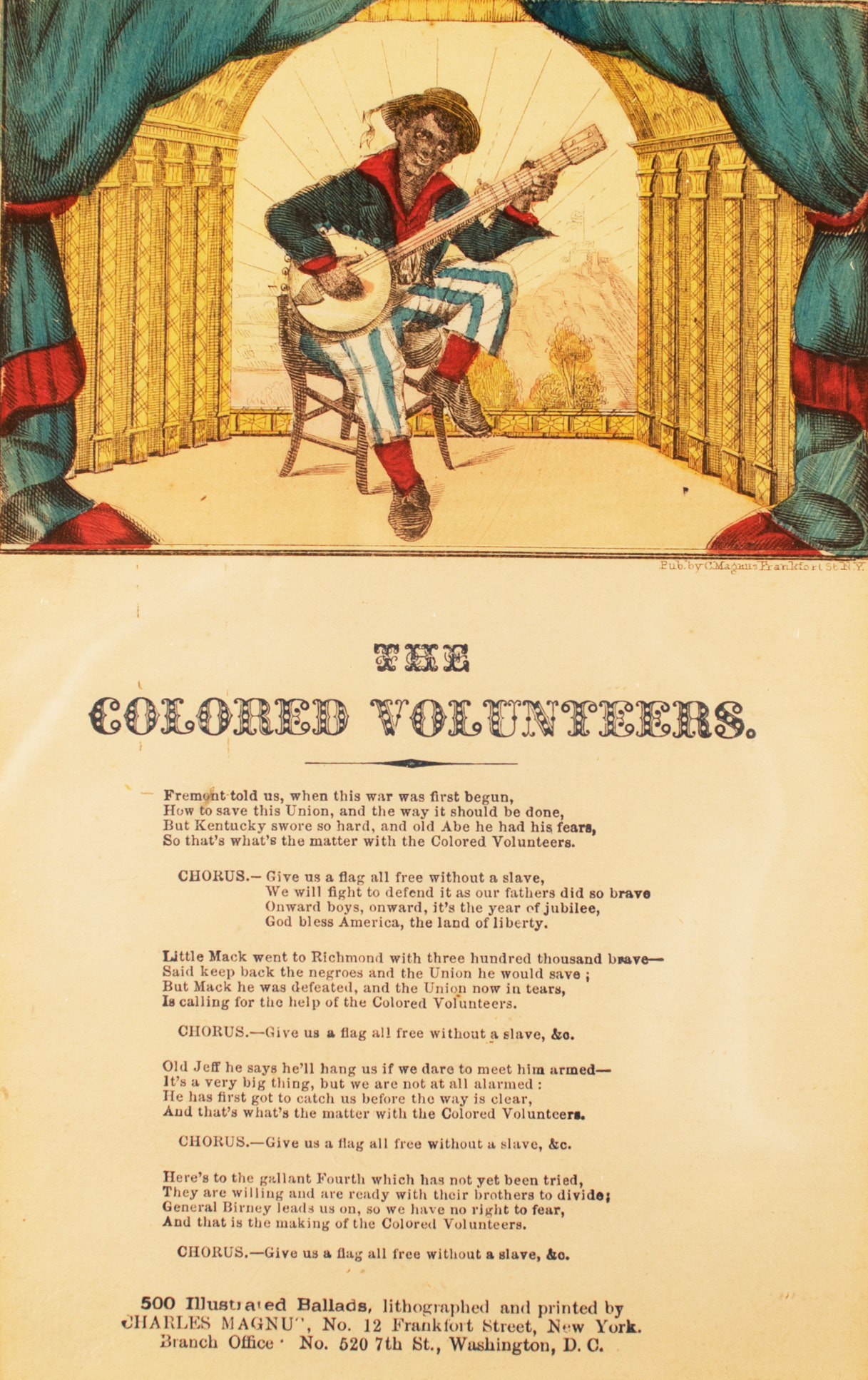
“The Colored Volunteers.” Song sheet. This song, encouraging black men to enlist, makes light the threat posed by Jeff Davis’s Special Order 111. After Fort Pillow, the reality of Confederate policy towards captured USCT became all too clear. Despite Confederate atrocities, black men continued enlisting throughout the war. Courtesy of Special Collections and College Archives, Gettysburg College.

Given the dreadful reality of the Civil War, there was little use for songs that accurately reflected the duties and risks of soldiering when it came to recruiting civilians to fight.  The danger involved in the war was high for all men, but black soldiers faced additional, unique threats. The particular hostility of Confederates to armed black men and distrust from their white Union comrades meant that they were especially vulnerable targets of wartime atrocities. Possibly written by a private in Company A of the 54th Massachusetts Infantry Regiment, one of the first official African American units, “The Colored Volunteers” (also referred to as “Give Us a Flag”) was a song used as recruitment propaganda to encourage black men to enlist during the Civil War.  The song’s lyrics sanitize many very serious issues and threats soldiers faced, offering a romanticized representation of the challenges a black enlistee would face.

Continue reading ““The Colored Volunteers”: A Recruiting Tune for the USCT”

The Legacy of the NEH

By Danielle Jones ’18

On March 16th, 2017, the Trump Administration released the first draft of their proposed 2018 Congressional budget. Many people were focused on the massive cuts to the EPA, but another troubling cut that the original budget proposed was the 12% cuts to the Interior Departments. Even more worrying for those of us in the Humanities, the budget also called for the complete elimination of the National Endowment for the Arts and the National Endowment for the Humanities. After the government’s hiring freeze, a cut to programs like the NEH was the last thing that museums and historical sites wanted to hear.

The NEH was founded in 1965, and lauds itself as one of the largest funders of humanities programs in the United States. The grants given by the NEH typically go to museums, archives, colleges, public television and radio stations, libraries, and to individual scholars. Some famous NEH programs include Ken Burns’ The Civil War and the “Save Our American Treasures” program by the National Museum of African American History and Culture which collects and preserves artifacts from African American communities, including a set of child’s slave cuffs and Harriet Tubman’s bible. Museums as large as the Smithsonian receive NEH grants, as well as small museums and historical sites. The NEH also provides grants and awards to educators in order to strengthen education in schools and colleges, to facilitate research and scholarship, and to strengthen the humanities as a whole. Virtually every state and 6 territories have been touched by NEH grants. The money given helps further American education and to foster education and enlightened discussions about the humanities in the U.S.

The proposed budget cuts would have had lasting impacts across the humanities field. Many of the institutions who receive NEH funding would not be able to support all the programs they run without the NEH, and there are many other institutions who would cease to function without NEH and other federal funding. Thus, the potential loss of funds caused a massive outcry by many in the humanities. The loss of NEH funding could lead to a significant decrease in the available jobs in humanities industry, and many academics would not be able to continue to support original research necessary to furthering their respective fields.

On May 1st, the House Appropriations Committee released the fiscal year 2017 Omnibus Appropriations bill to fund the federal government for the current fiscal year ending September 30, 2017. This bill provided some hope for those in the Humanities; the bill calls for $150 million each for both the National Endowment for the Arts and Humanities. This is a $2 million increase from the fiscal 2016 year. While this increase is of great benefit to the Endowments, it does not necessarily mean that the 2018 budget is going to keep the Endowments at the same level. As students, historians, and people who love the humanities, we must continue to work to show people the importance of programs like the National Endowment for the Humanities.


Sources:

“About the NEH.” National Endowment for the Humanities. Accessed May 02, 2017.

Farrington, Dana. “Read President Trump’s Budget Blueprint.” NPR. March 16, 2017. Accessed May 02, 2017.

Tableau Public. March 20, 2017. Accessed May 02, 2017.

Cascone, Sarah. “Despite Trump, NEA Lives to See Another Day as Congress Finalizes 2017 Budget.” Artnet News. May 01, 2017. Accessed May 02, 2017.

Kaplan, Thomas, and Matt Flegenheimer. “Bipartisan Agreement Reached to Fund Government Through September.” New York Times. April 30, 2017. Accessed May 02, 2017.

U.S. Cong. House. Committee on Appropriations. Comprehensive Government Funding Bill. By Rodney Frelinghuysen. 115 Cong. 244.

#CWI2017: Tours and the End

By Kevin Lavery ’16

Assistant Director’s Log, Star Date 006:  

Wow. Just wow. What a week it has been. It’s all over now. The last conference attendee boarded his shuttle a few hours ago and almost all of the missing keys have been located. I’m about to head home for the evening, but first I wanted to share some details about the last few days of the conference.

My energy held up fairly well all weekend, but I’ll be the first to admit that Monday did a number on me. But the heat wave was no match for our guests’ enthusiasm during their tours through Mosby’s Confederacy with Dennis Frye and Richard Gillespie, at Cedar Mountain with Greg Mertz, Antietam with Carol Reardon and Tom Vossler, Gettysburg with Brooks Simpson, and Mine Run with Eric Mink. I myself was on the Chancellorsville Staff Ride with Christian Keller from the Army War College. Although it was hot, most folks knew their limits and enjoyed the tour without pushing themselves beyond their limits. Monday was certainly a very full, very interesting day.

NPS Ranger Chris Gwinn concludes his battlefield tour on the campus of Gettysburg College. Photo by the author.

Continue reading “#CWI2017: Tours and the End”

#CWI2017: Lectures and Round Tables Galore

By Kevin Lavery ’16

Assistant Director’s Log, Star Date 002:  

We’re in full swing here at our summer conference. Bright and early this morning, Michael Birkner and John Quist kicked off our first full day with their lecture on James Buchanan and the Coming of the Civil War. John Marszalek followed on Henry Halleck, prompting lecturer and tour guide Brooks Simpson to observe that we scheduled talks two of the most unpopular men in American history back-to-back. It wasn’t a coicidence–certain themes carried over between the talks regarding how we think about unpopular figures. Our morning sessions concluded with Pulitzer Prize-winning historian T. J. Stiles discussing the life of George Armstrong Custer and the world he inhabited.

After lunch, we began our concurrent sessions with Earl Hess on Braxton Bragg, Brian Luskey on Bounty Men in the Union Army, and Kenneth Noe on late-enlisters in the Confederate Army. Rachel Shelden gave a popular talk on the culture of Civil War era Washington politics, while Fiona Deans Halloran spoke on Thomas Nast, the original American political satirist.

Continue reading “#CWI2017: Lectures and Round Tables Galore”

#CWI2017: The Adventure Begins

Interim Assistant Director Kevin Lavery ’16 reports on the first day of the 2017 Summer Conference.

By Kevin Lavery ’16

Assistant Director’s Log, Star Date 001:  

It has begun. This afternoon, hundreds of cargo-short-clad Civil War aficionados descended upon the campus of Gettysburg College. Joined by public and academic historians, they are friends old and new who together make up the “student body” of the Civil War Institute’s Annual Summer Conference.

The moment the clock stuck noon, we were flanked by guests eager to sign-in and receive their free #swagbags. After Director Peter Carmichael welcomed the audience, the program opened with Dr. Martin Johnson’s talk on the Gettysburg Address. Following dinner, WWI & WWII historian Dr. Michael Neiberg discussed the features of total war and how to make sense of how nations operate in war time. Dr. Carmichael then sat down with esteemed Lincoln scholar Harold Holzer for a wide-ranging conversation touching on everything from Lincoln to Confederate imagery. We ended the night with our annual ice cream social, made possible by the fine folks at Mr. G’s Ice Cream.

Continue reading “#CWI2017: The Adventure Begins”

A Beacon of Hope: Contraband Camps, Harpers Ferry, and John Brown

By Alex Andrioli ’18

This post comes from the exhibit catalog for “Right to Serve, Right to Lead:  Lives and Legacies of the USCT,” an exhibition in Special Collections and College Archives at Musselman Library, Gettysburg College. During the spring of 2017, we asked the CWI Fellows to select a item on exhibit and discuss its history and context. The resulting exhibit catalog is available at Special Collections, where the exhibit will run through December 18, 2017.

Contraband Camp at Harpers Ferry, WV. Stereoview card. The 3-dimensional stereoview and other photography brought the reality of the Civil War into civilian homes. This stereoview shows the rag-tag conditions of a contraband camp, erected just a few yards from John Brown’s Fort in Harper’s Ferry. Courtesy of Special Collections and College Archives, Gettysburg College.
Stereoviews were created by using a twin-lens camera that captured the same subject from two slightly different angles. The photographer then placed the two images on a stereoview card that could be inserted into a special viewer that merged the two images together and created a life-like, three-dimensional image. Stereoviews’ low cost meant they were an inexpensive way to insert one’s self into realistic three-dimensional scenes like the pictured contraband camp.

Continue reading “A Beacon of Hope: Contraband Camps, Harpers Ferry, and John Brown”

css.php