Pohanka Intern Reflection: Richmond National Battlefield Park

By Tyler Leard ’16

A few days ago, I was working the desk at the Cold Harbor Visitor Center when a burly man with a goatee walked through the door. Approaching the desk, he told us in a thick southern accent that he was looking for an ancestor who had fought at Cold Harbor 150 years earlier. He believed his ancestor had been wounded and taken to a hospital in Richmond. He told us that several days earlier a ranger had assured him his ancestor would have been hauled into Richmond on a railroad, not a wagon, as he had previously feared. He was looking for confirmation of this. “I want to make sure that I can tell my mother that he didn’t suffer, that they didn’t haul him all the way in on a wagon,” he explained.

Cold Harbor VC

Continue reading “Pohanka Intern Reflection: Richmond National Battlefield Park”

#cwi2014

By Ian Isherwood ’00, ‘Digital Historian’

I feel a little strange writing a reflective blog since I helped staff CWI 2014. Obviously, I am happy that conference went well, that our attendees and speakers were happy, and I am very proud of my co-workers for pulling off another great event. But it seems propagandist to point these things out. So I am just going to give a few observations, for whatever they’re worth.

The program was really well structured. There was a superb blend of topics/lectures that gave something for everyone. More importantly, the program emphasized what has been a running theme of the sesquicentennial: this is not your grandfather’s Civil War. Traditional military history certainly has its place and is extremely relevant and interesting, but the CWI blended military history with other fields, to make for a more comprehensive ‘war and society’ approach.

Continue reading “#cwi2014”

The Last Day

By Ian Isherwood ’00

Today was one of touring and teaching. Our attendees examined Gettysburg through the eyes of soldiers on their morning tours. Then they spent the afternoon in classrooms engaging with a wide variety of topics.

Here were our tours:

  • Michael S. Schroyer of the 147th Pennsylvania led by Sue Boardman
  • William C. Ward of the 4th Alabama led by Garry Adelman
  • William Henry Francis of the 14th U.S. Regulars led by John Rudy
  • Lieutenant J. Warren Jackson of the 8th Louisiana Infantry (Louisiana Tigers) led by Ed Bearss & Scott Mingus
  • Colonel David Ireland of the 137th New York led by Jennifer Murray
  • Private Reuben Ruch of the 153rd Pennsylvania led by Charlie Fennell

Continue reading “The Last Day”

Day Three: Tours

By Ian Isherwood ’00, Field Correspondent

Like Bob Dylan, we tour every year.

Our Civilwarpalooza started at 7:15 AM, a bracing hour, when our tour busses loaded and departed for Virginia. A sixth bus left later for Monocacy, their late rise something envied by us all.

(Sidebar: It has been exactly one year since I have used a clipboard. The experience of checking in attendees, ticking their names off my list with a sense of invented authority, perhaps one of the most satisfying of bureaucratic activities.)

20140623-214758.jpg

Continue reading “Day Three: Tours”

The Second Day

By Ian Isherwood ’00

Like yesterday, breakfast was a success. (The addition of bacon was a wise choice by the folks at Servo. The shredded cheese next to the scrambled eggs, perhaps, a stroke of genius.) Warmed with coffee and bacon, adorned all manner of Civil War related sartoria, our conference attendees packed the ballroom for the day’s work of understanding different angles on the war in 1864.

It is hard not to see the Gettysburg College Ballroom as one of the great fields of honor for Civil War historians. Here Civil Warriors introduce new ideas, revisit old interpretations, frolic in Clio’s fruitful orchard searching for the right ingredients for their ambrosia.

And today there was an intoxicating elixir concocted by our presenters. At the start was Keith Bohannon presenting on Sherman’s Atlanta Campaign. With a military map towering over his head, Bohannon argued that Sherman’s great legacy was one of supply and maneuver and not battlefield success. The anxious general was a master logistician – one unmatched by his foes – and the Atlanta campaign demonstrates what a talented Civil War general could do with an army of high morale under him, political support above him, and the ability to resupply his army behind. Bohannon took a well-known story and gave it some analytical heft.

Continue reading “The Second Day”

The First (real) Day

By Ian Isherwood ’00

Our first full day of CWI 2014 began with a hearty breakfast at the college dining hall (Servo). Armies, they say, march on their stomachs (and whatnot), and our army of Civil Warriors received the necessary sustenance of made-to-order omelets and assorted cereals to confront the day’s historiography.

Well-breakfasted, the ballroom was packed full of attendees by 8:30, all carrying their travelers of coffee (or tea) and waiting for CWI Director Peter Carmichael to speak on Robert E. Lee’s elusive search for a battle of annihilation. With C-Span and PCN’s cameras filming, we began.

Carmichael emphasized that commanders in the Civil War made decisions based on many different factors, not all of them represented in the established historiography. A neglected factor by many historians is the culture of sensibility, a prominent part of the worldview of all Americans 150 years ago. Notions of sensibility shaped nineteenth century men like Lee, men who were concerned, at their core, with matters of honor. Lee’s sense of heroic masculinity, argued Carmichael, influenced his command decisions. Carmichael challenged us in a fundamental way: to understand the past we need to immerse ourselves in the way people felt about the choices they were making, and not just on the decisions they made (or didn’t).

Continue reading “The First (real) Day”

And we’re off

By Ian Isherwood ’00

The CWI Staff congregated at command central/swag center at 7:30 this morning to finalize the work we needed to do to make sure that every nametag was printed, every key and meal card allocated, every swag bag stacked behind our registration tables.

After months of preparation, The War in 1864 was taking shape, the ballroom practically crying for the attentions of our always captivated (and captivating) Civil Warriors.

However, one should not violate the essential secrecy of bureaucratic inner-workings, so the less said about our staff discussions over linen procurement and nametag sorting the better.

Continue reading “And we’re off”

Prelude: CWI 2014

By Ian Isherwood ’00

Tomorrow begins CWI 2014. The conference this year is on the war in 1864 and features a wide array of speakers. The program reflects an impressive assortment of historians covering enough topics to please just about everyone. This year there will be over 400 attendees and 38 speakers and guides.

The CWI staff has been busy this week preparing for so many civil warriors descending upon our normally quiet (at least in the summer) liberal arts college. Our staff has been going over guest lists, checking names off spreadsheets, answering phone and email inquiries, creating nametags, folding and refolding merchandise, stacking books and boxes, and making the college ballroom a welcome place for conference guests. This afternoon culminated in the assembly line creation of over 400 guest swag bags, a process that took five people 2.5 hours.

Continue reading “Prelude: CWI 2014”

Inside the Leister House – July 2, 2013

By Avery Lentz ’14

As our readers certainly remember the summer of 2013 was the 150th Anniversary of the Battle of Gettysburg. On the days of the July 1-3, 1863, the pivotal battle of Gettysburg was fought between the Union Army of the Potomac and the Confederate Army of Northern Virginia, possibly to decide the fate of the nation. By 1863, the death toll had reached catastrophic levels and both North and South were growing fatigued by war. Confederate General Robert E. Lee was looking for a final knockout blow against the Union Army. After his victory at Chancellorsville in May 1863, Lee took his army of 80,000 men north into southern Pennsylvania, slowly being pursued by Union Gen. Joseph Hooker’s army of 93,000 men. On June 28th, Hooker was replaced by Gen. George Gordon Meade.The two armies collided in Gettysburg two days later.

avery3
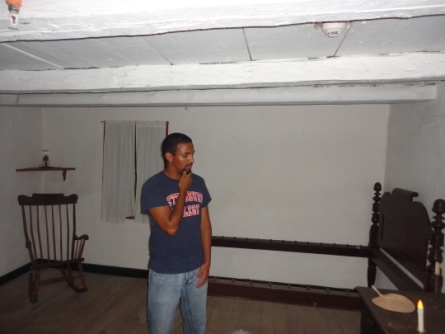
The first two days of the battle were extremely costly for both sides, racking up close to 15,000 to 20,000 casualties total every single day. The events that took place on the night of July 2, 1863 shaped the decisions and outcomes on July 3. General Meade called a council of war among his generals to find out what condition his army was in and whether they should continue to defend Cemetery Hill/Ridge. This pivotal meeting during this pivotal battle happened in the small quarters of the Leister farmhouse on Cemetery Ridge. It’s hard to imagine that people like Lydia Leister lived on the land that turned red with the blood of men in blue and gray. Continue reading “Inside the Leister House – July 2, 2013”

Junior Rangers to History Enthusiasts

By Emma Murphy ’15

With my internship at Richmond National Battlefield Park landing in the middle of the sesquicentennial of the Civil War, I have been fortunate enough to experience the world of public history during a major anniversary. However, going to school at Gettysburg College during the same anniversary provides me the academic side of historical interpretation. There has been a great debate about the connection between these two worlds. Whether this connection exists or not has been the question of the summer for me, and while working with Richmond National Battlefield Park, I believe I have found my answer:

Children.

Emma at Tredegar Iron Works
Emma at Tredegar Iron Works, Richmond National Battlefield Park

Continue reading “Junior Rangers to History Enthusiasts”

css.php