CWI Fellows and Friends Hit Up Public History Conference

This past weekend, a number of Gettysburg College students attended the 2016 Annual Meeting of the National Council on Public History. We asked a few of the CWI Fellows to share their reflections on the event.

1266_10153554053728107_424683628707367436_n (1)
CWI Fellows, Gettysburg College alumni, and past and future Pohanka Interns joined CWI Associate Director Jill Titus in representing Gettysburg College at the National Council on Public History.

Continue reading “CWI Fellows and Friends Hit Up Public History Conference”

To Gettysburg and Beyond: One Student’s Unforgettable CWI Summer Experience

By Emily Timberlake ’19

Applications to participate in the 2017 High School Student Scholarship Program are due at 4:00 p.m. on February 15, 2017. For more information on the summer conference, please click here. 

When I first heard about the Civil War Institute’s Summer Conference and its scholarship program for high school students, I was a senior in high school, dead-set on becoming a Civil War historian. I had no idea how to go about achieving that goal yet, although I had already been accepted to attend Gettysburg College in the fall, which seemed like a good first step. I applied rather last minute for the program, and the fact that I was so generously awarded a scholarship to attend has made all the difference in my college experience. The summer conference is most easily described as an amazing, eye-opening experience that allowed me to bond closely with Civil War enthusiasts my own age. Each program we attended was intriguing, and offered angles on either familiar or unfamiliar subjects that I had never considered before. It was such a rewarding experience to meet historians I had looked up to for so long, discuss both their writing and my questions about their ideas, and do it all on the campus of my new school. All of the scholarship students quickly bonded, as we were some of the youngest people attending the conference and we all had a similar passion for Civil War history.

Sailor%27s Creek Lunch (3) (1)
Enjoying lunch at Sailor’s Creek Battlefield in Virginia.

The setup of the programs we attended was perfect, from the specific events for scholarship recipients to the large, conference-wide sessions. Each segment of the program gave each of us the opportunity to form our own opinions, and then have multifaceted discussions about them. One of the first sessions that we attended as a group was a conversation between Dr. Peter Carmichael and Dr. James McPherson about Dr. McPherson’s classic book, Battle Cry of Freedom. As I sat with students I had only met that day, the conversation moved into a discussion of the Civil War in today’s memory, which struck a chord with all of the scholarship students. We realized that the conference was not only about learning history, but about applying it to our lives today. Continue reading “To Gettysburg and Beyond: One Student’s Unforgettable CWI Summer Experience”

The Opportunity of a Lifetime: Working for the National Park Service

By Megan McNish ’16

The author in her NPS uniform working with visitors. Photography courtesy of the NPS.
The author in her uniform working with visitors. Photography courtesy of the NPS.

When I sat down to write about working for the National Park Service, first as an intern through the Pohanka program and then this summer working as a seasonal employee, I thought it would be an easy task. It should be simple to write about something that you love, but it wasn’t. I wrote an entire blog post and then realized it just wasn’t right. It was bland and detached, entirely opposite of how I felt about my summer experiences. I’m passionate about public history and the work I have done at the parks, so much so that sometimes it is hard to articulate what makes it so special. How can I convey in words the very thing that drives me? How do I convey the responsibility and how it fills me with pride when someone trusts me with that responsibility? How do I convey the joy that fills me when I conduct programs for visitors? The success I feel when I can help a visitor see a new perspective? I finally decided that the best way to put into words how I feel is to relate some of my experiences with the NPS that illustrate what working there means to me.

I will never forget the day I received my first acceptance into the Pohanka program. I was a first-year student coming back from a field trip on the battlefield. As we sat in the vans on our way back to campus, I checked my email. The title to one read “Brian C. Pohanka Internship Program” and when I saw it my heart began to race. I opened the email and began to shake as I realized that I had been offered an internship at Appomattox Court House. I was filled with pride that, as a first-year student, I had been so lucky to be chosen for such an opportunity. Months later, as I sat in a hotel room the night before I was to move into my summer quarters, the weight of that responsibility on my shoulders was like that of the world itself. I was so unsure, so worried that I wouldn’t live up to the responsibility that had been presented to me. This summer, as I began my third summer with the Park Service, this time as a seasonal employee, I felt the weight of that responsibility all over again. I felt pride again when I received the email offering me the job that someone trusted me enough to hold the keys to our nation’s history. As I pinned my badge on my uniform for my first day of work I realized the excitement of being able to represent my country and its history every day. Continue reading “The Opportunity of a Lifetime: Working for the National Park Service”

A Human Medium

By Amanda Pollock ‘18

This post is part of a series featuring behind-the-scenes dispatches from our Pohanka interns working on the front lines of history this summer as interpreters, archivists, and preservationists. See here for the introduction to the series.

Civil War Parks serve a dual purpose: to educate visitors about the events that took place on their hallowed grounds, and to commemorate these events. Interpretative elements, such as informational signs and monuments, successfully memorialize and pay respect to the soldiers who risked their lives. Interpreters of the parks function as a ‘human medium’ to educate the public, and are given the unique responsibility to contextualize controversies that still exist today and explain just why these men were fighting in the first place.

Appomattox Court House National Historical Park has always placed a great deal of emphasis on the battle itself, for the sole reason that most people do not even know that two battles were fought at Appomattox. The park has made it its mission “to commemorate the surrender of General Robert E. Lee to Lieutenant General Ulysses S. Grant…brought about by the Appomattox Campaign from March 29-April 12, 1865, and to honor those engaged in this great conflict.” The employees at this park have the duty to explain to the public the important military events that occurred on park property, as the battles were a crucial part of both the history of the village and the nation. To fail to mention the actions of the men who fought and died there would indeed be undercutting their service. Continue reading “A Human Medium”

The Original Birthplace of George Washington

By Max Zammataro ‘16

This post is part of a series featuring behind-the-scenes dispatches from our Pohanka interns working on the front lines of history this summer as interpreters, archivists, and preservationists. See here for the introduction to the series.

Looking back at American history, George Washington was a monumental figure to a significant portion of our citizens. As a founding father of our country, historians and relatives of President Washington have long wanted to properly document and share his birthplace with the American public. Memorializing where President Washington was born and raised acknowledges the great service he did for our country. Over the past 150 years, there has been an ongoing investigation into where exactly George Washington was brought into the world. There have been conflicting arguments because there was no definitive proof of his birthplace. The original structure where he was born, in Popes Creek Virginia, was burnt to the ground in 1779, leaving archaeologists with minimal artifacts to work with, such as pieces of china, hinges, a candle, a silver teaspoon and a bunch of keys. The lack of solid historical evidence disabled investigations to conclude exactly where President Washington was born. The lack of proper documentation and technology in the past also made it significantly harder to keep track of the facts.

As time passed, a number of people have claimed that they know exactly where George Washington was born. The information many of these parties have provided conflicts with what others were led to believe. George Washington Parke Custis, adopted grandson of George and Martha Washington, was the first to take the initiative to mark the site of the original birth house, placing a stone slab inscribed with the date of George Washington’s birth. The problem was that without proper documentation of the actual house, Custis was escorted to the spot where there were a few bricks laid to supposedly mark the spot of George Washington’s birthplace. Unfortunately, this was not necessarily factual, but for the time being it was marked as the birthplace. As the years passed, Custis’s slab was moved numerous times and chipped away at. Later it was released by the Daily National Intelligencer in 1857 that another chimney that was part of a smaller separate structure had been found on the site. It was located in the same vicinity as the original chimney marked by Custis. While these may appear to be minor details, they are significant because those “interpreting” the site were sharing incorrect information with early visitors.

One must acknowledge that these early historians and interpreters were trying their best to preserve and share what little information they had with American citizens even though the information itself was incorrect. This misinformation continued for such a long time because historians had no other way of checking the historical data other than going off the records available to them. The questions surrounding the actual birthplace of George Washington were misinterpreted for so long was because there were few artifacts to support the authenticity of the site. It wasn’t until a nearby site was excavated that additional information surfaced reshaping the story of Washington’s birthplace. This archeological data made it clear that Custis was incorrect in locating the site of the birth home. He was working with less than perfect information so cannot be blamed for the inaccuracies. He was just trying to share what he thought to be his grandfather’s story with his county. Continue reading “The Original Birthplace of George Washington”


Holding the High Ground at Harpers Ferry

By Andrew Vannucci ‘15

This post is part of a series featuring behind-the-scenes dispatches from our Pohanka interns working on the front lines of history this summer as interpreters, archivists, and preservationists. See here for the introduction to the series.

Dwight Pitcaithley’s article, “A Cosmic Threat: The National Park Service Addresses the Causes of the American Civil War,” discusses the evolution of interpretation at Civil War parks that has moved toward a more complete, nuanced telling of Civil War history and the backlash against it. Before recent changes in NPS policy, most parks focused their interpretation solely on the military elements of their story. Groups like the Sons of Confederate Veterans interpreted this as appropriate deference towards honoring the men that fought in these battles. They saw moves toward setting battles in the context of social history (i.e., slavery) at these parks as taking attention away from and detracting from the sacrifices made by Confederate soldiers.

A memorial dedicated in 1931 by the Sons of Confederate Veterans to honor the memory of Heyward Shepherd, a free African American, and the first person to die in connection with John Brown’s Raid. Photo credit Andrew Vannucci.

There is no doubt that military history is the essential component in programming at battlefield sites. Often, the most significant story to be told at battlefield sites is about the battle that took place there, the men who fought there and the men who died there. Hearing these stories and honoring veterans is important, but without setting these battles within a greater historical context battles loses their meaning in the bigger picture of American history. The preservation of an accurate historical memory and understanding of the war and the preservation of the physical sites themselves are equally important tasks. Pitcaithley’s article makes clear that Lost Cause influences contributed to the avoidance of this broader picture for a long time, but current programming at Harpers Ferry National Historical Park reveals just how substantial the transformations of recent years have been. Continue reading “Holding the High Ground at Harpers Ferry”

Archives 2.0: Defying the Stereotypes

By Mikki Stacey ‘17

This post is part of a series featuring behind-the-scenes dispatches from our Pohanka interns working on the front lines of history this summer as interpreters, archivists, and preservationists. See here for the introduction to the series.

Everyone had a picture in mind when I said I’d be doing archival work for the DuPont library at Stratford Hall over the summer. Often, that picture included me amid stacks of dusty books and old documents, sitting in silence and solitude, frantically typing away with my glasses glued to the top of my nose. Each time I got a reaction to this effect, I had to laugh and ask, “Relying a little heavily on a stereotype, aren’t you?” Quickly, I would go into my spiel about why libraries are not at all antiquated, not realizing that there is a term for what I was trying to explain: “Archives 2.0.”

Mikki Stacey defies stereotypes of archival work in her Pohanka internship at Stratford Hall: The Home of the Lees. Photo credit Mikki Stacey.

Partially out of necessity and partially out of nature, libraries and librarians have evolved, and currently, we are in the period of Archives 2.0, which Kate Theimer distinguishes from other periods of archival work by its “spirit of flexibility and the willingness to experiment and collaborate.” a spirit that has brought interrelated changes to the field. More than gathering information, modern archivists want to disseminate information. This desire has resulted in an (maybe unexpected) embrace of technology to create a more user-friendly experience. Continue reading “Archives 2.0: Defying the Stereotypes”

Sorting Through the Layers of History

By Amelia Benstead ‘16

This post is part of a series featuring behind-the-scenes dispatches from our Pohanka interns working on the front lines of history this summer as interpreters, archivists, and preservationists. See here for the introduction to the series.

The confusion as to what site is truly the actual birthplace of George Washington stems from a variety of circumstances that combined to create a perfect storm of inaccuracy. In some cases, facts have been ignored in order to benefit those involved, conclusions have been drawn too heavily on eyewitness accounts which ultimately proved inaccurate, and investigations have coincided with important events, such as Washington’s 200th birthday, which would have been a controversial time to raise questions about whether the site being commemorated as his birthplace was actually the correct location.

The confusion first stems from the fact that George Washington Parke Custis wanted to place a marker on the site to commemorate where George Washington was born. Since the house had originally burned down, leaving very little evidence there had ever been a house on the site, especially not in what direction it had been pointing, he placed the marker in a location that he more or less guessed at, making conjectures that were unable to be supported by what he could see of the remaining building. From there, many people made additional conjectures based off of where Custis placed the marker. When contradictory information turned up, it was frequently downplayed or ignored because it would have caused too much upheaval at an inopportune time. This was exactly what happened when contradictory information was physically unearthed in an archeological dig just prior to Washington’s 200th birthday. Continue reading “Sorting Through the Layers of History”

Silent Guardian: The 15th New Jersey Monument

By Elizabeth Smith ‘17

This post is part of a series featuring behind-the-scenes dispatches from our Pohanka interns working on the front lines of history this summer as interpreters, archivists, and preservationists. See here for the introduction to the series.

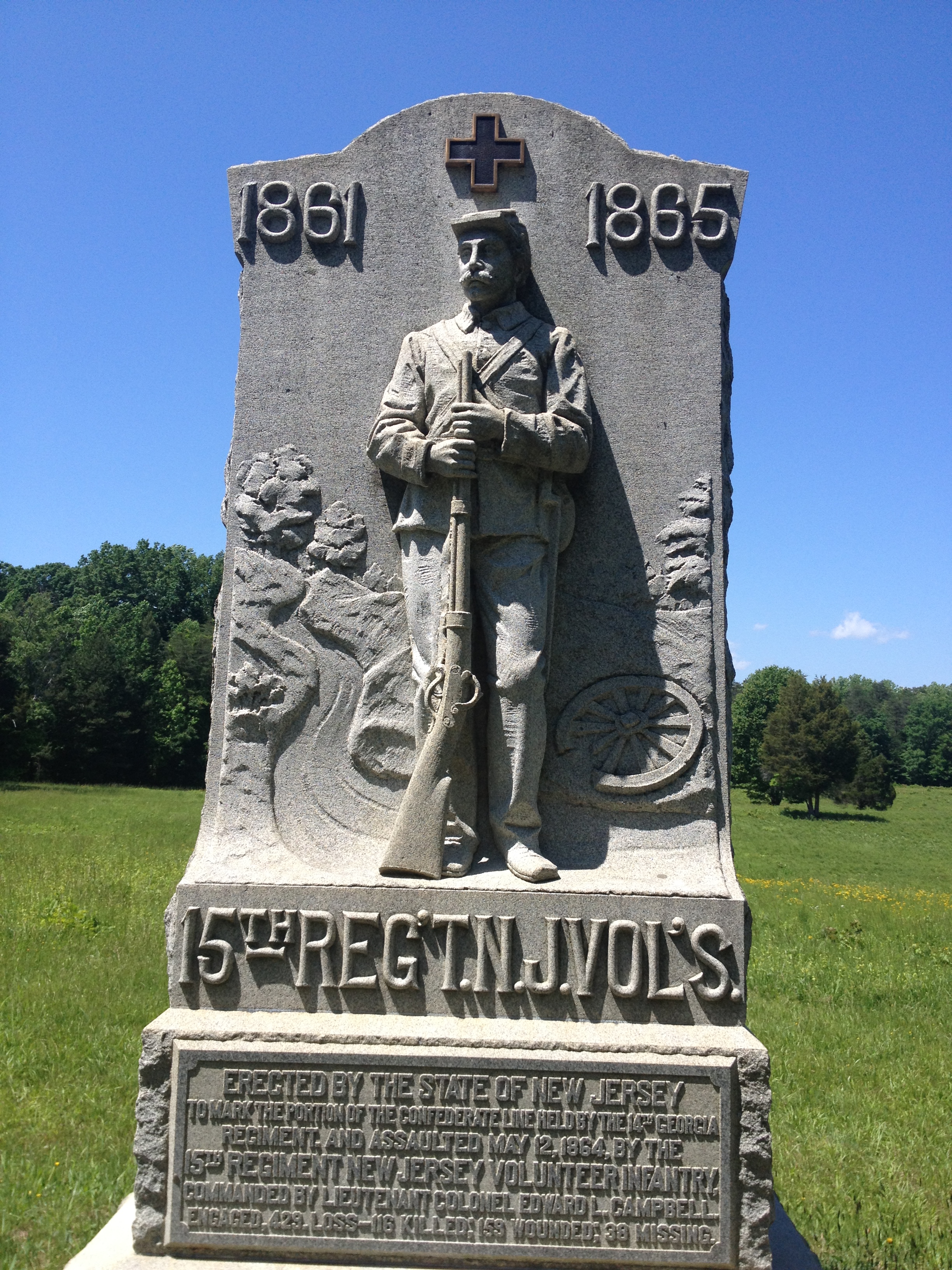
The 15th New Jersey Monument. Photo credit Elizabeth Smith.

He stands at rest, knees slightly bent, musket casually leant back. His hands loosely grip the barrel, one over the other, calm but prepared. His mustached face looks with weary eyes over the slaughter ground. In the background can be seen trees alongside a winding dirt road and a solitary wheel—perhaps from a cannon—beside his left leg. He stands immobile, forever gazing over the picturesque landscape, the beautiful green of the earthworks, the scene of hell on earth just 150 years ago.

The Battle of Spotsylvania Courthouse, known for the infamous Muleshoe Salient and the Bloody Angle, was fought May 8-21, 1864, immediately following the Battle of the Wilderness. On May 12, the twenty-two hours of continuous hand-to-hand combat at what would become known as the Bloody Angle would earn Spotsylvania a place in the history books. It is over this portion of the heaviest fighting that the 15th New Jersey Monument stands.

In his article “The Politics of Memory: Black Emancipation and the Civil War Monument”, Kirk Savage discusses how monuments do much more than just memorialize a unit or person, they memorialize an idea. From the idea of slavery to states’ rights to emancipation, monuments speak through both what they say and what they do not say. For this post, I will be discussing the 15th New Jersey Monument in light of Savage’s article. Continue reading “Silent Guardian: The 15th New Jersey Monument”

Historical Preservation: The Elizabeth Cady Stanton Property

By Amanda Thibault ‘17

This post is part of a series featuring behind-the-scenes dispatches from our Pohanka interns working on the front lines of history this summer as interpreters, archivists, and preservationists. See here for the introduction to the series.

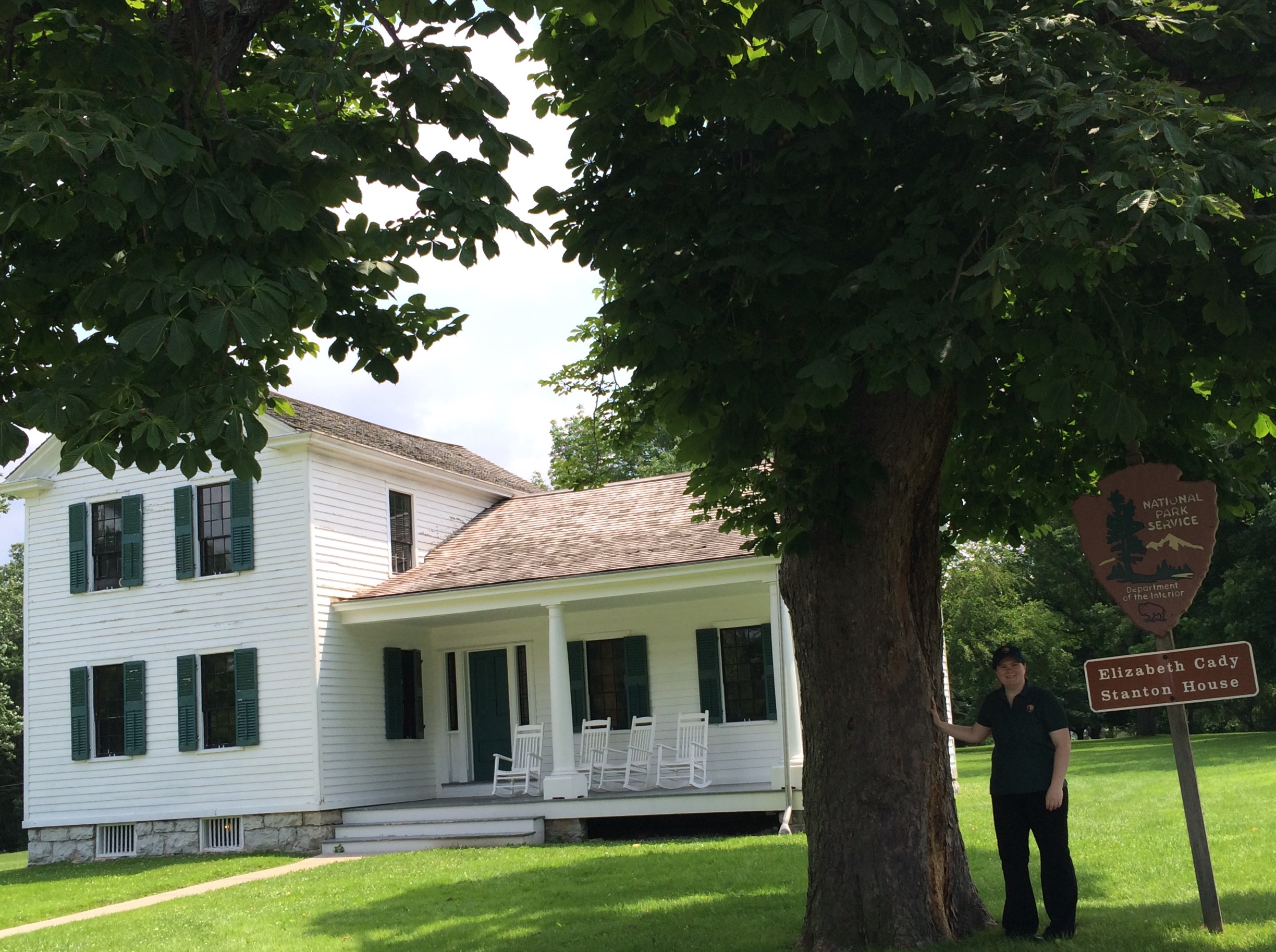
The Elizabeth Cady Stanton property presents a number of preservation and interpretive challenges. The NPS is currently considering launching a landscape restoration project. Photo courtesy Amanda Thibault.

Historical preservation has always been a problematic issue for the National Park Service. Park officials must find a balance between preserving and exploiting historical landscapes. At battlefields such as Antietam, the National Park Service has issued a policy of landscape freezing to help visitors understand the historical significance of the park. Landscape freezing refers to preserving the landscape of a particular historical period in time. Antietam has issued a policy of restoring the landscape to the eve of the battle to the maximum extent possible. However, there are many problems facing this plan, like removing the roads that allow visitors to travel through the battlefield and form an emotional connection to the site.

The problems of historical preservation are pronounced here at Women’s Rights National Historical Park in Seneca Falls, NY, especially at the Elizabeth Cady Stanton property. Elizabeth Cady Stanton was the primary figure behind the first Women’s Rights Convention in 1848. During tours of the property where Elizabeth Cady Stanton, her husband Henry Stanton, and her seven children lived from 1847 to 1862 only ten people are allowed in the house at once because of its small size. If there is a larger tour, the remaining visitors have to wait outside. Today, the only remnants of the Stanton property are the horse chestnut tree in front of the property and fruit trees located in the northeast corner of property. The orchard, flower and vegetable gardens, the circular driveway, the outdoor playground for the children, the barn and other outbuildings no longer exist. I believe the National Park Service should recreate as much of the original landscape as possible so visitors can roam around while waiting to go inside the house. Continue reading “Historical Preservation: The Elizabeth Cady Stanton Property”

css.php