Our two senior fellows sit down to reflect on their three years in the program and what it has meant to them.
Ryan – I have had a very busy, enjoyable, and rewarding three years as a Civil War Institute Fellow. My first project involved collaborating on a wayside marker for the Gettysburg battlefield that tells the story of Richard Ewell and his decision not to attack the Union position on Cemetery Hill on the evening of July 1, and from there on forward I knew that I had found a great place to express my academic and personal interests to a wider audience. In the Killed at Gettysburg project, I found an initiative with which I felt a great personal connection, and I am extremely honored to have been granted the opportunity to follow the lives, deaths, and legacies of seven soldiers who died here in Pennsylvania.
My time as a CWI Fellow has greatly assisted in developing the skills I hope to use every day in my future career. I have conducted original research using a variety of sources, forming the proverbial bedrock of my projects. I have learned how to craft interpretive texts to achieve the best possible clarity and force of narrative, both in short and long forms. Additionally, I have learned how to use social media in order to engage wider audiences, and hopefully you have enjoyed the Civil War Institute’s content this year. Overall, I am grateful to the Civil War Institute for all they have given me over the past three years, and I am looking forward to everything that is to come!
(photo via Civil War Institute)
Olivia – Lately, as I prepare to graduate and head off into the world, I’ve been taking time to reflect on my time at Gettysburg College. My three years with the CWI Fellows program has been a defining part of that time. During the past three years I have written articles about aspects of history that fascinated me, collaborated with a peer to design a new interpretive wayside for the Virginia monument here on the Gettysburg battlefield, and served as editor-in-chief for the Compiler. Throughout each of these experiences, I’ve learned a lot about writing. Trying to fit 100 years of history about the Virginia monument into 230 words showed me the beauty of language. Although it was frustrating to keep going through the draft of the wayside with the intention of cutting out what I thought were crucial pieces, my partner and I were always inevitably able to condense without losing any ideas by simply choosing better wording. As a writer and editor, I also came to appreciate the value of individual voice. Each one of us who writes for the Compiler has a unique way of telling each of these stories and these differences in storytelling are what brings the pieces to life.
Like Ryan, I know that all the skills and lessons I have learned as a Fellow will carry into my future. I intend to keep telling stories about history, and the encouragement I have received as a fellow (from peers and from readers’ comments) has given me confidence to draw upon. Working with the other Fellows has taught me so much about the Civil War, scholarship, and myself and I can’t wait to channel all of this into my future pursuits.
Civil War snare drum. (Image Courtesy of Special Collections, Musselman Library, Gettysburg College)
When I think about the battle front, I think about soldiers in uniform marching off to fight with their weapons and small mementos from home. I also think about the many doctors and nurses who provided care to men riddled with bullet holes and disease. I never thought of drummers, though, until I saw the snare drum pictured above. However, this drum and the many others like it were an integral part of army life. For the drummers themselves, their instrument represented a unique avenue of service where zealous, but often underaged, patriots could join the war efforts without being directly engaged in active combat. To soldiers in the midst of battle, listening to the drum could either inspire patriotism or fear, depending on whether the staccato taps came from their own drummers or those of the enemy. Outside of combat, the drum helped to create order in camp and in drill, as well as provide some musical relief from the dullness of a long march or extended period of encampment. Drum-based music accompanied nearly every aspect of life for Civil War soldiers.
Over the course of the war, about 40,000 men served as drummers. With so many drummers and musicians, the music industry boomed during the Civil War. The army’s need for musicians created a high demand for instruments, with companies like Stratton & Foote, the New York producers of the above drum, created by enterprising citizens. Union army guides for the drums dictated that the arms of the United States and regimental designation be painted on the drums; however, this was a rule which was hardly followed. Generally, field drums ranged from 15 to 16 inches in diameter and 10 to 12 inches in depth. The shells were generally single, double or triple ply made of maple, ash or holly. The variety of different compositions for drums was matched by the diversity of men who served as drummers in Civil War armies.
Since there were no strict age requirements for drummers, like in other forms of service, the age range of drummers who might have used the above pictured drum varied. Many of the drummers were young boys, some as young as twelve years old. Although these boys were not old enough to carry a musket onto the battlefield, they could still contribute to the war effort with their musical skills. Other men volunteered as drummers in order to avoid active combat, hoping that serving as a musician would keep them at a safe distance from the fighting. However, field musicians regularly set aside their instruments to serve as stretcher-bearers and in other roles of assistance to medical staff that still exposed them to the grisly realities of warfare. At times, musicians also did find themselves in the midst of battle. Twenty-eight army musicians received the Medal of Honor, mostly for bravery displayed while removing wounded soldiers from the field. Other musicians intentionally set aside their drums and other instruments to fight, such as George Palmer of the 1st Illinois Cavalry. Palmer was awarded a Medal of Honor for picking up a musket and taking part in a charge to reclaim an overrun hospital at a battle in Lexington, Missouri. Palmer’s service is evidence that for Civil War soldiers, musicians included, their experience was not always what they expected it to be when they enlisted.
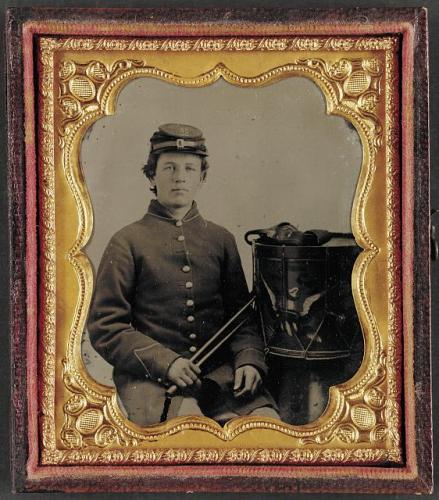
Drummer boy, taking a rest, Culpeper, Va. (image courtesy Library of Congress)
There also was no specific requirement that one had to actually be able to play an instrument like the above-featured drum in order to join either a regimental or brigade band. Often times, drummers and other field musicians enlisted without the ability to read music or play an instrument. The resulting unpleasant music was best described as a ruckus, and sometimes even led to moments of hilarity. Timothy H. Pendergast of the 2nd Minnesota wrote about one such incident where camp mules mistook a band’s “music” for the sounds of an incoming wagon train. This poor-quality music was less amusing for officers, who simply became frustrated with the noise. In this particular instance, Colonel Adelbert Ames of the 20th Maine staged an actual “charge” upon the drum corps with his sword in order to make the “music” stop. Training a regiment of green soldiers was frustrating enough, but poorly trained drummers who bungled commands became a nuisance on the training ground and a liability in combat. However, over time, with constant practice and rigorous training, , regiments and their musicians learned how to function effectively. Despite the initial learning curve for some Civil War musicians, however, others entered the service already accomplished, such as famous band leader Patrick S. Gilmore who enlisted in the 24th Massachusetts in an attempt to attract young men to join the army with his patriotic music. Gilmore’s service manifested itself in the song “When Johnny Comes Marching Home,” a song with a recognizable use of the drum. The frequency of the drum in every regimental company meant that its music touched the ears of most Civil War soldiers.
In battle, drums were used to provide inspiration to soldiers, as well as communicate orders and direction to troops. Musicians used their instruments to play patriotic tunes that might inspire soldiers to stand their ground and perform bravely in battle. Aware of the impact that music could have, officers often ordered their musicians to strike up a patriotic song to bolster the spirits and courage of their soldiers. In perhaps the most famous instance, General George Pickett’s men stepped off on their fateful charge at Gettysburg to “The Bonnie Blue Flag,” which prompted the waiting Federals to strike up “The Star-Spangled Banner” as both a rallying call to their own troops and an attempt to douse the spirits of their attacking foe. Both songs begin with the beating of a drum. One can imagine the wide range of emotions of a Confederate drummer, perhaps a young boy, solemnly playing his drum as friends and comrades slowly marched off towards their fate. The Union drummers likely watched the approaching Confederates with renewed determination but also apprehension, aware of the destruction that was about to ensue, yet in awe of the enemy’s martial courage. Solders clearly understood the impact that music had on their courage, as one told the Sanitary Commission, “I can fight with ten times more spirit, hearing the band play some of our national airs, than I can without the music.” At Dinwiddie Courthouse on March 31, 1865, Phillip Sheridan ordered his musicians to stand directly behind his men and play patriotic music. One band continually played “Hail Columbia” for the duration of the attacks launched by Fitzhugh Lee’s Confederates. Seeing how the music sweetened the sounds of battle to inspire Sheridan’s men, Lee ordered his bands to play. The result was not just dueling armies, but a symphony of bullets, brass and beating drums that rang in the eardrums of all.
On a more practical level, drums were also used during battle to give orders and direct troops amidst the fog and chaos of combat. Drums were kept near the line whenever possible in order to help ensure that the correct order was sounded down battle lines. Officers relied heavily upon drummers to sound the proper orders, as wrongly communicated messages could lead to chaos – and needless casualties- in battle. Some units took advantage of this chaos, using musicians to mask the true size of a force and make the unit look larger to intimidate the enemy. On at least one occasion, music was also employed to draw soldiers away from their lines and into enemy hands during combat. Additionally, during lulls in combat, musicians often played tunes to mask the sounds of the wounded and dying that lay on the field, thereby steadying the nerves of those still fighting. For nervous or inexperienced men under fire, or even those in their fifth or sixth battle, the familiar rhythms of the drum helped to bring clarity and order to the combat confusion that could so easily stunt a regiment’s successes on the battlefield.
Unidentified young drummer boy in Union uniform. (image courtesy of Library of Congress)
Another example of the use of drums and music as a means of order and focus during combat is when George Custer had his musicians perform “Yankee Doodle,” a song played partially on the drum, when on the attack at Brandy Station. Mounted cavalry bands, like infantry bands, had drums at the center of their operations. Following Brandy Station, Custer wrote that “it required but a glance at the countenances of the men to enable me to read the settled determination with which they undertook the task before them. The enemy, without waiting to receive the onset, broke in disorder and fled.” Custer’s anecdote shows the ability of Civil War music to lead to gallantry in combat. Music steadied the nerves of anxious soldiers and calmed them down so that they could more effectively perform their duty in combat. Musicologist James Davis argues that musical performances were recognized by soldiers in the same way that they recognized the bravado of their officers. A band’s performance during battle became a public presentation of the unit’s courage, so it was imperative that bands perform properly to represent the bravado and martial masculinity of their regiment. While serving in a different capacity than “fighting” soldiers, musicians and their instruments retained the ability to inspire their comrades to acts of bravery. The tapping of the drum was more than just music; it was a gallant patriotic expression that could help turn the tide of battle. Musical instruments, like this drum, reminded soldiers of their solemn duties in combat and of the need to perform honorably alongside their comrades.
Outside of combat, this drum sounded the more mundane tasks like waking soldiers up in the morning, ordering their tasks throughout the day, and sending them to bed at night. Musicians learned eighteen different signals that helped in fundamental ways to bring daily order to a unit. Music encouraged soldiers as they marched into battle, but it also kept them company on long marches, as Confederate drummer boy Delavan Miller reminisced, “for a marching column ther [sic] is nothing like martial music of the good ol fashioned king.” Music comforted soldiers when they felt homesick and provided a sense of camaraderie and togetherness, as evidenced by the 30th New York’s use of “John Brown’s Body” and various hymns to relieve stress and reinforce their soldierly bonds, even as the unit approached its June muster out date.
Music accompanied all aspects of life during the Civil War. The drum, and other Civil War musical instruments, had an intense power over the soldiers who regularly heard its familiar beats. If played poorly, humor ensued. If played well, a wide range of emotions, from patriotic pride to solemn reflection, could be produced. Music took on heightened value during combat, reinforcing the courage of soldiers and encouraging acts of gallantry when needed. Civil War soldiers were deeply attached to the musicians that served with them and carried with them a great appreciation for the instruments they carried. This drum, perhaps carried by a boy as young as 12, looks simple. It looks like a standard, typical drum. But to Civil War soldiers, it bolstered their spirits in combat and in camp in immeasurable ways.
Sources:
Davis, James A. “Union Musicians and the Medal of Honor During the American Civil War.” College Music Symposium 54 (2014).
Cornelius, Steven H. Music of the Civil War Era. Westport, Connecticut: Greenwood Press, 2004.
Davis, James A. “Music and Gallantry in Combat During the American Civil War.” American Music 28, no. 2 (2010): 141-72.
Manjerovic, Maureen, and Michael J. Budds. “More than a Drummer Boy’s War: A Historical View of Musicians in the American Civil War.” College Music Symposium 42 (2002): 118-30.
McWhirter, Christian. Battle Hymns: The Power and Popularity of Music In The Civil War. Chapel Hill : UNC Press. 2012
Gleason, Bruce P. “U.S. Mounted Bands and Cavalry Field Musicians in the Union Army during the Civil War-Background, Duties, and Training.” Journal of Historical Research in Music Education 27, no. 2 (2006): 102-19.
Private Confederacies: The Emotional Worlds of Southern Men as Citizens and Soldiers
James J. Broomall
ISBN: 9781469651989
UNC Press
$29.95
For generations, notable scholars such as Gerald Linderman, Reid Mitchell and Joseph Glatthaar, have tried to understand the experience of common Civil War soldiers. With Private Confederacies, James J. Broomall makes a penetrating dive into the emotional world of elite male slaveholders, focusing on how the Civil War, emancipation, and Reconstruction affected their personal lives, emotional expressions, and gender identities. He argues that white Southern men struggled to process their wartime experiences due to societal expectations of male self-restraint. To overcome such expectations regarding their self-expression they created soldier communities that they could rely upon for emotional support and comfort. Using a variety of sources, including letters, diaries, and material culture, Broomall studies both the private and public lives of white Southern men to reconstruct their emotional trajectories throughout the war and into Reconstruction. At its very core, Private Confederacies explores how the shift from national strife to national peace was more than just a national change, as it was a deeply personal and emotional transition for those who experienced it.
Broomall explores the dynamics of the private and public expressions of men who often harbored deep-seated sentiments that were at odds with their outward demeanor. Antebellum Southern men were reared in an honor-based culture that demanded distinct expressions of manliness based on Christian gentility, physical prowess, and self-mastery. In public, men were expected to distance themselves from bursts of emotion and instead show restraint and self-control. These cultural demands for appropriate conduct created boundaries between men and other members of society, which were necessary for maintaining their position at the top of the social order. In private, though, slaveholders were highly emotional and reflective. Broomall emphasizes antebellum diaries as a private place where Southern men could question themselves, interrogate the world around them, and freely express their emotions. However, upon becoming soldiers, these men found themselves ill-equipped to deal with the horrors of war.
With the outbreak of the Civil War, Southern men were thrust into unfamiliar territory which threatened existing social and cultural expectations of manhood and class hierarchy. Men’s pre-conceived notions of heroic action, stoicism, and the “good death” were challenged by the gruesome realities of battle and the seeming randomness of battlefield death, which could destroy men’s bodies, render them emotionally vulnerable before comrades and their subordinates, and potentially undermine their respectability. The randomness of battlefield death and new soldiering lifestyle was exhausting both physically and emotionally for Southern men. To cope with the new experiences of soldiering, Southern men developed new methods of emotional release which reflected a larger breakdown in barriers between their public and private lives. Using a focused study of material culture, Broomall traces men’s changing perceptions of themselves, their emotions, and the world around. When the war started, Confederate soldiers wore homemade uniforms, allowing them to maintain identities as citizens along with their pre-war worldviews. Once those uniforms deteriorated and were replaced by government-issued clothing, men fully recognized themselves as soldiers. This shift in self-identification and mindset made soldiers more willing to work together as a unit and to rely upon each other for emotional support.
Camp life also fostered critical changes in soldiers’ behavior. Camps were public places where men worked within and respected a social hierarchy. However, they also ate, slept, and performed domestic tasks in camp, all of which were aspects of their private lives. The camps, therefore, became a space where soldiers renegotiated their masculinity and created a community reminiscent of familial bonds. Traditional notions of masculinity shifted away from the independence of antebellum days to the interdependence required of a martial unit. These new soldier communities, which were essentially interdependent martial families, gave soldiers a space to reflect on the battles they had gone through, as well as reaffirmed their notions of social hierarchy through differences in rank and the important racial distinctions and bonds derived from the presence of slaves. As southern men found their pre-conceived notions of manhood and war challenged on and off the battlefield, they continued to turn to each other for support and affirmation.
When the war ended and Southern men had to come to grips with defeat and emancipation, many turned back to these martial communities to process their new world. The realities of Reconstruction and military occupation, mixed with the depression of defeat, took an emotional toll on white Southern men. While many adjusted and returned to their position as patriarch of the household, some channeled their emotions into extralegal violence. The soldier communities that had made the Civil War survivable became the underpinnings of paramilitary organizations, like the Ku Klux Klan. Although an extreme group and not representative of all Southern men’s feelings, the KKK tapped into the anger and fear felt by some white Southern men who used violence to assert their manhood in the face of emancipation and defeat, both of which were extremely emasculating for Southern white men who had built their identities upon social inequality and dominance.
Private Confederacies offers an insightful look into the evolution of the emotional worlds of Southern men during the 19th century. Broomall’s book reveals how the Civil War shook the self-identity of Southern males, whose new, tightly knit soldier communities became critical to their survival and their self-understanding during the hardships of the Civil War and its aftermath. Broomall’s book expands our understanding not only of Civil War soldiers but of Southern society in critical ways by revealing the war’s deeply personal impacts that collectively re-shaped southern culture in the postbellum era.
The above-pictured sheet music is an ode to Gettysburg’s own Jennie Wade, who was killed in the crossfire of July 3rd, 1863. The simple tune was created by lyricist E. B. Dewing and composer J. P. Webster who hoped they would inspire patriotism in their female audience while they worked to become accomplished musicians. When the Civil War broke out, the young women who played the piece had been left behind on the home front, only to imagine what horrors their men were facing. The government and the warfront alike relied on the homefront to present a brave and loyal face in order to maintain support for the war effort through the fostering of a nationalistic, sentimental culture that bled into all aspects of Union life. Music was a feminine expression of patriotic devotion that many women used to empathize with those on the battle front as well as to inspire themselves and their peers toward acts of patriotic sacrifice on behalf of their war-torn nation. After the war ended and America moved into Reconstruction, music like “Jennie Wade, the Heroine of Gettysburg” continued to inspire women, who were busy honoring the dead and healing the country’s gaping wounds.
In that vein, in 1865, Dewing and Webster produced a collection that was patriotically themed. One of the songs in that collection was “Jenny Wade, the Heroine of Gettysburg,” which was a simple tune included in an educational musical collection that described itself as being “divided into two kinds of lessons—the one for musical culture and the other for muscular culture… those lessons which are designed to awaken, develop, and strengthen a love for music.” Since the performers played this piece to develop their piano and vocal skills, it is likely that many of the earliest performers were young and still early on in their musical journey. It is also likely that many of the earliest performers of the song were in fact young women. Since musical ability was considered an asset for women’s marriageability and a marker of femininity and social class, many nineteenth-century young women were musically trained from an early age. If the intended audience for this music was indeed young women, then that makes it all the more interesting that the subject matter of this song is also a tribute to a woman. The women who played the music likely saw themselves in Jennie’s story; the shared experience of being a woman in a war-weary nineteenth century was a unifying force in the lives of both the consumer and the subject of the tune.
The message that these women consumed in the lyrics that Dewing wrote tap into nineteenth century ideas of sentimentalism. Soldiers and civilians alike relied upon the framework of sentimental thinking to understand and justify the brutality and fatality of war: Sentimentalism was an ideology that promoted unfailing courage in the face of seemingly overwhelming grief and honorable sacrifice in the name of a higher cause. Sentimentalism also emphasized the deep-rooted connection between soldier and home, reminding women on the homefront of their duty to remain stoic in the face of loss. Southern historian Lisa Laskin argues that “the people to whom the soldiers looked for emotional support also proved to be the group most capable of sabotaging soldier morale.” To protect soldiers’ morale, it was vital for women to maintain their patriotism during the war, and composers and lyricists such as Webster and Dewing monopolized upon the thirst for inspirational entertainment through the rapidly expanding genre of patriotic music.
At the onset of the Civil war, the patriotic music industry boomed, featuring many different styles of music, a large amount of which was styled after the Napoleonic epic of “The Battle of Prague.” Similarly styled songs, including “The Battle of Manassas” and “Battle of the Wilderness,” were composed throughout the war and attempted to capture the horrors of the battlefield through music, even calling for vocal sound effects (The “Battle of Manassas” encourages performers to exclaim “Chu Chu” at one point to imitate a train’s arrival) and dramatic gestures. Although the patriotic musical genre was dominated by battle songs and odes to the masculine, Dewing and Webster chose to honor a more feminine subject for a predominantly young, predominantly female audience. The song employs patriotic imagery as they praise her, saying her “spirit yet shall serve Free men defending right” because she died with the “courage of a woman true, [as she] Upheld the dear old flag.” Dewing intentionally chose these words to remind women of their bravery and sacrifice throughout the war, traits they would continue to need while facing its aftermath.
The publishers included a short line at the top of the sheet music that gives a brief explanation of the events that led up to Jenny’s death, noting that “the heroic girl…was making bread for our soldiers in a house between the two armies, and exposed to the fire of both, although repeatedly urged, she would not desist from her labors, and fell victim to her patriotism.” This story must have been striking to the young musicians who were playing the song for the first time. The young women who performed the piece doubtless all knew a man who had gone to war and would never return, but they were far less likely to have met a woman in the same situation. Being presented with the story of a young woman who died a bloody, masculine death must have been a stark reminder of the heavy cost of war: Even a northern woman, who was theoretically supposed to be safe from the danger of battle’s crossfire, could be killed in an instant and that minie balls did not discriminate on the basis of gender.
However, the description that Dewing wrote about Jennie’s death sanitized her passing as much as possible, distancing her death from the battlefield and aligning it with the feminine sphere. Dewing and Webster did not specifically mention how exactly Jennie died; they simply alluded to it and allowed players to infer the rest. Instead, the two men focused on what Jennie was doing at the time of her death – baking bread. This choice in details conveyed the message that Jennie’s physical and symbolic role in the war like all other women and civilians, was meant to be separate from the front-line action. Instead, a woman should prove her patriotic devotion by selflessly serving in the feminine sphere.
At twenty years old, Jennie Wade was probably not much older at her death than many of the musicians who played this piece. The song’s attempts to sentimentalize her death by laying Jennie to rest “with our bravest,” implied to performers that her sacrifice was just as deep and meaningful as the deaths of the more than seven thousand young men who fell on the Gettysburg battlefield. Consumers of “Jenny Wade, the Heroine of Gettysburg” and its message were presented with a sentimental interpretation not of those men’s deaths, but of the death of the one and only civilian killed during the battle. The song gives a face to this feminine martyr while inextricably linking the necessary and heroic sacrifices and sufferings of both the battlefield and the home front. Dewing and Webster’s song inspired their audience with the heroism that was expected of every American, civilian or soldier, in their country’s time of need.
Sources:
Laskin, Lisa. “”The Army Is Not near so Much Demoralized as the Country Is”: Soldiers in the Army of Northern Virginia and the Confederate Home Front.” In The View from the Ground: Experiences of Civil War Soldiers, 91-120. Lexington, KY: University Press of Kentucky, 2007.
Marisi, Rossella. “Female Music Making in the Nineteenth Century.” Review of Artistic Education, no. 5/6 (September 2013): 18–24.
Morgan, Elizabeth. “Combat at the Keys: Women and Battle Pieces for the Piano during
the American Civil War.” 19th Century Music, 40, 1 (2016):7–19.
When Claude-E’tienne Minié perfected the minié ball in 1849, it is doubtful he knew of the carnage that it would cause in the American Civil War some twelve years later. However, this small and compact bullet can teach us far more than simply the horrific bloodletting it caused on the battlefield itself. A closer analysis of the bullet’s impact on the human body also reveals a deeper glimpse into Civil War hospitals, medicine, and an entirely new scale and scope of death with which Victorian Americans were forced to come to terms as the war’s long casualty lists poured in from both on and off the battlefield. Considered by many to be a significant technological advancement in the 1840s for its supposedly marked increase in range and accuracy, this bullet was initially expected to have a revolutionary impact on battle tactics; however, as recent scholarship has shown, the ball’s impacts were most significantly felt not in the number of men it felled on a battlefield, but in the severity of the wounds it inflicted on its targets.
The minié ball was primarily the invention of two French army captains, Claude-E’tienne Minié and Henri-Gustave Dolvigue, in 1849. To provide ease of use in combat situations, the minié ball was made slightly smaller than the intended gun bore so it could be pushed down the barrel with little resistance. The bullet was made out of soft lead, had a conical shape, and had anywhere from two to four rings at the base. These characteristics allowed the minié ball to expand and engage the rifling of the gun barrel when it was fired, keeping the bullet on a straighter path. Such innovations did help to improve accuracy and slightly increased the range of the rifle musket over that of smoothbores, but the parabolic trajectory of the minie ball, combined with soldiers’ deficient training and both preference as well as skill for short-range firing, ultimately prevented any significant increase in long-range use or accuracy on the battlefield.
In 1855, the United States Army, under the direction of Secretary of War Jefferson Davis, adopted the minié ball and the rifled musket. The effectiveness of the rifled musket and minié ball were proven in the Crimean War in the 1850s when French and British forces used them against Russia’s smoothbore muskets. In the United States, the two most popular rifled muskets were the .69 caliber Harpers Ferry and the .58 caliber Springfield. When the Civil War erupted in the Spring of 1861, both sides still relied on the older and outdated smoothbore muskets because of the time and money it took to produce the new weapons. However, as the war progressed, the new rifled musket and minié ball phased out the smoothbore muskets. In terms of production of this new weaponry, the North had the upper hand. By 1860, about 90% of the United States manufacturing output came from the North. During the war, the North produced 32 times the number of firearms as the South did; for every 100 firearms the South manufactured, the North produced 3,200. In addition to having superior manufacturing capabilities, the North also had the advantage of more efficient transportation. The North housed around 70% of the nation’s railroads, which meant that it could transport weapons and ammunition to the front lines faster than the South could. With superior manufacturing capabilities, the North was able to equip its men on the front lines with this new technology faster and quicker than the South, thus gaining a slight technological advantage over the South.
The evolution and expanded use of the minié ball made many military commanders believe it would be necessary to overhaul military tactics. The range of the rifled musket was 300 yards to a ½ mile, whereas the range of a smoothbore musket was only 50 to 200 yards. In reality, though, both weapons were most effective in the same range of about 100 yards. The rifled musket could not take full advantage of its increased range because of the arc the minié ball travelled on, which created two killing zones. The first killing zone occurred in the first 100 yards and the second from 240 to 350 yards. Soldiers were relatively safe from roughly 100 to 240 yards because the arc of the minié ball, which made the bullet travel over their heads. With intense training, soldiers could accommodate for this arc, but they rarely received that much training and thus they could not take full advantage of the improved range of the rifled musket. Additionally, attacking troops quickly learned how to more efficiently navigate their ways through these two killing zones, thus reducing the number of possible casualties. However, within those killing zones, the impact of the minie ball could be catastrophic, especially to long, thin lines of attacking soldiers. Although successful in numerous Civil War battles such as Gaines’ Mill and Kennesaw Mountain, frontal assaults, if not properly executed and coordinated, could become suicidal in the Civil War, as can be seen through General Burnside’s attack on Marye’s Heights, at the Battle of Fredericksburg, in December 1862, and Pickett’s Charge, at the Battle of Gettysburg, in July 1863. At Fredericksburg, attacking Union forces suffered 12,500 casualties and in Pickett’s Charge alone, Confederate forces suffered over 6,000 casualties.
The improved military technology also led to evolution in the care offered at Civil War hospitals in order to keep up with the thousands of casualties that resulted when the minie ball did indeed hit its target. The soft lead of the minié ball caused the ball to flatten out upon hitting its target, and when the target was a human body, the bullet shattered bones and destroyed tissue in catastrophic ways. The increasingly grisly damage of the minie ball led to the high number of amputations performed at Civil War hospitals. Also, when a minié ball entered the human body, it could carry with it any foreign matter it picked up from the uniform, which meant a greater risk of infection. Although, over the course of the war, doctors developed a greater sense for some of the underlying causes of the rampant diseases that claimed the majority of Civil War soldiers’ lives, gangrenous wounds often spelled a death sentence for many men. Thus, the minié ball was responsible for a majority of combat casualties, with minie ball-induced amputations responsible for 3 out of 4 operations performed at Civil War hospitals.
Although the minié ball did not change military tactics as much as anticipated, it would be hard to argue to soldiers that the ball did not have a tremendous impact on their lives. For the many soldiers who were hit by a minié ball, or who lost comrades to the small scrap of lead, their lives were forever changed. Wounds caused by the bullet were often severe and, in many cases, required amputations, which left Victorian Americans, both civilians and soldiers, with the difficult task of coping with horrific and disfiguring injuries and long casualty lists. When added to the seemingly endless deaths soldiers succumbed to through disease, torturous, minie ball-inflicted fatalities further challenged Victorians’ conceptions of “the Good Death” and their reckoning with the graphic suffering they were forced to endure for four long years on behalf of cause and country. Wounded soldiers also faced the difficult task of integrating back into a post-war society. The minié ball may seem small and insignificant, but it had many far-reaching impacts that extended well beyond the battlefield and that still fascinate scholars and the American public today.
It is hard to believe that this is my last semester as a Civil War Institute Fellow, but that time has indeed come. When offered my choice of projects for this term, I figured it would only be appropriate to finish out my work on the Killed at Gettysburg project with one last deep dive into the life and legacy of a soldier who died here in Pennsylvania. I know I have stated this several times in my previous reflections on the project, but I feel that Killed at Gettysburg profiles offer an excellent way to consider the battle from a micro perspective and to remember the human element behind history. As such, I am proud to have worked on the project during my years as a CWI Fellow, and I hope you have enjoyed learning about the men behind the stories as well.
Mitchell A. Anderson (via Stockton Archives, Cumberland University, Lebanon, Tennessee)
For my final KAG profile, I wanted to ensure that I selected a soldier with a unique and compelling story, and I believe I have done just that. Mitchell A. Anderson was a native of Lebanon, Tennessee, a small town outside of Nashville. His father, Rev. Thomas Anderson was the president of Cumberland University in Lebanon during the Civil War, and Mitchell served as a teacher in the town in the years leading up to 1861. At approximately age 22, he enlisted in the 7th Tennessee Infantry, C.S.A. before Tennessee had formally seceded from the Union. He initially held the rank of corporal, but due to unknown circumstances, he was demoted to private in 1862 before the regiment had even seen battle. This loss of rank must have severely damaged Mitchell Anderson’s personal sense of honor, forcing him to emotionally come to terms with what had happened and to work to demonstrate his value once again. As an enlisted man, Anderson endured some of the most brutal battles of the war, including Gaines’ Mill, Antietam, Fredericksburg, and Chancellorsville. He fell ill around the time of Second Manassas and served as a nurse, treating wounded soldiers. Anderson regained the trust of his comrades following his demotion, and in May 1863 they elected him to serve as junior second lieutenant. This promotion would have constituted a significant boost in morale for Anderson, giving him a brighter outlook on his situation as the Confederate army moved northward that summer.
As part of Archer’s brigade, Anderson led Company K, 7th Tennessee into the thick of the fight on July 1, 1863 and performed ably, though his unit suffered heavy losses in Herbst Woods. While resting that night and the next day, Anderson surely took time to reflect on his journey to this point and to prepare for what the next day might bring for himself and his soldiers. The Tennesseans were called upon once more on July 3, and Anderson received a mortal wound during the climactic Pickett’s Charge. He died thousands of miles away from home, on enemy soil, and his final resting place is unknown today.
Mitchell Anderson’s story appealed to me for several different reasons. For one, Tennessee is likely not the first state you think of when considering the Confederacy, and I have often taken an interest in digging into comparatively understudied subject material. Additionally, the Volunteer State fell to Union forces relatively early in the war, and before he had even seen combat, Anderson had to cope with news of Federal soldiers occupying his hometown. This traumatizing event left Anderson and his comrades questioning where they truly belonged, as they could do nothing to protect their homes and families while stationed in Virginia. The shame and sense of dishonor that he must have felt at his demotion surely compounded his psychological suffering further at this time, making him unique among his fellow Tennesseans. The Army of Northern Virginia’s foray into Pennsylvania offered him an opportunity to exact some revenge for what had happened to Lebanon, as now he and his Confederate comrades could make the impacts of war hit home for Union civilians as they had for his family in Tennessee. Lastly, Anderson’s return to a leadership role stands out as something of a redemption arc, as he clearly found some way to prove himself as a man and a soldier within the hyper-masculine world of the Confederate Army. That he was struck down in his first battle after this promotion adds a final note of tragedy to the tale. These various elements combined to make Mitchell Anderson the perfect soldier for my final Killed at Gettysburg profile.
Yet, despite the intriguing nature of Mitchell Anderson’s life and death as I just described it, I have also found it extremely important to remember and emphasize his humanity in the course of the project. As a historian and a lover of history, it can be easy to fall into the trap of looking at a life like Anderson’s and simply thinking “wow, what a great story!” To do this, though, is to lose sight of the fact that this story is not a fictional tale, but that of a human being, who felt the same emotional highs and lows, the joy and the pain, that you or I do today. These elements of his life deserve careful consideration as such, because to Anderson, his struggles and his triumphs were all too real. Additionally, when visiting or thinking about the Gettysburg battlefield, considering the lives of men like Mitchell Anderson helps us all remember that generalizations about Civil War soldiers can only go so far, and that a rich world of human experiences lies just beneath the surface. These individualized nuances all contributed to the stories of Gettysburg and of Civil War armies, and twists and turns like those in Mitchell Anderson’s life make this portion of our past unique and complex. Keeping these essential bits of perspective in mind, whether considering the story of Mitchell Anderson or Patrick O’Rorke, Charles Phelps or Minion Knott, is key to truly reckoning with the lives and deaths of those men who gave their lives on the hills and fields of Gettysburg.
Sources:
Ancestry.com. 1860 United States Federal Census [database on-line]. Provo, UT, USA: Ancestry.com Operations, Inc., 2009. Images reproduced by FamilySearch.
Ancestry.com. 1860 U.S. Federal Census – Slave Schedules [database on-line]. Provo, UT, USA: Ancestry.com Operations Inc, 2010.
Cottrell, Steve. Civil War in Tennessee. Gretna, LA: Pelican Publishing Company, 2001.
Military, Compiled Service Records. Civil War. Carded Records, Volunteer Organizations. Records of the Adjutant General’s Office, 1890–1912. National Archives, Washington, D.C.
Venner, William Thomas. The 7th Tennessee Infantry in the Civil War: A History and Roster. Jefferson, NC: McFarland & Company, 2013.
By Cameron Sauers ’21 The bearer of this sword was a member of a United States Navy that rapidly grew in power during the Civil War, increasing its enlistment 500% and developing the first ironclad ship. However, even as the Navy was in the midst of its transition, one thing remained in place: The U.S. … Continue reading “Cutting Through the Ranks: the Navy’s Forgotten Legacy”
For all officers, Swords shall be a cut-and-thrust blade, not less than twenty-six nor more than twenty-nine inches long; half-basket hilt; grip white. Scabbards of black leather; mounting of yellow gilt. – 1864 US Naval Dress Regulations (photo via Smithsonian)
The bearer of this sword was a member of a United States Navy that rapidly grew in power during the Civil War, increasing its enlistment 500% and developing the first ironclad ship. However, even as the Navy was in the midst of its transition, one thing remained in place: The U.S. Model 1852 Navy Officer’s Sword. The sword is still used in the Navy today, albeit for ceremonial purposes. Yet, for all that this sword symbolizes, very few scholars have given much attention to it or the sailors who used it in the Civil War. The common soldier has received much more attention than the common seaman and his officers. While there were considerably more men serving in the Army than the Navy (the Navy started the war with 7,600 sailors and grew to 51,500 by the end, whereas the Union Army boasted about 2.2 million enlisted men), the Navy was still an important part of the Union war effort and therefore deserving of attention. An analysis of the U.S. Model 1852 Navy Officer’s Sword provides a window into the complicated power dynamics between naval officers and enlisted seamen. Furthermore, such an analysis also highlights the naval officers’ often contentious relationships with officers from other military branches, who frequently clashed over who was in command of joint naval-army operations. The sword also begs the question as to what types of individuals may have possessed, or fallen under the authority of, such swords, why they joined the Union Navy in the first place, and the challenges of command that confronted naval officers.
During the Civil War, change happened in nearly all aspects of the Navy, from the types of ships deployed down to the small arms used by sailors, all with the aim to transition the Navy from a small force into a global power. One of these changes was a move away from heavier broadswords towards a new cutlass modeled after the French naval cutlass, which would be the last naval sword issued to common sailors. However, the new naval cutlass lacked the beauty and authority of the 1852 Naval Officer’s Sword, which was not altered during the Civil War. The sword was one of the few holdovers from the weak antebellum Navy, which would be transformed into a powerful force during the Civil War. When Secretary of the Navy Gideon Welles assumed his post in March of 1861, he needed to rapidly mobilize ships and men to serve on them. The officers and seamen who served on naval ships created a unique maritime culture and experience different from what soldiers serving in the Army experienced. Enlisting in the Navy was an individual activity and lacked the theatrical or grand patriotic displays of enlistment traditionally associated with the Army. Army regiments marched off to war with flags made by wives and sweethearts and often participated in parades through hometowns before they went South for battle. Historian Michael Bennett argues that since ships were only able to be operated by collective groups of men, and not a singular individual, naval warfare clashed with the public’s belief that a singular individual could turn the tide of battle with their heroism. Thus, there were no grand send-offs for Union sailors. Enlisted sailors also represented a slightly different demographic from those in the Army. The “common sailor” was 26 years old and hailed from a major city along the Atlantic coast. He was also likely an unemployed worker from the laboring class seeking relief from an unemployment crisis among the skilled trades. The Navy also had significantly higher percentages of African-Americans and immigrants than did the Union Army.
Secretary of the Navy Gideon Welles (via Wikimedia Commons)
In contrast to his men, the naval officer who would have carried this sword with him was likely a native born, middle-or upper-class man who understood that the Navy was a hierarchy that functioned much like aristocracy. Unlike the Army, the Navy was not beset by problems of politically appointed officers because no politician was brazen enough to believe they could adequately command a warship, let alone a fleet or squadron. Commander J. A. Winslow wrote that the Navy would not accept “useless officers” in exchange for enlisted men. The Navy thus saw itself, especially its officer corps, as a uniquely professional service where experience was necessary. Graduation from the antebellum Naval Academy could take between 5 and 7 years, and with the first class of graduates joining the Navy in 1854, it was clear that experience could not be compensated for. However, the difference in background between officers and common seamen made it difficult for them to understand each other, leading to clashes and tests of authority.
This sword was a key symbol of authority for naval officers who continually found themselves in a struggle to maintain power over their men. Since officers and enlisted sailors came from different social classes, they frequently clashed over behavioral habits. Officers hated sailors’ penchant for rum, swearing, and brawls because such habits were unacceptable in the polite society to which they were accustomed. This disapproval, in turn, made officers appealing targets for the oaths of seamen – the phrase “swear like a sailor” fit in the Union navy. The two groups frequently complained about each other, with sailors snarking that officers were incompetent and officers lamenting that their sailors were inefficient with their labor. Rear Admiral David Dixon Porter complained to Rear Admiral Andrew H. Foote that “they send us all rubbish here; we want good men.” The clanging of this expensive sword, however, would have sent procrastinating sailors back to work, perhaps with an ensuing string of oaths about their upper-class officers. Even just sitting at the officer’s hip, this sword acted as a stark reminder of the status difference between the wealthy officer and the poor seamen he commanded. This sword is 39.25” inches long and, unlike the standard naval cutlass, was manufactured by Ames. The grip is wrapped in sharkskin and the blade is etched to show a fouled anchor, acanthus leaf, and U.S. shield. The elaborate designs continue onto the scabbard, including the drag of a dolphin. This sword is substantially more ornate than the traditional naval cutlass and would have cost much more than the average sailor could ever afford—a fact that intimidated some sailors into compliance, while making others bristle at the aristocratic displays of their officers. While army officers regularly clashed with some of their enlisted men, they truly feared any serious attempts to undermine authority onboard their naval vessels, as such behavior could spark a mutiny that could prove especially dangerous for the entire crew. Thus, it was imperative that naval officers remind the seamen, by action and by sword, that they possessed unquestionable authority, through experience, class, and social rank, over the ship.
While an officer’s sword would help him assert his authority over sailors, it was less effective in asserting naval authority when performing joint operations with the Army. At the start of the war, there was no protocol for who was to command joint naval and army operations, which hampered Union efforts because neither branch’s officers were willing to concede their own authority. This often left both parties in an uncomfortable dilemma. Some of these standoffs were either awkwardly or aggressively resolved, as was the case in 1862 during the joint Peninsula Campaign in Virginia, when Secretary of the Treasury Salmon Chase watched the initial contest for Hampton Roads stagnate because neither the army nor naval officers would concede authority in rolling out the campaign plans. The stalemate was resolved only when Chase subsequently received permission from President Lincoln to order the operation forward by invoking President Lincoln’s name, as the President is the sole individual with inherent authority over both Army and Navy. Historian Craig L. Symonds argues that for joint operations, cooperation was encouraged and perhaps expected, but it could never be mandated from officers, who were held accountable for their actions alone. Ultimately, the success of such operations was more dependent on the meshing of personalities than on any one side’s material or behavioral display of authority.
Unlike many Army officers, Union Naval Secretary Gideon Welles believed firmly in running the Navy as a meritocracy where officers were “energetic, resourceful, uncomplaining and ruthlessly aggressive,” which contributed to Army-Navy tensions. Naval officers’ inclination toward risk-taking produced a near-Navy-wide disdain for Army colleagues who received their postings through political jockeying instead of achievements in battle. Hence, when it came time for joint operations, naval officers felt they deserved command because they had the experience necessary to make important decisions about bold battle plans. Meanwhile, politically appointed Army officers may have felt they deserved command because they raised entire regiments of men themselves, and thus felt that their subordinates deserved to go into battle under the command of the man they signed up to fight under. Army officers also resented the fact that, if they made a mistake in battle that sacrificed the regiment they had raised, they would likely be cashiered or court martialed from the service. But if a naval officer had one of his ships sunk, his men would likely still survive, as they could simply be rescued by nearby boats or escape to land, as often happened, and, naval officers were more likely to simply be reassigned after such a failure, rather than discharged. No matter their politics, or wherever their command was, naval officers had a sword representative of their station. Unlike for Army officers, these swords were an unmistakable symbol of an individual’s military merit and not their political connections. Even so, naval officers routinely found that the authority invested in them through their swords, and all that these prized possessions symbolized, was tested at nearly every turn, on land and at sea, by army officers as well as enlisted seamen.
Admiral David Dixon Porter (via Wikimedia Commons)
As the Navy moved forward into the age of ironclad ships, traditional naval blades were eventually left behind alongside the outdated age of wooden battle ships. With the military efficiency afforded by ironclads, there was no longer a need for boarding parties, or for a blade to cut rigging down, and so the cutlass was phased out. The regal naval officers’ sword, however, remained, and is still used for ceremonial purposes today. Long celebrated as a “gentleman’s weapon,” the naval sword resisted retirement partially due to the reverence its bearers held for its symbolic appeals to uniquely naval traditions, as well as its symbolic celebration of military merit, social rank, and class distinction. The cold steel of the sword has been permanently enshrined in marble at the Naval Peace Monument, which was erected in 1877 on the grounds of the U.S. Capitol building. A dove (now missing) on the monument “once nested upon a sheaf of wheat in a grouping of a cornucopia, turned earth, and a sickle resting across a sword.” The sword is part of a monument that reminds viewers that “They died that their country may live.” Although the authority of the sword’s bearers was consistently tested, both on land and at sea, the sword’s featured placement on the monument stands as a lasting testament to the authority, influence, and distinction with which navy officers and the men they commanded served in order to ensure the successful prosecution of the Union war effort.
Sources:
Bennett, Michael J. Union Jacks: Yankee Sailors in the Civil War. Chapel Hill: University of North Carolina Press, 2004.
Eng, Matthew. ““Johnny I Hardly Knew Ye”: The Civil War Navies in Public Memory.” In The Civil War in Popular Culture: Memory and Meaning, edited by Kreiser Lawrence A. and Allred Randal, 117-34. University Press of Kentucky, 2014.
“Peace Monument.” Architect of the Capitol. Accessed March 21, 2019.
Looming Civil War: How Nineteenth-Century Americans Imagined the Future Jason Phillips
ISBN: 9780190868161
Oxford University Press
$34.95
In Looming Civil War, Phillips writes about the future, specifically, the one predicted by nineteenth-century Americans in the years preceding the Civil War. Challenging dominant narratives of the war, Phillips argues that nineteenth-century individuals were fully aware of a looming civil war and that many believed it would be a long, bloody, and disastrous conflict, not just a short excursion. As individuals looked to the uncertain future, they all made predictions unique to their race, religion, gender, and location. Some white southern elites saw the looming war as an Armageddon that would destroy civilized society, while abolitionists and slaves saw war as a harbinger of freedom. Phillips seamlessly blends these abstract conceptualizations of war with physical realities by using material culture as his driving impetus, illustrating how nineteenth-century Americans interacted with the physical world in a way that both illustrated and influenced their conceptions of the future.
Phillips begins his book by distinguishing between two distinct ways of understanding the future, or temporalities: Anticipation and expectation. Although the two words are used interchangeably today, Phillips explains that there is a difference between the two that stems from their Latin roots. Anticipation refers to acting on the future, such as buying on credit before actual money is at hand. Expectation is a state of waiting in suspense. Although both terms rely on predictions of the future, they differ in how the individual reacts to the future: Through action or inaction. Those who anticipated the future believed they could influence and shape events through their own active participation. Although Phillips cautions that generalizations about worldviews cannot be universally applied to members within a group, he notes that anticipation was more common amongst white men who were financially independent, like John Brown who anticipated the looming civil war and the emancipation of slaves. Brown believed that the only way to force emancipation was through action, so he killed members of the pro-slavery Doyle family in Kansas and raided Harper’s Ferry in order to help spur mass emancipation. Individuals who expected the future, on the other hand, believed that providence would ensure that events happened according to God’s will. Phillips points to the slaves who expected that Abraham Lincoln’s election as president would eventually lead to their freedom. While some slaves anticipated freedom, and thus ran away to Union lines to guarantee their freedom, others waited in bondage until freedom came to them, thus expecting freedom. As Americans marched towards what many saw as an inevitable conflict, their temporal understanding of the future influenced how they viewed the war and its causes, as well as what they believed the outcome of the war would mean for the nation.
Regardless of whether an individual anticipated or expected the war, their views were equally influenced by the myriad material objects they interacted with on a day-to-day basis. One of the objects Phillip focuses on is the bowie knife. When Henry Clay Pate set out to capture John Brown for the violence he inflicted in Kansas, Pate was carrying a bowie knife with him, a bowie knife which eventually became the possession of John Brown. To Phillips, the presence of the bowie knife was significant. Like many others, Pate acquired his bowie knife when he decided to move to Kansas. The bowie knife was not just a present for his journey, but a symbol of the type of political atmosphere Pate would be entering. Kansas, which was deciding whether to enter the United States as a free or slave state, had become a territory of intimidation. Most men carried bowie knives on their person, both to use in political intimidation and for protection. One Kansas resident told a reporter that a man needed to grab his bowie knife the second he saw another man reach towards his hip.
In one sense, the proliferation of the bowie knife was a reaction to the violent atmosphere in Kansas; however, as illustrated by the aforementioned Kansas resident, the knife also contributed to the rampant violence. Kansas had become a place of anticipation, with men carrying bowie knives in order to shape the future they wanted. Charles Sumner noted this aura of violence in his speech to Congress right before being caned by Preston Brooks, who chose to use a cane with great deliberation. The cane represented his class status as a wealthy southern slaveowner and gentlemen, the caning of Sumner thus symbolically reminding people of a slaveowner’s right to punish his slave for bad behavior. In practical terms, the cane was less likely to fall into Sumner’s hands during the altercation than a whip, another object closely associated with slavery. Throughout his book, Phillips shows the intentionality of individuals’ use of objects which speak to their predictions of the Civil War. His study of material objects grounds the more abstract ideas of the future in the concrete realities of the physical world, allowing readers to understand pre-war America in a way that is very similar to how nineteenth-century citizens would have experienced the world.
Over the course of this year, we’ll be interviewing some of the speakers from the upcoming 2019 CWI Conference about their talks. Today we are speaking with Rachel Shelden, Associate Professor of History at the University of Oklahoma. She is the author of Washington Brotherhood: Politics, Social Life, and the Coming of the Civil War (University of North Carolina Press, 2013), which received honorable mention for the Wiley-Silver Prize for the best first book on the Civil War and was a selection of the History book club. She is also the co-editor, with Gary W. Gallagher, of A Political Nation: New Directions in Mid-Nineteenth-Century American Political History (University of Virginia Press, 2012). Dr. Shelden serves as the book review editor for the Journal of the Civil War Era. Her current book project explores the political culture of the U.S. Supreme Court in the long Civil War era, from the 1830s to the 1890s.
Dr. Rachel Shelden
CWI: What were the major thematic undercurrents that defined the political debates of the 1850s? Who were the major players in these debates, and what roles did they play?
SHELDEN: Three of the most important themes that you can see pop up in political conversations over the course of the 1850s were anxieties about the role of slavery in American society (and especially the expansion of African American slavery into the western territories); a growing fear of immigrants and especially Catholics in many northern communities; and continuing frustration that politics – and Washington, D.C. in particular – were contaminated by corruption. These three issues interacted to create an explosive political atmosphere that helped destroy one of the major parties of the era (the Whigs), fueled increasing sectionalization (between slave and free states), and created a searing mistrust of Washington, D.C. Among the more important personalities who tried to grapple with these problems in Congress and through party politics were Stephen Douglas of Illinois, President James Buchanan of Pennsylvania, William Henry Seward of New York, Jefferson Davis of Mississippi, Alexander Stephens of Georgia, and a number of others.
CWI: Who was Dred Scott? Can you explain, in a nutshell, the major contours of the Dred Scott case and its significance to both the political debates of the 1850s and to the coming of the Civil War?
SHELDEN: Dred Scott v. Sandford (60 U.S. 393 (1857)) is a notoriously challenging case both in the ways it traveled through the state and federal court system and also in the contours of its decision(s). Briefly, Scott was enslaved in Missouri but sued for his freedom in St. Louis on the basis of having lived with his owner for two years in a free territory – designated as such by the Missouri Compromise of 1820. In 1850, the St. Louis court declared him free but in 1852, the Missouri Supreme Court overturned this decision. When the case reached the U.S. Supreme Court under new circumstances, the majority ruled in March 1857 that Scott was still a slave, with Chief Justice Roger Taney delivering the 7-2 opinion. Taney made two pronouncements: 1) that no black person could ever be a citizen of the United States and therefore could not sue in federal court; and 2) that Congress did not have the power to prohibit slavery in the territories and therefore the Missouri Compromise was unconstitutional. The first of these pronouncements was problematic enough for a number of antislavery activists and politicians, but the second was downright provocative. The Republican Party had staked its very existence on the idea of limiting slavery in the territories – a feat they firmly believed Congress had every right to enact. The decision, therefore, enraged many Northerners, even as most white Southerners celebrated Taney’s ruling (though even some white Southerners found themselves confused by Taney’s assertions about congressional power). This decision, and the potential that the Court might go even further – invalidating northern states’ right to ban slavery – hung over much of the politics of the late 1850s as the Republican Party warned of a “slave power” conspiracy to nationalize the peculiar institution.
Dred Scott (via Library of Congress)
CWI: How might a close analysis of the political crisis of the 1850s, as well as of the players and institutions involved, inform our understanding of our own political culture and institutions? How do the varying success and failures of the 1850s help inform our own understanding of useful contours for contemporary political debate?
SHELDEN: Using the past to explain phenomena in the present is always tricky. In particular, the ways in which Dred Scott, Taney, the Republican Party, and other critical actors of the period behaved were very much a product of their time. Still, understanding that context can remind us that our current perceptions of politics do not operate in a vacuum. In the case of Dred Scott, Taney’s ruling – and the general manner in which many of the justices operated in the mid-nineteenth century both in relationship to and outside of critical legal decisions – can remind us that current insistence that the Supreme Court is above politics or outside the political realm was never a truism, among the founding generation or the several generations beyond it.
James Murray’s disability certificate. (via Gettysburg College Special Collections)
The above-pictured oversized sheet of paper changed the entire world of its possessor. With a disability certificate and discharge from the military in hand, disabled citizens who had not long previously been abled bodied servicemen went through a period of emasculation followed by a return to waged labor which redeemed their sacrifice. These disability certificates were issued in large quantities by the sprawling northern bureaucratic machines created by the Civil War. The above-pictured certificate, issued to James Murray of the 56th New York, discharged Murray from service because, according to his regimental surgeon, he would “never be able to discharge his duty as a soldier.” Murray stood 5’8″ when he re-enlisted for three more years in the unit on February 17th, 1864 at Beaufort, South Carolina. This certificate was issued to him less than a year later. Murray had fulfilled Victorian notions of manhood by serving in the military and satisfying his patriotic duty; however, this certificate ensured that James Murray never finished out his term of service, thus leaving his patriotism and manhood questionable to outsiders, and perhaps even to Murray himself. Disabled Civil War veterans faced much uncertainty when they reentered the civilian world with these certificates in hand. The Civil War had the power to make men, but it also had the power to break men. Disability certificates were a common piece of Civil War paperwork. They were issued in depressingly high quantities that must have taken a physical and emotionally high toll on clerks who had to create and fill out the form, but which fundamentally changed the ways in which their recipients and non-combatants viewed and interacted with former soldiers .
Federal disability certificates marked the end of military service and of individuals’ direct association with the federal government. Dischargement via this certificate was likely an intensely emotional experience as soldiers sought to wrestle with their new identities and new relationships with civilian society. However, these certificates also created a comforting sense of community for their many recipients who could bond over their shared journeys from soldiers to disabled citizens. Such certificates would be churned out following battles like the one at Deveaux Neck, South Carolina that ended Murray’s service, or the battle at Honey Hill just prior, which claimed 50 of Murray’s comrades as casualties. An office clerk had to sit and painstakingly produce stacks of these certificates as the post-battle casualty lists rolled in, escalating further the enormous amounts of paperwork generated by the war. Upon receiving this certificate, Murray may have been relieved that he was never again going to be thrown into the maelstrom of the killing fields, or alternately, perhaps he felt guilty that he was alive and receiving the disability certificate when many of his comrades had died on the field of battle. For some, the issuing of these certificates by clerks and surgeons confirmed the emasculation of soldiers who had been wounded. Murray had reason to be proud of his service, but he also may have felt guilt for not being able to serve until the completion of the war.
George W. Warner of Co. B, 20th Connecticut Infantry Regiment with his wife, Katherine, and six children, Alice, Charles, George, Ettie, William, and Ruby in front of painted backdrop. (via Library of Congress)
Following the receipt of a grievous wound and the enusing disability certificate, many soldiers faced the question of how to inform their families that they were coming home. Some veterans who may have lost an arm had to rely on others to write the letter home from them. Such reliance symbolized the dependency on others that threatened to emasculate disabled veterans. Victorian values placed an emphasis on a man’s ability to contribute to society and perform labor, as well as a man’s ability to bring home wages that would provide for their dependents; yet with prosthetic technology still rudimentary, the disability certificate guaranteed nothing but uncertainty and doubt. Nonetheless, it was in everyone’s favor that disabled veterans be reintegrated into society. Without a guarantee of receiving Federal aid following their discharge, disabled Union veterans often sought out employment in whatever sectors of the regular workforce were willing to take on maimed men. When these certificates threatened to emasculate men because they prevented them from performing their traditionally masculine roles, disabled veterans instead often pointed to their war-inflicted disabilities to validate their heroic sacrifice, thereby recrafting their own narratives of war-time and postbellum masculinity.
Historian John Casey argues that Civil War veterans often used a return to employment as a way to push past the changes that had fundamentally altered them both physically and emotionally. Even though they had been issued a certificate labeling them disabled, veterans sought to prove that they were still masculine enough to work and provide for their household. Northern Civil War veterans sought to use wage labor, particularly autonomous professional identities such as farmer or salesman, to demonstrate that they were still capable of contributing to society and the enrichment of the nation and the free-labor society for which they had sacrificed so much. Individually, being able to work meant security for veterans’ dependents who had been rendered vulnerable by their patriarch’s physical disabilities and discharge from the federal payroll. More than just wages, work was a way for disabled veterans to regain a sense of self, dignity, and self-mastery over one’s household. Thus, while the disability certificate labeled veterans with a physical weakness over which they could have felt shame, many chose instead to combat that shame and the societal stigmas associated with physical disabilities by returning to the work force.
Group of veteran soldiers, National Home for Disabled Volunteer Soldiers. (via Library of Congress)
For those who were unable to return to work, the disability certificate was just the first piece in a seemingly unending stream of paperwork. Following the disability certificate came all of the documents necessary to prove one’s worth of receiving a pension, which was a critical (if meager) piece of income. Federal pension benefits expanded greatly after the Civil War due to the larger number of veterans rejoining society who advocated for financial reimbursement for the sacrifices they made as soldiers. The first pension system paid a completely disabled – meaning they could perform no labor – private $8 a month, an amount that was continually increased to pacify veterans advocating for increased benefits. In 1879 Congress passed the Arrears Act, which allowed disabled veterans to receive in a lump sum all the pension money they had been eligible to receive since their term of service. The Arrears Act was a great relief to men like James Murray who had received a discharge on account of disability because it allowed them to regain money they missed out on due to delays in the pension system. For those who sought a disability pension, the original disability certificate was one of the important pieces of paperwork needed to prove that they had indeed been disabled and required the assistance of the federal government. The sheer number of disability certificates and the growing pension system created an expanded reliance on the federal government as a provider for its citizens while also solidifying the contractual agreement between veterans and the federal government that promised veterans (and their families) protection in return for service and sacrifice on behalf of their country. The 1890 Dependent Pension Act expanded the umbrella of disability to include disabilities suffered post war and old age, which further strengthened citizen and veteran relationships with the government.
Recognizing that pensions could never fully replace the potential loss of wages, the federal government embarked on its first program of hiring disabled Civil War veterans, which significantly opened opportunities for the disabled. For instance, Samuel Decker, who lost both arms in an explosion, found post-war employment as a doorkeeper at the House of Representatives. Decker had once been a wounded, young soldier receiving a certification of disability without a guarantee that his future would be secured. Similarly, The Sanitary Commission sought to secure for disabled veterans occupations that were less physically demanding, such as cigar making, mail delivery, hat manufacturing, newspaper sales, and teaching. Perhaps these jobs were not the arduous farm labor that many had experienced before the war, but they did produce wages to bring home to one’s family as well as a return of a sense of dignity and self-sufficiency, while still fulfilling a man’s desire to perform service to their government.
Samuel Decker (via Harvard Medical School)
When James Murray received his Certificate of Disability, his future was uncertain. While no record of Murray’s postwar employment can be found, perhaps he attempted to overcome his disability and rejoin the workforce. Perhaps his disability certificate helped him gain his much needed pension. With the disability certificate came the realization that the nation must aid, in some way, the Union veterans who had served the nation in its time of need. The realization that disabled veterans could still be functioning, contributing members of society helped shape the pension system and preferential hiring that serves as the foundation for modern day veterans’ benefits. The large number of disability certificates issued across all theatres of the war necessitated the creation of such a support system for veterans. Even though this certificate labeled men as “disabled,” the disabled veterans themselves were quick to prove that disability did not equate to uselessness or being a burden. As disabled northern veterans had to swap their military uniforms for civilian suits, they validated their manhood in the form of contributions to the free labor economy, household, and nation on whose behalf they had sacrificed dearly. Disabled veterans returned home to a rapidly changing world, one that threated to leave them behind. However, the post-war period experienced remarkable change as disabled Civil War veterans challenged existing cultural values of manhood and created a social safety net that attempted to prevent further degradation of disabled veterans and granted federal protection to, and validation of, those men who had sacrificed their bodies on behalf of the Union.
Casey, John A. “Veterans, Artisanal Manhood, and the Quest for Postwar Employment.” In New Men: Reconstructing the Image of the Veteran in Late-Nineteenth-Century American Literature and Culture, 48-73. New York: Fordham University, 2015.
Casey, John A. “The Glorious Burden of the Aging Civil War Veteran.” In New Men: Reconstructing the Image of the Veteran in Late-Nineteenth-Century American Literature and Culture, 104-29. New York: Fordham University, 2015.
Clarke, Frances M. “Suffering in Victorian American” and “Honorable Scars.” In War Stories: Suffering and Sacrifice in the Civil War North, 8-27, 144-174. Chicago, IL: University of Chicago Press, 2011.
Goler, Robert I., and Michael G. Rhode. “From Individual Trauma to National Policy: Tracking the Uses of Civil War Veteran Medical Records.” In Disabled Veterans in History, edited by Gerber David A., by Shay Jonathan, 163-84. Ann Arbor: University of Michigan Press, 2012.
Gorman, Kathleen. “Civil War Pensions.” Essential Civil War Curriculum. Accessed February 23, 2019.
Skocpol, Theda. “America’s First Social Security System: The Expansion of Benefits for Civil War Veterans.” Political Science Quarterly 108, no. 1 (1993): 85-116.