More than a Stereotype?: A Reflection on the Life of Benjamin Watkins Leigh

By Jonathan Tracey ’19

For my most recent, and likely final, foray into the Killed at Gettysburg digital project, I delved into the story of Major Benjamin Watkins Leigh, Adjutant for “Alleghany” Johnson’s Division. This has certainly been a departure from my previous projects, Private Hannibal Howell of the 76th New York Infantry and Private James Bedell of the 7th Michigan Cavalry. Rather than examining unknown stories of Union privates, I worked to narrate the life and death of a Confederate officer. This was certainly a challenge, both because I lacked familiarity with Confederate primary sources and because of my inherent Unionist biases. I decided that the best way for me to approach the topic was to research someone with clear causes that motivated him as he joined the Confederate army. This way I wouldn’t need to presume his motivation and would instead be able to be fairly confident about why he chose to serve. Leigh’s immense wealth, familial upbringing by a father who was a vocal defender of slavery, and ownership of dozens of human beings makes it painfully clear that he understood the cause of the Confederacy to be the cause of furthering slavery.

KAG - Leigh1
Major Benjamin Watkins Leigh

In many ways, Leigh first appears to be the stereotypical Confederate officer. He was born into an influential Richmond, Virginia family. His father, Benjamin Watkins Leigh, Sr., was a member of the Virginia House of Delegates and even a United States Senator. Leigh was surrounded by the benefits of class prestige built upon human bondage, personally owning 34 slaves in 1860. Using his political and social connections, he received the rank of Captain, personally recruited Company A of the First Virginia Battalion, and went off to “whip the Yankees” when the war began.

Leigh later helped to reorganize the 42nd Virginia Infantry in late 1862, a unit that Brigadier General John R. Jones had called “almost entirely disorganized for want of a commanding officer competent to discipline it and manage its officers.” Leigh worked hard to reshape that unit, and though he would not receive promotion to Colonel as Jones had requested, his administrative abilities became evident. He was transferred to the staff of General A. P. Hill to serve as an Adjutant. The role of Adjutant is not one that catches the attention of public audiences. It isn’t a glorious job. It doesn’t come with the valor of front-line command, leading troops into battle and toward victory. Instead, according to the 1862 publication of the Army Officer’s Pocket Companion; Principally Designed for Staff Officers in the Field, it carries out tasks such as “publishing orders in writing; making up written instructions and transmitting them; reception of reports and returns…establishing camps; visiting guards and outposts; mustering and inspecting troops; inspecting guards and detachments; [and] forming parades and line of battle.” Though less dramatic than front-line command, these tasks were absolutely necessary for the functioning of the enormous armies that emerged in the Civil War.

As Hill’s Adjutant, Leigh was present at one of the most famous events within the Civil War. On May 2, 1863, in the midst of the Battle of Chancellorsville, Hill and Leigh accompanied Thomas L. “Stonewall” Jackson on a reconnaissance. As they returned to Confederate lines, southern soldiers opened fire on them, mortally wounding Jackson. In the chaotic aftermath, Leigh rushed to Jackson’s aid. Leigh ran in search of a litter, and then personally carried Jackson’s stretcher out of danger as artillery shells rained above him. Reflecting upon Jackson’s death in a letter to his wife Hellen, Leigh wrote, “The sleeve of my overcoat – the new one which you had made for me – is stained with Gen. Jackson’s blood which fell upon it as I was assisting him when he first rose and walked a short distance; and also are my gloves. I have a notion of preserving them as relics, and would do so if I had not daily need of them.” Leigh’s account of Jackson’s wounding is one of the definitive primary sources of the event. Written the same month, it accurately describes the aftermath and earns Leigh a mention or a footnote in nearly every scholarly history of Chancellorsville, even if he didn’t gain much fame for his actions at the time. Nevertheless, Leigh’s attachment to this story of duty and honor enhanced his reputation, allowing him to gain a small portion of Jackson’s reputation based off association.

Leigh performed yet another famous act, though it is less well known than his first. Reassigned to serve as the Adjutant for Johnson’s Division for the Gettysburg Campaign, he assisted in the planning for that division’s assaults on Culp’s Hill on July 2nd and 3rd. Around 11am on the 3rd, the final assaults were grinding to a halt. Trapped behind a rock ledge as most Confederates withdrew, approximately 40 men faced a difficult choice: Make a break for Confederate lines and risk certain death or face the shame of surrender? They chose surrender and began to wave a makeshift white flag. Leigh, watching from the base of the slope, rode up the hill to stop what he saw as a cowardly action. A Union volley immediately felled both horse and rider, with some accounts stating he was pierced by no fewer than seven minie balls. Riding up that slope into the jaws of near-certain death show the importance of southern notions of chivalry and martial masculinity. If anything, the fact he died attempting to carry out what he saw as his duty is potentially more heroic than if he had succeeded and lived.

Leigh’s final, somewhat well-known, distinguishing factor is his unique burial situation. His martial heroism gained the respect of both Union and Confederate soldiers alike. Rather than burying him as an unknown in a mass grave, a fate that befell most Confederates who died on Culp’s Hill, Union soldiers brought Leigh’s body within their lines and buried him in an identified grave. The grave is even one of the handful of labelled burials on S.G. Elliot’s famous map of Gettysburg burials. For decades, Leigh captured the attention of scholars such as Gregory Coco who believed that he had been brought to the Soldiers’ National Cemetery and buried as an Unknown there. However, following a long and complex search for his burial and reinterment process, his relatives ultimately ensured that he would be buried in the family cemetery in Richmond. He left behind a wife, Hellen, and three children, one of whom had been born while Leigh was off on the Gettysburg Campaign. Despite the family’s hardship, Victorian notions of the “Good Death” meant that it was extremely important to bury Leigh in an identified grave in a place that could be visited by loved ones.

KAG - Leigh2.JPG
A part of Elliot’s map of the Gettysburg Battlefield. Leigh’s grave is marked right in the center.

Leigh’s story proved to be a great deal more complicated than the stereotype of a wealthy slave owning officer initially suggested. Although he commanded combat troops for a time, he spent much of his service in an administrative role; he neither solely fits the romantic idea of field command nor solely the stereotype of an easy office job. His role as Adjutant is a task often overlooked by historians in favor of more dramatic actions, though the task of Adjutants was vital to the successful operations of armies. Of course, it does still conform partially to the stereotype, as Leigh’s high class and social position doubtless assisted him in attaining his Adjutant’s rank. Although his merit did assist him, rank in the Army of Northern Virginia often depended just as much on social status and pre-war connections as on personal ability.

Additionally, Leigh’s two famous acts do tend to conform more to the romantic stereotype of brave southern officers shepherding men through battle and not the tasks done by an Adjutant. Almost any Confederate nearby at Chancellorsville could have chosen to carry Jackson’s stretcher, and the task of rallying the wavering soldiers under fire is one suited for a combat officer. Although Leigh’s actions live on in historical narratives, there is no monument to Leigh or the men who carried out the key role of Adjutant on Civil War battlefields. Memorials tend to focus on heroic combat acts rather than administrative processes that brought men to those positions.

Leigh’s story is one that implores the public to look beyond his surface achievements and wealthy background. Leigh was more than the initial stereotype of a wealthy southerner who either romantically led gallant troops into battle or enjoyed the more “comfortable” life of war-time administrator. Indeed, Leigh was both. Furthermore, beneath the surface of Leigh’s Adjutant career lies a life not defined by romance, but often beset by bureaucracy: Denied promotions, tasked with largely “behind-the-scenes” administrative work, and a much-delayed return home due to the complex process of disinterment. Although his two “heroic” actions gained him fame and remembrance, Leigh’s other actions were the ones that actually made an impact on the war effort. Leigh’s administrative ability shaped the courses of battles a great deal more than his failed attempts to save Jackson or rally a small group of Confederate soldiers. Public attention, however, tends to focus on individual, dramatic moments in history rather than the day-in and day-out actions that often have more impact on historical events. Due to his unique background, Leigh’s life thus transcends simple classification and becomes far more complicated, but also somewhat more understandable. Rather than a marble man, these complex aspects of his life trajectory help to humanize his story.


Sources:

1860 United States Federal Census [database on-line]. Provo, UT: Ancestry.com Operations, Inc. 2009.

Chapla, John D. 42nd Virginia Infantry. Berryville: Virginia Book Company, 1983.

Craighill, William P. Army Officer’s Pocket Companion; Principally Designed for Staff Officers in the Field. New York: D. Van Nostrand, 1862.

Jedediah Hotchkiss Papers: Subject File, circa 1835-1899; Leigh, Benjamin Watkins, undated. Library of Congress.

Pfanz, Harry W. Gettysburg: Culp’s Hill and Cemetery Hill. Chapel Hill: University of North Carolina Press, 1993.

Pictures:

Detail of Elliott’s map of the battlefield of Gettysburg, Pennsylvania. Library of Congress.

Digital Image, Benjamin Watkins Leigh. Virginia Historical Society.

War’s Tragic Pawn

By Cameron Sauers ’21

Students, faculty, and local art buffs packed Schmucker Art Gallery here at Gettysburg College on October 25th to hear CWI Director, Peter Carmichael talk about visual depictions of warfare. The talk was given as a part of the ongoing exhibition, “The Plains of Mars: European War Prints 1500-1815,” which features an array of war prints depicting a range of both heroic and tragic moments of warfare. This semester I have been closely studying and writing about 19th-century images of warfare to help curate a photography exhibit for this summer’s CWI Conference, so I was intrigued by what Dr. Carmichael had to say about the artwork of war.

Carmichael began his talk on a personal note, explaining how his introduction to Civil War visual culture began with Bill Frassanito’s book, Gettysburg: A Photographic Journey in Time. As a child on vacation in Disney, Carmichael much preferred the book to anything the amusement park had to offer. The book, a product of Frassanito’s scouring of the battlefield for more than five years, gave the young Carmichael a sense of time travel. The young Carmichael was fascinated by the side- by- side comparison of historic photos and Frassanito’s modern photos of the battlefield. Frassanito followed his books on Gettysburg with a book of the photographs of Antietam, which are more graphic than the photographs from Gettysburg.

Following Frassanito’s lead, Carmichael transported the attendees back to the blood-soaked fields of Antietam by showing images of dead Confederates near Hagerstown Turnpike. These Antietam photos, taken by Alexander Gardner, were presented at Mathew Brady’s New York Gallery. Brady exhibited the photos in all of their gory detail, which earned him the scorn of numerous individuals who criticized his “unseemly” artwork. Following the exhibition of the prints, an unsigned New York Times editorial blasted viewers who pulled out magnifying glasses to inspect the gore in the photos, and through such voyeuristic enthusiasm, completely disregarded the humanity of the dead. The unknown editorial author was disappointed and disgusted by the public’s morbid fascination with the photos. Ultimately, the reason the author was disappointed with the images was because they challenged northern civilians’ romantic notions of death by showing the horrors of battlefield realities.

The images Gardner took were also published in Harpers Weekly as woodcuts, but these were sanitized of their grislier aspects. A woodcut of Burnside’s Bridge dominated a page of Harpers Weekly in October 1862, but for all the hard fighting that happened there, there was no destruction and death seen in the woodcut. Rather, the woodcut simply depicts two soldiers marching side by side towards the bridge. The emphasis is not on the men, though, it’s on the landscape. However, the land around the bridge has been cleared of any evidence of battle. Carmichael emphasized that what many members of the northern public were being shown as the horrors of war was actually a sanitized version of the gruesome reality. Other images published in the paper used shadowing and other doctoring techniques to obscure the more unpalatable images. The woodcuts of dead bodies could be just as jarring to the northern public, without being as offensive as the gore in the original photographs. The result of this doctoring was a public that thought they had experienced war, but had only experienced an image in a newspaper.

Although sanitized, these images were still shocking enough to cause significant political ramifications in the North. The images made the public contemplate the war’s purpose, especially as that purpose was altered after the battle of Antietam. The sacrifice of the soldiers captured in the images gave President Abraham Lincoln the political clout to announce the Emancipation Proclamation, which meant the Union dead had not died in vain. Their sacrifice gave Lincoln the stalemate, if not outright victory, he needed to be able to issue the Proclamation from a position of strength and legitimacy. The images softened public reaction to the Emancipation Proclamation, demonstrating to the northern public the necessity of the Proclamation to bring an end to the war.

Not only did the photos influence the public’s political views, they also reflected the shift in how the public engaged with and understood war. Carmichael spoke about the large role photographs play in influencing the way we remember events. He illustrated this by showing a picture of a Vietnam soldier whose forlorn face pulls on the heartstrings of the audience. Seeing the young man in distress reinforces the notion that war is inherently bad. However, Carmichael challenged the audience to look deeper for different interpretations of warfare as he presented more modern Civil War art. Pointing to one image that showcased a defiant Robert E. Lee at Appomattox, Carmichael noted that the artist sought to celebrate the heroic, or at least more noble aspects of war by creating a definitive homage to Lee and perhaps also offering a justification of the Confederate cause. The image does not condemn Lee or the Confederate cause, nor is there any reference to the issue of slavery that the war had been fought over. Rather than having Traveller (Lee’s horse) droop his head in defeat, Traveller’s head is raised and defiant. Traveller, like his owner, would not show deference to the United States. Similarly, a painting by Mort Kunstler of Joshua Chamberlain leading the 20th Maine down the slope of Little Round Top embodies the individual heroism that we want to believe carried the day on July 2 at Gettysburg. The heroic Chamberlain leads the 20th Maine in a gallant charge, and the only visible casualties have their faces covered and blend in with the dark ground. Behind Chamberlain, a massive United States flag is unfurled in one of the ultimate shows of patriotism. These works, which border on romanticizing war and soldiering, present a stark contrast to other works currently on display at Schmucker Gallery, like Jean Pierre Marie Jazet’s defeated French Soldier after Waterloo. This image focuses on a lone soldier sitting on a rock, a shovel in one hand and his head propped by the other hand. The soldier stares into the distance, no doubt contemplating his task of burying his fallen comrade, upon whom he has his wounded leg propped. He is too exhausted, or devastated, to even honor a fallen comrade. Carmichael explored how this image resonates with a modern audience because it validates what we have come to believe about war since Vietnam –that it destroys the emotional and mental state of the soldier who is nothing more than a tragic pawn caught in a deadly chess match.

In juxtaposing strictly heroic portrayals of warfare with images that spoke solely to the dehumanizing influences of war, Carmichael opened an effective window to discuss what war art continually lacks: A complex narrative. Carmichael emphasized the value of certain artistic tropes that armed conflict is inherently graphic, and he noted that the “Plains of Mars” exhibition is a necessary check on militarism because the exhibition displays the peril of war. However, Carmichael argued that war art has increasingly turned away from acknowledging that a heroic sacrifice for political reasons—namely, cause and country–does in fact exist. To validate his point, Carmichael showed the audience a painting done by Don Troiani of the 24th Michigan fighting on the first day of the battle of Gettysburg. The 24th Michigan’s battle flag is a symbol for the political causes endangered by secession, with that flag demanding courage of the men fighting under it. The battle flags amidst their ranks were made by their wives and sweethearts at home, often even sewn from wedding dress fabric. This knowledge drives home the idea that the men were fighting for their loved ones, in addition to fighting for their nation. This image plays into Carmichael’s lament that, since the Vietnam War, art has not portrayed the soldier as anything but a tragic pawn. Since Vietnam, the public has transitioned from romanticizing conflict to a cynicism about war. In general, a modern war image emphasizes the heroism of the act of fighting, but will not go as far as to confer heroic status onto those fighting. Despite the painting’s strengths, however, Carmichael still critiqued the lack of blood and fear amongst the men, arguing that war art needs to have a more complex narrative than even this Troiani piece, with subjects demonstrating characteristics other than heroic tropes. For all its strong political symbolism, the painting lacks reflection on the true horrors of war.

Carmichael then explored the political ramifications of war art, which can leave a long-lasting impact on a nation. Carmichael showed the audience pictures of Gordon, also known as “whipped Peter” whose scourged back from years of whippings while enslaved made him a symbol of the abolitionist cause. Gordon later enlisted in the Union army. Carmichael presented an image of Gordon in his uniform but noted that, for African Americans, it was not as simple as wearing the Union blue to achieve freedom. Gordon had gone from an enslaved man to a soldier, from “property” to hero. Images of Gordon reminded northern audiences that it took risk, and indeed sacrifice, to achieve the larger goal of liberty.

As he concluded his talk, Carmichael addressed the importance of images from the Civil War in reminding us that the great bloodletting and sacrifice of human life was done with the awareness that the nation’s future rested on individual heroism. Art can change how people actively view and remember events, allowing the malleable historical narrative to be shaped by influential images. An image can emphasize or sanitize a point of view, emotion, or event in the public consciousness, as photographs and woodcuts did during the Civil War. Carmichael asked the audience a hard-hitting question in conclusion: Should we remember the Civil War as a moment solely of heroic triumph? The art that has stuck in public memory of the Civil War does not give us full understanding of that conflict. We have to look deeper into the images. The Harpers Weekly woodcuts from Antietam depict corpses, but ignore images of grieving widows and orphans. Only on contemplation do we think of the families and the physical and emotional burdens they endured. And yet, even in their grief, these widows and orphans were individuals who understood that the sacrifice of their loved one was a part of a large and meaningful cause. For Civil War era Americans, imagery was key to reinforcing the importance of the individual, and the ability of the individual to ‘win the day’ with an act of heroism. These individuals did as much as anyone could do to advance the cause. Their sacrifice had to be made for a larger purpose. The images reminded those on the home front of the heroic, even if at times grisly, struggle.

Walking away from the gallery, I couldn’t help but reflect on one of the photographs from my own research this semester. The photo depicts the unidentified body of a Confederate soldier at Devil’s Den. This image, which was once difficult to look at, has become a common part of my day. The more I look at the image, the deeper connection I feel to the young man, who could be just about my own age. It hit home for me when Carmichael referenced the grieving families. The mangled body that northern audiences gawked at in the image was someone’s son. The young soldier had a family that loved and cared for him, and yet he became something for gallery visitors to gawk at. The image does not convey how his loved ones grieved, or what his death meant for the national struggle. Those narratives are for the historian to reconstruct.

Understanding the True Nature of War: Dr. James Clifton’s Lecture Mediated War

By James Goodman ’20

Wartime artwork allows us to experience certain aspects of battle and its aftermath and yet to also be distanced from it: When viewing the artwork, we get a small visual window into the carnage and devastation of war, but we are spared the affronts to our other senses. This concept was present in Dr. James Clifton’s lecture, Meditated War. Dr. Clifton, the director of the Sarah Cambell Blaffer Foundation at the Museum of Fine Arts, Houston, coordinated with Gettysburg College to loan the collection of European war prints for the exhibit, The Plains of Mars. The exhibition is currently on display at Schmucker Art Gallery and will remain so until December 7th. The pieces are comprised of wartime images from 1500 through 1825 and depict battles, individual soldiers, and civilians. Dr. Clifton’s lecture focused primarily on what one can learn from wartime art, specifically war prints, but also what they lack.

Dr. Clifton began his lecture by explaining the commonality of the pieces in the collection. According to him, there were thousands of war prints created from 1500 to 1825. European nations were at war almost every year during this time, so there were ample opportunities to create these works. During these conflicts, many Europeans could be very personally impacted by war: They not only paid for extensive armies, but they dealt intimately with all the direct challenges war created, like hunger and destruction. Clifton points out that for westerners this is largely not the case today. While Westerners pay for war in a financial sense, they cannot understand the emotional cost of heavy conscription, the razing of villages, or quartering thousands of men for months at a time. There is a significant degree of separation between modern people in the Western world and war. Early European society, however, was defined through war and Dr. Clifton indicated that this was the overarching reason behind the creation of this exhibition. Many of these pieces were created to bring viewers who did not partake in or witness a battle first-hand closer to the experiences of a conflict. The artwork allowed viewers to see events occurring upwards of thousands of miles away. However, these images also removed the viewer from the scene. While the images serve as a medium for war, they distance the viewer from the horrors of the true event; in doing so, they protected the viewer’s potentially delicate sensibilities.

However, Dr. Clifton urged modern-day viewers to look even more deeply at these images as windows into the societal makeup and cultural worldviews of various European countries over time, and think about how artwork reveals a great deal about how Europeans have thought about war in different contexts and how they wanted to portray violent conflict. While attempting to present scenes from war, these artists were consciously imbuing their images with particular narratives that would evoke certain feelings and thoughts from viewers. Therefore, the artists’ political motives and inherent biases prevented the images from being completely factual snapshots of the battle. These narratives within war prints persuaded public opinion and pushed forth the world view of the artist or his commissioner. Much of the time, these pieces served as news from a battle. Some were a bird’s-eye view of the destruction while others focused in on a specific moment within a battle or its aftermath. Despite their inherent political agendas and biases, these images were generally presented and accepted as fact, and Europeans would view and purchase these images with the assumption that they were accurate depictions of particular battles. Thus, these artists and their commissioners had immense power in shaping Europeans’ understanding of warfare and its political implications.

Dr. Clifton demonstrated his points using period images. A large portion of his images came from Francisco Goya, whose prints demonstrated the brutality of the French Invasion of Spain under Napoleon. Goya’s images were graphic; they included illustrations of death and grotesquely depicted French soldiers committing horrible acts against seemingly innocent Spanish civilians. This appears to be Goya’s goal when he created these prints: He wanted his audience to experience the pain the Spanish people had suffered under the French. His work conveys a clear political motive by presenting the French as blood-thirsty and heartless killers, while the Spanish appear as the innocent victims. Goya thus spun a narrative of sympathy for the Spanish in his war prints by forcing the viewer to visualize and feel the shock of the carnage inflicted by the Napoleonic French soldiers. However, despite Goya’s intent to depict the horrors of war to viewers, that degree of separation between the violence and the viewer was still there. According to Dr. Clifton, this is due to the sanitizing nature of art. Since the viewer is not actually present at the site of the atrocity being depicted, they cannot fully grasp the emotions present in the painting. They can view what has occurred as terrible, but they cannot fully understand the event’s far-reaching impacts: Even though I was looking at pictures of dead bodies, it was still apparent that I was not there and could not feel the pain inflicted on those soldiers.

Dr. Clifton concluded his lecture by harkening back to his initial point of art’s ability to both bring us closer to the realities of war while also sanitizing it for us. Although artists want the viewer to feel something through the artwork, they can never fully capture what is present before them on a battlefield. However, this sense of removal may be intentional. The artist may want to present a particularly costly victory as a major triumph or hide the full extent of devastation to protect contemporary sensibilities. It depends on the goals of the artist. (Goya’s work would fall heavily on the destruction aspect of this scale, which again speaks to his personal political motives.) Both extremes are highly political. An artist depicting triumph is likely attempting to rally their nation behind the cause of war and nationalism while an artist depicting the opposite is seeking to discourage future conflict by bringing the sobering reality of war to the public eye. Thus, art served as an educational mediator between civilians and war during this period. Without completely exposing the viewer to the devastation present in war, war art informed people of what was occurring so far from their homes, while also seeking to craft a particular narrative about the nature and political implications of that conflict. Dr. Clifton’s lecture reminded us that modern viewers especially, who largely have been spared the first-hand brutalities of war experienced by earlier Europeans and depicted in these images, inherently walk away with from the images in this exhibit with more sanitized and less intimate sensory perceptions of these early European conflicts. However, he also reminded us that, while it is important to understand that art thus always veils from us the true nature of war, through close cultural analysis of these war images, we are able to gain valuable insights into the social and political world of the artists who created them and the societies that initially consumed them.

Recording the Ruckus: Field Desks and Battlefield Administration

By Elizabeth Hobbs ’21

For most people, the American Civil War calls to mind images of artillery, bayonet charges, waves of blue and gray uniforms, and daring acts of bravery and heroism. What we forget, however, is that behind every shift in an army’s position or deployment of troops was a long line of administration. Effective communication, as well as accurate record keeping of supply and personnel movements, recording the order of events of each engagement, and documenting the number of men engaged and lost, was crucial to the safety of soldiers and the success or failure of the war effort. During the Civil War, with communication and transportation methods so limited, disorganization and mismanagement of troops and supplies could (and as many scholars believe, in the Confederate case, did) lead to the loss of the war . However, given the vast distances armies travelled and the sheer quantity of troops involved in the war, the successful communication and execution of operations during the war is incredibly impressive, and proved crucial to war efforts. Perhaps the simplest, but most effective, tool in this quest for efficiency was the officer’s portable field desk. With communication considered an utmost priority for officers on both sides, the two armies took measures to ensure the accessibility of materials to aid officers’ communication, like the issuing of field desks as camp necessities.

In a situation where the frequency of movement was uncertain, the survival of Civil War era field desks, despite the need to move quickly and the potential of capture, is incredibly impressive and provides insight into the “behind the scenes,” managerial nuances of the war effort. Survival of these desks proves to be even more remarkable when one considers the sheer number of recorded occurrences of the abandonment or capturing of material by both Union and Confederate troops, especially nearing the end of the war. The museum at Gettysburg National Military Park is home to one such desk, formerly the possession of Lieutenant John Wright of the 34th Pennsylvania Volunteers.

field desk
Lieutenant Wright’s portable field desk, currently located at the Gettysburg National Military Park.

Although Wright served in an administrative position which entailed much writing, and documents are what most historians gravitate towards, it is the physical desk on which he conducted business which has ironically cemented his place in the historical record. Wright, who was from Lancaster County, started the war as a commissioned officer with the 34th Pennsylvania Volunteers. In the Spring of 1863, while the regiment was stationed as defense in Washington D.C. and Alexandria, Wright was promoted to Adjutant. This new role would have come with a significant increase in administrative duties, making his field desk all the more important to him. Wright would have handled thousands of records and pieces of correspondence, managing supplies and troops, with the written fates of men crossing his desk every day. At the end of June, Wright’s regiment joined the Army of the Potomac in the field, just in time to take part in the Battle of Gettysburg in July. During the course of their service, the 34th Pennsylvania lost 141 men to death, to wounds sustained in combat, and to capture. It’s possible that Wright himself reported many of those losses while sitting at his field desk.

Wright
Lieutenant John L. Wright, 34th Pennsylvania Volunteers

Though they varied in shape, size, and level of intricacy, field desks were essential to the internal operations of field headquarters on both sides of the war. While the function of an officer’s field desk seems self-explanatory on the surface, within the context of managing armies, it takes on a more significant role. The varied administrative duties of officers during wartime influenced every aspect of the war effort. The armies kept records of every weapon issued to soldiers, of soldiers themselves, and of each movement made by the many regiments. In attempting to keep all these records, officers were essentially creating a handwritten database from which they could pull information when developing new plans and strategies. Having this information could mean the difference between an officer implementing an informed tactical strategy that won the day, and a blunder that caused the loss of thousands of soldiers’ lives.

Officers also wrote personal correspondence to loved ones at their field desks . Anecdotes from their families served, for many, as a consistent reminder of why they put their lives on the line during each engagement. Private Silas S. Auchmoedy of the 120th New York Volunteers wrote to his mother on March 23rd, 1863 on this very topic. In his letter he said, “I had not received a letter from home in over two weeks & began to be discouraged, but Mother when I came into my tent & found a letter from home one from Kate & one from Eliza, you may bet I felt all right.” He goes on later in the letter to say, “I tell you Mother which will discourage a soldier more than to have folks at home say or think Well now I must write him today… they say well I will write tomorrow & so on. That is no way. Write often.” Writing to loved ones, and receiving letters in return, created a haven of sorts amongst the chaos and destruction which accompanies war. Without that connection to home, soldiers like Private Auchmeody suffered from low morale, which impacted their ability to perform in the field. Lieutenant Wright was no doubt equally as eager to hear from his own family and would have greatly enjoyed his stolen moments corresponding with them at his field desk.

Although administrative actions were largely successful on both sides of the war, there were many instances where administration failed. Some scholars have claimed that “the Confederate leadership… neither planned nor efficiently managed the war effort,” and that this administrative failure ultimately led to the defeat of the Confederacy. Despite efforts by the Federal government and the Missing Soldiers Office (founded by Clara Barton), as well as statewide efforts in the former Confederate states, thousands of men still went unaccounted for in the years following the end of the war. The unknown fates of these men haunted their families who didn’t know what had become of their loved ones and were unable to even take solace in knowing the final resting places of their sons and husbands. Prioritizing administrative needs was not always an option, though, as the war continued years longer than anticipated and casualty counts rose, forcing compromises and shifts in priorities, such as postponing record-keeping in favor of attempting to improve conditions in the moment.

Keeping up with administrative duties not only affected the war itself, but also our memory of the war. The importance of communication during the Civil War continued into the following decades as people began piecing together histories of the war, trying to portray events in as accurate a light as possible. Records that passed over the surfaces of field desks were, and still are, studied meticulously in hopes of preserving the narrative of the war within public memory. Following the war, there was mass communication from state governments to their veteran constituents, requesting that they provide their own accounts and recollections of the war in order to flesh out regimental histories and fill holes left by incomplete government records of the war. Inconsistent records of events were often corrected by the general consensus of men who were present and able to recall specific details from battles and campaigns. Due to the hectic nature of war, though, there are still countless gaps in information within records caused either by a loss of certain records, mismanagement of administrative duties, or general chaos which prevented accurate record keeping.

Pieces of material culture, such as field desks, currently serve as tangible reminders of aspects of the Civil War which are often forgotten in favor of remembering great generals and vicious battles. However, at its base level, the war was one fought not only on the battlefield, but in the countless pieces of correspondence that changed hands at every level. Whether it be field officers sending requests to their higher-ups in search of more supplies and aid, or men like Private Auchmoedy writing to their families in search of levity and motivation to get them through their next battle, efficient communication was a necessity to the war effort.


Sources:

Auchmoedy, Silas S. 1862. “Letter from Silas S. Auchmoedy to His Mother, Dated Camp near Falmouth, Mar. 23, 1863.” Silas S. Auchmoedy Collection: Papers, 1862-1865, September, 027–028.

Bates, Samuel P., History of Pennsylvania volunteers, 1861-5; prepared in compliance with acts of the legislature, by Samuel P. Bates (Harrisburg, PA: B. Singerly, State Printer, 1869).

Clark, John E. Jr., Railroads in the Civil War: The Impact of Management on Victory and
Defeat (Baton Rouge, LA: Louisiana State University Press, 2001).

“Gettysburg National Military Park, Camp Life: Civil War Collections”, Museum Management Program, accessed September 25, 2018.

Hess, Earl J., Civil War Logistics (Baton Rouge, LA: Louisiana State University Press, 2017).

Schlereth, Thomas J., Material Culture Studies in America (Lanham, MD: AltaMira Press, 1999).

“U.S., Civil War Draft Registrations Records, 1863-1865”, Provo, UT, USA: Ancestry.com
Operations, Inc., 2010


The Perfect Vessel of Grief: Women and Mourning Photography

By Savannah Labbe ’19

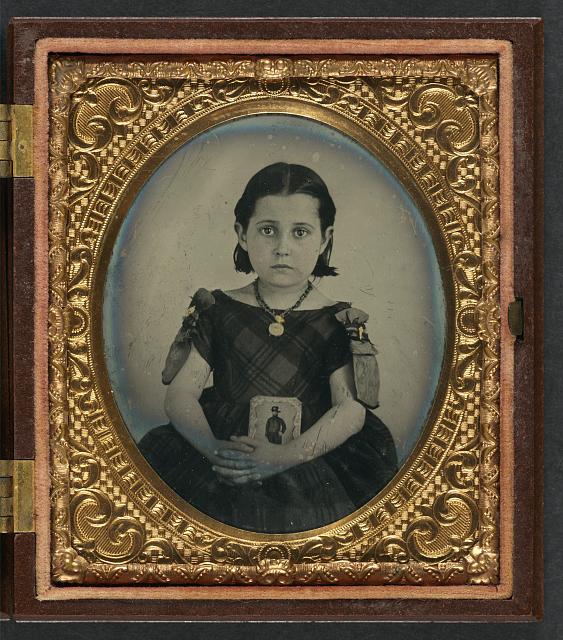
mourning photo.jpg
Unidentified girl in mourning holding a picture of her father. (photo via Library of Congress)

After her father died, the girl in the photo above went through a highly ritualized and formalized process of Victorian mourning. This process radically changed with the invention of photography in 1839. Now one could record the grieving process, which is what the photograph above accomplished. The photograph is a typical mourning portrait, depicting the mourner (the little girl in this case), with the photo of her deceased loved one in her hands. Like so many other photographs, this one recorded the grieving process, allowing loved ones to keep a piece of that person even after their death. 19th-century photographs also were often used to capture images of loved ones while they were dying. Photography was particularly apt for this kind of work as it was seen as a vessel of truth, intimately connecting the past and the present. 19th- century Americans realized that photographs told stories like few other objects could, and they used this storytelling ability to convey their emotions surrounding mourning.

Queen Victoria, after whom the Victorian era was named, went into deep mourning following the death of her husband, Prince Albert, in 1861. Although mourning was already an important part of people’s lives before Albert’s death, it became even more so due to Queen Victoria’s highly public and drawn out mourning process, which was aided by the invention of the photograph. Mourning was such an important process because death was a constant feature of life in the 19th century. Disease, an overall lack of understanding of how to treat illnesses, and poor sanitary conditions shortened the average lifespan to about fifty years old. Due to the constant reality of death, funeral and mourning practices became an important aspect of everyday life. When someone was expected to die, their house would be draped in black crepe to let everyone know the family was expecting a death. The family would often prepare for death by taking portraits of the dying person. These portraits would later be sent out as part of memorial cards, informing one of the funeral and providing them with a keepsake to remember the dead by. In addition, the family would often take photographs with their deceased loved ones, especially infants, to further commemorate their life and passing.

After the death, women especially became vessels of grief. Women were thought to be more emotional and sensitive, so it was particularly their job to express their emotions over the loss of a loved one. They wore black, as well as jewelry specially made for mourning which would include a picture of the deceased on it. It was also common to include a lock of the deceased’s hair in the mourning jewelry. The child in the picture above is already preparing for her role as a mourner, which would only become more circumscribed as she aged. She is dressed in all black, is wearing mourning ribbons, and holds a picture of her father, who died in the Civil War. Although she is young, she is already learning how one dresses, acts, and behaves while grieving, as well as performing a central part of the mourning process.

An integral part of mourning processes like the little girl’s was the mourning portrait. These portraits did not begin with the invention of photography. In fact, many portrait companies were created to produce lithographs of the mourning process, such as the company that would come to be known as Currier and Ives. These lithographs usually depicted women in full mourning next to a tomb, which was oftentimes topped with an urn. There also was usually a weeping willow and a church in the background. These images typically showed women in exaggerated poses of sorrow, draped over the tomb next to them. Women were in these poses because mourning was very public; one had to show they were deeply aggrieved by the loss of their loved one. If women did not show their emotion, it was thought that they were cold and uncaring about the death of their loved ones. Since it was women’s jobs to mourn and be emotional, not doing so would have been considered a social faux pas. However, a woman could not be too emotional either, as that would have been unseemly for an era which also called for personal restraint in public. Not only did they have to “perform” their grief, but they also had to record it. They would hang these lithographs, and later, photographs, on the walls next to a portrait of their loved one, forever immortalizing their loved one’s death and their own grief at the dead’s passing. The photograph of the little girl is a continuation of the lithography process in a new medium. Now all at once, the girl has a picture of her father and of herself mourning her father.

mourning lithograph.jpg
A typical mourning print done by Currier and Ives. (image via Library of Congress)

Photographs radically changed the mourning process because people saw photographs as somehow more truthful and organic than other artistic depictions, such as paintings. While it is true that the process of taking a photograph was staged, the photographer still could only capture material realities. One could not just add things into photos that were not actually there, at least not in the 19th century. In addition, by staging the photos in a certain way, people felt like they were able to convey a deeper truth and reality, unlike they could in paintings. Victorian Era Americans also believed that by looking at a photograph of someone you could see into their soul and see what they were feeling at the moment the photo was captured. A photo could therefore authenticate a moment in history, which was why photography became so important to the mourning industry, so much so that people built businesses out of traveling and taking mourning photographs. Mourning photographs served as proof of the mourner’s deep sorrow, more so than a lithograph ever could. The girl in the photograph has a haunting expression on her face and she looks much older than she actually is. The photo served to capture her emotion and the fact that she was forced to grow up by losing a parent long before any child should. Her father will always be with her though, and will never be forgotten, as is evident by the way she clasps his photograph to her.

The photograph was also important in mourning practices because it could capture the visual attributes of the deceased, either in the process of dying, or just before. On the brink of death, people were supposed to be resolute and accepting of their fate and if their face showed this in the photograph, family members would know that their loved one was going to heaven. The photograph, therefore, became a vessel for memory and a way to remember a loved one. Before the invention of photography, people only had an article of clothing or a toy to remember the deceased by. Photography now allowed loved ones to have a memento of the loved one’s appearance, which played a role in both the public and private mourning process. The girl in the photo could always remember specific details about her father’s appearance or demeanor, as she had a photograph of him. In addition, her father’s death no doubt served as a political statement and evidence that he fought and died in the name of the Union’s just cause. Such mourning photographs of Civil War dead thus played a significant role in perpetuating key, familiar tenets of 19th-century sentimentalism—that death, and familial grief for a loved one served a higher, patriotic purpose in which those who were left behind should take comfort. Therefore, not only did this specific image allow the little girl to remember her father’s death; she could also remember how she herself felt after his death, as she also had a picture of the mourning process. The photo was a way of transporting her into the past to ensure that she would never forget her father, the higher purpose for which he died, or his guiding influence.

Mourning photography fulfilled similar needs for many other families of the deceased, especially during the deadly years of the Civil War. In this way, the technology of photography was able to radically and rapidly change the mourning tradition. People quickly noticed and took advantage of the capacity for photography to capture landmark moments in history by capturing “truth,” be it all natural or staged for even greater or “more truthful” effect. In addition to providing a window into 19th-century mourning practices, this photograph also serves as a testament to how technological innovations throughout history have helped to better connect past and present, and affect sweeping cultural changes.


Sources:

Bedikian, Sonia A. “The Death of Mourning: From Victorian Crepe to the Little Black Dress.” Omega: Journal of Death & Dying 57, no. 1 (May 2008): 35–52. Accessed October 1, 2018.

Grootkerk, Paul. “American Victorian Prints of Mourning.” Southeastern College Art Conference Review 11 no. 4 (1989):276-283. Accessed October 1, 2018.

McConnell, Kent A. “Photography, Physiognomy, and Revealed Truth in the Antebellum South.” Southern Quarterly 52, no. 4 (Summer 2015): 32–53.

“The Custom of Mourning During The Victorian Era.” Nps.Gov. Last modified 2018. Accessed October 1, 2018.

Unspeakable Suffering; Eloquent Explanations: National Civil War Medicine Museum’s 26th Annual Conference

By Benjamin Roy ’21 and Cameron Sauers ’21

On Friday, October 12th, 2018, the National Civil War Medicine Museum kicked off its 26th annual conference and began its three-day event with a series of lectures on topics ranging from Confederate medical practice to cultural understandings of cowardice. A series of unique lectures given by a professionally diverse cast of presenters illuminated the often-peripheral field of Civil War Medicine.

Our day started on a high note with coffee and a thought-provoking inquiry into the position of Confederate Surgeon General. Dr. Guy R. Hasegawa, a pharmaceutical doctor and scholar, detailed the unique history of this crucial Confederate leadership position and the men who filled it during the war. The Confederate Surgeon General, identical to his Federal counterpart but without the benefits of the massive resources at Union command, was tasked with maintaining the health of the Confederate armed forces and citizenry. Building the medical department from the ground up presented the Confederate Surgeon General with challenges not experienced by his already established Federal counterpart. Hasegawa’s presentation provided particularly interesting insights into the life of Samuel Preston Moore, Confederate Surgeon General from 1862 until surrender. The lecture detailed the challenges, successes and controversies that defined Moore’s Confederate career. Among the engaging topics were the innovations pioneered by Moore and implemented by the Confederate medical department. Under Moore, the Surgeon General’s office established a medical journal, implemented exhaustive collection and analysis of medical data, and even pursued indigenous remedies. Moore also supervised the Association for the Relief of Maimed Soldiers, which provided prosthetic limbs to Confederate veterans. Hasegawa’s talk provided an insight into the struggles that the Confederacy faced as it tried to establish itself as a new nation.

Dr. Robert Hicks, Director of the Mutter Museum of Philadelphia, continued the theme of Confederate medical practice in his presentation on the mass vaccination efforts at inoculating both the Confederate Army and civilian populace. Hicks used Confederate efforts at inoculation during an 1863 smallpox outbreak to highlight the pioneering efforts of the Confederate medical staff in epidemiology. This insightful and interdisciplinary talk combined material culture, epidemiology, and more traditional historical records, like primary source documents, to explain the smallpox outbreak the Confederacy dealt with in 1863. The outbreak was exacerbated by Confederates who attempted to vaccinate themselves, but inadvertently gave themselves and their comrades the disease. Laid atop the solid foundation of Hasegawa’s introduction of important figures in the Confederate Medical Department, Hicks’s presentation was personable and engaging. Combining scholarship and personality, Hicks’s talk was one of the highlights of the conference. The lecture mirrored an essay he recently contributed to Joan Cashin’s new edited volume, War Matters: Material Culture in the Civil War Era. His research into Confederate vaccination emphasized the importance of those objects in his talk, with Hicks declaring, “Working with the stuff always gives you something you didn’t expect” and “material culture always produces surprises.”

Hicks
Dr. Robert Hicks

Paige Gibbons Backus’s talk, entitled “Revealing the Chaos and Carnage of the Hospitals of First Manassas,” gave a stark contrast to the orderly medical system emphasized by Hicks and Hasegawa. The talk highlighted the disorder and panic that inhibited the treatment of the wounded during and after the First Battle of Manassas. Field hospitals were shelled, wounded were left on the field for days, and spooked Federal doctors fled mid-surgery for the safety of Washington. Backus then shifted into describing how Ben Lomond Historic Site, which served as a field hospital during the battle, interprets Civil War medicine through the sense of smell. The site contracts with a company that manufactures smell canisters that recreate the odors of a hospital, thus giving visitors a direct connection to the often-unimaginable environment of a Civil War field hospital. By using smell as an educational tool, the site provides visitors with an interpretation that moves beyond audio and visual demonstrations, allowing them to have a more immersive experience. Backus noted that she has become accustomed to the rank smell of gangrene emitted by these canisters. Like Backus, Civil War medical personnel would have gone nose-blind to the horrific smells due to constant exposure in their daily routines of aiding the wounded. (As an aside, the audience was most disturbed when Backus revealed that that same company contracts with Starbucks to manufacture the smell of coffee that permeates their locations, eliciting a common groan of disgust from all attendees).

Captain Frank K. Butler, M.D. gave the next talk on current standards of care in the armed forces, titled, “Battlefield Trauma Care – From Antietam to Afghanistan.” Butler immediately commanded attention from the audience by showing a picture of an Afghan mountain range in his title slide and remarking, “this is from when we were hunting for Mr. Bin Laden.” The talk focused on battlefield medicine in Afghanistan and Iraq, wars with high stakes in our own young lives. Remembering our friends in the armed forces made Butler’s talk one of the more personally resonant presentations for us. Using the tourniquet as the medical thread to tie Civil War soldiers fighting on the plains of Antietam to Special Forces Operators ascending the mountains of the Hindu Kush, Butler assumed a highly medical voice as he discussed the nature of military medical reform. Butler’s advocation of the TCCC (Tactical Combat Casualty Care) plan among the armed forces was the focus of the talk. The Department of Defense uses TCCC to teach Special Forces operators life saving techniques and strategies for tending to trauma injuries received on the battlefield. Often using graphic depictions of real wounds sustained by Special Forces soldiers in the war against terror, Butler’s presentation offered a sobering picture of battlefield medical care and the challenges it still poses today. Butler portrayed continuity by explaining how the use of morphine has remained relatively unchanged from the Civil War into today, reflecting a lack of innovation that mystifies Butler. Although TCCC significantly lessened the death rate for wounds to the extremities, Butler’s goal is to eliminate preventable deaths and keep innovating. Butler’s talk offered a poignant example of how professionals in their fields use material culture, like the humble tourniquet, and historical knowledge to highlight the evolution of battlefield trauma and make lifesaving innovations.

CWI Director, Dr. Peter Carmichael finished the first day with a thought-provoking inquiry into how sentimentalism shaped the way surgeons treated soldiers suffering under the pressures of Civil War combat. Very broadly, sentimentalism refers to a 19th -century belief that faith in God and strength of will would prevent moral failure. Dr. Carmichael stated that belief in sentimentalist prescriptions of manhood shaped Victorian Americans’ belief that cowardice, and the way it could manifest itself through various bodily “ailments,” was an affliction to be overcome through masculine force of will, not through medicinal treatment. Carmichael provoked the audience with passages from a war-time medical journal and engaging rhetoric that challenged conference attendees to see not the barbaric practices of early modern surgeons, but rather cultural tropes that directly shaped Americans’ views of soldiering, masculinity, and medical practice during the Civil War. Carmichael used the example of a northern surgeon who concluded in a medical journal that combat was the best cure for homesickness, as it allowed the men to drown individual sufferings and longings by expressing their manly impulses and created a community within the regiment. Using case studies of different Civil War soldiers, Carmichael nicely grounded this sophisticated talk about the complex concept of sentimentalism in the concrete reality of men’s experiences.

Jake Wynn, the Director of Interpretation at the National Museum of Civil War Medicine, started the second day with a talk on the functions of the Army of the Potomac’s medical department during the Overland Campaign. The Overland Campaign was the first campaign following the departure of Jonathan Letterman from his post as Medical Director of the Army of the Potomac. Letterman had revolutionized battlefield medicine by pioneering the use of the triage system and emphasizing the use of ambulances. The campaign’s aggressive and unrelenting drive to the South and East, and the bloody battles it produced along the way, overwhelmed the medical department. During May and June 1864, the medical department had treated 40,000 wounded men. Wynn noted that ambulances became a critical part of the campaign as wounded soldiers needed to be evacuated to the main Union hospital. The difficulty for the medical department was that, as Grant and Lee continued their southeasterly drive toward Richmond, new hospitals had to be constantly established in their wake. Wynn discussed the experiences of nurses and wounded soldiers during the campaign to highlight how the department performed without its now legendary head, Jonathan Letterman. The department kept Letterman’s reforms, which are still used today in battlefield medicine, to treat the wounded.

The final lecture of the conference came from Melissa DeVelvis, a doctoral candidate in history at the University of South Carolina, specializing in the Civil War era, gender studies, and sensory and emotional history. DeVelvis’s talk covered the impact of the senses in Civil War hospitals, focusing specifically on the experience of Civil War nurses. One topic of intrigue was how important touch was to recovering soldiers. DeVelvis provided an example of a Confederate nurse remarking that the Union soldiers in a Confederate hospital had a higher mortality rate because the nurses were less tender with them than they were with Confederates soldiers. Another interesting point was that nurses, especially in the Deep South, had to consider the men they were treating as their brothers and sons to avoid transgressing on Victorian morality. The intimate relationships between soldiers and nurses would have defied ideas of propriety if they were not considered to be family. The final topic of the lecture covered how Civil War nurses became numb to death through their constant contact with the dead and dying. DeVelvis noted that nurses wrote about tending to the dying as a minor occurrence, reporting it in their letters home as just a mechanical byproduct of their work. DeVelvis compared the numbness of hospital workers to soldiers who became accustomed to the fighting and killing on the front lines. The combined experience of soldiers and civilians led to a reevaluation of Victorian ideals, like the notion of the “good death,” and led to a renegotiation of certain moral values.

As we left the conference, we reflected on two days of lectures, the wide scope of topics covered by presenters, and how grateful we were to the National Museum of Civil War Medicine for providing scholarships so that we, and other Gettysburg students, could attend the conference. We witnessed an exciting example of how rich history can be when it embraces interdisciplinary methods. Examples of the application of material culture, gender studies, cultural history and numerous other disciplines inspired us to apply the same to our own research for the Civil War Institute. This semester, we are curating a photography exhibit that will be displayed at this summer’s CWI Conference comprised of images taken at Gettysburg following the battle. What we learned at the conference challenged us to re-consider the images in our exhibit in a new light. The topics interweaving both science and medicine gave broader perspective to two historically minded people like us. As historians, we normally view ourselves as the antithesis to medicine and science, but the Civil War Medicine Conference provided us the opportunity to see how the fields overlap. The field of Civil War history often can seem overpopulated with histories covering the same figures and events. We left the conference full of hope and convinced that our own scholarship could be groundbreaking in unique ways, like the presentations at the conference.


Hot off the Press: War Matters Review

by Cameron Sauers ’21

War Matters: Material Culture in the Civil War Era
Ed. Joan Cashin
University of North Carolina Press
ISBN: 9781469643205
262 pages
$29.95

This collection of essays illustrates that a material culture approach to the past can help us better understand some of the deeper complexities of the Civil War era, such as the expansion of consumer culture, the common soldier’s experience, and behavioral history, as well as issues of race, bondage, and emancipation. Cashin argues that it is important to study the objects featured within the book to understand their multi-valenced roles in the daily lives of 19th-century Americans, as well as the cultural and emotional significance they held for those who utilized them. From Robert Hicks’s essay on vaccinating the Confederate armies, to Sarah Jones Weicksel’s examination of shelter in refugee camps, these pieces explore a wide assortment of artifacts. The authors reveal that these artifacts enabled historical actors to shape events in specific ways and give meaning to their surrounding world.

In her own essay, Cashin focuses on the relationship Civil War soldiers had with artifacts from the American Revolution. She specifically notes southern whites’ veneration of Revolutionary War artifacts and their desire to protect them from Union soldiers. Union soldiers were eager to find jewelry and cuts of wood from Founding Fathers as they campaigned, items that were valuable to them but were also easy to physically carry. Cashin argues that soldiers wanted physical contact with these artifacts to serve as second-hand connections to great figures, especially George Washington, which would serve as inspirational reminders of the past, as well as mementos that could be taken away as souvenirs of war. Cashin’s essay ends with a sentence that sets up this new subfield of historical scholarship: “The study of material culture can illuminate yet other undiscovered aspects of politics and memory in the long sweep of American History.”

Two other essays in the collection that complemented each other were Earl Hess’s, “The Material Culture of Weapons in the Civil War,” and CWI Director Peter Carmichael’s, “The Trophies of Victory and The Relics of Defeat: Returning Home in the Spring of 1865.” While exploring different aspects of the soldier experience, both pieces cover the tenuous relationship that many Civil War soldiers had with their weapons during the war. Hess explores the ambivalence that soldiers felt toward their guns and the act of shooting them. Some Civil War soldiers were petrified by the power of their rifles, realizing that the weapon purposefully took the life of an enemy or could accidentally discharge into a comrade. For other soldiers, America’s emerging gun culture made them supremely confident in the handling and use of small arms while campaigning. Carmichael discusses how rifles and other militaria carried heightened symbolism during the Confederate surrender at Appomattox. Some Confederate soldiers were so grief-stricken, or in denial, over the Confederacy’s demise that they could not bring themselves to personally surrender their weapons. Instead, they simply left their weapons in their tent and walked away rather than face the indignity of handing over these much-desired trophy pieces to Union victors. Enlisted men felt that the surrender of their weapons encroached on their personal honor because the decision to surrender was not theirs.

For casual buffs or serious scholars, War Matters is a rewarding read. Each author reconstructs the physical and symbolic importance of objects for readers. Moreover, the authors give voice to different human stories and the material objects through which individuals made sense of their world. The more we understand the artifacts themselves, the more we understand the people who used them. As the contributors to War Matters successfully showcase, material culture is an important complement to traditional history. Cashin and the contributors to the volume illuminate new subjects and provide another layer of understanding to the construction and unpacking of historical narratives.

Complicating the Civil War Narrative: The Lincoln Lyceum Lecture

By Savannah Labbe ’19

Ayers
Edward Ayers

On October 3rd, the 2018 Lincoln Prize-winning author and historian, Edward Ayers, gave a talk on his most recent book, The Thin Light of Freedom: The Civil War and Emancipation in the Heart of America. Ayers began the process of writing this book in 1991 while driving through the Shenandoah Valley and wondering how places so naturally beautiful could go to war with each other so quickly. In his book, he attempts to answer that question by looking at how the Civil War was experienced on the ground by normal, everyday people. He does this by following two communities from 1863 to the immediate post-war years: Augusta County, VA and Franklin County, PA. He began following these two counties in his previous book, In the Presence of Mine Enemies, and The Thin Light of Freedom serves as a follow-up to that book. Ayers chose these counties because, on the surface, they seemed to be very similar. Both counties had similar soil and geographic features and they are relatively close in proximity. They also both initially supported the Union. However, despite their similarities, their inhabitants still went to war with each other and had very different opinions about the war. Augusta County ultimately sided with the Confederacy when Virginia seceded, which radically changed the lives of the county’s inhabitants, both black and white. By examining the war’s impact on both whites and blacks in these two communities, Ayers provides a fuller picture of the complex racial, social, economic, and cultural fabric of these societies. Ayers sees these counties as a sort of microcosm of the Civil War itself, in that they provide specific examples and concrete evidence for the larger, intangible legacies of the war, such as the fight over historical memory.


Ayers began his lecture by arguing that the Civil War was marked by boundaries of all kinds, not just regional ones. The war changed the boundaries that marked who was considered a human being and who was considered property. Time also made its mark on the lives of soldiers in that soldiers would often look back upon battles and see them as landmarks, or turning points, in their lives. Battles such as Gettysburg, where Ayers begins his book, had this effect. A man from Franklin County was at Gettysburg, and after the great victory near his home, he was able to sneak off to see his wife. His wife back home could hear the roar of battle but could not see it. After his visit, though, she was able to feel secure in the knowledge that her husband had survived the battle. For the soldier, his visit home after the great carnage at Gettysburg served not only as a much-needed break from the battlefield’s death and destruction, but also was a celebratory moment and a happy memory from which he could derive hope and purpose. However, on the Confederate side, the scene was very different. Confederates were not able to return home and celebrate their victory with their wives. Instead, they watched as wounded and mutilated men were dragged down the road by wagons, some of whom had not even seen a doctor yet. In contrast to the more hopeful Union soldier, the Confederates looked back upon the Battle of Gettysburg as a moment of immense and unmitigated suffering and loss.

Though the Confederates lost at Gettysburg, they were able to come back in 1864 and capture another Pennsylvania town: Chambersburg. In addition, the Union forces also occupied Staunton, the largest town in Augusta County, in June of 1864. When the Confederates took Chambersburg, the residents of Franklin County despaired over its loss. However, the Confederates relished in the terror of Chambersburg’s citizens and hoped that the county would never again be under Union control. An African American soldier defending the town wrote about how bravely his regiment had fought. The raid was particularly dangerous for this black soldier not only because he risked his life in battle, but also because he risked being captured and sold into slavery by the Confederates. However, he was determined to fight to gain the rights of black people to be acknowledged as human beings, to be free, and to vote, or die trying. Ayers used the experiences of town citizens, Confederates, and the black soldier to portray the range of emotions involved when the Confederates captured Chambersburg. Ayers showed this range of emotions and opinions in order to provide insight into what was at stake for each of these groups of people.

The citizens of these counties had differing opinions and feelings about many political and social issues, including the election of 1864. During the campaign season, northern Democrats vilified Abraham Lincoln. The Republicans and African Americans, on the other hand, believed Lincoln was correct in issuing the Emancipation Proclamation and making the war not only about the preservation of the Union but also about ending slavery. Though he only gained 1% of the northern Democratic vote, Lincoln won in a landslide vote in the electoral college, ultimately ensuring the demise of the Confederacy. However, white Augusta residents vowed to never give up, and even offered to send their slaves to fight for the Confederacy. They had already lost so much, since much of the war was fought on their land, and were willing to sacrifice even their most prized “possessions”—their slaves– in order to preserve southern independence. In proposing to send their slaves to fight for the Confederacy, Augusta residents defied many other southern slaveowners who believed that slavery provided both the physical labor and the socio-political backbone that kept the Confederacy on its feet. The actions of southerners like the Augusta residents helped shape the Lost Cause narrative and southern memory of the war. For example, the idea that southerners would never give up influenced the Lost Cause idea that the southerners never did give up but were, instead, simply overrun by overwhelming numbers. Augusta residents’ willingness to give up their slaves also shaped the Lost Cause narrative, as southerners used such evidence to try to argue that the war was not about slavery, but rather about southern independence.

White southerners, such as those of Augusta County, entered the post-war world believing they were in the right and that God had been on their side, and they fought tenaciously to preserve such a narrative for posterity in their attempts to control the historical memory of the war. Immediately after the guns of war fell silent, the whites of Augusta County set out to decorate the graves of the Confederate fallen. In doing so, they sought to promote the notion that the Confederate dead were the only war dead that deserved to be honored, as they had fought for the only noble cause. The next day, the African Americans of Augusta County went out to decorate the graves of Union dead. With this action, they fought back against the white residents’ attempt to control historical memory of the war by arguing that the Union dead were more deserving of having their graves decorated because they had fought for the more righteous cause of freeing the slaves.

Due to African American resistance to the Lost Cause narrative, southerners did everything they could, both legally and illegally, to prevent African Americans from gaining suffrage and fully participating in American society. In this way, Ayers believes, the South committed its own suicide: If southerners had not fought so hard to deny blacks their rights, then the drastic reforms of the Radical Republicans in Congress that forever changed the fabric of southern society would not have been necessary. Ayers believes that the Radicals’ most important reform was the public-school system, which allowed African Americans to become educated. Southerners did not want blacks to have access to education because then they would become a threat to southerners’ visions of “proper” political and social order. Through public education, blacks would gain the knowledge and intelligence necessary to fight for suffrage and to stop discrimination. African Americans would then realize that they could achieve everything white people could, thus making them the equals of the white man. Such realizations would challenge the claim that white people were inherently superior and would ultimately undermine whites’ discrimination methods, such as segregation.

Ayers’s lecture provided an in-depth look at two counties which, on the surface, seem very similar but were actually radically different. His close analysis of Augusta and Franklin Counties offers a compelling window into the lived realities of the war for two specific communities, while unpacking some of the critical regional complexities that shaped those communities’ differing experiences of and reactions to the war. Additionally, his examination both of the long fight for historical memory and of the differing worldviews and experiences of all those involved in the conflict shows that a multi-faceted view of the war is necessary to fully understand the conflict and its legacies.

To Liberty, Honor, and…Cufflinks?: The Grand Army of the Republic

By Savannah Labbe ’19

Gar pin
Grand Army of the Republic cufflink. (via Special Collections at Gettysburg College)

Borne of the Civil War, one fraternal organization quickly assumed such great authority that it re-shaped cultural prescriptions of manhood, dictated the northern public’s memory of the war, and even influenced presidential elections. This organization, the Grand Army of the Republic (GAR), was formed in Illinois in 1866 by veteran Benjamin Franklin Stephenson and its number of posts in the United States quickly increased. In order to be a member, one simply had to be a Union veteran. By the 1890s, there were 7,000 GAR posts around the country; approximately 1.3 million men, half of all Union veterans, were group members. Members would have worn these cufflinks, or more commonly, the badge with the same image on it, as status symbols. They purchased these cufflinks and badges not merely so that they could have another piece of jewelry, but so they could show everyone that they were one of the heroes who fought for the Union, one of the brave soldiers who were now part of the most powerful veterans’ organizations in the United States. Being a member of the GAR meant one had participated in one of the greatest wars of modern times (so they thought). In addition, these accessories indicated that one had not only participated in that war, but that he had fought on the right side– the side of liberty and freedom. These cufflinks became a symbol of one’s martial manhood, proving that one had served with courage and honor while fighting for a just cause. In this way, the GAR promoted its own history of the war– what is now known as the Treasury of Virtue. Similar to the Lost Cause narrative, it promotes a biased interpretation of history, in this case from the northern perspective. According to this narrative, all northern soldiers were noble, honorable, and heroic men who triumphed because they fought for the righteous goal of emancipation.

The imagery on the cufflinks also served to highlight the ideas of moral righteousness and martial fraternalism that the GAR tried to foster within its members Lady Liberty can be seen in the background–yet another concrete reminder that Union veterans had fought for a virtuous cause. A soldier and a sailor clasp hands in front of Lady Liberty, which symbolizes fraternalism, one of the goals of the GAR tried to promote. These cufflinks would have made it easier for men to recognize each other as fellow brothers-in-arms: They would know immediately that the man they had just met had gone through the same experience they had and would understand it as no one else could. It is hard to relate the horrors of war to someone who has never been through it, and the GAR provided an outlet for former soldiers to express these horrors and know that those around them would understand and empathize, instead of simply pitying them. Amidst the fraternal comfort of the GAR, that strict veil of 19th century manliness could be pulled aside; veterans could realize that they were not the only ones who had felt scared in combat or had been wracked with guilt over killing a man. To help facilitate these connections between veterans, the GAR held local, regional, and national meetings in which they would sit around campfires singing war songs and telling stories. Not only did this serve as a sort of therapy for the men, but it also allowed them to reminisce and be proud of their actions and the fact that they were part of so great a cause at so important of an historical moment.

Two figures kneel before the soldiers on the cufflink. Scholars debate over who these figures are supposed to represent. Some believe they are two orphan children, while others believe they are slaves. Either one would make sense. The GAR set up a fund to help widows and orphans and they also helped set up many homes for orphans. These activities went hand-in-hand with another goal of the GAR– that of charity. The GAR believed that those who had fought and died for the Union deserved proper care for their families. The government was hard-pressed to provide pensions for veterans, let alone to provide for the families of the fallen, so the GAR took this task upon itself. By doing so, members set an example, showing that veterans and their families deserved to be rewarded for their sacrifice, and thereby declaring them members “worthy of charity.” It is also equally plausible that the figures in front are slaves because GAR members liked to promote an image of themselves as the liberators of the oppressed.

The GAR used its moral authority of being on the side of righteousness to try to control the memory of the war. The GAR funded many Civil War memorials and monuments in order to promote its version of history. For example, in Arkansas, a state divided in its loyalties and with many more Confederate monuments than Union ones, the GAR made sure to make its presence known. The inscription on one of the three GAR monuments in Arkansas proudly proclaims that the Union soldiers’ “sacrifices cemented our union of states and made our flag glorious forever.” Not only did the GAR remember the Civil War through monuments, but it also started the official tradition that came to be known as Memorial Day, (though many others, particularly Southern women, had been observing similar days since the war ended). Originally known as Decoration Day, the commander-in-chief of the GAR designated that May 30, 1868, would be a day for the decoration of Union graves. 31 states adopted Decoration Day as an official state holiday by the next year. This ensured that those who had sacrificed their lives for the Union cause would never be forgotten. In addition, it also served as a reminder that those living veterans who would proudly wear their cufflinks to these events to publicize their fraternal identity, deserved to be rewarded for their services.

In order to fight for what they believed veterans deserved, especially pensions, the GAR became a very political body. After the Civil War, it was difficult for a president to be elected or even win a primary without the endorsement of the GAR. The GAR became a political arm of the Republican party, lobbying for certain presidents and political candidates. It was not until 1885 that a Democrat, Grover Cleveland, was elected president. However, Cleveland was not able to win immediate reelection because he vetoed a pension bill, which made members of the GAR angry . The GAR was very concerned with the welfare of veterans, and because of this they focused their lobbying efforts on obtaining pensions for veterans and their families. When politicians vetoed or opposed pension bills they were sure to feel the wrath of the GAR. Before the formation of the GAR, soldiers did not really take a large role in politics. Americans held that the ideal soldier was first and foremost a citizen and as such they should not take a role in government affairs. Americans were all too familiar with the unruly armies in Europe who did not protect the citizens but instead fought for money and power. American soldiers tended to return quietly to private life after they were done fighting because of this fear. The GAR, in contrast, was openly political and fought for what they believed they were owed.

This cufflink was much more than just a piece of jewelry. It was a way for comrades to identify each other and immediately bond over shared wartime experience . As such, it promoted camaraderie, friendship, and healing among veterans. Those who wore it were immediately identified as a member of a heroic class, and the white, northern veteran became the new model of honorable manhood. This cufflink also helped the GAR shape the memory of the Civil War. Its symbolism reinforced the idea that the Union had fought a just war that had saved global democracy and liberated an entire race of people. Additionally, the monuments and the traditions that the GAR started helped to promote a distinctly northern memory of the war, its causes, and consequences . As is evidenced by the actions of those who proudly wore these cufflinks, the post-war years were not, contrary to popular belief, all about reconciliation and a “forgive and forget” attitude; both sides tried passionately, and for many decades, to assert their own particular memory of the war. While the GAR was a veterans’ organization, it also became a political lobbying group. For the first time since the American Revolution, citizen soldiers became a tightly organized interest group dedicated to reshaping the political life of the country. No longer retreating back into their post-war private lives, these veterans but became directly involved in national politics, fighting for the material benefits and respect they believed they deserved in return for their sacrifice.


Sources:

Blight, David W. Race and Reunion. Cambridge, USA: Harvard University Press, 2009.

Christ, Mark K. “Arkansas Listings in the National Register of Historic Places: Grand Army of the Republic Monuments.” Arkansas Historical Quarterly 77, no. 1 (Spring2018 2018): 67-73. Accessed September 16, 2018.

O’Leary, Cecilia Elizabeth. ““When Johnny Comes Marching Home”: The Emergence of the Grand Army of the Republic.” In To Die For: The Paradox of American Patriotism, 29-48. Princeton, NJ: Princeton University Press, 1999.

“The Grand Army of the Republic and Kindred Societies (Main Reading Room, Library Of Congress)”. Loc.Gov. Last modified 2011. Accessed September 16, 2018.

“Where the spirit of the Lord is there is liberty”: The Bible as a Vessel for Remembrance, Guidance, and Self-Understanding during the Civil War

By Savannah Labbe ’19

bible
The Bible of Lewis Tway


Courage, guidance, family, strength, self-understanding, and survival: These are just a few of the things that this Bible represented to the soldier who carried it. For Private Lewis Tway of the 147th New York Volunteers, this Bible provided a tangible link to all these things—a way to make sense of the at-times non-sensical chaos and carnage of war, a way to grow, learn, and adapt to the infinite physical and spiritual challenges of soldiering while still firmly rooting Tway in the foundational people and principles that gave his life meaning. Tway’s engagement with this Bible was never static; the evolution of that engagement, coupled with the multiple meanings that this Bible took on throughout the course of the Civil War were instrumental in shaping, and re-shaping, the man who carried it.

21-year-old Lewis Tway enlisted in the 147th New York in July of 1863, shortly after the Battle of Gettysburg, and was discharged in July of 1865. The 147th saw heavy fighting in between: The Battle of the Wilderness, the Mine Run Campaign, Cold Harbor, and the Siege of Petersburg were just a few of their major engagements. This Bible was carried through the carnage of those battles in Tway’s pocket. Soldiers had to carry everything with them wherever they went. Though merely a palm-sized New Testament, this Bible would have meant extra weight for Tway to carry, but he found it important enough to do so. Its black leather binding worn to brown in some places from constant use, the Bible conveys a sense of constant companionship and consultation for Tway. It has a latch in the front that Tway would have to consciously remove to open it, but he did so time and time again. On the front page, he wrote his name and his regiment, which would have served as a type of dog tag in the case of his death—no doubt a comforting notion to a soldier who would be fighting hundreds of miles away from home and family. It also had blank pages in it which Tway could use as a sort of journal and a place to reflect on his experiences of warfare.

The text of the Bible is very small, but Tway marked up a lot of the passages in it that resonated with him, even writing notes in the margins. Tway’s notes bear witness to the emotional and spiritual challenges he confronted as well as his evolving perspective on those challenges. For example, he circled in pencil, 1 Corinthians 15:20, which refers to the resurrection of Christ, and he writes the word “easter” next to it. He may have been reading this and remembering the comforts of home and how he attended Easter services before the war began, as well as how he celebrated the holiday with his family. Making such notations may have also been a way for Tway to get his mind off the horrors of war, by really thinking about and examining each verse and attempting to understand what they meant in the broader context of the Bible as well as the context of his life as a soldier. From instances like these it is obvious that Tway dedicated time to reading the small text of the Bible and reflecting on it and how its message intertwined with the realities of his daily life. As exhibited in Tway’s notations, Tway appears to have turned to the Bible for self-understanding and as a coping mechanism during some of what were likely the darkest, most confounding days of his life.

For men like Tway, the Bible was not simply a holy book, but a piece of home they could carry with them. Many men received their Bibles as gifts from family members or dear friends. While it is unknown how Tway received his Bible, he most likely got it before leaving home. Judging by how worn and well-loved the Bible looks, it was one of Tway’s most cherished possessions, perhaps one that was a reminder of who was waiting at home for him. While he was not married until after the war, he did have a sister that he was very close to and who was one of the few people he wrote to during the war. The Bible was a piece of home for Tway, a reminder of his sister and other loved ones for whom he was fighting, and who were waiting for him to come home. Along with this Bible, he also carried a picture of a little girl, possibly his sister, which would have complemented the Bible as a visual reminder of whom he was fighting for.

The weight of the Bible in Tway’s pocket also served as a reminder to keep the faith and resist the many temptations of army life, such as alcohol, gambling, and prostitution. Religion, especially Christianity, was a powerful force in the lives of most 19th century Americans. They went to church every week and looked to the Bible for all forms of moral guidance and teaching. It was essential not to stray from those teachings, which was why so many soldiers, such as Charles O. Varnum of the 40th Massachusetts, were warned by their parents to be wary of temptation in camp. Such calls for caution were not unique to the Union. On the Confederate side, Carlton McCarthy’s likewise father said he would rather see his son dead than hear tales of his immorality. The army had long been known as a place of temptation and these fathers were correct in voicing concern over their sons’ moral health. The physicality of the book in Tway’s pocket served as a constant reminder from home to never stray from the teachings of the Bible that so strongly undergirded so many elements of Victorian society.

Tway also probably found himself looking to his Bible often for religious advice or guidance in the midst of a war where God often seemed quite absent amidst the constant and horrifyingly brutal deaths of friends and comrades, who succumbed not only to battle wounds but to debilitating diseases. Tway wrote in a blank page of his Bible, “where the spirit of the Lord is there is liberty.” He may have been trying to fortify his own courage by reminding himself that constant faith in the Lord would liberate his own soul, both to perform great acts of courage in battle and to reach the gates of Heaven. However, by writing this notation in the midst of war, Tway may have been suggesting that he believed the spirit of the Lord was with the Union and on the side of liberty, and thus also with Tway, as a soldier in blue. His notation also may have referred to the liberation of slaves, as he joined the army after the Emancipation Proclamation was issued. Thus, Tway may have been reflecting on the political aims of the war through the lens of the Bible which, for many, imbued the Union cause with a comforting sense of sacredly ordained responsibility.

Like Tway, people on both sides of the conflict used the Bible as justification of their cause. The South tended to take a literal approach to the Bible, citing its many references to slavery as proof that God condoned slavery. The North tended to interpret the Bible less literally, saying that the characteristics of God as depicted in the Bible proved that He would not condone slavery. Due to passages found in the Bible, both sides believed that God was on their side and that He supported their cause. Indeed, not only soldiers, but entire armies felt that they were carrying out God’s will. For example, “Battle Hymn of the Republic,” a Civil War song, is a deeply religious song written by a northerner who believed that the Union Army was doing God’s work. The North was on a Christ-like mission, according to the song: “As [Christ] died to make men holy, let us die to make men free.” The Bible was proof that the war and the killing necessitated by it were acceptable to God. Thus, the Civil War transformed the Bible into much more than a book that one looked to for moral guidance. It became a moral justification for all the killing and carnage that went along with the war. For the North especially, the war took on an increasingly religious cause, with the Emancipation Proclamation and the freeing of the slaves raised to a holy mission. Many northerners thus ultimately interpreted the war as a conflict fought under God’s will for the North and the Union’s great “democratic experiment ” to win and the oppressed to be freed, not merely a war to reunite the states.

Similarly, Tway seemed to have looked to the Bible for constant reassurance that his actions on the battlefield were indeed compatible with, and justified, by God. He marked Mark 10:17-20 in which a man asks Jesus what he has to do to achieve eternal life and Jesus answers that he must keep the commandments, one of which is not to kill. Tway was unable to keep this commandment during the war, but he seemed to have reconciled this fact both with the comforting knowledge that the cause in whose name such killing occurred was morally justified, and with other, specific verses in the Bible that gave more personal comfort. One of these, was Luke 15:7, which reads “there will be more joy in heaven over one sinner who repents than over ninety-nine righteous persons who need no repentance.” As long as he repented, Tway knew he would still have a place in heaven. Tway was not the only soldier who worried about the apparent contradiction between soldiering and moral living; many dealt with immense guilt over the fact they had to kill their fellow human beings, even if they were the enemy. For these soldiers, the Bible provided moral guidance on how one could still achieve salvation.

In addition, the Bible also provided soldiers with temporary salvation from their present mental hell. Soldiers were constantly aware of the fact that they could die at any moment, which caused immense anxiety and depression for many. Tway became so preoccupied by the eventual reality of his own death, that he even wrote his own obituary after the war was over. This suggests that the war changed Tway by awakening him to the reality and eventuality of his own death. With death being a possibility every day during the war, Tway realized that it was similarly possible after the war and he made sure to take control of how he would be remembered. Many soldiers faced this same reality of possible death, especially before a battle; some looked to the Bible, praying that they would make it through safely, or praying for the strength to accept the Bible’s teachings about the preordained nature of death. Others looked to it after battle, as a way of coming to terms with the horrors they had witnessed and the carnage in which they had participated. For those on the verge of going into battle, carrying a Bible provided a sense that God literally was “by their side,” especially if one made it out of that battle alive and in one piece, which often caused immense gratitude towards God. The moral fortitude and sense of peace that many soldiers derived from the Bible also gave soldiers courage and the strength to face the prospect of death. This was especially necessary in a society where displays of cowardice could impugn both a soldier’s masculinity and sense of honor. Although Tway survived the war, he was wounded badly enough at the Battle of the Wilderness to receive a furlough so he could recover at home. The fact that he survived such a terrifying experience likely would have filled him with gratitude toward God and deepened the sense of personal closeness he felt to his Creator. Indeed, Tway likely clung to this very Bible not only during, but after his recovering as an act of devotion to God, who had saved his life.

Bibles were also used as momento mori, objects proving the soldier had died a “good death.” Achieving the “good death” was essential for 19th -century Americans. One was supposed to die at home, surrounded by family, and demonstrating a preparedness for death. It was believed that the last moments before death were reflective of what that person’s afterlife would be like. For instance, it was thought that if a person were to die screaming, they would be sentenced to perpetually scream in the afterlife. Screaming was a sign that the deceased was not prepared for death nor resigned to God’s will, so their place in heaven was uncertain. With soldiers fighting hundreds of miles away from home, and facing unimaginable horrors and prolonged suffering , the good death was hard to come by on the battlefields of the Civil War. Thus, surviving soldiers constantly struggled to justify the death of a fallen comrade when writing to his family. Families wanted to hear that their soldier had died a heroic death, and was calm and serene at the end, accepting of his fate. When no one was around to see how the soldier died, momento mori served as hints as to if the soldier faced death with bravery and acceptance or cowardice and denial—hints that fellow comrades could convey to family to comfort them in their grief. A Bible was an important momento mori because it showed that the deceased was a believer and had held onto his Bible until the last second, proving that he had accepted God’s will. If Tway had died during the war, his Bible would have helped assure his family that he had a place in heaven. Although Tway survived the war, his Bible likely still played an important role in how he remembered and internalized his wartime experiences. An active member in postwar veteran’ organizations, Tway clearly derived great pride and meaning from his military service. Such meaning was deeply shaped by the religious lens through which he had understood his soldiering experience and the war, its causes, and its consequences. His Bible had helped him, physically, morally, and spiritually survive the war and ensured that he could help contribute to the restoration of the Union and the liberation of four million souls.

Tway
Lewis Tway

As is evident, the Bible took on many meanings for Tway and many other Americans during the war, and it helped shape the wartime experiences and worldviews of soldiers in camp and on the battlefield. Tway used the Bible, as many other soldiers did, as a lens through which to view his experience and explain what was happening to him. The Bible was able to affirm for him that, while what he was doing was technically a sin, he could still earn a place in heaven should he kill in the name of liberty, and repent sufficiently for taking a life. For many other soldiers, the Bible provided the same comfort in the face of battle and possible death. It provided them with courage to face the ensuing carnage and an explanation as to why they deserved to live when so many of their friends had died. For these soldiers and Tway, the Bible helped shape their wartime experiences and provided them with hope, courage, and guidance amidst a kind of carnage and death they had never experienced before.


Sources:

Faust, Drew Gilpin. “‘This Is My Last Letter to You’. (Cover story).” Civil War Times 47, no. 1 (February 2008): 28-35. Accessed September 3, 2017.

MacDonald, G Jeffrey. “Gettysburg Museum Looks at Faith Roles in Civil War.” The Christian Century 130, no. 17 (August 21, 2013): 17. Accessed September 3, 2017.

Miller, Randall M. “The Civil War as a Theological Crisis: A Comment.” Fides Et Historia 39, no. 2 (Sum 2007): 13-22. Accessed September 3, 2017.

MS-011: Lewis Tway Collection. Gettdigital: Civil War Era Collection, Special Collections and College Archives, Gettysburg College, Gettysburg, PA. Accessed September 10, 2018.

css.php