Over the course of this year, we’ll be interviewing some of the speakers from the upcoming
Steve Phan. Image courtesy of Steve Phan
2018 CWI conference about their talks. Today we are speaking with Steve T. Phan, a Park Ranger and historian at the Civil War Defenses of Washington. Prior to his arrival at CWDW, Steve worked as an intern and park guide at Richmond National Battlefield Park, Hopewell Culture National Historical Park, and Rock Creek Park. A military history scholar of the Civil War era, Steve’s research focuses on military occupation, operational command, fortifications, and the Western Theater during the Civil War. He is the author of several articles about Asians and Pacific Islanders in the Civil War and is currently writing a guide book for the Civil War Defenses of Washington. Steve is also continuing his work on an extended research project about the Union Army First Corps and the life of General John F. Reynolds. He holds a Masters degree in American History, with a concentration in Public History.
Over the course of this year, we’ll be interviewing some of the speakers from the upcoming
William Marvel. Image courtesy of the Conway Historical Society
2018 CWI conferenceabout their talks. Today we are speaking with William Marvel, an independent scholar of mid-19th-century American History. Marvel is the author of eighteen books, including most recently, Lincoln’s Mercenaries: Economic Motivation among Union Soldiers, which is due for release by LSU Press in the early fall of 2018. Some of Marvel’s additional publications include: Lincoln’s Autocrat: The Life of Edwin Stanton (UNC Press, 2015), A Place Called Appomattox (UNC Press, 2000), and Andersonville: The Last Depot (UNC Press, 1994), for which he won a Lincoln Prize, the Douglas Southall Freeman History Award, and the Malcolm and Muriel Barrow Bell Award. He has also written a four-volume history of the Civil War that was published by Houghton Mifflin between 2006 and 2011. Mr. Marvel is currently working on a biography of Fitz John Porter.
A collection of approximately 150 Civil War era envelopes, mainly produced by Philadelphia publisher James Magee as well as the King & Baird printers, with patriotic Unionist themes is located in Gettysburg College’s Special Collections & College Archives. Of particular interest are the “throwbacks” and references to the American Revolution. The “Glorious Old Hall of Independence,” a depiction of Bunker Hill, and Mount Vernon are only a few illustrations from the collection that demonstrate this American Revolution era theme. Continue reading “You’ve Got Mail: Throwback to the American Revolutionary War”
This semester, I have been working on the Killed at Gettysburg digital history project, which aims to tell the story of soldiers who died at Gettysburg while also tracking their movements on a map so that they can be followed. I was given Hannibal Howell of Company C of the 76th New York Infantry, and his story proved to be a lot more than I expected.
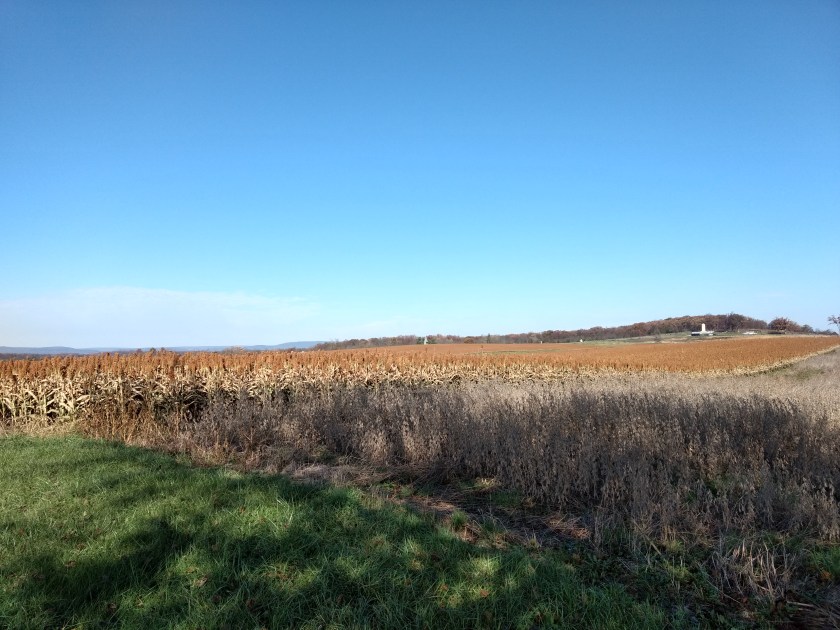
This granite monument, dedicated by the State of New York on July 1, 1888, stands near the intersection of Reynolds Ave and Buford Ave. This monument marks the first line of battle where the 76th NY lost over half the regiment as killed, wounded or missing in only twenty minutes.
His story is one that cannot be understood without contextualizing it by discussing his family. In 1861, he was a 34-year-old married painter with several children. His wife, Charlotte, was pregnant with their fifth child, though he likely did not know that yet. He does not exactly fit the stereotypical image of the 18-year-old unmarried soldier, so why did he enlist? The answer probably lies within the fact that his two younger brothers Byron and Tappan joined up. All three enlisted together on September 16, 1861, serving in the same company. Byron was made a Corporal, which certainly must have elicited some teasing and jokes between the brothers. Byron did not last long in the army; he was discharged for an unknown disability in April 1862. He likely had no choice in the matter, but potentially would have felt guilty for leaving his brothers, neighbors and new friends behind. Soon after, the other two brothers first saw combat. Tappan would be mortally wounded at the Battle of South Mountain a year after enlisting, and Hannibal was now alone. Hannibal was killed on July 1st, 1863, when his regiment took over 50% casualties in a mere twenty minutes. Only days before. he had passed within a mile and a half of South Mountain.
Of course, the story does not suddenly end when he was killed at Gettysburg. Almost all the personal information I could gather about Hannibal was found in his pension record which was over thirty pages long. Charlotte was caught in a bureaucratic nightmare in order to receive a pension she so badly needed to raise five children, most of whom were under the age of ten. She had even been forced to move closer to Hannibal’s parents after he had enlisted so that she could have a support network. The town in which they had been married in changed counties, and the Reverend who performed the ceremony was missing, so Charlotte could find no written record of their original marriage, despite the marriage lasting fourteen years. This is where Byron re-entered the picture. Trying to help his sister-in-law, he traveled across New York trying to find records. Though he was unsuccessful, Charlotte did receive the pension in 1864. After the war, when the government instituted increased pensions based off the number of children, Charlotte applied for the increase with Byron acting as her attorney for free. Byron also appears as the attorney for numerous other pension records for Union soldiers, especially for others who served in the 76th NY. Perhaps this was his way of redeeming himself for leaving the army, his friends, and his brothers so soon.
After pulling back to reorganize, the regiment formed a second line of battle. From here, they could see their dead and wounded. Perhaps Hannibal had already been killed, or perhaps he was forced to watch comrades that he couldn’t help suffer while he was still fighting for his own life.
The story of Hannibal Howell can only be understood through the lens of family, and that makes his story still relevant over 154 years later. It is timeless. The story of brothers enlisting together, the story of a wife left alone to raise children, and the story of one brother working tirelessly to help his sister-in-law can all connect with someone in a different way. The story continues from there. Hannibal is listed only as having been buried on the field, with no records beyond that. It is unclear if he remains somewhere on McPherson’s Ridge, or in an unknown plot in the National Cemetery. His name is also on a stone he shares with Charlotte at the Hector Presbyterian Church Cemetery in New York near many other family members. He may have been brought home, or maybe that stone is simply a way to remember a man who left home and never returned. This is a story that people can relate to, and this is a story that lay mostly buried for countless years. Hannibal, Charlotte, Tappan, and Byron all had their own struggles during the Civil War, and it deserves to be remembered. To quote Lincoln’s famous Bixby letter, the Howell’s surely had solemn pride “to have laid so costly a sacrifice upon the altar of Freedom.”
We may never know what compelled the Howell brothers to enlist. They might have believed in an in-dissolvable Union of states, they may have had abolitionist beliefs, or maybe they just saw it as their generation’s chance for adventure. Nonetheless, whatever expectations they had upon signing up were far from what they saw. Their experiences with disability, death, and disease shattered the Victorian ideal of “the Good Death,” and Byron and Charlotte were left behind after to pick up the pieces of a shattered family after the war. Their experience are important, as they remind us that behind every regimental marker, every unknown plot in the Gettysburg National Cemetery, every stone in the Antietam National Cemetery, and every family plot in a local cemetery is a story. The stones are not stones; they are people. They are people with real lives, real stories, and real pain.
When I was in high school, I read The Things They Carried for my English class. It is a fiction book about the Vietnam War written by a Vietnam veteran. The author, Tim O’Brien, had the life experiences to write an autobiography based on true events, but he chose fiction as his vehicle. He explains this choice in one of the chapters in his book. O’Brien stated that, in an ironic way, fiction allowed him to share more truth than reality. His made-up stories allowed him to create the feelings and meanings of the war that his real experiences couldn’t get across for people who had not lived them. This is an idea that has stuck with me ever since, and it has been on my mind a lot lately.
This year, I was asked to work on a special project for the Civil War Institute that involves creating a new wayside for the Gettysburg battlefield. Another student and I have partnered with Gettysburg NPS to write a wayside for the Virginia Memorial. This is a very daunting task, especially in today’s political climate, which has made me all the more determined to do history and the monument justice. A lot of what I have been sifting through for the monument deals with Civil War memory, especially Gettysburg and Confederate memory. This is why I have kept going back to The Things They Carried. Like O’Brien’s book, the Virginia Monument is a fictitious image of a war scene. It was not meant to depict an actual scene of war but to share important feelings. The big questions for me have been what those intended feelings were and how they have shaped our memory of Confederate involvement at Gettysburg.
Virginia Memorial. Photo via Wikimedia Commons.
The speeches from the monument’s dedication answered many of my contextual questions. The memorial was revealed in June of 1917, two months after the United States entered World War I. The dedication speakers were quick to connect the monument’s significance to war efforts. The country needed men to enlist and families to support the war effort from home. The Virginia Memorial became a tool for inspiring those sacrifices. Each speaker explained that by remembering the martial valor of Virginians and their dedication to the Confederacy, Americans would find an example of what would be required of them in World War I. “We treasure the heroic deeds and inspiring example of all the brave soldiers living and dead who gave to us and to the world a new standard of American manhood,” proclaimed Henry Carter Stuart, Governor of Virginia.
This new standard of manhood was also used to reunite the country. Dedication speakers repeatedly stressed the greatness of American unity after such great sectional strife. Standing in the crowd on June 8, 1917 were Union and Confederate veterans. 54 years earlier, those same veterans had faced each other on opposite sides of the field for Pickett’s Charge with the intention to kill. Something like that doesn’t go away overnight. The design of the Virginia Memorial was an attempt to smooth over the still-lingering scars of war through a celebration of martial manhood. The Virginians at the base of the memorial represent the ideal soldiers. Although each man is from a different military branch, they are all strong and manly. Their faces and stances show a mixture of anxiety and determination. They are facing great odds, but they will go forward. Lee towers above the group, the picture of stoicism. He is calm and collected, even in the face of battle. At the time, he was also a reminder of Christian ideals. This was a man who believed God had a plan for him and allowed that faith to keep him steadfast. These were values that could be appreciated by men everywhere, regardless of their war loyalties. Those Union and Confederate veterans could stand beside each other in the crowd that June day and find common ground.
How these messages affect our memory of Gettysburg and the Confederacy is interesting. On the one hand, the romantic aspect of the Virginia Memorial obscures many realities. For example, the focus on the military side of war often excludes the Confederate cause. Like the Virginia Memorial, our conversations often jump right into the fight and skip past why the men were there fighting. The Confederacy was formed to protect the right to own slaves as property. The soldiers themselves had different reasons for fighting, but the ultimate Confederate goal was to successfully secede and protect slavery. We don’t see that in the monument, and subsequently, most of us aren’t having that conversation when we visit the battlefield. The Virginia Memorial also adds to the misconception that Gettysburg was the end of the Confederacy. When I talk to many of my non-history friends, they think that Gettysburg spelled the end for the Confederacy and that Appomattox was right around the corner. They are shocked when I tell them that the war continued for two more years after Gettysburg. Clearly, Gettysburg didn’t end the Confederacy if they could keep going for two years; it was just one of their defeats. However, the Virginia Memorial’s depiction of the soldiers as grimly determined to do their duty even though they knew they would lose makes Pickett’s Charge the last stand of the Confederacy in popular memory.
On the other hand, the Virginia Memorial also reveals a lot about Americans at the time. Seeing the celebration of martial manhood reminds us of the importance of rigid gender roles at the time. We can see that men were expected to defend their cause and prove their worth on the battlefield. The absence of slavery representation tells us that Americans have always been uncomfortable with our past connection to the institution. It also shows us that unification was important above all else. Even though the Union won, Northerners allowed Southerners to place this shrine of Confederate ideals on the Gettysburg battlefield. Northerners allowed Lee to top this monument in a somewhat defiant location that allows him to stare down Union General Meade. Northerners even accepted speeches which hailed Virginians of the Confederacy as the ultimate examples of ideal soldiers and men. Virginians compromised by displaying their state flag on the monument instead of the Confederate flag. They also made several revisions to the inscription at the base in an attempt to find a less inflammatory message. Both sides were willing to make concessions for the goal of unity. That’s the legacy that the Virginia Memorial gives us. We still have a lot of work to do as a nation, and we always will, but we treasure our unity and will always fight for that.
Sources
Dugan, David. 15-23-0327: Virginia Memorial. August 17, 2015. In Wikimedia Commons. Accessed November 13, 2017.
Foster, Gaines M. Ghosts of the Confederacy : Defeat, the Lost Cause, and the Emergence of the New South, 1865-1913. Cary: Oxford University Press, 2014. Accessed November 15, 2017. ProQuest Ebook Central.
Gallagher, Gary W., and Nolan, Alan T. The Myth of the Lost Cause and Civil War History. Bloomington, IN: Indiana University Press, 2000. Accessed November 15, 2017. ProQuest Ebook Central.
Ingraham, William M. “Address at the Dedication of the Virginia Memorial at Gettysburg, Friday, June 8, 1917 By Hon. William M. Ingraham, Assistant Secretary of War.” Address, Dedication of Virginia Memorial, Virginia Memorial, Gettysburg, PA, June 8, 1917.
O’Brien, Tim. The Things They Carried. Mariner Books, 2009.
Przyblek, Leslie A. Soldiers to Science: Changing Confederate Ideals in the Public Sculpture of Frederick William Sievers.
Stuart, Henry Carter. “Address at the Dedication of the Virginia Memorial at Gettysburg, Friday, June 8, 1917 By His Excellency Henry Carter Stuart, Governor of Virginia.” Address, Dedication of Virginia Memorial, Virginia Memorial, Gettysburg, PA, June 8, 1917.
Memory is a peculiar thing. To recall it is to remember, and there are two days dedicated to this activity in mid-November in Gettysburg. On November 18 and 19, reenactors and keynote speakers gather here to honor the sacrifices of millions of soldiers and sailors during the American Civil War. November 19 rings throughout the history of oration as the date of Lincoln’s famous Gettysburg Address, itself an exercise in remembrance. The recent Remembrance and Dedication Days have encouraged me to think of my work on the Virginia Monument Wayside Project in light of the celebrations. Just as much as the parades and memorial wreaths, the monument speaks to a complex, ever-evolving memory of one of the defining moments in American history.
On June 8, 1917, a crowd gathered in front of the veiled Virginia Monument. Politicians and ministers gave stirring speeches that celebrated the valor of Virginia’s soldiers, especially Robert E. Lee. The date was a crucial moment in reconciliationist memory of the war. For the majority of the previous fifty years, Union veterans and Northern politicians vehemently opposed nearly every attempt to commemorate the Confederacy at Gettysburg. As the ranks of veterans’ organizations thinned and new generations of Americans prepared to embark on ships bound for France, attitudes began to shift. The monument’s design followed a rocky road as well.
The Battle Flag of the Army of Northern Virginia, perhaps the most recognizable symbol of the Confederacy, is notably absent from the monument. Instead, the gallant Virginia trooper along the monument’s base carries the Virginia State Flag. This feature is no accident. The War Department and the Battlefield Commissioners strongly encouraged the use of the State Flag and the committee formed by Virginia’s General Assembly complied. One suggested inscription containing the phrase,“They Fought for the Faith of Their Fathers” was rejected outright by the Commissioners. They wanted a politically neutral message in the monuments on the landscape. Regardless, the monument possessed, and continues to possess, a powerful message of the Southern – specifically Virginian – memory of the war.
This photograph shows one of Frederick William Siever’s plaster studies of an early design for the Virginia Monument. The soldiers are replaced by women, children, and a grave. The image of Lee as the protector of the South’s most vulnerable inhabitants presents a protector of virtue and innocence rather than a master of strategy. It is curious to think what message the Virginia Monument might show if this design were what we see today. Photo courtesy of Gettysburg National Military Park.
The romantic heroism of the soldiers on the Virginia Monument is evident, yet so too is a hint of anxious preparedness for an assault on the Union positions along Cemetery Ridge. Even before the monument’s creation, many individuals in both the North and South embraced the attitude that Pickett’s Division was a force comparable to Napoleon’s Old Guard. Robert E. Lee epitomized the Christian, agrarian values of the Old South. Absent, however, was the specter of slavery. Lee became the silent spokesperson for a lost way of life. This message is not explicitly written on the monument, though the speakers at the unveiling understood this point well. Governor Henry Carter Stuart of Virginia stated that Lee “represents and embodies all that Virginia and her sister Southern States can or need vouchsafe to the country and to the world as the supreme example of their convictions and principles.”
No doubt few visitors take the time to consider seriously the history of the layered memories associated with the Virginia Monument. The same, perhaps, can be said of the activities of Dedication and Remembrance Days. The November 19 festivities date only to 1938: the seventy-fifth anniversary of the National Cemetery’s dedication. Congress formalized the day eight years later. At a time when only a handful of Civil War veterans remained, the occasion presented an opportunity for Lincoln’s words to live on as those who carried their echoes passed away.
The messages of Union and liberty are still as apparent to modern audiences as they were to the crowds of 1863 and 1938, though the context has changed considerably. Initially a holiday that honored only Union veterans, Confederate sacrifices, too, are now part of the festivities. As debates about the display of Confederate imagery continue to swirl, the meaning of both Dedication and Remembrance Day and the Virginia Monument will continue to change, as well. Memory is shaped by these same currents, evolving with each subsequent generation until the amnesia of time obscures fact into fantasy. Memory is complex. For instance, memory makes some of the most gruesome events of history – the Civil War, for example – appear rosy and grand. The grim realities of slavery, and its role in the countless political debates before and during the Civil War, was one of the first casualties of this amnesia, as were the horrors of the battlefield. How else were the worlds of Gone with the Wind or The Blue and the Gray born? On other occasions, however, memory may summon the pains of the past, and encourage us to think critically about wounds that continue to plague us. Indeed, memory is a peculiar thing.
Nicholson, John P. John P. Nicholson to L.L. Lomax, February 7, 1912. Gettysburg National Military Park Archives.
Reardon, Carol. Pickett’s Charge in History and Memory. Chapel Hill, NC: The University of North Carolina Press, 1997.
Stuart, Henry Carter. “Address at the Dedication of the Virginia Memorial at Gettysburg, Friday, June 8, 1917, By His Excellency Henry Carter Stuart, Governor of Virginia.” Speech Given at the Dedication of the Virginia Monument, Gettysburg, PA, June 8, 1917.
In Gettysburg, we celebrate the anniversary of the Gettysburg Address in two ways: the Dedication Day ceremony and the Fortenbaugh Lecture. Every year on November 19, Gettysburg College and the Robert Fortenbaugh family invite a scholar to present their new Civil War research. This year, that scholar was Dr. Thavolia Glymph who presented her lecture titled “I’m a Radical Girl”: Enslaved and Free Black Women Unionists and the Politics of Civil War History. As the title reveals, her lecture revolved around black women unionists and their place in war efforts—a role which has often been overlooked.
Duke University history professor and 2017 Fortenbaugh Lecture speaker Dr. Thavolia Glymph.
During the Civil War, the title “unionist” was given to Southern women helping the Union cause. These women were accorded favors and gifts from Union soldiers and the government, often being given any aid they required with no expectation of repayment. When the Union soldiers came into town, there were many benefits in being a unionist woman. Unfortunately, black women were excluded from those ranks. Even though black Southern women were contributing to the Union cause, they were not honored with the title of unionist or with the benefits that went along with it. That didn’t stop these women from sacrificing, though, or from forcing their way into American politics.
Towards the beginning of the lecture, Glymph showed a picture of a young African American woman with a small American flag tucked into the waistline of her dress. When the picture first popped up on the screen, it meant very little to me. It was just the picture she had chosen for the cover of her book, probably a photo of one of the women she had talked about as an example of black unionists. I would have completely forgotten this image if it weren’t for the pointed question Glymph posed. Why would a woman who has been dismissed by Northerners, a woman who would have to work extra hours to pay for rations from Union soldiers whom she helps, why would that woman wear the Union flag? Blacks were treated poorly by Union soldiers. Runaway slaves who went to Union troops were often given deserted tents and forced to sleep on the ground, made to pay for food rations and supplies, and in one extreme case, a group of runaway slaves were put on a train and sent to Chattanooga where they were left at the side of the tracks. The American flag was not necessarily a symbol of sympathy for blacks.
Yet, in spite of all those dismissals of blacks by Union supporters, or because of those dismissals, that black woman has stuck an American flag in her dress. By doing this, she asserts her ability to change what that flag stands for. She claims the freedoms that flag promises for herself and forces the Union to reevaluate their ideas of what they should do for blacks. All that black women unionists sacrificed in support of the Union war efforts made it clear that they had as much a right to be a part of the Union as any white person. They refused to be forgotten or pushed aside.
Talking to Dr. Glymph at breakfast the next morning, she explained that she always took her time with her writing because lives were at stake. She was referring to the people she writes about. Their lives and how we remember them are influenced by how she portrays them in her books. Decades after their deaths, she still has the power to guard or take their agency. I cannot speak for those black women unionists, but I think she gave them a platform for their voices to be heard. She brought those women back into our historical consciousness and finally gave them the title they deserved 150 years ago: unionist.
This semester, I have had the honor of working on the Civil War Institute’s Killed at Gettysburg project, hosted at killedatgettysburg.org. The project seeks to document the lives and legacies of soldiers who died during the three days of fighting in July 1863. I am happy to be contributing to Killed at Gettysburg again, as I strongly connected with the project when I worked on it for Dr. Carmichael’s Gettysburg class last semester.
In the course of my research and writing, I have dealt specifically with two men who gave their lives at Gettysburg. One, Colonel Patrick O’Rorke of the 140th New York Volunteer Infantry, is quite possibly one of the most well-known soldiers among the battle’s dead. The other, Fourth Sergeant Charles Phelps of the 5th New Hampshire Volunteer Infantry, may not be quite as famous but still has a great story of his own. Over the last couple of months, I have researched the lives and deaths of these two gallant soldiers and constructed narratives to inform readers about their experiences before Gettysburg; what happened to them on July 2, 1863; and how their deaths affected other people, both at home and beyond. Supplementary interactive maps will join these narrative texts in the final product, enabling viewers to explore the ground over which Patrick O’Rorke and Charles Phelps took their final steps and creating a more holistic reader experience.
Colonel Patrick O’Rorke, 140th New York. Photo via Wikimedia Commons.
My primary goal throughout my work on Killed at Gettysburg has always centered around putting flesh and blood behind these stories of the past. Rather than presenting O’Rorke and Phelps as ephemeral legends of a bygone era, I want to humanize them to the reader. These men who gave their lives so long ago had personalities that made them unique. In addition to remarkable heroism and bravery, they had hopes, dreams, worries, and fears, just as we do today. I hope that the Killed at Gettysburg project can help close the gap between the past and the present by making readers feel like they are truly getting to know the soldiers we are profiling on a level beyond their basic achievements in life.
In many ways, it is hard to believe that it has been 154 years since the Battle of Gettysburg and Abraham Lincoln’s famed address. Living and learning in Gettysburg can sometimes make it feel as though these events took place not so long ago. This observation, and the commemorations that take place each year, beg a larger question: why bother remembering what happened at Gettysburg? What makes men like Patrick O’Rorke and Charles Phelps worthy of attention in a modern that is world far different from that which they inhabited?
To me, we should–and do still–care about the past because of how it can help us improve in our present and our future. O’Rorke and Phelps both demonstrated highly admirable qualities in their daily lives and on the battlefield at Gettysburg that we can learn from today, even across such a wide expanse of time. Patrick O’Rorke grew up as an Irish immigrant during a time when anti-Irish sentiment was at its absolute highest in the United States. Yet, he did not allow himself to be put in a box based on his background; he excelled as a student, graduated first in his class at West Point, and appeared poised for a sterling military career before a Confederate bullet tore through his neck on Little Round Top. Charles Phelps demonstrated great loyalty and tenacity by striking down the enemy soldier who had mortally wounded his brigade commander before being killed near the Wheatfield. Only nineteen years old at the time of his enlistment, Phelps displayed strength beyond his years in his final hours. Both men ultimately put their lives on the line for the cause of the Union in which they so dearly believed. When the time came, as Lincoln said, they gave their last full measure of devotion, and that ultimate sacrifice cannot be forgotten. Patrick O’Rorke and Charles Phelps stand as prime examples of courage and devotion that we can still learn from, and to me, that makes their stories matter even today.
Each year, Remembrance Day provides us with a perfect opportunity to consider these lessons and sacrifices from so long ago. The luminaria candles that adorn the gravestones in the Soldiers National Cemetery represent the everlasting public memory of those who gave their lives so that the nation might live. Though Patrick O’Rorke and Charles Phelps are both buried in their home states rather than the national cemetery, I believe that those candles burn for them as well. Beyond the immediate stimulus of Remembrance Day, I hope that the Killed at Gettysburg project will also keep these flames of memory alive. O’Rorke and Phelps deserve secure places in the public mind so that we in the present can continue to learn from their exemplary lives and legacies. Remembrance Day and Killed at Gettysburg both serve as important reminders of these lessons from the past, and this year we should take the opportunity to remind ourselves once again.
At Dedication Day, we remember Lincoln’s dedication of the Soldier’s National Cemetery. At the dedication ceremony, Lincoln delivered the Gettysburg Address, a speech that has become enshrined in the American consciousness. In just a few short minutes, Lincoln delivered a speech that evoked the spirit of the Founding Fathers, honored the sacrifice of the dead, and challenged the living to commit themselves to the young nation and the principles upon which it was founded. Through the Gettysburg Address, Lincoln shaped the collective memory of the Civil War and of American ideals.
Monuments and wayside markers also shape public memory. When asked to develop a wayside marker for Little Round Top, my colleague, Savannah, and I hoped to fully honor the sacrifice of the 20th Maine men by avoiding a purely romantic interpretation of their heroism and instead acknowledging their humanness. Like the rest of us, the Maine men were imperfect. Though many fought for high ideals like patriotism and duty, others fought for less noble reasons. They fought because desertion was a crime, because everyone else did, or because they craved adventure. We wanted our wayside to show that the men who fought on Little Round Top were individuals with their own lives and motivations.
Photo courtesy of the author.
Whatever their reasons for fighting, the Maine men experienced the brutal reality of war on Little Round Top. We felt that it would do these men a disservice if we used our wayside to tell a comfortable tale about heroic action or tactical maneuvers. Instead, we hoped to develop a wayside that illustrated the savagery of war. Men were killed indiscriminately, their bodies strewn across the rocks. Colonel Joshua Lawrence Chamberlain described the men, “torn and broken, staggering, creeping, quivering on the earth, and dead faces with strangely fixed eyes staring stark into the sky.”
The battle at Little Round Top was incredibly brutal, but in no way did we want to suggest that the casualties were senseless. The 20th Maine men died for a purpose much higher than themselves. They were sacrificed for the freedom of millions of enslaved people and for the preservation of a country that was “conceived in Liberty, and dedicated to the proposition that all men are created equal.”
Photo courtesy of the author.
The Gettysburg Address is surrounded by myths. It is a widely-held belief that Lincoln wrote the Address on the back of an envelope on the train to Gettysburg. This story remains popular in the public imagination because people want to remember Lincoln as a common man with a great gift that allowed him to assume the highest office in the United States. The ways in which people alter memory are often reflective of how they want to remember historic moments.
Many want to remember Little Round Top as the place where Colonel Chamberlain led the 20th Maine to a victory that saved the Union. Popular culture, specifically the movie Gettysburg, has reinforced this version of events in the nation’s collective memory. When designing our wayside, Savannah and I had to contend with the preconceptions that tourists bring to Little Round Top.There is no doubt that Joshua Chamberlain was an able leader, but he was nothing without the dedication of his men. The 20th Maine did not save the Union, but it was one of many vital parts that contributed to the Union victory. We hope to use our wayside to complicate the traditional story of the 20th Maine.
Making our vision for the wayside text a reality proved to be a challenge. Savannah and I were given 250 words to tell a nuanced version of the events at Little Round Top, and it seemed an impossible task. But then we remembered the Gettysburg Address. In 272 words, Abraham Lincoln both inspired and redefined the nation. Surely, we could give park visitors a better understanding of the 20th Maine men and their fight for a hilltop.
Every November, on the Saturday closest to the 19th, the town of Gettysburg celebrates Remembrance Day. This day is held in memory of those who fought and died at the Battle of Gettysburg and during the Civil War as a whole. On November 19th, crowds gather to celebrate Lincoln’s Gettysburg Address and his dedication of the Gettysburg National Cemetery. These events pose a few very important questions: why do we still remember the Civil War in this manner? Why do we find it so important to have an entire day dedicated just to Civil War soldiers? Why does Civil War memory matter?
Over the semester, I have been working on a project in which similar questions have arisen. I am working to create a new wayside for the 20th Maine on the Gettysburg Battlefield. The one that currently sits there is more a wayside to Colonel Joshua Chamberlain than it is to the men of the regiment. Why do officers seem to loom so far above regular soldiers? During Remembrance Day, the ordinary soldiers who sacrificed their lives are remembered, which is very important because without them, the generals who are usually highlighted would not have been able to accomplish the feats they are best remembered for. Something I have been attempting to do in developing the text for the wayside is remember the ordinary soldier and shift the 20th Maine’s story away from only being about Joshua Chamberlain. This has proved a challenging task, as the ghosts of the movie Gettysburg that propelled Chamberlain to fame do not seem to want to leave.
20th Maine memorial on Little Round Top. Photo via Wikimedia Commons.
As I am from Maine, this project has been a special one for me. I am helping shape the legacy of fellow Mainers. I am also working to write a text that will influence visitor’s perceptions of the battle and Maine’s role in it. While Maine did have many other regiments at Gettysburg, the 20th is the one that is best remembered and most likely offers battlefield visitors’ only glimpse of the state. I want to do my fellow Mainers and their sacrifice at Little Round Top justice while at the same time making sure I am not being plagued by Chamberlain’s ghost and the idea that the 20th Maine saved the Union. In addition to all of this, I am left with the question of why this matters. Why is the 20th Maine so important, and how will the words I write shape their memory? This is not an easy question to grapple with, but as a history major, I believe that history matters and the way we remember it is important.
History helps us learn from our past and gives us context for the problems in the present, and thus, how we tell this history and how we shape the past has important contemporary implications. Do we present a past that paints the Maine men as noble and dedicated heroes, or do we portray them as men who had flaws and may not even have wanted to fight? I believe the solution is a combination of both. The 20th Maine was made up of regular men, but they did do something heroic and important. Theirs was a critical position in the Union line but, at the same time, the battle raged on for another day and the war for another two years, so by no means did the 20th Maine save the Union. This question of how to best remember is an important one, and I believe it is raised in both my wayside project and on Remembrance Day. Is it right to remember the men who died through reenactments and parades? How do we shape memory in a way that is true to history, and how do we do justice to the men that died at Gettysburg while at the same time being careful not to make them akin to gods?






 Dugan, David. 15-23-0327:


