“This Is War”: The Construction of the Laird Rams

By Hannah Christensen ‘17

By the spring of 1863, American ambassador to England Charles Francis Adams had a much bigger problem than the activities of British-built Confederate raiders on his hands: the construction of two 230-foot long ironclad rams in the Laird shipyard at Birkenhead that evidence suggested were destined for the Confederacy. At 230 feet long and 40 feet wide, with 6-7 foot iron spears at the front, rotating turret batteries, full iron plating, and a top speed of 10 knots, these ships were the Americans’ worst nightmare. Lincoln’s cabinet even considered blatantly ignoring Britain’s “neutrality” and sending a U.S. Navy squadron to destroy the rams, which had been under construction since the previous summer.

In the summer of 1862, Confederate Navy Secretary Stephen Russell Mallory sent orders to one of the Confederacy’s agents in England, James Bulloch, to go ahead with plans to have two large ironclads built for the Confederate Navy. Identified as Nos. 294 and 295, the ships were supposed to be completed by the Laird firm by March and April of 1863, respectively, and delivered to Liverpool for pickup. Bulloch had originally decided that both ships should be built in the same yard to cut cost, decrease potential Union interest in their construction, and hopefully speed up production. However, any hope of reduced Union interest disappeared quickly. Union spies, informants, and agents were everywhere, and their activities only increased, particularly in spring 1863, as the ships were nearing completion.
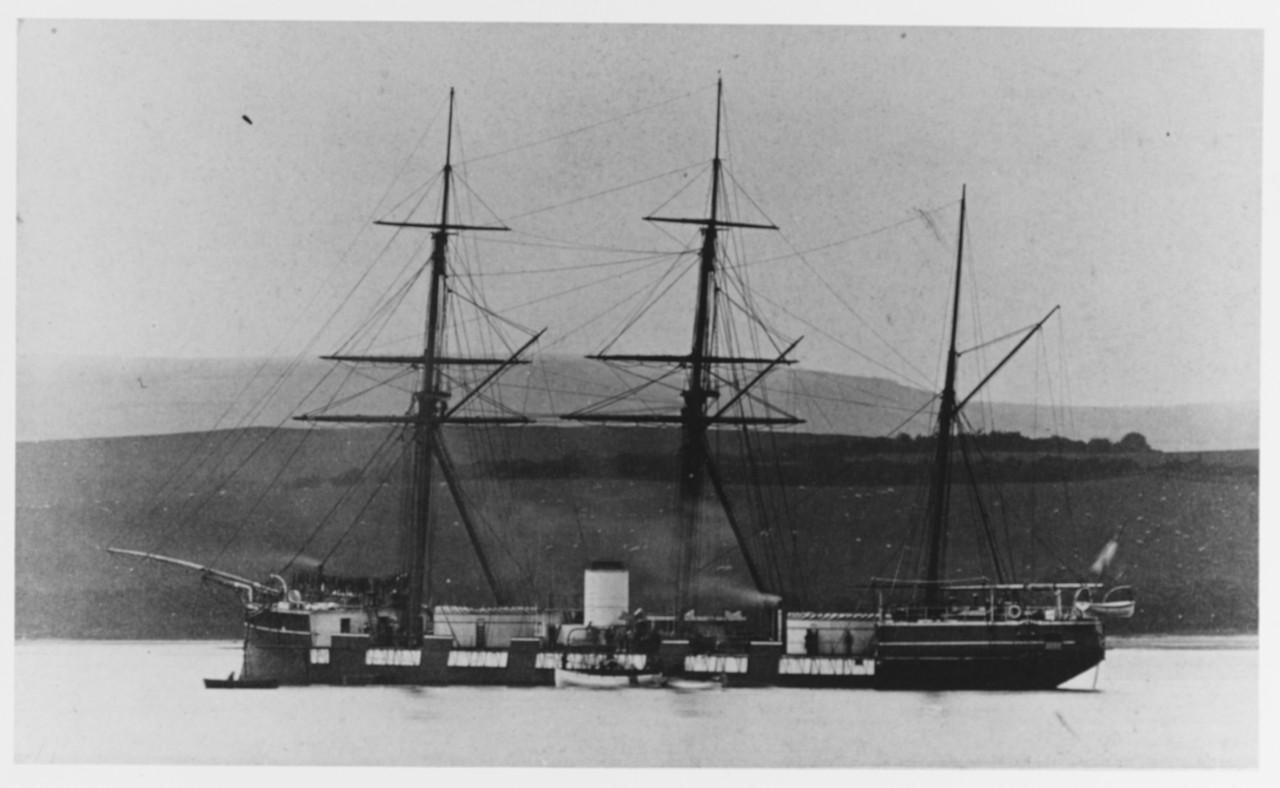
The HMS Wivern, originally built for the Confederate Navy. Courtesy of U.S. Naval History and Heritage Command.

Continue reading ““This Is War”: The Construction of the Laird Rams”

Marching in Step:  USCT Veterans and the Grand Army of the Republic

By Ryan Bilger ‘19

This post comes from the exhibit catalog for “Right to Serve, Right to Lead:  Lives and Legacies of the USCT,” an exhibition in Special Collections and College Archives at Musselman Library, Gettysburg College. During the spring of 2017, we asked the CWI Fellows to select a item on exhibit and discuss its history and context. The resulting exhibit catalog is available at Special Collections, where the exhibit will run through December 18, 2017.

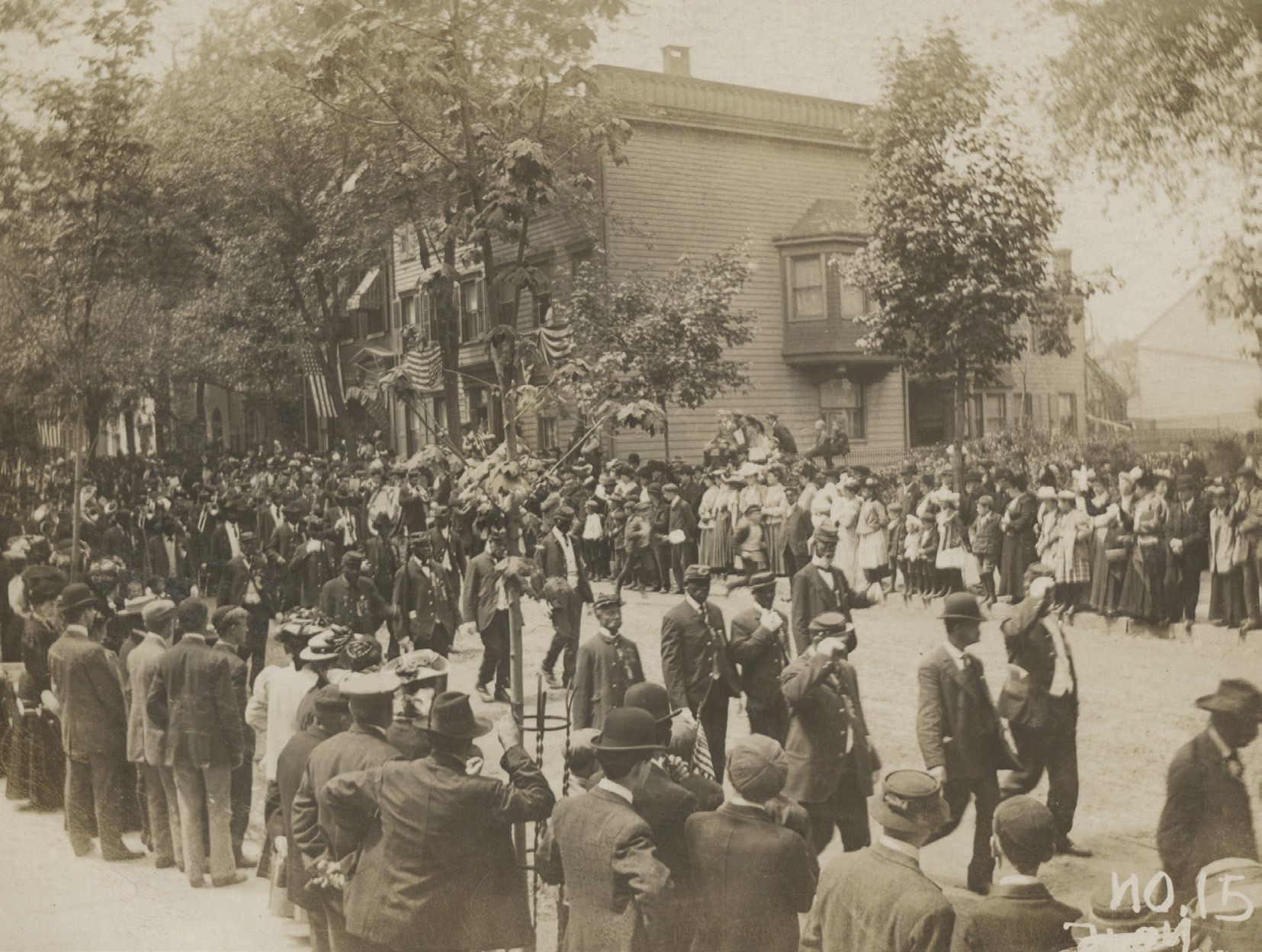
USCT Veterans on Parade, Easton, PA. Postcard. Black veterans of the Grand Army of the Republic were, like their white counterparts, very active in the realms of commemoration and politics. “Decoration Day,” the precursor to our modern Memorial Day, officially started with the GAR in 1868, and served both purposes. Courtesy of Special Collections and College Archives, Gettysburg College.

For many United States Colored Troops, remembering the Civil War and their comrades who fell in it became an important part of their post-war life. One of the primary opportunities for public expression of remembrance was Decoration Day, now known as Memorial Day. African Americans played a critical part in the creation of this holiday. On May 1, 1865, the newly-freed black residents of Charleston asserted their place in Civil War memory by leading a parade to a recently constructed cemetery for Union prisoners at the city’s horseracing course. The procession heaped flowers upon the graves of the honored dead, after which ministers from the town’s black congregations gave dedicatory speeches. This event, known among some in the North as the “First Decoration Day,” exemplified African American interest in perpetuating the memory of the Civil War. However, the resentment of white Southerners at the time towards this instance of black agency led to the marginalization and eventual forgetting of the event in the mind of the public at large.

Continue reading “Marching in Step:  USCT Veterans and the Grand Army of the Republic”

A Home for Volunteers: Togus and the National Soldiers’ Homes

By Savannah Labbe ’19

The current U.S. Department of Veterans Affairs traces its origins to the Civil War. Before the Civil War, there had been some attempts to provide services for veterans but these benefits were solely for career military veterans and not volunteers. Since Civil War veterans were mostly volunteers, this became a problem. The services provided before this had been mostly in the form of homes like the U.S. Naval Asylum in Philadelphia where veterans could receive long-term care. Many felt that homes were the best way to care for soldiers and so, in March of 1865, legislation passed to create a national asylum for disabled volunteers. On November 10, 1866, the first branch of three national homes was established. At first, the branches were open to all Union soldiers who could prove a connection between their service and their injury. They then later welcomed veterans of the War of 1812 and the Mexican War as long as they didn’t fight against the Union in the Civil War. Confederate veterans were never allowed. Each home had a barracks, dining halls, hospital, cemetery, and recreational facilities.

togus
The eastern branch of the National Home for Disabled Volunteer Soldiers in Togus, ME. Via Wikimedia Commons.

Continue reading “A Home for Volunteers: Togus and the National Soldiers’ Homes”

Black Servicemen on the Seas: African Americans in the Union Navy

By Hannah Christensen ’17

This post comes from the exhibit catalog for “Right to Serve, Right to Lead:  Lives and Legacies of the USCT,” an exhibition in Special Collections and College Archives at Musselman Library, Gettysburg College. During the spring of 2017, we asked the CWI Fellows to select a item on exhibit and discuss its history and context. The resulting exhibit catalog is available at Special Collections, where the exhibit will run through December 18, 2017.

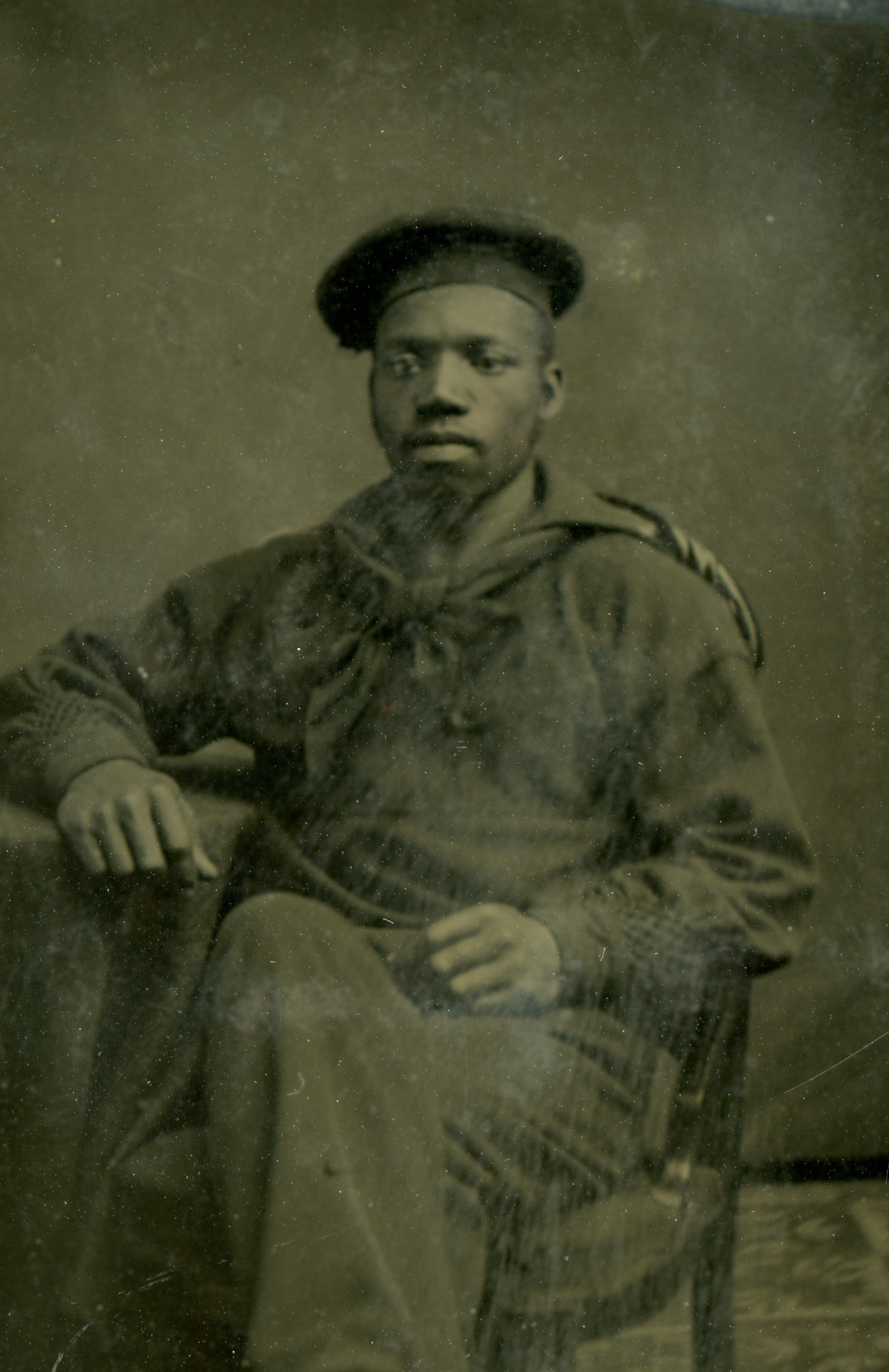
Unknown sailor. Tintype. Approximately 19,000 black men served in the Navy, a much smaller number than the 180,000 who served in on land. The entire Union military totaled 2,000,000; one in ten Union soldiers was a black man. Courtesy of Special Collections and College Archives, Gettysburg College.

When the Civil War began, the United States Navy’s Atlantic Squadron, commanded by Commodore Silas H. Stringham, sought to blockade the entire Eastern Seaboard of the Confederacy. It faced two major problems: a shortage of manpower and an abundance of fugitive slaves flocking to the Union fleet. The commander of one vessel, Commander O.S. Glisson, had fifteen refugees on his ship, none of whom he intended to return to their owners. Glisson wrote to Commodore Stringham asking for advice, and Stringham wrote to Secretary of the Navy Gideon Welles with an idea. Arguing that “if Negroes are to be used in this contest . . . they should be used to preserve the Government,” Stringham asked permission to recruit these fugitive slaves. Secretary Welles knew the Navy needed men, so he approved the request.

Continue reading “Black Servicemen on the Seas: African Americans in the Union Navy”

Bearing the Battle, Binding the Wounds

By Kaylyn Sawyer ’17

When I arrived at Appomattox Court House National Historical Park for my summer 2016 internship orientation, I introduced myself as being from Yorktown, VA.  The ranger quipped “you must have a thing for surrender towns.”  I hadn’t really thought about it, but I suppose I do.  I’ve lived in and around historic towns my entire life. I was born in Richmond, graduated high school in Yorktown, attended college in Gettysburg, and completed internships in New Market, Appomattox, and in the Hampton Roads area.  I never seem to be far from a battlefield or a battle town, physically or emotionally. I love these towns and the stories of the ordinary people who fought within them.  I have some relatives who fought for the Union and others who fought for the Confederacy, and although not a family relation, I feel a special connection to James Greenleaf of Pennsylvania.

McLean House
The Wilmer McLean House in 1865, where Robert E. Lee surrendered to Ulysses S. Grant. Photo via Wikimedia Commons.

Continue reading “Bearing the Battle, Binding the Wounds”

Fredericksburg’s Gray Angel: Truth or Utility?

By Jon Danchik ’17

As with other battles, the Battle of Fredericksburg in 1862 yielded shocking results. Homes were destroyed, thousands died, and military doctrine was challenged and changed. One particular story, however, has emerged from Fredericksburg to represent a different narrative, one of compassion. The actions of a 20-year-old Confederate sergeant named Richard Rowland Kirkland are enshrined in stone at the end of Fredericksburg’s infamous “Sunken Road.”

I wrote a post about this statue and its meaning last summer while I had the privilege of interning at Fredericksburg and Spotsylvania Military Park. I was asked to write about a monument and its historical connotations, and Kirkland immediately came to mind. After all, it is perhaps the most popular monument in the park. Kirkland’s story became very popular in the 1880s, and the statue was erected in the 1960s—both times during which Civil War commemoration followed a particular bias which I attempted to trace. If you want to read about historical context, check out my older article. Today, though, I wish to revisit the Kirkland story because there are some factual controversies that call into question its usefulness as an interpretive resource.

Danchik 1
The Kirkland Monument, visible just above the only surviving portion of the Sunken Road’s stone wall. Photo by the author.

Continue reading “Fredericksburg’s Gray Angel: Truth or Utility?”

Brother against Brother: John Wilkes and Edwin Booth

By Laurel Wilson ’19

When John Wilkes Booth assassinated President Lincoln, he became one of the most infamous figures in American history almost overnight. This rapid fall from grace took quite a toll on his family, especially his brother, Edwin. Edwin Booth was one of the most accomplished and successful actors of the Civil War era. He became famous for his portrayals of Shakespearian roles, especially Hamlet, which became his signature role. The Booths were an illustrious family of actors, though Edwin would become the most critically acclaimed and famous for his acting ability.

John, Edwin, and Junius Booth, Jr. 1864. Via Wikimedia Commons.

Continue reading “Brother against Brother: John Wilkes and Edwin Booth”

Science, Signals, and Service: The Smithsonian Institution’s Role During the Civil War

By Danielle Jones ’18

Today, the Smithsonian is known for its world-famous exhibits, massive collections of American and natural history artifacts, and its contributions to research around the world. But many people don’t know the role the Smithsonian played during the Civil War. The Smithsonian Castle was finished in 1855 and would become the first home of the research center, the library, and the US Museum. The government recognized the importance of the Institution and, after war was declared, the US Secretary of War ordered Joseph Henry, the Smithsonian Secretary, be issued twelve muskets and 240 rounds of ammunition “for the protection of the Institute against lawless attacks.” The building was in a vulnerable position because it was situated in between the Capitol Building and the White House, and cut off from the rest of the city by the Washington Canal . The Institution was witness to soldiers on parade, as well as to the thousands of wounded soldiers sent back to the city after the First Battle of Bull Run. It suffered no war damage, but suffered from financial woes because Congress was more focused on paying for the war than paying the interest on the Smithson bequest. The inflation and currency devaluation of the era also affected finances.

Smithsonian
Image of the Smithsonian Castle in Washington DC, with the unfinished Capital Building in the Background. The hand-written caption, “Washington, D.C. April 1865” is incorrect because the castle was terribly damaged in a fire in January of 1865. Image courtesy of Smithsonian Institution Archives.

Continue reading “Science, Signals, and Service: The Smithsonian Institution’s Role During the Civil War”

A Gun With a Story: Waller Patton’s Civil War Pistol

By Laurel Wilson ’19

Musselman Library Special Collections is home to a wide variety of artifacts, including a rather impressive number of Civil War era items. One Civil War artifact, the Patton Pistol, stands out from the rest by virtue of the story attached to it. The 1861 Navy Colt revolver originally belonged to Waller Tazewell Patton, who was the great uncle of General George S. Patton Jr. of WWII fame.

Patton Pistol
The 1861 Colt Navy Revolver owned by Confederate Colonel Waller T. Patton and donated to Gettysburg College Special Collections by James D. Patton ’13. Courtesy of Gettysburg College Special Collections.

Waller T. Patton was a Colonel in the 7th Virginia Regiment of the Army of Northern Virginia. He was mortally wounded during Pickett’s Charge on July 3rd, 1863, when a piece of artillery shrapnel removed much of his jaw. He was brought to the Pennsylvania College Hospital (now known as Pennsylvania Hall at Gettysburg College), where he eventually died on July 21, 1863. Continue reading “A Gun With a Story: Waller Patton’s Civil War Pistol”

Confederate Memory

By Olivia Ortman ’19

This year as a CWI Fellow, I’ve been doing a lot of research and thinking on Civil War memory, specifically that of Confederate memory. When doing this work, the question at the back of my mind is always: How should monuments, symbols, and other examples of Confederate memory be handled? This is a very difficult question, so up until now, I’ve left it alone, knowing that there would come a time in the future that I would sit down and wrestle with my conflicting opinions on the matter. A couple days ago, the Civil War Era Studies Department here at Gettysburg College sent out an email sharing the news that New Orleans had begun removing Confederate monuments and several other cities were thinking of doing the same. After reading this, I knew the time had come for me, and all of you, to join the discussion about Confederate Memory.

The first question that I ask myself when thinking about how to handle Confederate Memory is what the people want. Confederate monuments have a variety of owners. In some cases, the monuments are owned by a private organization or individual who put them up, in other cases, the city, state, or federal government may own them. The same goes for the land they are on. If owned by individuals or private groups, it’s their choice what happens. When the monument or land belongs to the local government, as is the case with the New Orleans monuments, it should be the people’s choice what happens. Although the city council of New Orleans voted 6 to 1 to remove several monuments, the residents didn’t get the chance to vote. For many issues, allowing the council to take care of matters on their own is fine; the people elected them because they trusted them to make the right decisions. In matters that generate a lot of public concern, though, residents are usually asked to vote. We vote on taxes, why not on monuments? If the majority of city residents agree with the removal of a Confederate symbol or monument, remove it and say no more. If the majority of residents are against the action, however, it doesn’t seem right to disrespect their wishes. The popular vote in New Orleans may have agreed with the removal of the monuments, but without that formal vote, we can’t know for sure.

Continue reading “Confederate Memory”

css.php