Ideology on Trial: A Common Cavalryman Goes to War

By Abigail Adam

This past Fall, the Special Collections & College Archives of Gettysburg College’s Musselman Library received, through the generous donation of Kerry Cotter of Easton, Maryland 21 letters penned by her ancestor, Private Eli S. Knowlton of the 3rd New York Cavalry. Over the course of the Fall semester, CWI Fellows Abigail Adam (’22) and Ziv Carmi (’23) transcribed these letters for future researchers and interpreted them through additional contextual information from census records, pension files, and secondary source reading.  The following is a post authored by Abby offering her reflections on some of the main interpretive themes and take-aways she gathered from her transcription work with Knowlton’s letters.

View the Knowlton letters through the GettDigital Database

Like many Civil War soldiers, throughout his nearly two-and-a-half years of service in the Union army, Private Eli S. Knowlton of the 3rd New York Cavalry penned numerous letters to his family. Some of the letters from January of 1863 through December of 1864 still survive. Eyeing the yellow pages and faded ink, modern readers can imagine the scent of campfire smoke while Knowlton sweated in the North Carolina and Virginia heat. Many times, Knowlton’s military obligations left him exhausted by the time he picked up his pen. Other times, he complained that sitting in the shade and writing was the only thing to do amidst the monotony of camp life. He talked about daily life as a soldier and his battle experiences, and reacted to the news his family shared with him. He openly relayed his opinions about army life, his comrades, the Confederacy, and the war as a whole, and was not afraid to let his emotions direct his writing. Anger, homesickness, happiness, and disgust pepper his accounts. Through such candid writing, modern readers can examine, among other interesting features of Knowlton’s life, the motivation behind his initial enlistment in the army, his sustaining motivations for remaining on the front lines, and his own evolving views of the continuously evolving Union war effort.

Eli S. Knowlton was born around 1843 to Seneca and Polly Knowlton. The Knowltons owned a family farm in Clarkson, New York. Though Eli attended school when he was young, he later admitted to being a poor student. His lack of attention to formal education is also evident through the spelling in his letters: ‘Any’ became “enny”, ‘month’ became “munth”, and ‘guerillas’ became “Garilleyes,” to name just a few examples. Modern readers can imagine him sounding out particularly difficult words, carefully penning them exactly as they sounded. On August 13, 1862, Knowlton enlisted in Company M of the 3rd New York Cavalry. He would serve for two years and nine months. But why did he enlist, and why did he wait until sixteen months into the war to do so?

In his letters, Knowlton appears unenthusiastic about serving, demonstrating that he did not enlist for glory or adventure. He also makes numerous racist and disparaging comments about African Americans, forcefully declaring that he did not enlist for the abolitionist cause, and lamenting being forced to fight for the freedom of the slaves. On January 28, 1863, shortly after the Emancipation Proclamation (which made it legal for black men to join the army) went into effect, he wrote that he would rather be captured by the Confederates than serve alongside African Americans.  Such a declaration is revealing, considering how dishonorable and shameful many soldiers regarded allowing oneself to be captured by the enemy! Knowlton’s stance on race was certainly common amongst numerous Union soldiers, most of whom enlisted to restore the Union, and not out of any affection for African Americans or any strong inclinations toward emancipation or abolition. However, Knowlton’s home community was notoriously in favor of emancipation. Many community members were even abolitionists. As such, Knowlton’s views may have caused some tension within the regiment. Or, perhaps Knowlton knew his opinions were unpopular and thus saved them for his letters.

Interestingly, while Knowlton may have fancifully wished, in early 1863, to be captured by the Confederates rather than serve alongside black soldiers, his notions of martial masculinity, duty, and honor appear to have ultimately helped to sustain his commitment to remaining in the Union army as the months wore on. Knowlton wrote strongly about his disgust for army deserters. In one instance, he called a deserting man a “Coward” and a “pisspot,” and regularly disparaged the manhood and courage of those who left the front lines. 

However, as was true for many other soldiers, Knowlton’s views on matters such as duty and desertion were not necessarily one-dimensional, and at times, came into direct conflict with each other. Throughout his army career, Knowlton was perpetually homesick. On January 28, 1863, he wrote of his wish to enjoy cider and donuts in his parents’ new house—one of the countless references to his longing for home, family, and familial traditions. He followed this statement with a rather dejected message: “the old Saying is I cant allways be with you”. Sometimes, Knowlton would address parts of his letter to his younger brother, Randolph “Ran” Knowlton. Eli clearly missed Ran. He asked him to relay how the neighborhood “Gals” looked that spring, emphasizing that he wished he could be there, too. He also asked Ran to relay local adventures with friends. As he wrote, “tell me what for a time you had and all about it for as I Cant take a peace of that fun I wood like to hear how the rest of you take it”.  Such longings for home at one point caused him to toy with the idea of deserting the army. At the very least, he wished he could do it. On January 28, 1863, Knowlton wrote that some of his friends had “dug out” of the army, reflecting that “all I have to regret is that I had not dug to”. Nevertheless, Knowlton’s desire to leave simmered down as time went on. He became increasingly interested in seeing Union military success, as well as connecting his honor and masculinity to the success of his regiment.” Knowlton himself directly addressed this change in his attitude. He admitted that, in the past, he would have considered desertion. However, by August 13, 1863, he would not even entertain the idea. In a spirited flourish, Knowlton ended that same letter in which he called a deserter a “Coward” and a “pisspot” with the following crass, yet honest statement: “thay can kiss my US ass all of them.”

Another theme that runs throughout Knowlton’s letters—and a thread that sheds considerable light on why he may have chosen to enlist in the first place—is his continuous, open discussion of his finances and the money he routinely sent home to his family.  This trend suggests that he may have seen military service as an opportunity for steady employment, and may have finally chosen to enlist in the late summer of 1862 out of financial necessity, or perhaps fear of the draft, combined with community pressures to join up. One aspect of Knowlton’s life suggests that his enlistment was economically motivated. The 1860 census listed that the Knowlton property was worth $1,960. This value is the equivalent of $61,451.67 in 2020. In comparison, only 7% of homes in modern-day Clarkson, New York, fall between $50,000 and $99,000. The average home value is $150,100. Thus, the Knowltons were certainly not a wealthy family.

Eli Knowlton’s letters also had a large financial emphasis. On January 10,1863, Knowlton wrote that he sent $15 to his family and planned to send an additional $20 upon his next paycheck. This was a considerable amount, considering that he had received a total of $54.80 thus far. A few months later, Knowlton defended his inability to send more money to his parents. They presumably caught wind that John, a fellow soldier, was sending more money home than Knowlton was. Modern readers can imagine Knowlton tensing up as he defended himself through his writing. He was quick to explain that he was ill over the winter and thus needed to buy nutritious food. He also iterated that John gained his money from sources outside the military. If anything, Eli and John were paid the exact same amount. Eli, perhaps feeling guilty or under pressure, finished his tangent by promising to send more money upon his next paycheck. Such continuous, and sometimes quite passionate, references both to his own finances as well as to the economic viability of his parents and the family farm seem to suggest that economic stability may have loomed large as a motivating—and sustaining—factor for Knowlton’s army service.  Again, such motivation was hardly unique among Union soldiers, and often times it was a blend of reasons—economic, political, social, cultural, and ideological—that shaped men’s decisions to enlist, and helped, alongside commitment to comrades, to sustain them through the dark days of the war.

            Eli S. Knowlton’s letters provide fascinating insights into the daily life of a Union cavalryman during the Civil War. But, his surviving letters also highlight his humanity as a loving son and brother who cared deeply about his family. He was a complex man of numerous opinions, many of which shifted and changed throughout the war. Those opinions were complicated, sometimes contradictory, and could even cause conflict among his fellow soldiers. Soldiers such as Knowlton used the war to bolster their notions of pride, honor, duty, and masculinity, which, in turn, gave meaning to soldiers’ wartime experiences. Those experiences also changed many men as they navigated the horrors of war, interacted with new people of diverse backgrounds, and underwent challenges that were completely new to them. Many travelled farther than ever before and witnessed events so incredible that paper accounts could only hint at their impact. In fascinating and sometimes unexpected ways, these experiences both transformed the emotional and ideological worlds of soldiers such as Knowlton, while also reinforcing their commitment to the fight ahead.

Sources:

Ancestry.com. 1850 United States Federal Census [database on-line]. Provo, UT, USA: Ancestry.com Operations, Inc., 2009. Images reproduced by FamilySearch.

Ancestry.com. New York, U.S., Grand Army of the Republic Records, 1866-1931 [database on-line]. Provo, UT, USA: Ancestry.com Operations, Inc., 2013.

https://civilwarintheeast.com/us-regiments-batteries/new-york-regiments-and-batteries/cavalry/3rd-new-york-cavalry/

http://dmna.ny.gov/historic/reghist/civil/cavalry/3rdCav/3rdCavMain.htm

https://www.niche.com/places-to-live/clarkson-monroe-ny/

https://www.officialdata.org/us/inflation/1860?amount=1960

The Eli S. Knowlton letters

“Keenly Alive” – Gates Fahnestock and the Children’s Experience of Gettysburg

By: Brandon Neely

“War on the Doorstep: Civilians of Gettysburg”

By late June of 1863, alarms warning of approaching Confederate forces were nothing new for the 2,400 residents of Gettysburg. Living just ten miles from the Mason-Dixon line, small-scale raids, kidnappings of freed-people, and rumors of an imminent clash between the two great armies had long plagued the borough and its surrounding community.  Nevertheless, none of these events could prepare Gettysburgians for the ferocious 3-day fight between 165,000 soldiers in early July of that year that would transform the lives and lands of Gettysburg’s civilians forever. However, these civilians’ experiences were not monolithic; while some were defined by tragedy and blight, others included remarkable episodes of perseverance, successful pragmatism, and creative profiteering.  This new blog series profiles the lives of diverse Gettysburgians who were forced to confront the war at their very doorsteps, each on their own terms, whose stories speak to the kaleidoscope of experiences of civilians struggling to survive, and thrive, along the Pennsylvania-Maryland border during the Civil War.

At the corner of Gettysburg’s Baltimore and West streets stands a beautiful red brick structure. Three stories tall, the Fahnestock Building sits across from the Gettysburg Courthouse, a part of Gettysburg’s town center. Today, it is used for senior living, but since its construction sometime around 1810, it has played countless other roles. For Gates Fahnestock, born in 1853, the Fahnestock building became more than just a family home – during the Battle of Gettysburg, its use by Union and Confederate troops, living and dead, proved fundamental in the shaping of the young boy’s notions of war, and of humanity.

            Gates Fahnestock was the grandchild of Samuel Fahnestock, a businessman who moved to Gettysburg sometime before 1833. After purchasing a local tavern and setting up his new store within it, Samuel had become one of the town’s “most active and successful merchants.” From 1833 to 1863, Samuel and his three sons worked to make the “Samuel Fahnestock & Sons Store” the largest store in Gettysburg, and a central figure in the town’s business scene. When he passed away in 1861, the store passed down to his three sons, becoming the “Fahnestock Brothers Store.” The oldest of the “Fahnestock Brothers,” James Fahnestock, lived across the street with his five children, including ten-year-old Gates Fahnestock.

             For young Gates, the busy-ness of the business provided plenty of excitement and activity. As he remembered later in life, “A boy of that age is an active creature – not thinking of hazard or danger as in later years.” From the second floor of his home, he and his brothers watched as the people of Gettysburg went about their lives. Recollecting his early life, Gates described that he spent his early childhood “not appreciating or understanding the great problem of life and the nation as in later years – but [I] was keenly alive to activity about [me] and usually [wanted] to have a part in it.” On June 26th, 1863, this activity came to life when Confederate cavalry rode through the town center, firing pistols and looting supplies. As for Gates and his brothers, “they enjoyed it as they would a wild west show.”

            For the ten-year-old boy, the coming battle was an exciting form of entertainment. The adrenaline-inducing galloping of horses and bullets shot into the sky soon transformed into an awesome spectacle of martial grandeur when Union troops set up camp on Seminary Ridge, west of town. Just 24 hours before the battle would officially begin, Gates and other children of the town were curiously strolling through Union encampments. The panorama of thousands of men, costumed in blue uniforms with flashing sabers and bayonets, preparing busily for battle, provided a fascinating and glorious sight to Pennsylvania children who had, for two years, heard rumors of battle along the Pennsylvania-Maryland border, but had not yet witnessed the harsh realities of war.

            This is not to say that Gates or others had not been affected by the war, however. In June 1863, goods from the Fahnestock store were stolen from railcars en route to Philadelphia. Additionally, not all of the prelude to the battle had been fun and games: While the Confederate cavalry gave Gates and his brothers their very own wild west show, they had also raided the Fahnestock Brothers Store. Fortunately for Gates and his brothers, several members of the family, including the youngest son, Edward, were enlisted in a nearby infantry regiment. It was one of these family members – a cousin of Gates’s father – who warned Gates and the other children to run home on the morning of July 1st as fighting began west of town. Gates and his brothers returned to their home, but did not want to miss out on the thrill of a real battle in their own backyard; they climbed onto the roof of their home and sat next to the chimney, watching shells fly over the home. In a poignant juxtaposition of childhood innocence and martial grimness, as the boys were eagerly soaking in the panorama of war, Union Major General Oliver Otis Howard also stood atop the Fahnestock Brothers Store, solemnly surveying the battle as it moved through the town.  The boys were “having a good time” when Gates’s uncle discovered his missing children on the roof, and brought them inside the house.

            As Union troops were pushed back to Cemetery Hill, around a dozen of them entered the Fahnestock home to hide from advancing Confederate soldiers. In his recollections, Gates youthfully describes these men like participants in a game of hide-and-seek: “Some to closets, under beds, cellar room, potato bin – one went and covered himself with potatoes – some to attic among boxes with stored winter clothing.” The excitement of battle for the brothers continued into the night, as the famed “Louisiana Tigers” camped on the sidewalk in front of the family home. Fascinated by the battle which had been brought to his family’s doorstep, Gates and his brothers eavesdropped on the conversations of the Confederates outside.

            In the following two days of battle, the harsh realities of war truly set in as the Fahnestocks hid in their cellar for safety after a stray bullet smashed into the home above their heads. They buried a few prize belongings and wondered what they would do if the house caught fire or was intentionally destroyed. When the battle was over, Gates and his family did what they could to aid the wounded men left on the battlefield and filling any available building in town. It was this experience – the intense suffering and fear experienced by wounded men – which ultimately transformed Gates’s notions of war and, almost overnight, seemingly matured him by years. His awe at flying shells and booming musketry was replaced by horror at the sights, sounds, and smells of Civil War hospitals, but also by an impressive moral courage and a burning yearning to help mitigate the suffering: “There was so much to excite the interest and sympathy of the boys and it was nearly overpowering, but after seeing the first amputations, at which [I] nearly fainted, there came a remarkable self-control and the interest in the wounded and an inspiring desire to do something to help them,” Gates reflected.

            Gates’s and his family’s desire to help the wounded would transform the Fahnestock Brothers Store from a booming business into a supply hub for the U.S. Sanitary Commission. In addition, delegation members from the Sanitary Commission and the Christian Commission arrived to aid in the humanitarian crisis left in the wake of the battle – including Ohio Governor David Tod, who stayed with the Fahnestocks. The exhilaration of the first few days of battle faded quickly for Gates, and a curiosity for battle turned into abhorrence: “The horrors of war new to the boy brought bitter abhorrence of war in itself and as a medium for settling differences – a deep reverence for the soldiers who sacrificed life. We never could, never will be reconciled to the thought that individuals or nations can by standing on opposite lines and shooting each other to the death rightly decide any questions,” he declared some 71 years later, in 1934.

The Fahnestock Brothers Store, July 9 1863. (Courtesy of the United States Military History Institute)

By August, 1863, the Sanitary Commission had returned the home to the Fahnestock family, and the Fahnestocks began to rebuild their lives and livelihoods. When President Lincoln arrived in November to deliver the Gettysburg address, Gates was too young to fully understand the meaning of his speech or the eloquence of his words. Rather, he remembered, “It was the face I saw – sad – deep lined – earnestly thoughtful. That thoughtful look back of the eyes. It was the spirit of the man I seemed to see.” Undoubtedly, Gates’s sensitivity to Lincoln’s emotions had been awakened by the death and destruction that consumed his home and his community.

            Ultimately, Gates would leave the Gettysburg community behind, becoming a successful businessman in Philadelphia and Brooklyn. Not only did he carry on his family’s legacy of generating wealth, but he also became known for his philanthropic devotion. By the time of his death in 1936, the 83-year-old Gates was an active member of his church and a number of charitable organizations.

            Gates Fahnestock was witness to a number of incredible transformations in his lifetime. As a boy, he witnessed his childhood hometown erupt into a vicious and iconic battlefield. His home became a front-row seat to wild cavalry rides and artillery demonstrations, then a port of refuge for hiding Union soldiers, then a life-saving shelter for his own family. The family store was used as a gathering place for Union commanders, then a storehouse for the supplies needed to treat those commanders’ wounded and dying men. Cemetery Hill, once a pastoral neighborhood feature, became the point upon which the fate of the nation seemed to depend during those three days in July, and later, the point upon which the meaning of the nation was articulated. But, the most significant transformation was within Gates himself: Over three days, Gates went from an innocent, curious boy endlessly entertained and thrilled by the romantic aesthetic of battle to a young man disgusted by war and its inhuman consequences—a young man, in many ways, well-beyond his years whose mission in life was now driven by a passion for aiding others and restoring humanity to a war-torn nation.

            Gates’s individual story provides a window into the myriad transformations that affected Gettysburg during and after the battle. The town he called home was permanently altered by the events which occurred on its soil, both during those three July days and for months afterward. The nearly mythical stories of battle and bravery that occurred in this small Pennsylvania town do not capture the full weight of what the people of Gettysburg witnessed. Gates’s story isn’t just important because he was witness to the battle, it is important because he was changed by it. As we seek today to understand the legacies of Gettysburg, Gates’s story provides an instructive example of the battle’s transformative power upon the worldviews and perceptions of those who witnessed it and who would carry its conflicting memories with them for the rest of their lives.

Gates Fahnestock’s grave in Philadelphia. – Courtesy of Ellen Johnson (Find A Grave)

Basil Biggs and America’s “Unfinished Work”

By: Brandon Neely

“War on the Doorstep: Civilians of Gettysburg“

By late June of 1863, alarms warning of approaching Confederate forces were nothing new for the 2,400 residents of Gettysburg. Living just ten miles from the Mason-Dixon line, small-scale raids, kidnappings of freed-people, and rumors of an imminent clash between the two great armies had long plagued the borough and its surrounding community.  Nevertheless, none of these events could prepare Gettysburgians for the ferocious 3-day fight between 165,000 soldiers in early July of that year that would transform the lives and lands of Gettysburg’s civilians forever. However, these civilians’ experiences were not monolithic; while some were defined by tragedy and blight, others included remarkable episodes of perseverance, successful pragmatism, and creative profiteering.  This new blog series profiles the lives of diverse Gettysburgians who were forced to confront the war at their very doorsteps, each on their own terms, whose stories speak to the kaleidoscope of experiences of civilians struggling to survive, and thrive, along the Pennsylvania-Maryland border during the Civil War.

For over 150 years, Americans have worked to more fully understand and properly memorialize the Battle of Gettysburg. The most enduring of these attempts – “a few appropriate remarks” in the form of the Gettysburg Address – has been etched in the hearts and minds of all Americans. Other ways of remembering the battle, however, have yet to be fully recognized. While it was the 16th president who uttered the most famous speech in American history, it was a black Gettysburgian – Basil Biggs – who set the stage for that speech and dedicated his life’s purpose to the nation’s “unfinished work”.

            Born free in Maryland on August 10th, 1819, Basil Biggs was quickly introduced to difficult labor. His mother passed away when he was only four years old, leaving him $400 to secure an education. This money, however, disappeared before he could receive any schooling, leaving him to “work with his hands.” Ultimately ending up in Baltimore, the industrious Basil found work as a teamster – the person who drove a team of horses to pull a wagon. This job paid well and he quickly developed his skills with wagons and cargo, both of which played central roles throughout his life. It was in Baltimore that he also met his wife, Mary Jackson, whom he married in 1843. Together they owned $300 of real estate and began a family.

            After fifteen years of marriage, Basil and Mary Biggs decided to move further north to provide their children with a formal education. In Maryland, black children were not allowed to attend public schooling, regardless of their free or enslaved status. Thus, the Biggs family moved to Gettysburg in 1858 with their four children: Hanna, Eliza, Calvin and William. By time of the 1860 census, the Biggs family had added their fifth child, Mary. During his early years in Gettysburg, Basil worked as a tenant farmer for John Crawford, near Marsh Creek.

            Basil continued his farm work until he and his family made the difficult choice to evacuate from Gettysburg in late June of 1863 in response to rumors of Confederate kidnappings—common throughout the war—began to proliferate through the region. Although the family ultimately was safe from the battle, their home was not. Used as a field hospital by Confederate soldiers, the home was littered with abandoned items. Upon returning, the Biggs family must have been dismayed to see so much of their hard-earned property destroyed or stolen. In a claim to the federal government, Basil’s losses in livestock and property amount to $1,506, including his children’s beds and much of the family’s food. Because this destruction was perpetrated by Confederates, Basil did not receive any reimbursement.

            With much of his property destroyed, and the landscape littered with bodies and debris, Basil returned to his work as a teamster: Beginning on October 27th 1863, Basil dug up the decomposing bodies of fallen soldiers and transported them to the National Cemetery for reburial. He was probably chosen for this task because of his ability to cart nine bodies in his wagon at a time. To assist him in the traumatizing work, Basil hired nearly a dozen other black men from the area.

            This process was not finished by the time President Lincoln gave the Gettysburg Address on November 19th 1863. In fact, it was not formally completed until March 18th 1864 – eight months after the battle. The final resting place which the president eloquently sanctified through his words would not have existed if not for the work of Basil Biggs and other members of the black community in Gettysburg. Thus, despite – and perhaps, ironically, because of – his illiteracy and lack of formal education, Basil was able to play a critical role in shaping the historical landscape of Gettysburg and its meaning, preserving the memory of those who fell upon it.

Unlike many Gettysburg residents, Basil Biggs managed to generate additional wealth in the aftermath of the battle. In 1863, he inherited the 8-acre farm of John Fisher, a local black resident, just south of the famous “High-Water Mark”. In 1865, Basil purchased 30 more acres from Peter Frey along the Taneytown Road. He moved his family to a building on this second plot of land, and rented out a tenant house on the first. With this income, Basil was one of the wealthiest black citizens of Gettysburg.

Basil Biggs At His Home (Courtesy: National Park Service)

Basil Bigg’s contributions to the community did not end with the war, however. With the burial of white soldiers who died at Gettysburg completed, he turned his attention to Gettysburg’s black veterans. Informally banned from burial alongside white soldiers in the National Cemetery, deceased soldiers from the United States Colored Troops lacked a final resting place. Basil became a prominent member of the Sons of Good Will, a local organization dedicated to honoring these heroes. The group purchased a half-acre of land in which to inter black veterans, probably with significant financial aid from Basil. This Good Will Cemetery was established in 1867.

            Shortly after, while chopping down trees on his property in 1868, Basil was approached by artist and early battlefield preservationist, John Bachelder. While Basil planned on selling his newly harvested wood as rails, Bachelder persuaded him to leave the trees standing, as they were part of the Copse of Trees, of “Pickett’s Charge” fame on Cemetery Ridge. Bachelder explained that, “If he allowed them to stand to mark the spot he would eventually get ten times as much for them.” True to his word, Biggs made $1,350 by selling seven acres of land to the Gettysburg Battlefield Memorial Association in 1881. This sale exemplifies Basil’s lifelong foresight into how to secure economic prosperity – even amidst personally challenging, chaotic times – as well as his deep appreciation of the historical meaning that his town would forever hold.

            Basil Biggs’s role in the formation and preservation of these many, now famous local landmarks illuminates his pivotal contributions to shaping Gettysburg’s national memory, as well as his personal devotion to the nation’s unfinished work. Such devotion is also readily apparent in his local civil rights activism. During the election of 1870, Basil Biggs worked alongside white allies as a poll worker. After receiving word that white citizens were being transported to voting locations, but not poor black citizens, Basil once again returned to his work as a teamster. Joining with Dave Henke, a white ally, Basil drove a wagon of black voters to the polls, ensuring that they could make their voices heard.

            Basil Biggs continued to purchase land and serve his community until his retirement from farming in 1894. He moved to the center of Gettysburg and sold his land and home to the federal government; the former Biggs property now comprises some of the most heavily visited land within Gettysburg National Military Park. He lived in the borough for 12 years before his death by heart attack in 1906. Fittingly, he was buried alongside those same black Gettysburgians whose lives he had fought to improve in the much-expanded Good Will Cemetery. Eventually renamed the Lincoln Cemetery, Basil Biggs’s final resting place—in large part the product of his personal devotion to uplifting the local black community—the formerly known Good Will Cemetery today continues to be known by its identification with the 16th president.

Basil and Mary Biggs. (Courtesy: Public Broadcasting Service)

            While Basil Biggs filled countless important roles in his life, it is his position at the head of a wagon which connects them all. After his inheritance was consumed, Basil created his own wealth as a teamster in Maryland, true to the enterprising ideals celebrated by black and white Americans alike. One can imagine Basil fatefully driving his wagon north to Gettysburg to provide his children with the education he could not attain, in the hopes of giving them a life and civic voice he likely never imagined he would have. In 1863, it was Basil’s wagon that carted the bodies of men who died in a war that determined the fate of over four million black men, women, and children held in bondage. Only seven years later, in 1870, Basil’s wagon brought black citizens to the voting booth, ensuring that their voices were heard in the government which had only recently recognized their freedom.

            Even still, Basil Biggs was far more than a man who simply drove a wagon, or the man who buried Gettysburg’s dead – he both embodied and actively shaped the meaning of the Civil War for black and white Americans alike. The Frey-Biggs farm stands quietly in the shadow of a nearby hill, atop which Abraham Lincoln proclaimed the importance of honoring those who died during the Battle of Gettysburg. The silent gravestones lining that hillside, the quiet plot of land tucked behind Gettysburg’s main thoroughfares now known as Lincoln Cemetery, and the faded records of local black voters tucked away in local archives, all speak to the critical work of Basil Biggs and his dedication to the nation’s “unfinished work”.

Surviving, Persevering, and Profiteering: The Story of Lydia Leister at Gettysburg

By: Jessica Roshon

“War on the Doorstep: Civilians of Gettysburg”

By late June of 1863, alarms warning of approaching Confederate forces were nothing new for the 2,400 residents of Gettysburg. Living just ten miles from the Mason-Dixon line, small-scale raids, kidnappings of freed-people, and rumors of an imminent clash between the two great armies had long plagued the borough and its surrounding community.  Nevertheless, none of these events could prepare Gettysburgians for the ferocious 3-day fight between 165,000 soldiers in early July of that year that would transform the lives and lands of Gettysburg’s civilians forever. However, these civilians’ experiences were not monolithic; while some were defined by tragedy and blight, others included remarkable episodes of perseverance, successful pragmatism, and creative profiteering.  This new blog series profiles the lives of diverse Gettysburgians who were forced to confront the war at their very doorsteps, each on their own terms, whose stories speak to the kaleidoscope of experiences of civilians struggling to survive, and thrive, along the Pennsylvania-Maryland border during the Civil War.

When the Civil War arrived on the literal doorstep of widow, Lydia Leister in July of 1863, it transformed her small plot of land into one of the most famous postage stamps on the Gettysburg battlefield, but also into a blighted homestead. Lydia was forced to flee her house during the battle to seek safety elsewhere, but it is the story of how Lydia chose to respond to the destruction she encountered upon returning to her homestead that sets her apart from so many.

            Lydia was born in Carroll County, Maryland and was of German descent. She married her husband, James Leister, also of Carroll County, sometime before 1830 and eventually they settled down on a farm built by James’s father in Silver Run, Maryland. Together, they had six children: James Leister, Jr., Eliza, Amos, Daniel, Hannah, and Matilda. In 1850, the couple moved to the Gettysburg area where they remained until James passed away on December 11, 1859. Fortunately, Lydia was able to sustain herself financially with money her father, John Study, left to her in his will. She ultimately bought a farm of nine acres for $900.00 on the Taneytown Road, in Cumberland Township, on March 30, 1861. The land was first owned by a man named Thomas Nolan, who had sold it to Henry Bishop, Jr. around 1840. Bishop then sold his ten acres of land, one and a half story log cabin, and several outbuildings to Lydia Leister. These buildings would famously become the site of General Gordon Meade’s headquarters in the years to come.

            On the afternoon of July 1, 1863, a man arrived on horseback and informed 54-year-old Lydia and her two children then present at the home, Hannah and Matilda, that they needed to evacuate, since fighting was drawing closer to the area. Although the other children are unaccounted for during the time of the battle, it is known that Amos Leister, born October 22, 1840, had enlisted in the Union Army and marched in the 165th PA from October 16, 1862 to July 28, 1862, then later reenlisted in 1865. James Leister, Jr. was also in the service of the Union Army. In any case, upon receiving the warning, Lydia packed a chip basket full of clothes and followed an officer on the Taneytown Road to George Spangler’s nearby farm, where other civilians had gathered to seek shelter. They remained there for a time until the area fell under artillery fire, so the small group of civilians proceeded to a new safe haven on the Baltimore Road where they remained for several days, waiting out the fighting. Once the battle concluded, Lydia and her family returned to their home to find the house and the surrounding farmland ravaged by shellfire.

A Photograph of the Headquarters of General Meade, Commander of the Union Army” by Alexander Gardner and Timothy O’Sullivan, July 1863. (Courtesy of The Museum of Modern Art (MoMA) via Metropolitan New York Library Council and Empire State Digital Network)

            During the battle, the Leister farm had sat slightly to the rear of the Union line, somewhat sheltered behind a gentle slope and along a major Union thoroughfare, making it an ideal location to set up the base of communications which eventually became General George Meade’s headquarters after the first day’s battle. The house and barn also served as a temporary field hospital. On the other hand, its strategic position also made it the recipient of massive amounts of artillery fire. One shell fell straight through the whitewashed main house, demolishing the front porch and blowing a bedstead to smithereens. Both during and after the fighting, soldiers scavenged much of the house’s siding for grave markers and firewood. All the fence rails on the property collapsed and burned. Additionally, the barn and outbuildings also suffered severe damage. Lydia’s crops and yard also fell victim to scavenging soldiers and artillery shells alike: Frantic horses had trampled all her wheat, soldiers had impressed most of her meat and flour, shot and shell had destroyed her peach and apple trees, and the rotting corpses of fallen horses contaminated her spring. Despite these seemingly insurmountable losses, her age, and her widowhood, Lydia Leister ultimately managed to take them in stride and was able not only to recoup her losses, but ironically make a profit off of the battle’s destruction as well.

In the weeks following the battle, Lydia replaced the siding on the barn and house and had the well re-dug. In order to acquire some of the money necessary to finance these repairs, she began selling the bones of dead horses on her property after the meat rotted off them one year later. Although the remains of horses were used for a variety of products, the main usage for bones was to harvest a substance called collagen and use it to make an adhesive. This process must have been extremely appalling and gruesome work for Lydia and her daughters; however their willingness to defy traditional 19th-century gender norms provides an illustrative example of how war-time necessity could, in many instances, stretch and shift the boundaries between masculine and feminine spheres. By 1868, Lydia’s work had clearly paid off, as she expanded her property with the acquisition of nine additional acres on the northern side of the original property from Peter Frey for $900.00. She also put on a two-story addition to the east gable of the house and expanded the barn in 1874. She remained on the farm until 1888, when her failing health caused her to move in with her daughter, Hannah, in the borough of Gettysburg itself. In May of that same year, the Gettysburg Battlefield Preservation Association purchased the Leister farm for $3000.00, eventually turning the property over to the National Park Service in 1933. Even though six decades had passed since the battle, Lydia still strove to transform the legacy of the destruction and bloodshed wrought on her farmstead into lucrative outcomes. Lydia herself passed away on December 29, 1893 on her 84th birthday.

The Leister Farm as photographed by Alexander Gardner on July 6, 1863. (Library of Congress)

Lydia Leister’s story highlights her industriousness, determination, and remarkable ability to turn the war’s destructive forces into engines for personal opportunity. She did not receive any assistance from the government to repair her property, so she earned every penny by herself. Lydia even engaged in a subtle form of war profiteering, with the sale both of the horse bones and of her now famous property, in order to attain this money and achieve long-term financial stability in the wake of the battle. Despite the necessity of these actions, German stereotypes common throughout the 19th century tainted, if not obscured the full significance behind the nature and meaning of Lydia’s profiteering. One particular encounter between an early tourist of the battlefield and Lydia plainly showcases such impressions: “This poor woman’s entire interest in the great battle was, I found, centered in her own losses,” the man disgustedly remarked. “That the country lost or gained she did not know nor care, never having once thought of that side of the question.” The man also made a point to comment on Lydia’s very plain, “Dutch”-like appearance and thick accent, implying that Lydia’s German heritage was largely to blame for her selfish, harsh demeanor and seeming politically ignorance. However, Lydia’s struggles highlight how the harsh realities of war at the doorstep, by necessity, often re-focused civilians’ gaze squarely on the pragmatism of family survival, whereas civilians out of harm’s way, politicians, and even those soldiers on the front lines often placed discussions of the politics of war, martial order, camaraderie, and the political outcomes of military campaigns at the fore. As a result, individuals such as this tourist were inclined to misunderstand, mischaracterize, or misinterpret Lydia’s post-battle endeavors and concerns as unseemly, selfish, ignorant, or even backward. Truth be told, Lydia Leister was none of these, as it was her grit, determination, and creative opportunism in the face of incredible hardship that allowed her and her family to look to the future with great optimism.

Titans for a Battlefield: Horatio Ames and his Colossal Cannon

By: Abigail Adam

One of the most awe-inducing and terrifying components of Civil War combat was artillery fire. The haze of cannon smoke, the sudden blasts, and the weapon’s raw capacity for destruction have captured the minds of artists, filmmakers, and reenactors for decades. Cannons were sources of brutal, unbridled battle strength. Solid shots crippled enemy guns and wagons. Explosive shells blasted agonizing shrapnel into enemy soldiers. One innovative ironmaster was particularly fascinated by cannons. However, the typical 4,000-pound cannon and 10-pound shot did not satisfy Mr. Horatio Ames. He pushed his ironworks to be bigger and bolder than ever before, ultimately producing a massive 19,500-pound cannon that could fire 125-pound shells over five miles. Though the Union won the Civil War before the government purchased his cannon, Ames’s devotion to the project demonstrated the war-induced fervor for creative and unprecedented advances in munitions; manufacturers’ firm beliefs in their ability to ensure Union victory; and businessmen’s ambitious eye for personal profiteering off patriotic enterprise.

Horatio Ames was born in 1805 to Oliver and Susanna Ames. Oliver owned a shovel-manufacturing business in North Easton, Massachusetts. Between the century’s ongoing railroad construction and the California Gold Rush, the business was highly fruitful. In 1834, Horatio built his own furnace in nearby Salisbury, Connecticut, with fellow investors, John Edd and Leonard Kinsley. Ames’s co-investors withdrew over time, and the ironmaster found himself to be the proprietor of the newly renamed Ames Iron Works. Ames was an imposing figure, standing at six feet and six inches tall and weighing approximately 300 pounds. He had an unbridled passion for his work, often engaging in physical labor alongside his men while dressed in his signature black coat and top hat. His respect for blue-collar work was likely engrained throughout his youth. When Horatio turned eleven, his father employed him as a factory worker. With time, he was promoted to the rank of salesman. It is unclear why the wealthy Oliver Ames would choose such an unconventional path for his son. Perhaps he thought that physical labor would instill a good work ethic and valuable real-world experience. At any rate, Horatio rarely balked at performing manual labor. Ames Iron Works specialized in the production of train wheels. It also manufactured crowbars, railroad axles, wagon axles, railroad car wheels, and iron crankshafts. By 1850, the ironworks boasted over two hundred employees and one of the largest steam hammers in the United States. Over time, the complex grew so large that it became known as Amesville. Though Ames generated products as the market demanded, his true passion was innovation. He was a dreamer with a creative mind, a true human product of the Industrial Revolution. The outbreak of the Civil War provided Ames with precisely the opportunity he craved.

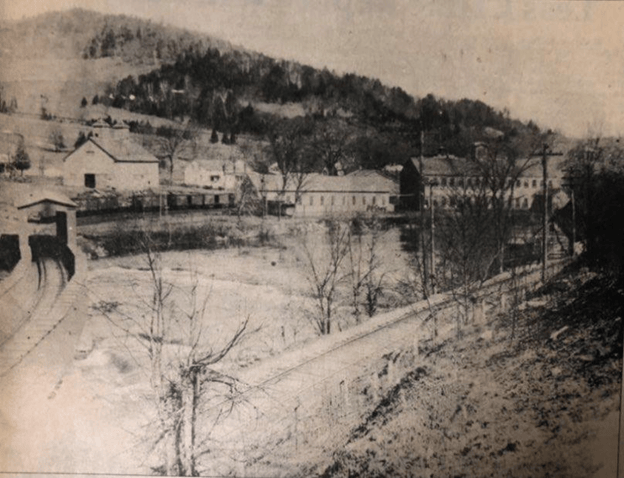
Ames Iron Works, year unknown. This photograph was taken from the Falls Village side of the Housatonic River. The complex lies on the river’s Salisbury side.

Once the war broke out, Ames wasted no time in switching his efforts over to cannon manufacturing. The company produced and sold artillery that shot fifty-pound balls, which was considerably larger than the average ten-pound ball. Nonetheless, Ames was not satisfied. As soon as 1861, he started to lay out plans to produce massive wrought iron cannons. The company’s steam hammer, puddling works, and labor force of several hundred men would allow such a bold, expensive, and risky idea to become reality. In 1863, confident that his prowess in munitions manufacturing would be intrinsically important to battlefield victories, Ames personally petitioned Abraham Lincoln for an official government commission.  His bold request to the president was likely inspired by his older brother’s increasing participation in national politics, as Oakes Ames was elected Congressman of Massachusetts’ 2nd District in 1862. The Ames family also donated considerably to Lincoln’s 1860 presidential campaign. The family secured another anchor in national politics via the Pacific Railroad Act, which the President signed in 1862. The Central Pacific Railroad and the Union Pacific Railroad had difficulties attracting investors. Members of the Ames family invested nonetheless, making the clan one of three major investment groups. In light of these three connections, Horatio Ames was well-equipped to contact the president directly. After Horatio penned a proposal, Lincoln responded on September 28, 1863. As the president wrote,

“If you will, on or before the first day of March, 1864, within the state of Connecticut, or at any point nearer this city, produce guns, each of a capacity to carry a missile of at least 100 pounds weight, and notify me thereof, I will cause some person or persons to examine and test said guns; and if, upon such examinations and test, it shall be in the opinion of such person or persons, that said guns, are or any of them, are on the whole better guns, than any of like caliber heretofore, or now in use in the United States, I will on the account of the United States, accept said guns … it being understood that I have no public money at my control, with which I could make such payment absolutely.”[1]

Lincoln agreed that he would try to purchase the cannons if his conditions were met. However, he never made a definitive promise. Nevertheless, Ames plunged into the project head-first. Before March 1864, the ironmaster successfully produced a multitude of his 19,500-pound cannons. He and several Washington officials tested them in Bridgeport, Connecticut. The first test used a 120-pound shot, which was 20 pounds above the minimum. Clearly, Ames was confident in his product. Packed with 25 pounds of gunpowder, the cannon fired with a colossal boom. The shot remained in the air for 39 seconds and travelled 5.43 miles, just shy of the 5.5-mile requirement. Ames did not give up. He instructed for the next cannon to be packed with an additional 5 pounds of powder. The final shot flew over 6 miles, far surpassing the minimum requirement.  Cheering and celebration followed. It appeared that the ironmaster’s hard work had paid off.

Horatio Ames (second to the left) and his 19,500-pound cannon. He stands in his signature top hat and coat.

Unfortunately, Ames learned that a promise to try is not a promise to succeed. The tests in Bridgeport were some of the few times the cannon was actually used, as securing funding for its purchase was easier said than done. Not all within the government agreed that the guns were a worthy investment. After all, they were unlike any battlefield equipment previously used by the Union Army. They were strikingly heavy, bulky, and never-before tested within a battlefield setting. Government officials were so divided over whether or not to purchase the guns that by the time a resolution was reached, the Civil War had ended. Additionally, the ambitious project had required Ames to borrow a significant amount of money. As the cannons’ purchase was continually delayed, his debts grew more and more pressing. Eventually, Horatio had no choice but to sell Ames Iron Works to his brother, Oliver. Thus, once the government eventually paid $215,000 for 13 of Horatio’s cannons, the money was directed to the new ironmaster. Sadly, Horatio Ames was never able to enjoy the fruits of his ambition.

            It is impossible to know how Ames’s cannons would have impacted the Civil War if they were used during the conflict. Perhaps the 125-pound shells would have devastated Confederate lines in key engagements. On the other hand, the 19,500-pound cannons could have simply been too cumbersome for effective use. After all, they were a far cry from typical Napoleon or parrot guns, which hovered around 1,000 pounds. And of course, Ames’s cannons would have weighed even more once they were hooked up to their limber and caisson. While hefty, these additions were essential as they made cannons mobile and added storage for powder and ammunition. Furthermore, the average cannon shot weighed around 10 pounds. It was far easier to move multiple of these lighter shots than even just one of Ames’s 125-pound shots. Lastly, moving a typical gun required a minimum of twelve horses. One team of six horses would pull the cannon itself while the others would pull the caisson. If these horses pulled approximately 1,000 pounds per team, then individual horses pulled around 167 pounds each. With this in mind, an astonishing estimated 1,168 horses would be needed to adequately pull just one of Ames’s cannons. Unless the guns travelled via train or ship, it is hard to imagine how they would have been feasible for battlefield use. On the other hand, they might have been valuable for anchored, strategic positions in forts or along coastal fortifications. Perhaps it was this uncertainty over the cannons’ actual usefulness that lay at the root of the initial conflict over their purchase; while Lincoln clearly believed in their utility, other officials were not as sure.

            Horatio Ames ultimately died in 1871, less than a decade after the Civil War ended. His physical health likely suffered from the mental anguish caused by his debt, his fall from the company, and witnessing Oliver reap the benefits of his own hard physical and financial labor. In the words of historian Ed Kirby, “Horatio died a broken man.”[2] Though Ames’s risky wager ultimately caused him financial ruin, the undertaking of such a project demonstrated his innovation, determination, work ethic, and foresight into how patriotic purpose, combined with industrial production, could potentially lead to great personal fortune. Not only did he succeed in garnering Abraham Lincoln’s support, but he also made several capable guns that fit the president’s needs. Ultimately, historians can only speculate on how Ames’s cannons may have actually impacted the war’s length and outcome. However, it is the fascinating backstory of these uniquely colossal cannons’ creation and the mastermind behind them that sheds the greatest light on their ultimate significance both in Horatio Ames’s personal civil war, and within our national history.


[1] Abraham Lincoln to Horatio Ames, September 28, 1863, in The Making of the Iron Industrial Age (Sharon: Sharon Historical Society, 2019), 86.

[2] Ed Kirby, The Making of the Iron Industrial Age (Sharon: Sharon Historical Society, 2019), 198.

Sources:

Gordon, Robert and Michael Raber. Industrial Heritage in Northwest Connecticut: A Guide to History and Archaeology. New Haven: The Academy of Arts and Sciences, 2000.

Kirby, Ed. Echoes of Iron: In Connecticut’s Northwest Corner. Sharon: Sharon Historical Society, 1998.

Kirby, Ed. The Making of the Iron Industrial Age: An Historical Chronology: The Iron Men and Women of the Sharon Industrial Age, the Salisbury Iron District and Their Connections to the Transcontinental Railroad. Sharon: Sharon Historical Society, 2019.

Newell, Clayton R. and Charles R. Shrader, “The Artillery,” in Of Duty Well and Faithfully Done: A History of the Regular Army in the Civil War, 265-283. Lincoln: University of Nebraska Press, 2011. https://www.jstor.org/stable/j.ctt1df4h5t.20 JSTOR.

Pool, J. Lawrence. America’s Valley Forges and Valley Furnaces, edited by Angeline J. Pool. Dalton: The Studley Press Inc., 1982.

https://www.battlefields.org/learn/articles/10-facts-civil-war-artillery

https://www.civilwarencyclopedia.org/abolition-ameatk

A New York Cavalryman’s Civil War: The Letters of Private Eli S. Knowlton, Company M. 3rd New York Cavalry

By: Abigail Adam

This past Fall, the Special Collections & College Archives of Gettysburg College’s Musselman Library received, through the generous donation of Kerry Cotter of Easton, Maryland 21 letters penned by her ancestor, Private Eli S. Knowlton of the 3rd New York Cavalry. Over the course of the Fall semester, CWI Fellows Abigail Adam (’22) and Ziv Carmi (’23) transcribed these letters for future researchers and interpreted them through additional contextual information from census records, pension files, and secondary source reading.  The following is a post authored by Abby offering her reflections on some of the main interpretive themes and take-aways she gathered from her transcription work with Knowlton’s letters.

Like many Civil War soldiers, throughout his nearly two-and-a-half years of service in the Union army, Private Eli S. Knowlton of the 3rd New York Cavalry penned numerous letters to his family. Some of the letters from January of 1863 through December of 1864 still survive. Eyeing the yellow pages and faded ink, modern readers can imagine the scent of campfire smoke while Knowlton sweated in the North Carolina and Virginia heat. Many times, Knowlton’s military obligations left him exhausted by the time he picked up his pen. Other times, he complained that sitting in the shade and writing was the only thing to do amidst the monotony of camp life. He talked about daily life as a soldier and his battle experiences, and reacted to the news his family shared with him. He openly relayed his opinions about army life, his comrades, the Confederacy, and the war as a whole, and was not afraid to let his emotions direct his writing. Anger, homesickness, happiness, and disgust pepper his accounts. Through such candid writing, modern readers can examine, among other interesting features of Knowlton’s life, the motivation behind his initial enlistment in the army, his sustaining motivations for remaining on the front lines, and his own evolving views of the continuously evolving Union war effort.

Eli S. Knowlton was born around 1843 to Seneca and Polly Knowlton. The Knowltons owned a family farm in Clarkson, New York. Though Eli attended school when he was young, he later admitted to being a poor student. His lack of attention to formal education is also evident through the spelling in his letters: ‘Any’ became “enny”, ‘month’ became “munth”, and ‘guerillas’ became “Garilleyes,” to name just a few examples. Modern readers can imagine him sounding out particularly difficult words, carefully penning them exactly as they sounded. On August 13, 1862, Knowlton enlisted in Company M of the 3rd New York Cavalry. He would serve for two years and nine months. But why did he enlist, and why did he wait until sixteen months into the war to do so?

The 3rd New York Cavalry’s standard.

In his letters, Knowlton appears unenthusiastic about serving, demonstrating that he did not enlist for glory or adventure. He also makes numerous racist and disparaging comments about African Americans, forcefully declaring that he did not enlist for the abolitionist cause, and lamenting being forced to fight for the freedom of the slaves. On January 28, 1863, shortly after the Emancipation Proclamation (which made it legal for black men to join the army) went into effect, he wrote that he would rather be captured by the Confederates than serve alongside African Americans.  Such a declaration is revealing, considering how dishonorable and shameful many soldiers regarded allowing oneself to be captured by the enemy! Knowlton’s stance on race was certainly common amongst numerous Union soldiers, most of whom enlisted to restore the Union, and not out of any affection for African Americans or any strong inclinations toward emancipation or abolition. However, Knowlton’s home community was notoriously in favor of emancipation. Many community members were even abolitionists. As such, Knowlton’s views may have caused some tension within the regiment. Or, perhaps Knowlton knew his opinions were unpopular and thus saved them for his letters.

Interestingly, while Knowlton may have fancifully wished, in early 1863, to be captured by the Confederates rather than serve alongside black soldiers, his notions of martial masculinity, duty, and honor appear to have ultimately helped to sustain his commitment to remaining in the Union army as the months wore on. Knowlton wrote strongly about his disgust for army deserters. In one instance, he called a deserting man a “Coward” and a “pisspot,” and regularly disparaged the manhood and courage of those who left the front lines. 

However, as was true for many other soldiers, Knowlton’s views on matters such as duty and desertion were not necessarily one-dimensional, and at times, came into direct conflict with each other. Throughout his army career, Knowlton was perpetually homesick. On January 28, 1863, he wrote of his wish to enjoy cider and donuts in his parents’ new house—one of the countless references to his longing for home, family, and familial traditions. He followed this statement with a rather dejected message: “the old Saying is I cant allways be with you”. Sometimes, Knowlton would address parts of his letter to his younger brother, Randolph “Ran” Knowlton. Eli clearly missed Ran. He asked him to relay how the neighborhood “Gals” looked that spring, emphasizing that he wished he could be there, too. He also asked Ran to relay local adventures with friends. As he wrote, “tell me what for a time you had and all about it for as I Cant take a peace of that fun I wood like to hear how the rest of you take it”.  Such longings for home at one point caused him to toy with the idea of deserting the army. At the very least, he wished he could do it. On January 28, 1863, Knowlton wrote that some of his friends had “dug out” of the army, reflecting that “all I have to regret is that I had not dug to”. Nevertheless, Knowlton’s desire to leave simmered down as time went on. He became increasingly interested in seeing Union military success, as well as connecting his honor and masculinity to the success of his regiment.” Knowlton himself directly addressed this change in his attitude. He admitted that, in the past, he would have considered desertion. However, by August 13, 1863, he would not even entertain the idea. In a spirited flourish, Knowlton ended that same letter in which he called a deserter a “Coward” and a “pisspot” with the following crass, yet honest statement: “thay can kiss my US ass all of them.”

Another theme that runs throughout Knowlton’s letters—and a thread that sheds considerable light on why he may have chosen to enlist in the first place—is his continuous, open discussion of his finances and the money he routinely sent home to his family.  This trend suggests that he may have seen military service as an opportunity for steady employment, and may have finally chosen to enlist in the late summer of 1862 out of financial necessity, or perhaps fear of the draft, combined with community pressures to join up. One aspect of Knowlton’s life suggests that his enlistment was economically motivated. The 1860 census listed that the Knowlton property was worth $1,960. This value is the equivalent of $61,451.67 in 2020. In comparison, only 7% of homes in modern-day Clarkson, New York, fall between $50,000 and $99,000. The average home value is $150,100. Thus, the Knowltons were certainly not a wealthy family.

Eli Knowlton’s letters also had a large financial emphasis. On January 10,1863, Knowlton wrote that he sent $15 to his family and planned to send an additional $20 upon his next paycheck. This was a considerable amount, considering that he had received a total of $54.80 thus far. A few months later, Knowlton defended his inability to send more money to his parents. They presumably caught wind that John, a fellow soldier, was sending more money home than Knowlton was. Modern readers can imagine Knowlton tensing up as he defended himself through his writing. He was quick to explain that he was ill over the winter and thus needed to buy nutritious food. He also iterated that John gained his money from sources outside the military. If anything, Eli and John were paid the exact same amount. Eli, perhaps feeling guilty or under pressure, finished his tangent by promising to send more money upon his next paycheck. Such continuous, and sometimes quite passionate, references both to his own finances as well as to the economic viability of his parents and the family farm seem to suggest that economic stability may have loomed large as a motivating—and sustaining—factor for Knowlton’s army service.  Again, such motivation was hardly unique among Union soldiers, and often times it was a blend of reasons—economic, political, social, cultural, and ideological—that shaped men’s decisions to enlist, and helped, alongside commitment to comrades, to sustain them through the dark days of the war.

            Eli S. Knowlton’s letters provide fascinating insights into the daily life of a Union cavalryman during the Civil War. But, his surviving letters also highlight his humanity as a loving son and brother who cared deeply about his family. He was a complex man of numerous opinions, many of which shifted and changed throughout the war. Those opinions were complicated, sometimes contradictory, and could even cause conflict among his fellow soldiers. Soldiers such as Knowlton used the war to bolster their notions of pride, honor, duty, and masculinity, which, in turn, gave meaning to soldiers’ wartime experiences. Those experiences also changed many men as they navigated the horrors of war, interacted with new people of diverse backgrounds, and underwent challenges that were completely new to them. Many travelled farther than ever before and witnessed events so incredible that paper accounts could only hint at their impact. In fascinating and sometimes unexpected ways, these experiences both transformed the emotional and ideological worlds of soldiers such as Knowlton, while also reinforcing their commitment to the fight ahead.

Sources:

Ancestry.com. 1850 United States Federal Census [database on-line]. Provo, UT, USA: Ancestry.com Operations, Inc., 2009. Images reproduced by FamilySearch.

Ancestry.com. New York, U.S., Grand Army of the Republic Records, 1866-1931 [database on-line]. Provo, UT, USA: Ancestry.com Operations, Inc., 2013.

https://civilwarintheeast.com/us-regiments-batteries/new-york-regiments-and-batteries/cavalry/3rd-new-york-cavalry/

http://dmna.ny.gov/historic/reghist/civil/cavalry/3rdCav/3rdCavMain.htm

https://www.niche.com/places-to-live/clarkson-monroe-ny/

https://www.officialdata.org/us/inflation/1860?amount=1960

The Eli S. Knowlton letters

John Held and Joseph Seitz: Soldiers of the 26th Wisconsin Infantry

By: Jaeger Held ’23

In the early afternoon of July 1, 1863, several hundred soldiers of the 26th Wisconsin Volunteer Infantry advanced through the town of Gettysburg, Pennsylvania. On that summer day, the German–American regiment would suffer heavier losses than on any other day during the American Civil War. Among its members were John Held, a private in Company D, and Joseph Seitz, a private in Company K, the author’s 4th great-uncles.

John Held was born in Prussia in 1839. He and his elder brother Joseph immigrated to the United States and settled in Racine, Wisconsin, by the 1850s. When the American Civil War began he was living in Racine and his occupation was listed as a cooper. On August 19, 1862, during the second year of the war, he enlisted in the Union army for three years’ service around the age of twenty-three. He was described at enlistment as having gray eyes, light hair, a light complexion, standing five feet, five inches in height, and having a slender build.

Corporal John Held, Co. D, 26th Wisconsin Volunteer Infantry, 1862 portrait, image courtesy Terrence Held.
 

Joseph Seitz was born on March 2, 1836, in Heiligenzell, located in present-day Baden-Württemberg, Germany. He and several members of his family immigrated to the United States and settled in Wisconsin by the 1850s. Joseph’s younger sister Marianna Seitz met and married Joseph Held of Racine, Wisconsin, the brother of John Held. When the American Civil War began he was living in Milwaukee, Wisconsin and his occupation was listed as a painter. Milwaukee, along with Cincinnati, Ohio and St. Louis, Missouri, formed what came to be called the “German Triangle” of settlement in the midwestern United States in the mid-19th century. On August 21, 1862, Joseph enlisted in the Union Army for three years’ service at the age of twenty-six. He was described at enlistment as having brown eyes, brown hair, a fair complexion, standing five feet, four and one-half inches in height, and having a medium build. Joseph and John were both mustered in on September 17, 1862, and each was paid a bounty of $25.

Private Joseph Seitz, Co. K, 26th Wisconsin Volunteer Infantry, postwar portrait, image courtesy Terrence Held.

The 26th ‘Sigel Regiment,’ also known as the ‘Second German Regiment’ of Wisconsin, named in honor of German-born major general Franz Sigel, was composed almost entirely of men of German birth or German parentage. On the day their regiment was organized in Milwaukee, the bloodiest single-day battle of the war was fought along Antietam Creek in western Maryland. John Held and Joseph Seitz were both listed as being present with their regiment during the fall of 1862. After a brief period of training at Camp Sigel in Milwaukee, the 26th Wisconsin was transported by rail to Washington, D.C., in early October 1862 where it was assigned to the 2nd Brigade, 3rd Division, of General Sigel’s largely German 11th Corps, recently attached to the Army of the Potomac, then stationed around Fairfax, Virginia. The 11th Corps was held in reserve during the disastrous Battle of Fredericksburg in December, and John and Joseph were both listed as present that winter as their regiment participated in the infamous Mud March in January. The near brothers-in-law were both listed as present throughout the spring of 1863 as the Army of the Potomac again prepared to fight the Army of Northern Virginia.

Recruitment poster in German for the 26th Wisconsin Volunteer Infantry, image courtesy Wisconsin Historical Society.

In early 1863, Sigel resigned as commander of the 11th Corps, and corps command was given to Major General Oliver O. Howard. The 11th Corps’ 3rd Division, to which the regiment belonged, was commanded by Major General Carl Schurz, a German revolutionary, and the 2nd Brigade was led by Polish-born Colonel Włodzimierz Krzyżanowski. In late April and early May 1863, John, Joseph, and the 26th Wisconsin participated in the Chancellorsville Campaign in Virginia. During the evening of May 2, 1863, as the regiment rested at the edge of a forest known as the Wilderness, Confederate soldiers led by General Thomas “Stonewall” Jackson attacked. Jackson’s 28,000 men struck the exposed end of the 11th Corps, the right flank of the Union line. The 26th Wisconsin formed into line of battle and delivered several volleys into the advancing Confederates. After a twenty-minute struggle, the Badger state Germans were forced to retreat. In its first battle, out of 471 engaged, the 26th Wisconsin suffered 204 casualties in killed, wounded, and missing, including their colonel, the fifth-highest losses of any northern regiment on the field. After the Union withdrawal back across the Rappahannock River, John and Joseph were with their regiment as the Army of the Potomac pursued the Confederates northward into Pennsylvania.

26th Wisconsin Volunteer Infantry 1862 national colors, image courtesy Wisconsin Veterans Museum.

On the morning of July 1, 1863, the 26th Wisconsin and the rest of the 11th Corps were encamped around Emmitsburg, Maryland when they received word that Confederate infantry were advancing in force near the small town of Gettysburg, Pennsylvania. The Wisconsin Germans set out on a forced march north towards Gettysburg. After a fatiguing thirteen-mile journey, the regiment arrived in the borough by early afternoon and rested in an apple orchard at the northern edge of town. Krzyżanowski’s brigade eventually received orders to advance across the plains of Gettysburg to reinforce Brigadier General Francis Barlow’s exposed 1st Division of the 11th Corps, positioned on a knoll owned by farmer John Blocher. As the 26th Wisconsin advanced on the right of the brigade, the regiment engaged Georgians of George Doles’ and John B. Gordon’s brigades. The regiment exchanged volleys with the Confederates but was eventually flanked and forced to retreat through the town of Gettysburg. In the savage fighting north of town, the regiment suffered severely, losing their state colors, both remaining field officers, and 210 casualties in killed, wounded, and missing out of 458 men present at Gettysburg. The regiment was positioned on Cemetery Hill during the second and third days of the battle and not engaged. For his actions in the battle, John Held was promoted to the rank of Corporal, dated July 1, 1863.

Following the Battle of Gettysburg, the Sigel Regiment and the remainder of the Army of the Potomac pursued the Army of Northern Virginia back into Virginia. In September 1863, two divisions of the 11th Corps, including the 26th Wisconsin—so reduced in number the regiment was now led by a company officer, Captain Frederick C. Winkler—were transferred by rail to northern Alabama to relieve the Army of the Cumberland then under siege in Chattanooga, Tennessee. The Second German regiment was present at the Tennessee battles of Wauhatchie, during the night of October 28-29, 1863, and Missionary Ridge, on November 25, 1863. During a reorganization of the Union armies in the spring of 1864, four divisions of the 11th and 12th Corps were combined to form the new 20th Corps of the Army of the Cumberland. The Sigel Regiment, led by Major Winkler, was assigned to the 20th Corps’ 3rd Brigade, 3rd Division. As part of this command, the 26th Wisconsin participated in the Atlanta Campaign in north Georgia, fighting in many battles including Rocky Face Ridge, Buzzard’s Roost Gap, Resaca, Cassville, Burnt Hickory, Dallas, and New Hope Church in May 1864 and Pine Mountain, Golgotha Church, Lost Mountain, Muddy Creek, Noyes’ Creek, Kolb’s Farm, and Kennesaw Mountain in June. By mid-July, the Union army had advanced to within a few miles of Atlanta. On July 20, 1864, Confederate forces launched a massive frontal assault against Union lines positioned along the southern bank of Peachtree Creek. The Confederates were repulsed, though at a heavy cost. The 26th Wisconsin, led by Lieutenant Colonel Winkler, lost thirteen soldiers killed or mortally wounded in the action and captured the colors of the 33rd Mississippi Infantry. Numbered among the slain was Corporal John Held, who fell, according to his company commander, “in the line of his duty as a soldier by a Rifle Ball fired by the enemy of the U.S. in consequence of which he was killed instantly.” After a six-week siege, Atlanta fell to Union forces on September 2, 1864.

Corporal John Held’s military headstone, Marietta National Cemetery, Georgia, image courtesy Helen Gaskill.

In the fall of 1864, Joseph Seitz was reassigned from the Sigel Regiment and served on detached service in Chattanooga, Tennessee until he rejoined the regiment at war’s end in the spring of 1865. Three of Joseph’s brothers, Fidel, Ferdinand, and Charles, also served in the Union Army. Fidel Seitz enlisted in 1861 and served in Company B, 1st Nebraska Infantry, fighting at the Battles of Fort Donelson, Tennessee on February 15, 1862, and Shiloh, Tennessee on April 7, 1862. He deserted on February 22, 1863, near Arcadia, Missouri. Ferdinand and Charles were drafted in 1864. Charles Seitz served in Company F, 39th Wisconsin Infantry, a unit of ‘Hundred Days Men’ assigned to garrison duty in Memphis, Tennessee, where his regiment defended the city from an attack by Confederate General Nathan Bedford Forrest’s cavalry in the Second Battle of Memphis on August 21, 1864. Ferdinand Seitz was drafted into Company B, 18th Wisconsin Infantry, attached to the 93rd Illinois Infantry, and participated in the Savannah Campaign in November and December 1864 and the Carolinas Campaign in early 1865, fighting at the Battle of Bentonville, North Carolina on March 20-21, 1865. Joseph Seitz mustered out with the remainder of the 26th Wisconsin Volunteer Infantry near Washington, D.C., on June 13, 1865. John Held was initially buried on the Peachtree Creek battlefield, before being reinterred in the Marietta National Cemetery in Marietta, Cobb County, Georgia in the fall of 1866. Joseph Seitz returned to Wisconsin and died on April 14, 1913, in Racine, and he is buried in the Holy Family Catholic Cemetery in Caledonia, Racine County, Wisconsin.

26th Wisconsin Volunteer Infantry 1864 state colors, image courtesy Wisconsin Veterans Museum.

During three years of service, the 26th Wisconsin Infantry lost 191 men, including Corporal John Held, killed and mortally wounded, the fourth-highest percentage of any Union regiment. Colonel James Wood, commanding the 3rd Brigade, 3rd Division, 20th Corps, in his official report, said this of the conduct of the 26th Wisconsin in the Battle of Peachtree Creek: “Where all behaved well, it may be regarded as invidious to call attention to individuals, yet it seems to me I cannot discharge my duty in this report without pointing out for especial commendation the conduct of the Twenty-sixth Wisconsin Volunteer Infantry and its brave and able commander. The position of this regiment in the line was such that the brunt of the enemy’s attack fell upon it. The brave, skillful and determined manner in which it met this attack, rolled back the onset, pressed forward in a counter charge and drove back the enemy, could not be excelled by the troops in this or any other army, and is worthy of the highest commendation and praise.”

Sources:

1st Regiment, Nebraska Infantry. National Park Service. https://www.nps.gov/civilwar/search-battle-units-detail.htm?battleUnitCode=UNE0001RC.

18th Regiment, Wisconsin Infantry. National Park Service. https://www.nps.gov/civilwar/search-battle-units-detail.htm?battleUnitCode=UWI0018RI.

26th Wisconsin Volunteer Infantry. https://www.facebook.com/26thWisconsin/.

26th Regiment, Wisconsin Infantry. National Park Service.https://www.nps.gov/civilwar/search-battle-units-detail.htm?battleUnitCode=UWI0026RI.

39th Regiment, Wisconsin Infantry. National Park Service. https://www.nps.gov/civilwar/search-battle-units-detail.htm?battleUnitCode=UWI0039RI.

Bartsch, August. “Letter to the family of Corporal John Held from Captain August Bartsch, Company D, 26th Wisconsin Infantry, October 10, 1864.” Held Family Tree. Ancestry.com. https://www.ancestry.com/mediaui-viewer/collection/1030/tree/65399329/person/48148725537/media/5623717e-1d36-4371-87f3-90d3402a5bf8?_phsrc=KrZ838&usePUBJs=true.

Compiled Service Records of Volunteer Union Soldiers who Served in Organizations from the State of Wisconsin. The National Archives.

Gettysburg Stone Sentinels, 26th Wisconsin Volunteer Infantry Regiment monument. https://gettysburg.stonesentinels.com/union-monuments/wisconsin/26th-wisconsin/.

Germans in the Midwest. National Museum of American History – Smithsonian Institution. https://americanhistory.si.edu/many-voices-exhibition/peopling-expanding-nation-1776%E2%80%931900/pushed-and-pulled-european-immigration-0.

Held Family Tree. Ancestry.com. https://www.ancestry.com/family-tree/tree/65399329/family/familyview.

John Held (1839-1864). Findagrave.com. https://www.findagrave.com/memorial/3950710/john-held.

Joseph Seitz (1836-1913). Findagrave.com. https://www.findagrave.com/memorial/7112143/joseph-seitz.

Pula, James S. (1998). The Sigel Regiment: A History of the 26th Wisconsin Volunteer Infantry, 1862-1865. Savas Publishing Co.

U.S., Civil War Soldier Records and Profiles, 1861-1865. Ancestry.com.https://search.ancestry.com/cgi-bin/sse.dll?indiv=1&dbid=1555&h=3701107&ssrc=pt&tid=65399329&pid=48148725537&usePUB=true.

U.S., Registers of Deaths of Volunteers, Wisconsin. Ancestry.com.https://search.ancestry.com/cgi-bin/sse.dll?indiv=1&dbid=2123&h=377934&ssrc=pt&tid=65399329&pid=48148725537&usePUB=true.

Killed at Hunterstown – Saddler Charles C. Krauss, 6th Michigan Cavalry

By Jaeger Held

Charles Christian “Carl” Krauss was born on April 5, 1832, near the town of Herrenberg in the Kingdom of Württemberg in present-day Baden-Württemberg, Germany. He was the second of four children born to Georg Heinrich Krauß, a glove maker by trade, and Friedricke Catharina Krauß, née Oerthle. His parents were married as Lutherans. In 1848, revolutions swept across Europe and in 1849, at age seventeen, Carl and his family, including one older and two younger brothers immigrated to the United States. His youngest sibling, Paul, only eight years of age, died at sea during the Atlantic voyage, and Charles’ surviving younger brother Gustavus was deaf and could not speak. Ten years after the family’s arrival in America, his mother died, leaving his father a widower at age sixty. Charles eventually settled in the small town of Lowell east of Grand Rapids in western Michigan where he kept a saddle shop. He was living there in 1862 as the American Civil War entered its second year. On August 1, 1862, at age thirty, Charles Krauss enlisted in the Union army, and on August 28 he was officially mustered in as saddler of Company A, 6th Michigan Volunteer Cavalry Regiment. Eighteen men from Lowell, out of an 1860 population of 547, enlisted in the 6th Michigan Cavalry—including seven in company A, eight in company M, and one each in companies G, H, and the regimental staff. Carl likely formed bonds with some of these men who came from the same small community he called home.

6th Michigan Volunteer Cavalry regimental flag, image courtesy Michigan Capitol Committee.

Shortly before Carl’s enlistment, his father had fallen ill with chronic rheumatism and as a result was unable to continue his trade. Charles’ regiment was sent to Washington, D.C. in December 1862, and that month, he sent his father forty dollars from his army pay to help sustain him and his handicapped younger brother. During the winter of 1862-1863, the regiment served in the defenses of the capital city, participating in several scouting missions in northern Virginia until June 1863, when the Michigan cavalry brigade, consisting of the 1st, 5th, 6th, and 7th Michigan cavalry regiments, was designated as the 2nd Brigade, 3rd Division, Cavalry Corps, Army of the Potomac. The entire 5th regiment and two companies of the 6th were armed with seven-shot Spencer repeating rifles, advanced weaponry at the time. On June 23, 1863, while Charles’ regiment was camped near Gainesville, in northern Virginia, he wrote home to his father in Michigan in his native German language:

[Translation of letter] “Gainesville, Va.  June 23, 1863.  Dear father, I write to inform you that our Regiment together with the whole division, 9 Regiments of Cavalry have started from Fairfax and are now in this neighborhood. I have at present very little opportunity to write, I have ways to work to prepare for march; have been very unwell since several days. I have sent you today my watch, together with forty dollars in greenbacks through our regiment’s saddler, who is going to visit his family in Lansing. He will leave the package in Detroit in the Express Office. Please write me whether you received the same. I must conclude having received notice to join my Co[mpany]. My respects for You & Gustav.  Your faithful Son, Charles C. Krauß.”

6th Michigan Volunteer Cavalry regimental flag reverse, image courtesy Michigan Capitol Committee.

The Wolverines rode north in pursuit of J.E.B. Stuart’s Confederate cavalry and one week later fought their first battle on June 30, 1863, near Hanover, Pennsylvania. The 6th Michiganders, 611 strong, arrived near Gettysburg, Pennsylvania on July 2, and were ordered to move northeast toward the small town of Hunterstown, Pennsylvania, about five miles from Gettysburg. A brigade of Confederate cavalry under General Wade Hampton were posted near the village to guard the left flank of the Army of Northern Virginia. Upon their arrival, the Union cavalry brigades of Brigadier Generals George A. Custer and Elon J. Farnsworth, both newly appointed to their commands, of H. Judson Kilpatrick’s division deployed to attack. Cavalrymen dismounted and formed into skirmish lines as Battery M, 2nd United States Artillery unlimbered and began firing toward the Confederates south of Hunterstown.

Around sundown, the brigade commander, Custer, led Company A of the 6th Michigan Cavalry down the Hunterstown road in a mounted charge against the Confederate position. Charles’ company was fired on and counterattacked by several companies of Cobb’s Georgia Legion. During the fighting, Saddler Krauss suffered a gunshot wound through the spine. The wound proved mortal, and he died soon thereafter, with some records listing his death as occurring that evening and others the next day. Custer himself was unhorsed and nearly killed by a southern cavalryman during the charge, but he was rescued by one of the Michigan men. Firing continued for a short time, but no further mounted attacks were made that evening. Private Krauss had lost his life in a skirmish where relatively few casualties were sustained on either side. The engagement in which he died has been referred to locally as North Cavalry Field.

The area south of Hunterstown where Saddler Charles C. Krauss was mortally wounded on the evening of July 2, 1863, image courtesy J. David Petruzzi and Steve Stanley.

On July 3, the 6th Michigan Cavalry moved off to the southeast and was positioned in support of Captain Alanson Randol’s U.S. Artillery Battery on the edge of what is now known as East Cavalry Field, while the remainder of the Michigan Brigade led by Custer fought Confederates under J.E.B. Stuart. During this engagement, the regiment suffered additional losses, and total casualties for the regiment during two days of fighting numbered one killed, twenty-six wounded and one missing. Saddler Charles C. Krauss was the only member of the 6th Michigan Cavalry at Gettysburg who would not live to see the battle’s end.

Following the Battle of Gettysburg, the 6th Michigan Cavalry, along with the rest of the Michigan Brigade, pursued the retreating Confederate army through the mountains into Maryland, skirmishing heavily along the way. The regiment later saw service through the Overland and Shenandoah Valley campaigns of 1864 and was present at Appomattox Court House when Lee surrendered. At war’s end, the regiment was transferred to the western plains and fought in the Indian Wars in present-day Wyoming and Montana during the summer and fall of 1865 before finally being mustered out at Fort Leavenworth, Kansas on November 24, 1865.

The Michigan Cavalry Brigade monument at East Cavalry Field near Gettysburg, dedicated in 1889, image courtesy Steve Hawks.

In the fall of 1863, the remains of Charles C. Krauss were interred in the Michigan plot, section I, site 9 of the newly created Gettysburg National Cemetery, the only soldier buried in the cemetery identified as a member of the 6th Michigan Cavalry. In 1866, his widowed father successfully applied for a disability pension from the government, stating that his son who was killed at Hunterstown was his only support. It is not known if he was ever able to visit his second son’s final resting place. On his grave marker, his name is incorrectly rendered as “Charles Crouse,” a sorrowful end for a soldier who served and fought and died for his adopted country.

Sources:

1860 U.S. Census, Lowell, Michigan.

6th Regiment, Michigan Cavalry. National Park Service. https://www.nps.gov/civilwar/search-battle-units-detail.htm?battleUnitCode=UMI0006RC.

Case Files of Approved Pension Applications of Widows and Other Dependents of Civil War Veterans. The National Archives. Fold3.com. https://www.fold3.com/image/301296504?terms=krauss,war,us,165789,civil,148838,charles,rel&xid=1945.

Charles C. Krauss (1832-1863). Findagrave.com. https://www.findagrave.com/memorial/29061113/charles-c-krauss.

Compiled Service Records of Volunteer Union Soldiers who Served in Organizations from the State of Michigan. The National Archives.

Gettysburg Stone Sentinels, Michigan Cavalry Brigade monument. https://gettysburg.stonesentinels.com/union-monuments/michigan/michigan-cavalry-brigade/.

Hunterstown – Then and Now. http://hunterstown-thenandnow.com/id19.html.

Krauss Family Tree. Ancestry.com. https://www.ancestry.com/family-tree/tree/164013811/family/familyview.

Petruzzi, J. David and Steve Stanley. Hunterstown Part 1. https://www.gettysburgdaily.com/hunterstown-part-1-with-authors-jd-petruzzi-and-steve-stanley/.

Petruzzi, J. David and Steve Stanley. Hunterstown Part 2.https://www.gettysburgdaily.com/hunterstown-part-2-with-authors-jd-petruzzi-and-steve-stanley/.

Roster, 6th Michigan Cavalry, Company A. http://www.migenweb.org/michiganinthewar/cavalry/6cava.htm.

Spencer Rifles at Gettysburg.https://npsgnmp.wordpress.com/2011/09/01/weapons-at-gettysburg-the-spencer-repeating-rifle/.

U.S., Civil War Soldier Records and Profiles, 1861-1865. Ancestry.com.https://search.ancestry.com/cgi-bin/sse.dll?indiv=1&dbid=1555&h=934251&ssrc=pt&tid=164013811&pid=312132443958&usePUB=true.

U.S., Registers of Deaths of Volunteers, Michigan. Ancestry.com. https://search.ancestry.com/cgi-bin/sse.dll?indiv=1&dbid=2123&h=282496&ssrc=pt&tid=164013811&pid=312132443958&usePUB=true.

Württemberg, Germany Emigration Index, Carl Christian Krauss. Ancestry.com https://search.ancestry.com/cgi-bin/sse.dll?indiv=1&dbid=3141&h=30124&ssrc=pt&tid=164013811&pid=312132443958&usePUB=true.

Unsolved Mystery of the Galleries: Sixth Corps Trenches at Spotsylvania Court House

By Lindsay Waller

Tucked in the woods, off modern-day Grant Drive, are Union Sixth Corps fortifications that are known to historians as the “Galleries.” Few people have ever seen these earthworks, let alone even know they exist. Even Eric Mink, the Cultural Resource Manager of Fredericksburg and Spotsylvania National Military Park (FRSP), has a difficult time finding their exact location. When he showed me the trenches this summer, we were wandering around in the woods for thirty minutes before we stumbled across them. But I didn’t mind because trudging through the woods was worth it. While the now dense forest poses challenges for visiting the fortifications, it has also kept these works incredibly well preserved, so much so that I grew giddy as we slowly moved down the line of lunettes. Bushwhacking through the woods was like being transported back in time. It felt like these works were abandoned mere hours before we got there, and not over 150 years ago. As we made it to the main line of trenches, I was struck with even greater awe, but also with confusion, as these stair-stepping trenches look unlike any other Civil War trenches I have ever encountered. Amongst park historians, they have a reputation of being a unique spot to take diehard visitors, but beyond that, not much is known about these unusual works. Every time I asked a Park Ranger what they knew about them, the answer was pretty much the same: “They are terraced trenches built by the Union Sixth Corps.” This summer at my internship at Fredericksburg and Spotsylvania National Military Park, I did research to uncover the mysteries of the Galleries.

In 1864, Ulysses S. Grant, recently promoted to Commanding General of the United States Army, and George Meade, the commander of the Army of the Potomac, focused their efforts on attacking Robert E. Lee’s Army of Northern Virginia. The plan was simple: Push the Confederates south, take Richmond, and end the war. By the summer of 1864, the Army of the Potomac and the Army of Northern Virginia had seen three years of battle and the end appeared to be nowhere in sight. However, none of the fighting up until that point would even compare to the carnage and bloodshed that was soon to come in the Overland Campaign. The campaign opened on May 5th, 1864 in the Wilderness, a relatively small area bordering Orange and Spotsylvania Counties. The hard-fought battle in the Wilderness would only last three days, but it would leave some 28,000 men dead, wounded, or missing. Immediately after the battle, Grant ordered his army to disengage from the Wilderness and march south toward Spotsylvania Court House, a critical crossroads.  On the night of the 7th, the Union army stepped off, and on the evening of the 8th, the head of the Union column, led by the Fifth Corps, eventually found themselves engaged with the Confederate army once again, and the Battle of Spotsylvania began. On May 9th, both armies settled into their positions and immediately started digging in. The Sixth Corps was positioned in the middle of the Union line, between the Brock Road and Scott Shelton’s House. It was the area in the middle of the Sixth Corps line, held by the 2nd Division, where the trenches in question are located.

The 2nd Division was made up of Brigadier General Frank Wheaton’s Brigade, Colonel Lewis A. Grant’s Brigade (also known as the “Vermont Brigade”), Colonel Daniel D. Bidwell’s Brigade, and Brigadier General Henry L. Eustis’s Brigade. These were the first men to occupy and fortify the area in question. In the regimental history of the 77th New York, George T. Stevens, a surgeon for 77th, recalls arriving on the 9th and the terrain that his men held. He writes:

There was little hard fighting on Monday the 9th, though skirmishing was briskly kept on the whole line throughout the day. Our line of battle was now extended from northwest with Hancock’s Second corps on the right, Warren’s Fifth corps on the right center, Sedgwick’s Sixth corps on the left center, and Burnside’s Ninth corps on the extreme left. Our Second division was formed in a clearing on the side of a hill which sloped gradually until it reached a swamp, which, however, turned and passed through our line at our left. About three hundred yards in front of us was a strip of woods one-fourth of a mile wide, and beyond the woods an open field where the rebel force were posted behind formidable earthworks. Just in our rear and on the crest of the hill, our batteries were posted so as to fire over our heads. On our right was a dense forest where the Fifth corps were posted, and on our left Burnside’s troops occupied a more open country.[1]

Stevens’s account provides a valuable window into what the Union line looked like on the 9th, but more importantly, it presents a vivid description of what the ground looked like that reveals who the likely architects of the Galleries were. The 2nd Division was on “a hill which sloped gradually until it reached a swamp.”[2] This description matches perfectly with the exact terrain of where the Galleries are. Therefore, the 2nd Division (or at least a Brigade in that Division) were the men who built and occupied the Galleries. Based upon descriptions from soldiers, like Stevens, it is most likely that either Bidwell’s or Wheaton’s Brigade was responsible for their creation. However, we cannot be certain about this without doing some archaeological research.  

The unique earthworks straddle a ravine located on a hillside that ascends 12 feet over 30 yards.[3] The Galleries themselves are composed of three sets of trenches. The main line of trenches is made up of 11 steps with a traverse trench running along the side. The traverse trench connects all of the steps leading to the top of the hill. Lining the top of the hill are 12 single-gun emplacements that were used to help support the Union attack on the Bloody Angle on May 12th. The other sets of trenches, just to the west of the main line, are constructed in the same fashion, but are significantly smaller than those along the mainline. Needless to say, this design is unusual and unlike any other fortifications in the Civil War. The below GIS map made by David Lowe, a National Park historian and Civil War trench enthusiast, provides a nice visual overview of the layout of the Galleries.

Sixth Corps “Galleries” as represented on a Geographic Information System (GIS) map provided by NPS Historian David Lowe, August 5, 2020.

I spent my summer poring over countless primary source documents written by the men of the Sixth Corps to try and discover any information I could about their unusual design. Unfortunately, nothing that I came across specifically talked about their construction. Due to the silences in the written records, we are thus forced to interpret the landscape through context. In an email correspondence with David Lowe, David explained that, in his interpretation, the unique layout of the Galleries is due to the terrain. Because of the way the soldiers who built them were situated on the hillside, building stair-stepping trenches was most pragmatic way to defend their position.[4] Lowe also thinks that their design would not only be effective in protecting the troops  from fire, but also in helping to concentrate the men’s fire back onto the Confederate position.[5] There would have been around 700 men in these fortifications. Approximately  200 men (a small regiment) occupied the main trench and the trenches to the north-west, and about 300 men occupied the trenches parallel to the main one.[6]

Unlike some other speculations, Lowe seems to think that the ravine was used more as a natural covered way. In other words, the men used the ravine to protect them as they moved between, and communicated with comrades from the different set of trenches. He explained that the traverse trench was constructed primarily to protect against any flank attacks. This theory also makes sense because both armies would have been wary of any flanking maneuvers, especially after the previously devastating flank attacks they endured at the Wilderness.  As for the effectiveness of the Galleries as a fortification, Lowe explains, “Yes, I think it was an effective defense for the salient angle. I wonder how effective it would have been without the wooded area to the front; if the Confederate artillery could have drawn a direct bead on those massed regiments, it might have gotten ugly.”[7]

Constructing earthworks was like second nature to these men, meaning that the Galleries were probably constructed out of instinct and in direct response to their unfolding combat situation rather than some carefully orchestrated plan. Most of the soldiers would have aided in these earthworks’ construction. However, by 1864, there was usuall a specific group of men who were usually responsible for the construction of earthworks. These “pioneers” were detailed to each brigade in the Union Army and carried the spades, shovels, and axes necessary for fortification. In, Trench Warfare Under Grant and Lee, historian Earl J. Hess explains the duty and training of the pioneers:

In addition to the regular and volunteer engineer troops, Meade’s army had a detail of pioneers attached to each brigade. These were the men detached from the ranks, but they were never trained as engineer troops. Their job was to facilitate the movement of infantry by repairing roads and bridges, bury the dead, help construct trenches and latrines, and do any other job of manual labor needed by their brigades.[8]

The pioneers thus were tasked with doing all the manual labor that would usually be assigned to the engineers. One might even conjecture that perhaps they had even more influence on the ground than traditional engineers ever did. There is a strong possibility that the pioneers were the ones that constructed the Galleries, or at least significantly helped with their construction. However, there is no real evidence to confirm this. Unfortunately, little has been written about the pioneers at Spotsylvania. However, they are recorded at the Wilderness as building works and assisting other soldiers in the construction of fortifications there.

At the end of the day, no matter who built them, the Galleries are a unique set of fortifications. Unfortunately, many questions still remain about these trenches. While we can speculate that Bidwell’s or Wheaton’s Brigade constructed and occupied the Galleries, archaeology must be conducted in order to know, definitively, who was there. In such an excavation, archeologist would likely search for uniform buttons, or any kind of artifact that would identify an exact regiment as having occupied that position. While such archaeological investigation is not current priority for FRSP, it is certainly something the park would like to undertake in the future. Ultimately, the long-term goal is to construct a trail, erect waysides, and this fascinating site for the public.  But for now, the mystery of the Galleries still remain tucked away in the woods of the Spotsylvania battlefield.

Works Cited

I. Primary Sources:

Abbott, Lemuel Abijah. Personal Recollections and Civil War Diary 1864. Burlington: Free Press Printing Co., 1908.

Barnhart, Lorenzo. The War of Rebellion. http://web.archive.org/web/20031203111927/http://www.bright.net/~lrrp/ldb.html.

Bowen, James. “In the Wilderness: Movement of Both Armies from the Opening Fight to the Close of Spotsylvania.” Philadelphia Weekly Times, June 27, 1885. Bound Volume 141. Fredericksburg and Spotsylvania National Military Park (Hereafter cited as “FRSP”).

Galloway, Norton G. “Annals of the War: Chapters of Unwritten History, Battle of the Wilderness.” Philadelphia Weekly Times, February, 16, 1884. Bound Volume 141. FRSP.

Lewis, George. The History of Battery E, First Regiment Rhode Island Light Artillery, In the War of 1861 and 1865, to preserve the Union. Providence: Snow & Farnham Printers, 1892.

Moody, William. Letter to the Pittsburg Evening Chronicle, May 29, 1864. Bound Volume 115. FRSP.

“Our Army Correspondence.” Pittsburg Evening Chronicle, June 1, 1864. Bound Volume 361. FRSP.

Seiser, August. “Rochester in the Civil War.” Edited by Blake McKelvey. Rochester, The Rochester Historical Society Publications. Bound Volume 117. FRSP.

Schoyer, Samuel. The Road to Cold Harbor: Field Diary, January 1 – June 12, 1864 of Samuel C. Schoyer. Edited by William T. Schoyer. Apollo: Closson Press, 1986. Bound Volume 116. FRSP.

Stevens, George. Three Years in the Sixth Corps: A Concise Narrative of Events in the Army of the Potomac, From 1862 to the Close of the Rebellion, April, 1865. Albany: S.R. Gray Publisher, 1866.

Willsey, Berea. The Civil War Diary of Berea M, Willsey: The Intimate Daily Observations of AMassachusetts Volunteer in the Union Army, 1862-1864. Edited by Jessica H. DeMay. Bowie: Heritage Books, 1995. Bound Volume 352. FRSP.

II. Secondary Sources:

Hess, Earl. Trench Warfare Under Grant and Lee: Field Fortifications in the Overland Campaign. Chapel Hill: The University of North Carolina Press, 2007.

Lowe, David. Email conversation with author, July 31, 2020 – August 3, 2020.

“NPS Battle of Spotsylvania Troop Movement Maps.” Frank O’Reilly assisted by Elizabeth Getz, Kelly O’Grandy, illustrated and produced by Steve Stanley. 2000. 21

Rhea, Gordon. The Battles for Spotsylvania Court House and The Road to Yellow Tavern. Baton Rouge: Louisiana State University Press, 1997.


     [1] George T. Stevens, Three Years in the Sixth Corps: A Concise Narrative of Events in the Army of the Potomac,

From 1862 to the Close of the Rebellion, April 1865 (Albany: S.R. Gray Publisher, 1866), 326.

     [2] Ibid.

     [3] Earl J. Hess, Trench Warfare Under Grant and Lee: Field Fortifications in the Overland Campaign (Chapel

Hill: The University of North Carolina Press, 2007), 236-237.

     [4] David Lowe, email correspondence with the author, July 31, 2020.

     [5] Ibid.

     [6] Ibid.

     [7] Ibid.

     [8] Earl J. Hess, Trench Warfare Under Grant and Lee: Field Fortifications in the Overland Campaign (Chapel Hill: The University of North Carolina Press, 2007), 11.

Healing a Nation Sick at Heart: Fighting a Spiritual Pandemic with “Our Better Angels”

By: Christopher R. Fee

Fee headshot
Dr. Christopher R. Fee, Professor of English at Gettysburg College

This summer has been a hot and uncomfortable one, literally, metaphorically, and spiritually: We seem to be at a cross-roads in history. A particularly notable flash-point occurred when armed right-wing paramilitaries occupied the Gettysburg Battlefield on the Fourth of July on the basis of a rumor of flag-burning already widely discredited at the time. Two weeks later the source of that rumor was outed, and it turned out to be a left-wing agitator.

During this summer of unrest, such out-of-all-proportion responses to threats—real, imaginary, and invented—seem all too common, and the fact that we are in the middle of the greatest pandemic in a century is not at all incidental.

Moreover, the time and place of this particular incident are themselves hardly inconsequential: July the Fourth is the most seminal of American holidays, while the Gettysburg Battlefield is the most iconic monument in the landscape of the American imagination, sanctified by none other than Abraham Lincoln, arguably the most revered martyr in our secular pantheon.

On the very eve of the Civil War, Lincoln uttered a sentiment which comes to my mind when I see Americans treating each other with disdain and even hatred over political differences:

“We are not enemies, but friends. We must not be enemies. Though passion may have strained it must not break our bonds of affection.”

Lincoln Inauguration LOC
Inauguration of President Abraham Lincoln, March 4th 1861. (Library of Congress)

Lincoln has been much criticized for not taking a stronger stand against the evils of slavery at that moment, and I do not wish to be accused of not seeing the hateful legacy of that vile institution reverberating in the actions and inactions that required the rise of the Black Lives Matter movement in the first place. Slavery was evil, Jim Crow was evil, and the institutionalized 21st century racist oppression that engendered the BLM reaction is the unspeakably evil step-child of that legacy.

As a local Quaker and peace-maker, however, I must align my words and deeds with those of my spiritual forebears in this very community who steadfastly worked for justice and freedom and equality while at the same time refusing to hate and to vilify those they opposed: They loathed the sin of slavery and had to react strongly against it, but never violently, and they were at all times required to love the sinner with all their hearts.

I must do the same, and as Friends always have, I call on the broader community to do so, as well.

There has been a lot of fast and loose talk about “a second Civil War” this summer, and although that seems incendiary and unhelpfully volatile rhetoric to me, I’ll leave it to the many fine scholars of the Civil War who read this blog to debate the finer points of comparison on that score.

I’m a medievalist, and my expertise is more grounded in the cultural backlash caused by the pandemic that has catalyzed the current crisis, so I’ll confine myself to those aspects of this summer’s discontent that I can comment upon professionally:

When people are frightened and are faced with how little control they really have over their lives, they often respond inappropriately, and all too often violently.

This is nothing new: we have accounts dating back thousands of years that illustrate this point.

I’ve spent the past few months deeply immersed in the literature of pandemic, from the Bible to Boccaccio’s Decameron, from Greek historians to modern novelists. As a medievalist, I’ve always had a professional interest in the Plague, but of course this spring it became personal for all of us. Many of the greatest works of literature touching on the Plague describe deep and powerful connections between a physical disease that wracks the bodies of a populace and a spiritual malaise that corrupts the soul of a people.

Indeed, since ancient times Plague has been both a very real terror and an extremely powerful metaphor, from Homer’s Iliad and Sophocles’ Oedipus Rex to Jack London’s The Scarlet Plague and Albert Camus’s La Peste. Given the pandemic and social unrest raging all around us, it would be worth our while to consider the realities of life in America in the summer of 2020 from the perspectives of these latter two books, which use the metaphor of pestilence to make diametrically opposed points:

Jack London described a world which descends into savagery and brutality because of a deadly pandemic. London’s core notion is that civilization is at best a thin veneer, and that descending chaos unlocks the bestial within us all, freeing us from all constraints and decency. His vision is dark and horrifying and ultimately offers little hope, because to London, even the shackles of morality and the semblance of polite society merely channel and control the innate human need to dominate and to subjugate.

Jack London LOC
Jack London (Library of Congress)

I would submit that both the internet troll who circulated that fake account of threatened flag-burning and the armed reactionaries who took his bait are illustrating the worst fears of Jack London.

Camus, on the other hand, describes in detail a terrible outbreak of Bubonic Plague that decimates the population of the city of Oran in Algeria, unleashing countless horrors. But while Camus fully acknowledges the worst of which we are capable, he focuses on the best, offering ultimately a vision of hope in the midst of despair, of light flickering defiantly against the impending shadows. Camus wrote his novel shortly after World War II, and the Plague in his book is often seen as an allegory for fascism, although it is also much, much more: Camus calls for us to stand firm in our humanity, to be our best even when faced with the utter worst. He does not promise us that everything will be OK, that we will have a Hollywood ending, and that everything will work out for the best. No, Camus implores us to be kind, to be thoughtful, to care for others, to alleviate suffering and ignorance, if only for a moment; Camus offers us the opportunity to be at our best by shining our light against the worst the darkness can offer, not for glory or accolades, but because it is right, and because that is what makes us human.

I am more inclined to look for the best than the worst in people, and those who stand their ground peacefully—Walls of Moms in Portland, Black Lives Matter protesters, and professors on the Battlefield of Gettysburg—give me hope in this regard:

On the Fourth of July, a couple of my bravest friends and colleagues, historians of international repute, gently tried to provide some context for the monuments on the Gettysburg Battlefield and the debates concerning them. They were harassed and threatened and insulted for their trouble. They did not attempt to agitate nor to incite those armed protestors who confronted them: They are public scholars, and it is their vocation and avocation to try to shine a light in the darkness.

It is perhaps especially notable that those who shouted them down refused to wear masks; there was a time when those who revered the icons of the fallen Confederacy hid behind masks and hoods, but now they take pride in appearing openly, and, moreover, they refuse to wear protection against spreading a disease they feel is a hoax.

Those brave, unarmed teachers, meanwhile, were attempting to maintain their own dignity, as well as their respect for those with whom they disagreed, simply by offering thoughtful responses to mindless hate.

Camus Wikimedia Commons
Albert Camus (Wikimedia Commons) 

Just as Albert Camus himself worked diligently throughout the war, undermining a cacophony of Nazi propaganda with solitary, tiny little messages of truth in an underground newspaper, my colleagues held their candles to the darkness, offering flickering glimmers—not because a spark will overwhelm the darkness—but because without those tiny sparks of light and love and hope and good, darkness and hate and despair and evil threaten to overwhelm us all.

They offer stirring examples and object lessons for the rest of us, issuing a call for us to embrace the light, however much fear and hate tempt us to turn to the dark. By doing so, we choose the path blazed by Camus, and reject the road mapped by London.

That’s what those history professors did on the Battlefield of Gettysburg on July the Fourth; they embodied the ideal encapsulated in the closing of Camus’s La Peste:

“What we learn in time of pestilence: That there are more things to admire in men than to despise.”

Lincoln came to a similar conclusion in his First Inaugural Address when he implored us to invoke “the better angels of our nature.”

I leave you with those words, which do not offer us a perfect solution, but rather offer just a glimmer of how we might begin to work towards such a solution; to evoke a favored Quaker phrase, “I love to feel where the words come from,” and I feel that Lincoln’s words come ultimately from love of his fellow Americans, a palpable desire for reconciliation courageously embodied by my dear friends and colleagues at the height of this summer’s madness.

About the Author: Christopher R. Fee is Professor of English at Gettysburg College and a scholar of the Middle Ages. Fee is the author of several books on Medieval topics, as well as the editor of American Myths, Legends, and Tall Tales: An Encyclopedia of American Folklore, and the award-winning Conspiracies and Conspiracy Theories in American History. Fee’s latest two works,  From Black Death to Zombie Apocalypse: Great Plagues in History and Literature  and The Truth About Tall Tales: American Folklore from Johnny Appleseed to Paul Bunyan, will be released this month. Fee is a practicing Quaker and the former Clerk of the Menallen Friends Meeting, an active waypoint on the Underground Railroad just ten miles north of Gettysburg.

css.php