A Medal of Distinction:  Remembering the Montford Point Marines 

By Matthew LaRoche ‘17

This post comes from the exhibit catalog for “Right to Serve, Right to Lead:  Lives and Legacies of the USCT,” an exhibition in Special Collections and College Archives at Musselman Library, Gettysburg College. During the spring of 2017, we asked the CWI Fellows to select a item on exhibit and discuss its history and context. The resulting exhibit catalog is available at Special Collections, where the exhibit will run through December 18, 2017.

Montford Point Marines. Bronze replica medal. 1.5 in. replica of the Congressional Gold Medal designed by U.S. Mint Sculptor-Engraver, Don Everhart and awarded collectively to the Montford Point Marines on June 27, 2012 in the U.S. Capitol. The Congressional Gold Medal is the highest award issued by Congress for distinguished achievement. Approximately 600 Montford Point Marines have received their medals. On loan courtesy of Dr. Deborah M. and Stephanie C. Smith, USMC Colonel (Ret.).

In the century that followed the Civil War, Jim Crow wormed its way into the heart of every American institution—including the military. Despite the illustrious tradition laid down by black servicemen in the Civil War, the racial norms of the post-war years worked to beat their successive generations back into the shadows. Many branches—including the Marine Corps—entirely banned African Americans from serving. Even traditionally inclusive institutions, such as the often short-handed Navy, relegated blacks to menial roles. Beginning in 1893, they could serve only as cooks and cleaners aboard U.S. ships.

Continue reading “A Medal of Distinction:  Remembering the Montford Point Marines “

The Emblem of the XXV:  A USCT Corps from Petersburg to Appomattox

By Jonathan Tracey ‘19

This post comes from the exhibit catalog for “Right to Serve, Right to Lead:  Lives and Legacies of the USCT,” an exhibition in Special Collections and College Archives at Musselman Library, Gettysburg College. During the spring of 2017, we asked the CWI Fellows to select a item on exhibit and discuss its history and context. The resulting exhibit catalog is available at Special Collections, where the exhibit will run through December 18, 2017.

25th Corps. Corps badges. These pins were worn by members of an all-black unit formed late in the war which had the distinction of being the first to enter Richmond. Corps badges like these were used to easily identify units on the battlefield. Each corps had a unique design, and each division a different color—red for the first, white for the second, blue for the third, and sometimes green for the fourth.

Pictured here are three corps badges for the Union XXV Corps. Beginning in 1863, most corps in the Union Army adopted symbols so it would be easier to distinguish different commands from each other during the height of battle. In addition to the symbol distinguishing what corps a soldier belonged to, badges were also color-coded to denote divisions. Generally, red would mark the first division, white the second, and blue the third. The XXV Corps adopted this shape, sometimes worn as a square, although usually seen pinned on as a diamond.

Continue reading “The Emblem of the XXV:  A USCT Corps from Petersburg to Appomattox”

“I long for the time to come when you will come home”: A Letter to a USCT Soldier from His Wife

By Laurel Wilson ‘19

This post comes from the exhibit catalog for “Right to Serve, Right to Lead:  Lives and Legacies of the USCT,” an exhibition in Special Collections and College Archives at Musselman Library, Gettysburg College. During the spring of 2017, we asked the CWI Fellows to select a item on exhibit and discuss its history and context. The resulting exhibit catalog is available at Special Collections, where the exhibit will run through December 18, 2017.

Lucinda Lawrence to Husband. Envelope. Lucinda wrote to her husband Canny on April 1, 1865. Conditions for their family and the families of other USCT were dire. Since their last exchange of letters, the commander of the camp where she drew rations had decided to cut back. The Army now only provided food for her child. Courtesy of Special Collections and College Archives, Gettysburg College.

Just as the experiences of African American soldiers during the Civil War went under-recorded and underrepresented, so too did the hardships suffered by their wives and children behind the lines.

Continue reading ““I long for the time to come when you will come home”: A Letter to a USCT Soldier from His Wife”

On the Periphery of War: Sutlers, Luxuries, and the USCT

By Jon Danchik ‘17

This post comes from the exhibit catalog for “Right to Serve, Right to Lead:  Lives and Legacies of the USCT,” an exhibition in Special Collections and College Archives at Musselman Library, Gettysburg College. During the spring of 2017, we asked the CWI Fellows to select a item on exhibit and discuss its history and context. The resulting exhibit catalog is available at Special Collections, where the exhibit will run through December 18, 2017.

Sutler’s Token. This coin would be used as credit with a sutler, or vendor, who followed the Union Army, selling a range of luxury items from toothbrushes and soap to tobacco, cheese, and custom identification tags. Courtesy of Special Collections and College Archives, Gettysburg College.

The Civil War caused an unmistakable strain on production and the allocation of resources in the North as well as the South. In order to keep armies in good order, a steady influx of supplies was needed, leading to shortages of food on the home front and in places like prisoner of war camps. The armies were typically well-fed, and many rations commonly consisted of small amounts of coffee, salt pork, and hardened bread called “hard-tack.” While enough to keep one from starvation, rations could hardly be described as appealing, and soldiers spent much of their time in camp devising new and innovative ways to make them more appetizing. Foraging for supplies yielded resources for combatant armies, but the practices of foraging depended on different commanders’ interpretations of official policies and unofficial social contracts. Soldiers were capable of living off of the land, and sometimes taking supplies from hapless farmers at the point of a bayonet was the only way to stay well-fed. Clearly the rationing system had its downsides.

Continue reading “On the Periphery of War: Sutlers, Luxuries, and the USCT”

A Record of Service: The logbook of the 28th Indiana Infantry

By Danielle Jones ‘18

This post comes from the exhibit catalog for “Right to Serve, Right to Lead:  Lives and Legacies of the USCT,” an exhibition in Special Collections and College Archives at Musselman Library, Gettysburg College. During the spring of 2017, we asked the CWI Fellows to select a item on exhibit and discuss its history and context. The resulting exhibit catalog is available at Special Collections, where the exhibit will run through December 18, 2017.

28th USCT. Descriptive logbook. Every regiment kept a descriptive log of the “special orders” issued by its colonel to the regiment, and “general orders” from higher up the command chain that affected the regiment in some way. Courtesy of Special Collections and College Archives, Gettysburg College.

The 28th Indiana Infantry Regiment—officially the 28th Regiment United States Colored Troops—was Indiana’s first and only all-black regiment during the Civil War. Mustered into service on January 12, 1864, the 28th formed in response to fears sparked by Confederate General John Hunt Morgan’s raid into Indiana in the summer of 1863. Morgan hoped to rouse Copperheads in the North and inspire them to rise up against the Union. The raiders ransacked Corydon, Salem, Dupont, Versailles, and other small towns in southern Indiana, burned and looted property, and stole over 4,000 horses. All told, the raid caused over one million dollars in damage. Thousands of Hoosiers enlisted in response to the raid, including the men of the 28th. The raid ultimately failed; Morgan was chased out of southern Indiana by state troops and kept out by the United States Navy. Although the 28th was recruited to help prevent future rebel violence, state officials feared that raising more than one African American regiment would provoke another Confederate raid.

Continue reading “A Record of Service: The logbook of the 28th Indiana Infantry”

The 75th Anniversary of the Battle of Gettysburg: Healing the Divide? 

By Savannah Labbe ‘19

This post comes from the exhibit catalog for “Right to Serve, Right to Lead:  Lives and Legacies of the USCT,” an exhibition in Special Collections and College Archives at Musselman Library, Gettysburg College. During the spring of 2017, we asked the CWI Fellows to select a item on exhibit and discuss its history and context. The resulting exhibit catalog is available at Special Collections, where the exhibit will run through December 18, 2017.

Larkin Woodruff, 50th USCT. 75th Anniversary of Gettysburg medals. Veterans attending 75th Anniversary commemorations wore medals like these full of symbolism. The bundle of wooden rods surrounding an axe is a classical symbol called a “fasces.” In Roman times, it stood for martial strength through unity and brotherhood and brotherhood. Sadly, Larkin Woodruff died just weeks before the 75th Anniversary Commemoration in Gettysburg, PA. Courtesy of Special Collections and College Archives, Gettysburg College.

Between June 29 and July 6, 1938, approximately 1,870 Union and Confederate veterans gathered at that fateful battlefield where many of them had fought 75 years earlier. The veterans stayed in camps and took part in various ceremonies and parades, including a parade of veterans from all wars since 1863, as well as a military flyover. The highlight of the ceremonial events, however, was the dedication of the Eternal Light Peace Memorial on Oak Hill outside of town. President Franklin Roosevelt made the dedication speech on July 3, 1938, around the same time Pickett made his charge 75 years before. More than 200,000 people attended, watching the friendly reunion of men who had once been enemies. Together, two men—92-year-old Union veteran George N. Lockwood of Los Angeles, CA, and 91-year-old Confederate veteran A.G. Harris of McDonough, GA—undraped the flag covering the memorial.

Continue reading “The 75th Anniversary of the Battle of Gettysburg: Healing the Divide? “

Commanding the African Brigade: A Portrait of Union Officer Edward Wild

By Savannah Rose ‘17

This post comes from the exhibit catalog for “Right to Serve, Right to Lead:  Lives and Legacies of the USCT,” an exhibition in Special Collections and College Archives at Musselman Library, Gettysburg College. During the spring of 2017, we asked the CWI Fellows to select a item on exhibit and discuss its history and context. The resulting exhibit catalog is available at Special Collections, where the exhibit will run through December 18, 2017.

Brigadier General Edward Wild. Carte de visite. Brigadier General Wild was a USCT commander of some note. Serving from First Bull Run, the first major battle of the Civil War, to the end, he suffered multiple wounds and lost his left arm. Courtesy of Special Collections and College Archives, Gettysburg College.

Edward Augustus Wild grew up in Massachusetts at a time when abolitionist fervor ran rampant within New England society. A doctor by profession and an adventurer by choice, Wild became a military officer out of a strong sense of personal honor, writing his wife Frances Ellen Wild that he did not enlist “to be elevated, but simply from a sense of duty.” At the outbreak of the war, Wild fulfilled the twin drives of duty and adventure by raising a company of volunteers and becoming a captain in the 1st Massachusetts Infantry.

Continue reading “Commanding the African Brigade: A Portrait of Union Officer Edward Wild”

A Beacon of Hope: Contraband Camps, Harpers Ferry, and John Brown

By Alex Andrioli ’18

This post comes from the exhibit catalog for “Right to Serve, Right to Lead:  Lives and Legacies of the USCT,” an exhibition in Special Collections and College Archives at Musselman Library, Gettysburg College. During the spring of 2017, we asked the CWI Fellows to select a item on exhibit and discuss its history and context. The resulting exhibit catalog is available at Special Collections, where the exhibit will run through December 18, 2017.

Contraband Camp at Harpers Ferry, WV. Stereoview card. The 3-dimensional stereoview and other photography brought the reality of the Civil War into civilian homes. This stereoview shows the rag-tag conditions of a contraband camp, erected just a few yards from John Brown’s Fort in Harper’s Ferry. Courtesy of Special Collections and College Archives, Gettysburg College.
Stereoviews were created by using a twin-lens camera that captured the same subject from two slightly different angles. The photographer then placed the two images on a stereoview card that could be inserted into a special viewer that merged the two images together and created a life-like, three-dimensional image. Stereoviews’ low cost meant they were an inexpensive way to insert one’s self into realistic three-dimensional scenes like the pictured contraband camp.

Continue reading “A Beacon of Hope: Contraband Camps, Harpers Ferry, and John Brown”

Marching in Step:  USCT Veterans and the Grand Army of the Republic

By Ryan Bilger ‘19

This post comes from the exhibit catalog for “Right to Serve, Right to Lead:  Lives and Legacies of the USCT,” an exhibition in Special Collections and College Archives at Musselman Library, Gettysburg College. During the spring of 2017, we asked the CWI Fellows to select a item on exhibit and discuss its history and context. The resulting exhibit catalog is available at Special Collections, where the exhibit will run through December 18, 2017.

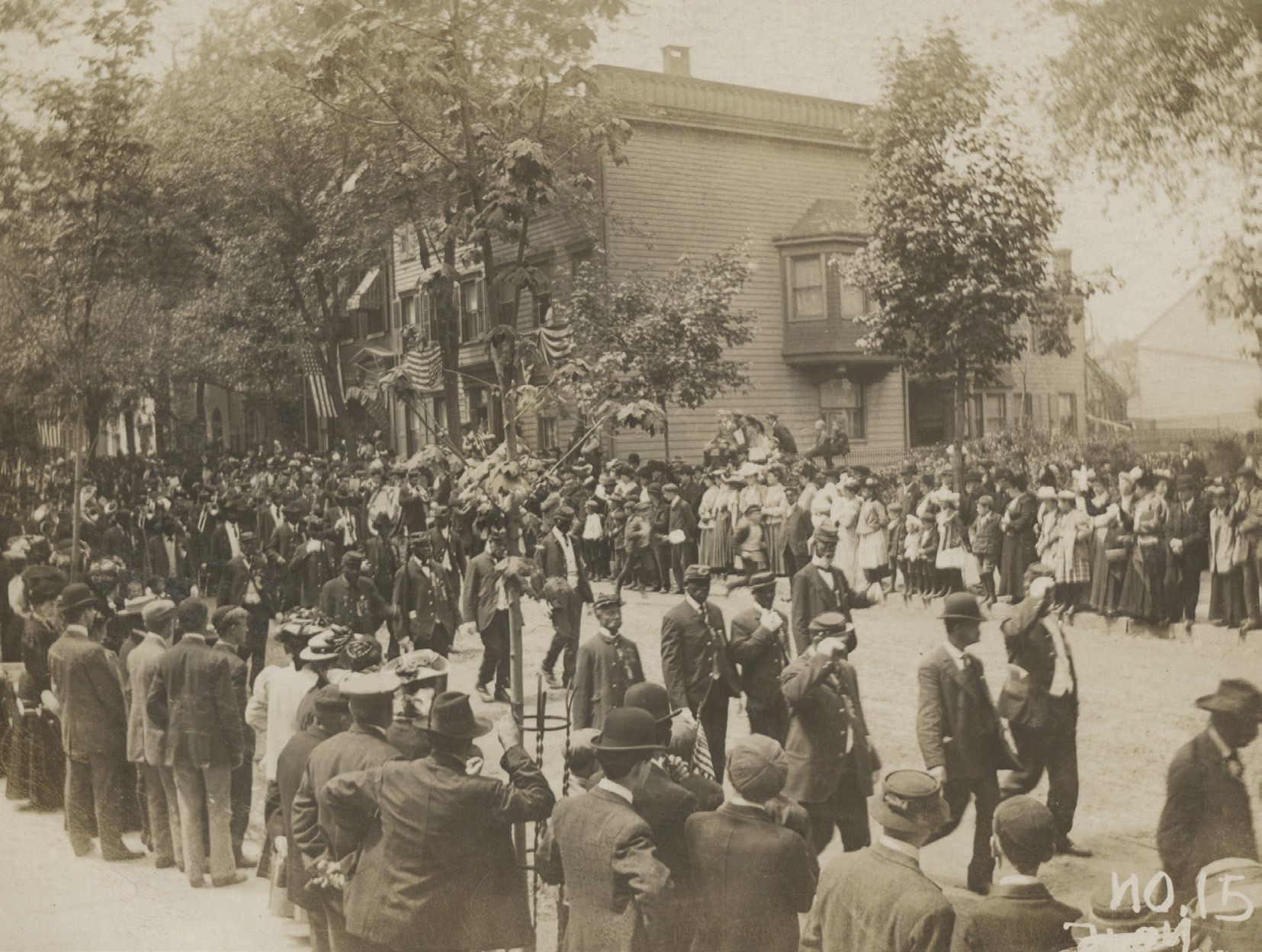
USCT Veterans on Parade, Easton, PA. Postcard. Black veterans of the Grand Army of the Republic were, like their white counterparts, very active in the realms of commemoration and politics. “Decoration Day,” the precursor to our modern Memorial Day, officially started with the GAR in 1868, and served both purposes. Courtesy of Special Collections and College Archives, Gettysburg College.

For many United States Colored Troops, remembering the Civil War and their comrades who fell in it became an important part of their post-war life. One of the primary opportunities for public expression of remembrance was Decoration Day, now known as Memorial Day. African Americans played a critical part in the creation of this holiday. On May 1, 1865, the newly-freed black residents of Charleston asserted their place in Civil War memory by leading a parade to a recently constructed cemetery for Union prisoners at the city’s horseracing course. The procession heaped flowers upon the graves of the honored dead, after which ministers from the town’s black congregations gave dedicatory speeches. This event, known among some in the North as the “First Decoration Day,” exemplified African American interest in perpetuating the memory of the Civil War. However, the resentment of white Southerners at the time towards this instance of black agency led to the marginalization and eventual forgetting of the event in the mind of the public at large.

Continue reading “Marching in Step:  USCT Veterans and the Grand Army of the Republic”

Black Servicemen on the Seas: African Americans in the Union Navy

By Hannah Christensen ’17

This post comes from the exhibit catalog for “Right to Serve, Right to Lead:  Lives and Legacies of the USCT,” an exhibition in Special Collections and College Archives at Musselman Library, Gettysburg College. During the spring of 2017, we asked the CWI Fellows to select a item on exhibit and discuss its history and context. The resulting exhibit catalog is available at Special Collections, where the exhibit will run through December 18, 2017.

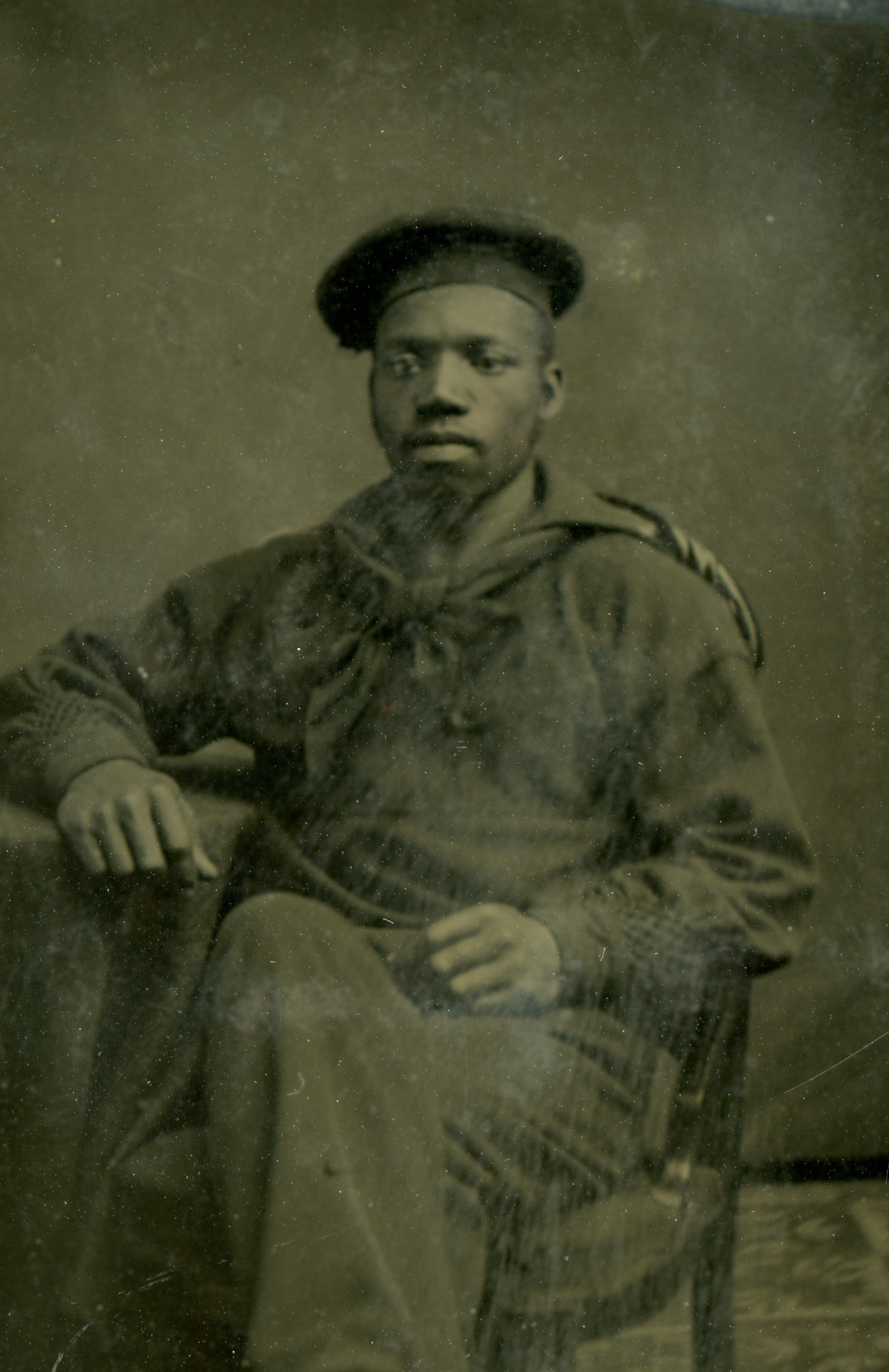
Unknown sailor. Tintype. Approximately 19,000 black men served in the Navy, a much smaller number than the 180,000 who served in on land. The entire Union military totaled 2,000,000; one in ten Union soldiers was a black man. Courtesy of Special Collections and College Archives, Gettysburg College.

When the Civil War began, the United States Navy’s Atlantic Squadron, commanded by Commodore Silas H. Stringham, sought to blockade the entire Eastern Seaboard of the Confederacy. It faced two major problems: a shortage of manpower and an abundance of fugitive slaves flocking to the Union fleet. The commander of one vessel, Commander O.S. Glisson, had fifteen refugees on his ship, none of whom he intended to return to their owners. Glisson wrote to Commodore Stringham asking for advice, and Stringham wrote to Secretary of the Navy Gideon Welles with an idea. Arguing that “if Negroes are to be used in this contest . . . they should be used to preserve the Government,” Stringham asked permission to recruit these fugitive slaves. Secretary Welles knew the Navy needed men, so he approved the request.

Continue reading “Black Servicemen on the Seas: African Americans in the Union Navy”

css.php