Tales from a Boston Customs House: “Worthy” Suffering

By Sarah Johnson ’15

Despite Francis Clarke’s argument that men who suffered in exceptional ways, such as amputees, were regarded as national martyrs and held up as the emblem of sacrifice to the nation, this argument cannot be applied wholesale to all exceptional sufferers in the post-war North. Although men who lost limbs in battle were often remembered in terms of glory and treated as national heroes, those who suffered in non-heroic ways, such as prisoners of war and the victims of non-combat related accidents, were often treated as less deserving of honor.

Brian Matthew Jordan, discussing amputees, argued that the empty sleeve of the veteran itself embodied the idea that he has termed the Won Cause, a counterpart to the Lost Cause tradition. Within the Won Cause, veterans had not lost their arms, but instead sacrificed them for a just cause. The sight of a pinned-up sleeve noted the bearer’s integral role in a moral cause. And yet, the way in which a veteran suffered might shift the way he was perceived in society.

Andersonville

Continue reading “Tales from a Boston Customs House: “Worthy” Suffering”

Tales from a Boston Customs House: “Living Monuments”

By Sarah Johnson ’15

The image of the amputee is a classic one in the memory of the American Civil War. Francis Clarke has argued that the long-suffering and sacrificial Union amputee became a national martyr to the righteousness of their cause. While this view was manifested in various ways throughout the postwar North, the case of double-arm amputee Lewis Horton serves to give depth insight into–and possibly push back against–this argument.

Continue reading “Tales from a Boston Customs House: “Living Monuments””

Tales from a Boston Customs House: Recovering from Trauma

By Sarah Johnson ’15

After losing both arms in a gunnery accident aboard the USS Rhode Island in 1863 and being told he would not live, Medal of Honor recipient Lewis Horton resolved that he would recover and be with his family again soon. The double amputation, completed within an hour of the accident, was successful, but Horton lost a significant amount of blood and could merely wait and hope. Eighty days after amputation, the ligatures — cords left in the limb to hold arteries closed until they had sufficiently healed — were removed, and healing commenced quickly. Shortly after, he was discharged and the process of learning to live as a double-amputee began.

Continue reading “Tales from a Boston Customs House: Recovering from Trauma”

“Home Again:” The Contrasting Experiences of Richard D. Dunphy and Lewis A. Horton

By Sarah Johnson ’15 and Kevin Lavery ’16

Union veterans returning home from the war in 1865 faced a myriad of experiences and reacted to the return to civilian life in a variety of ways. Richard D. Dunphy and Lewis A. Horton, both double-arm amputee veterans of the Navy, ably demonstrate the differences in experience and reaction to the war and life afterwards.

It is estimated that about 45,000 men survived amputations, causing the first widespread demand for artificial limbs in American History. The post-war period saw the first government subsidized limbs for qualifying soldiers. Experiences with these early models of artificial limb varied, however.

Kevin: Although Dunphy reported that one model of prosthetic arm allowed him to write and eat without assistance, he did not frequently use them later in life. His wife lamented this fact, saying that instead he was content allowing strangers to transact his business for him. In another deposition, an acquaintance describes how Dunphy could “take up a glass of soda off the counter between his teeth and hold his head up and drink it down,” depicting how he had adapted to his disability.

Sarah: Horton tried to use prosthetic arms, but found them to be “tiresome, of no use.” Noting that he had no control over his six-inch stumps, it makes sense that he would not like prosthetic arms if he could not manipulate them. Horton rehabilitated in a different way, learning to write with the pen in his mouth and re-teaching himself how to sail his beloved yacht. Continue reading ““Home Again:” The Contrasting Experiences of Richard D. Dunphy and Lewis A. Horton”

An Evening with David Blight

By Sarah Johnson ’15

Monday evening, November 18, students from Gettysburg College got to sit down and discuss memory with Dr. David Blight from Yale University, author of the renowned work Race and Reunion. The session was conducted as an informal panel with Dr. Blight and Gettysburg College’s own Dr. Isherwood and Dr. Jordan. Dr. Blight spoke about beginning his work when memory studies was not an official field and stumbling his way headlong into working with the memory of the American Civil War. When discussing whether or not memory studies were a fad that would pass away, Blight reassured the audience that people have doing memory studies long before there was an official field. Memory is essential to who we are as human beings and all peoples and all nations construct their past in a way that is useable to their future.

An Evening with David Blight

Continue reading “An Evening with David Blight”

Tales from a Boston Customs House: Lewis Augustine Horton

By Sarah Johnson ’15

One morning as he was preparing the morning paper, Boston-based Washington dispatch examiner Joseph O’Hare’s eye caught a dispatch noting the Medal of Honor was being awarded to a Lewis Horton for courageous acts while rescuing crew members of the U.S.S. Monitor off the coast of Cape Hatteras in 1862. O’Hare was particularly struck by the name of the man, since a double arm amputee veteran named Lewis Augustine Horton worked at the local customs house. O’Hare related the dispatch to Horton, noting the similar name, to which Horton reportedly responded in genuine surprise, “By Jove! It may be for me. I was one of the volunteers that went out in the Rhode Island’s cutter and saved the crew of the Monitor.”

Rhode Island and Monitor
In December of 1862, Horton was an ordinary seaman aboard the U.S.S. Rhode Island. On the night of December 30, the Rhode Island was towing the Monitor of Hampton Roads fame when a terrible storm started. In the storm the Monitor sprung a leak and began to sink. Horton and six other seamen volunteered to undertake a rowboat rescue mission to save the crew. All but four officers and twelve men were rescued. After two successful trips, on the third trip the men found the Monitor had completely sunk. After waiting for a period of time for potential survivors, the men turned the cutter about and began to make for the Rhode Island. The Rhode Island appeared to be about two miles away, but the rain and fog from the storm severely reduced visibility and the men lost sight of her. The men chose to row northwest in hopes of coming across another vessel patrolling the coast and continued to row all night long to keep them out of the strong northeast current that threatened to send them deep into the Atlantic Ocean. Continue reading “Tales from a Boston Customs House: Lewis Augustine Horton”

“A Very Brutal Man”: Lewis Horton, David Todd, and Prisoner Torture

By Sarah Johnson ’15

In the late summer of 1861, just after the battle of Bull Run, Union seaman Lewis Horton was captured while serving on the U.S.S. Massachusetts and taken to Libby Prison in Richmond, Virginia. In transport, Horton would recall being shackled to his comrades and marched through the streets for people to jeer at and being forced to spend a night in a building used for convict slaves. Hobnails, Horton remembered, had been hammered partly into the walls and floors of the building, making it too torturous to lie down or lean against the walls. Once he arrived in Richmond, Horton would meet the commandant of the prison, Lieutenant David Todd. Todd was none other than the half-brother of Mary Todd Lincoln, one of several of her siblings to swear loyalty to the Confederacy.

As commandant of Libby Prison, Todd would make a name for himself because of his shocking cruelty to prisoners. Prisoners were given rotten food, nearly no medical treatment, and lived in filth. In addition to this, Horton would recall he was “…a very brutal man. I saw him saber a poor fellow one day because the prisoner had a small bit of lighted candle in order to see to dress his wound. He cut him to the bone. On the least provocation Todd would inflict cruelties on the poor fellow.” Horton and others would also recall that Todd ordered several men to be executed just for trying to look out a window.

libby prison
Continue reading ““A Very Brutal Man”: Lewis Horton, David Todd, and Prisoner Torture”

Writing on the Operating Table Part Two: The Letters of James Langstaff Dunn, Civil War Surgeon

By Sarah Johnson ’15

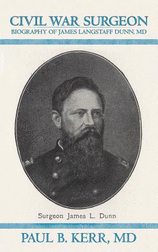
After discussing the war letters of James Langstaff Dunn through the lens of Gerald Linderman’s Embattled Courage and challenging the idea of mass disillusionment among Civil War soldiers, it becomes necessary to revisit the Dunn letters to discuss a more helpful framework for viewing Dunn and his war experience. Frances Clarke’s War Stories: Suffering and Sacrifice in the Civil War North sets up the Civil War against a backdrop of notions of Victorian suffering. By using Clarke’s approach, Dunn is revealed as an individual dedicated to cultural notions of suffering and sacrifice for cause and country.
Dunn2
Continue reading “Writing on the Operating Table Part Two: The Letters of James Langstaff Dunn, Civil War Surgeon”

Writing on the Operating Table: Letters of James Langstaff Dunn, Civil War Surgeon

by Sarah Johnson, ’15 Gerald Linderman???s Embattled Courage defines the pursuit of courage as the prime motivator for Civil War soldiers. For men going off to war, idealistic notions of courage and duty caused them to rise above their fears and fig…

By Sarah Johnson ’15

Gerald Linderman’s Embattled Courage defines the pursuit of courage as the prime motivator for Civil War soldiers. For men going off to war, idealistic notions of courage and duty caused them to rise above their fears and fight for their cause. However, the last chapter of Embattled Courage, titled “Disillusionment”, argues that eventually Civil War soldiers developed a hardened and stoic indifference to the suffering around them. Linderman argues soldiers stopped feeling like a vital part of an important cause and more like a small, insignificant piece of a vain struggle. The letters of James Langstaff Dunn, volunteer surgeon of the 109th and later 111th Pennsylvania Volunteers, offer a different interpretation, one that copes with the death and destruction by a grisly determination to see the war to its end.

Civil-war-0351

Dunn’s early letters reflect Linderman’s analysis of Victorian ideals about courage. He wrote his wife on May 2, 1861 assuring her that “the boys are healthy and in good spirits, ready to do their duty.”[i] The 109th PA received their baptism of fire on August 9, 1862 at the battle of Cedar Mountain. In the aftermath, Dunn spent twenty-four hours in surgery with no food and little water. He performed twenty-two amputations of the thigh alone, and “a great many” on arms.[ii] Dunn would go on to be involved in Second Bull Run, South Mountain, Antietam, Chancellorsville, and Gettysburg before being transferred to the west to Chattanooga, Lookout Mountain, Mission Ridge, and the Siege of Atlanta, in addition to other minor engagements.[iii]

Along the way, Dunn experienced, first-hand, the destruction the war brought. Stealing a moment to himself after Chancellorsville, he wrote to his wife assuring he was safe. The letter begins, “I have just one minute to write and I am writing it on the operating table.”[iv] Charged with putting broken men back together, Dunn was forced to evaluate the costs of the war and justify them to himself. The first patient Dunn lost haunted him. Lieut. Austin, a New Jersey cavalryman, was described by Dunn as “a handsome fellow, not over 21 or 22…I will remember his boyish looks and earnest appeals for help as long as I live.”[v]

A second incident that deeply affected Dunn was the loss of his hometown friend, J. W. Patton. Patton was hit by a shell at the top of the humerus, near where the arm articulates with the shoulder. The hit caused his humerus to fracture all the way down to his elbow. Dunn examined the wound and determined the arm could be saved, but after he passed on to treat another soldier, the arm was amputated by another surgeon.[vii] Amputation of the arm at the shoulder was a relatively simple procedure for an experienced surgeon, disarticulating the humerus at the joint with the shoulder was a natural place to separate and there was rarely a problem with controlling the bleeding. Three-fourths of shoulder amputees survived.[viii] Patton, however, did not. Dunn was profoundly hurt by what he deemed as an unnecessary loss of life; had not thought the arm needed amputation in the first place.

Dunn’s response to the trauma of war was not with disillusionment.  His war experiences reflect determination. Dunn’s letters reveal, instead of bitterness with the war, frustrations with the political wavering at home; he was a severe critic of Copperheads and Peace Democrats of the North. Dunn’s tirades against the Copperheads boiled down to a belief that the broken men on the field, bleeding and dying, deserved better than quasi-commitment at home.[ix]  Dunn’s 1864 New Year’s Resolution demonstrates his convictions and his justification for the costs of war:

Still, my life is spared. Tomorrow is New Years Day. I hope…that its end may see the close of this fearful War, to be crowned with garlands of a glorious peace in and undivided country, and with every man, black or white, enjoying the rights that God has given him. I know that some call this abolitionism, but it must come as the fruits of the many fearful sacrifices that have been, and are now being made by the best blood of the nation.[x]


[i] Paul Kerr, Civil War Surgeon-Biography of James Langstaff Dunn, MD, AuthorHouse, 2005, Letter to wife, Temperance, May 5, 1862, 21.

[ii] Kerr, Civil War Surgeon, Letter to wife, August 15, 1862, 63.

[iii] Kerr, Civil War Surgeon, 333.

[iv] Kerr, Civil War Surgeon, Letter to wife, May 4, 1863, 92.

[v] Kerr, Civil War Surgeon, Letter to wife,  May 12, 1863, 89.

[vi] Kerr, Civil War Surgeon, L
etter to wife, May 12, 1863, 89.

[vii] Kerr, Civil War Surgeon, Letter to wife, May 17, 1863, 94-95.

[viii] Medical and Surgical History of the Civil War, Volume X, Wilmington: Broadfoot Publishing Co., 1991.

[ix] Kerr, Civil War Surgeon, Letter to wife, January 27, 1863, 82.

[x] Kerr, Civil War Surgeon, Letter to wife, December 31, 1863, 153.

Photos from the National Archives.

Five Questions with Scott Hartwig

by Sarah Johnson, ’15 This past week I was given the opportunity to interview D. Scott Hartwig, Chief Historian of the Gettysburg National Military Park. I was able to ask him several questions and these are his answers. 1) Your new book, To Antie…

By Sarah Johnson ’15

This past week I was given the opportunity to interview D. Scott Hartwig, Chief Historian of the Gettysburg National Military Park. I was able to ask him several questions and these are his answers.

Img_1363 Continue reading “Five Questions with Scott Hartwig”

css.php