Tactical Insight and Sick Burns from a Woman at War: The Diary of Nadine Turchin

By Ryan Nadeau ’16

On June 27th, 1863, while camped at Murfreesboro, Tennessee, Nadine Turchin, wife of Brigadier General John Turchin of the Army of the Cumberland, wrote an irate entry in her journal. “Really, I think that the commanding general should take me as his chief of staff,” she began, “or at least as his personal advisor.” She went on to discuss the movements of her husband’s regiment as they campaigned in the west, criticizing the orders given to him by his superiors that had resulted in several deaths within the regiment and offering her own take on how they should have proceeded. “Oh, uncivilized beasts!” she concluded, in reference to the army’s leaders: “They are dedicated to sacrificing this unfortunate army.”

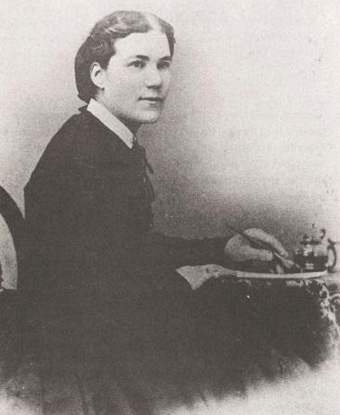
As I have previously written on this blog, Nadine Turchin was an extraordinary woman. Not only did she follow her husband to war (and by some accounts directly engage in the fighting), but she was highly articulate and possessed an incredible intellect. A multilingual Russian immigrant from an aristocratic background, Nadine was a unique observer of the Union army. She kept a diary while with the army, written primarily in 1863 as a writing exercise so that her mastery of French would not decay. In it, she recorded her frequently scathing thoughts on a variety of topics, including the rights of women, the conduct of the war, and the state of the country. She also used it to record her wartime observations, and it includes accounts of both the Battles of Chickamauga and Chattanooga, written from her point of view during the fighting.

The Battle of Chickamauga, witnessed by Nadine and described in her diary.
The Battle of Chickamauga, depicting the Union army Nadine Turchin believed only knew how to die, and the Union officers she believed to be incompetent. Image via Wikimedia Commons.

Continue reading “Tactical Insight and Sick Burns from a Woman at War: The Diary of Nadine Turchin”

Causing Conversation: Civil War Memory in Beyoncé’s “Formation”

By Annika Jensen ’18

Not only did Beyoncé slay in her latest music video, but she got historical. Her single “Formation” touches on feminism, oppression, sexuality, and police brutality, and her video offers a visual representation for the overall theme of African American cultural ownership. It is, of course, an essential message for contemporary discussion, and the formerly-silenced subject is beginning to achieve prevalence in the music industry, but there is something special and bold about Beyoncé’s take on race: by appealing to Civil War memory and forcing viewers to accept the African American struggle for life, freedom, and success, she is shattering perceptions of one of our country’s most popular areas of historical study. What’s more? She’s a woman.

In some scenes, the iconic singer reconnects with her Southern roots by appearing in a Civil War era Southern-style parlor with other women of color, all sporting opulent Victorian clothing. In another, she stands clad in black outside what appears to be a large plantation home and, in an act of rebellion, flips off the camera. These historical allusions certainly create a powerful image of African American social progression, but they also present a more subtle message about the memory of slavery and the Civil War. Beyoncé is denying any attempt to erase her from our history while presenting the complexity of black lives during the Victorian era. She carefully lays out the connotations of black and white, of woman and man, and of power and submission.

Beyoncé gets historical in her latest music video. Photograph via Billboard.com.

Continue reading “Causing Conversation: Civil War Memory in Beyoncé’s “Formation””

Ready, Aim, Feminism: When Women Went Off to War

By Annika Jensen ’18

I like to imagine that if Sarah Emma Edmonds were my contemporary she would often sport a t-shirt saying, “This is what a feminist looks like.”

Edmonds was a patriot, a feminist, and, along with an estimated 400 other women, a soldier in the American Civil War. Fed up with her father’s abuse and appalled at the prospect of an arranged marriage Edmonds left her New Brunswick home at the age of fifteen and soon adopted a male identity to become a successful worker. When the war erupted, she was compelled by a sense of patriotism and adventure to join the fight and was soon mustered into Company F of the Second Michigan Volunteers. The newly dubbed Frank Thompson, with her cropped hair and ill-fitting uniform, was able to fit in easily with the other youthful soldiers and soon marched to Manassas where her war story commenced. Throughout the war, Edmonds/Thompson served as a postman, a nurse, and a spy until she contracted malaria and was forced to desert for fear of revealing her true sex.

My queen Sarah Edmonds, alias Frank Thompson, of the Second Michigan Volunteer Infantry. Photo via nps.gov
My queen:  Sarah Edmonds, alias Frank Thompson, of the Second Michigan Volunteer Infantry. Photo via NPS.

Edmonds’ case is not unique, though not much is known about the other fighting women. Likewise, historians have trouble narrowing down their reasoning for joining the war: some, like Satronia Smith Hunt, could not bear to lose their husbands and decided to fight alongside them, while others enlisted out of a sense of patriotism, duty, adventure, or honor. But there was one incentive that tied each of these women together, from Jennie Hodgers to Loreta Velasquez, one motivation that governed their daring, noble actions: feminism and the desire for equality.

Let’s break down our reasoning. Continue reading “Ready, Aim, Feminism: When Women Went Off to War”

A Woman in Soldier’s Dress: To Wear the Uniform

By Elizabeth Smith ’17

This post is the last in a three-part series on women soldiers in the Civil War and during modern reenactments. You can also check out the first and second parts of this series.

At Civil War reenactments such as the one in Cedar Creek, Virginia, women are permitted to take the field as soldiers. Photograph by author.

Civil War reenacting has come a long way in the years since Lauren Cook was asked to leave the Antietam reenactment. Now women who aspire to portray soldiers have a far easier time of joining a unit that will allow them to take to the field. This does not, however, mean that the controversy surrounding women soldiers has vanished. Women may not be directly approached about their persona, but the disapproving glares like the ones I myself have received are all too prevalent.

Women who wish to portray soldiers in Civil War reenactments face a multitude of challenges. First, they must get past the physical limitations. “How serious are you at disguising yourself and presenting yourself as a ‘man?’” writes one reenactor on an online chatroom specifically dealing with women portraying soldiers.

Would you cut your hair? Trim your nails? Go without any makeup and perhaps smear your face with dirt? Wear restraints to hide your feminine features? The reason most reenacting units will not permit a female in the ranks is because, 1. It is more historically accurate. 2. Most women trying to act like a male soldiers do a rotten job of it.

Continue reading “A Woman in Soldier’s Dress: To Wear the Uniform”

A Woman in Soldier’s Dress: Then and Now

By Elizabeth Smith ’17

This post is the second in a three-part series on women soldiers in the Civil War and during modern reenactments. Also check out the introduction of this series.

I was thirteen years old when I joined the 5th Kentucky Orphan Brigade, a Confederate reenactment group based out of south-central Kentucky. At fourteen, I “saw the elephant”—a Civil War term for seeing battle—for the first time as a soldier. It was the most terrifying thing I’ve ever done, but seven years later I credit that decision to go through with it as bringing me to where I am now, writing for the Compiler here at Gettysburg College. In those seven years, however, I have faced my fair share of scrutiny for portraying a soldier rather than a civilian. I didn’t become aware of the scrutiny until more recently, however, as I became more conscious both of historical and modern views about women portraying soldiers at Civil War reenactments.

I’ve been lucky. Only once have I ever been in a situation where I thought I would not be able to participate in the event because I am a woman, but that one time when I was sixteen was quickly fixed by my first sergeant convincing the board of that particular reenactment to amend the rules that had said no women were allowed to portray soldiers. In seven years, never once has anyone directly questioned whether or not I should be allowed to take the field. I’ve been complimented on my authenticity, encouraged to continue to be as accurate as possible, and never had a negative comment directed at my portrayal of a woman soldier.

Although I haven’t had anything said to my face, I have received nasty glances that clearly say “She doesn’t belong.” Though the reenacting community has become far more open to women soldiers since 1989, there are some who do not believe it is a woman’s place to be on the battlefield. I’ll discuss this more in depth in the next post, but for now it is safe to say that there are some who believe no women should portray soldiers. Continue reading “A Woman in Soldier’s Dress: Then and Now”

A Woman in Soldier’s Dress: Taking the Field

By Elizabeth Smith ’17

The year was 1989. The place, a Civil War reenactment at Antietam National Battlefield. Lauren Cook (then Burgess) had been participating in reenactments for two years. Her portrayal of a fifer required her to wear a soldier’s uniform rather than in a civilian woman’s dress. She did her best to portray a soldier, disguising her sex so she could pass the “fifteen yard” rule, which meant that at fifteen yards she could not be identified as a woman. The call of nature proved to be her undoing, however, when an NPS official “caught” her coming out of the women’s restroom. Asked to wear a dress and portray a civilian, Cook refused and was told to leave the event. Cook perceived this as sex discrimination and filed a law suit against the federal government. Four years later, in 1993, she would win her court case.

Though dramatic in nature, Cook’s experience is echoed through the many stories of women who attempt to portray soldiers in Civil War reenactments. Times have changed since 1989, and women are now allowed to portray soldiers, but the stigma remains. Women who wish to portray soldiers are expected to not only have an accurate uniform, but to pass the “fifteen yard rule.” For some, this is what they strive to do and many go above and beyond in accomplishing this. Others, however, do not even attempt to disguise their sex. This is where the controversy begins and people start to question whether or not women should be allowed to portray soldiers at all.

The author in uniform. Photograph by the author.

Continue reading “A Woman in Soldier’s Dress: Taking the Field”

Historical Preservation: The Elizabeth Cady Stanton Property

By Amanda Thibault ‘17

This post is part of a series featuring behind-the-scenes dispatches from our Pohanka interns working on the front lines of history this summer as interpreters, archivists, and preservationists. See here for the introduction to the series.

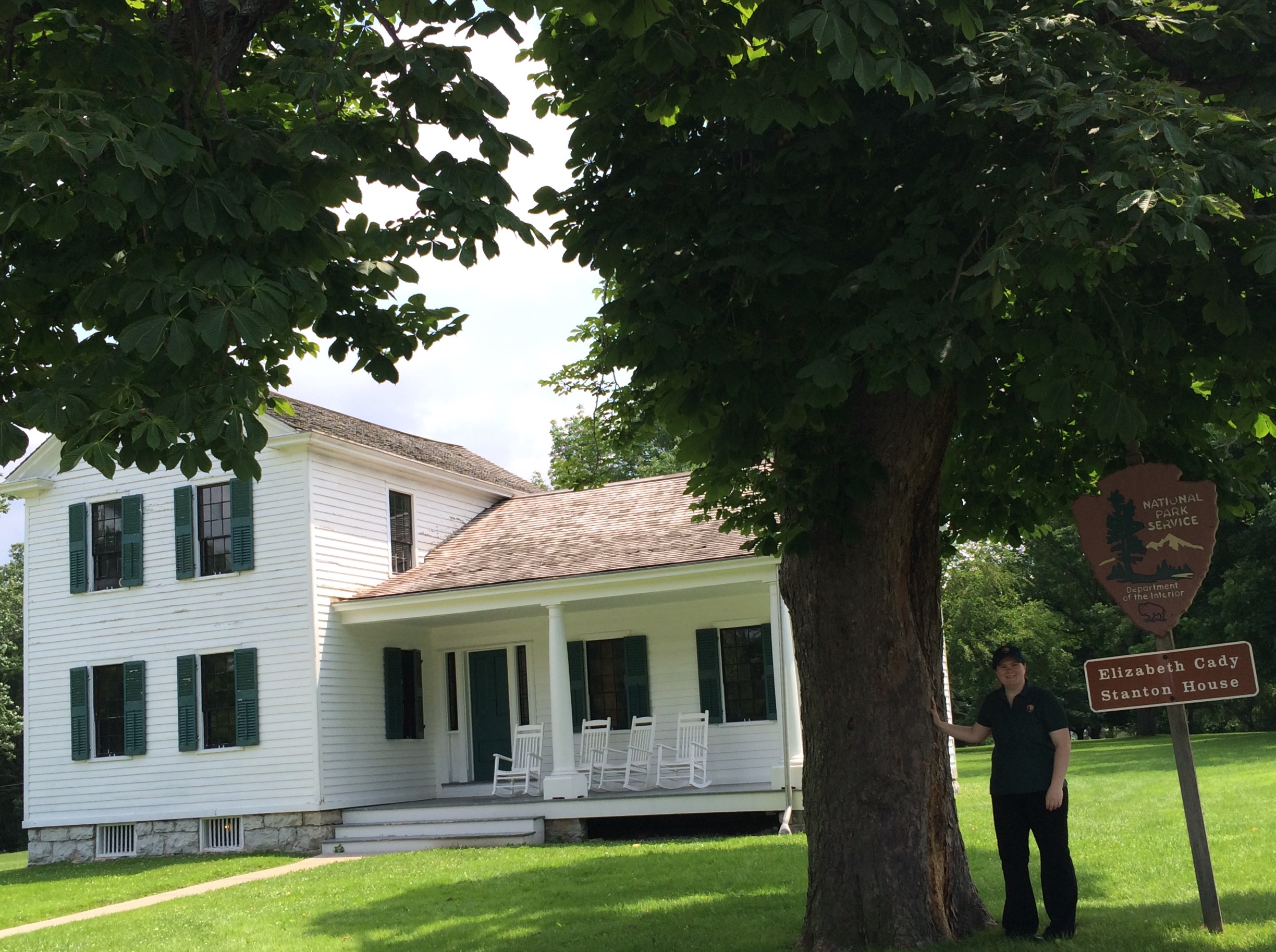
The Elizabeth Cady Stanton property presents a number of preservation and interpretive challenges. The NPS is currently considering launching a landscape restoration project. Photo courtesy Amanda Thibault.

Historical preservation has always been a problematic issue for the National Park Service. Park officials must find a balance between preserving and exploiting historical landscapes. At battlefields such as Antietam, the National Park Service has issued a policy of landscape freezing to help visitors understand the historical significance of the park. Landscape freezing refers to preserving the landscape of a particular historical period in time. Antietam has issued a policy of restoring the landscape to the eve of the battle to the maximum extent possible. However, there are many problems facing this plan, like removing the roads that allow visitors to travel through the battlefield and form an emotional connection to the site.

The problems of historical preservation are pronounced here at Women’s Rights National Historical Park in Seneca Falls, NY, especially at the Elizabeth Cady Stanton property. Elizabeth Cady Stanton was the primary figure behind the first Women’s Rights Convention in 1848. During tours of the property where Elizabeth Cady Stanton, her husband Henry Stanton, and her seven children lived from 1847 to 1862 only ten people are allowed in the house at once because of its small size. If there is a larger tour, the remaining visitors have to wait outside. Today, the only remnants of the Stanton property are the horse chestnut tree in front of the property and fruit trees located in the northeast corner of property. The orchard, flower and vegetable gardens, the circular driveway, the outdoor playground for the children, the barn and other outbuildings no longer exist. I believe the National Park Service should recreate as much of the original landscape as possible so visitors can roam around while waiting to go inside the house. Continue reading “Historical Preservation: The Elizabeth Cady Stanton Property”

The Double Disadvantage: African American Women in White Male Memory

By Megan McNish ’16

In darkness the boat crept up the river, silent as death. The captain in charge was sure of himself, sure of the information on which he was acting and of those guiding him up the narrow river. The young woman, somewhere on the ship, was the most reliable woman in the region. As the sun rose over the horizon, the boats pulled up to the ferry dock and the soldiers departed. The slaves were ready and at first word flocked to the boats, pushing and shoving to make their way on board. In the chaos that followed, the two small boats managed to get away with close to 300 captives. After it was all over, newspapers announced the Combahee Ferry Raid’s success and its most famous participant, Harriet Tubman.

This subject may be familiar to some of you who follow the Compiler closely, as Becky Oakes wrote about the Combahee Ferry Raid a few years ago (see Becky’s post for a more thorough treatment of the event). It was undeniably an impressive feat. Tubman managed over the period of a few months to gather enough information to steal slaves right from the plantation and, though the event was fairly well known in its time, it is virtually absent from American historical memory today. Harriet Tubman’s role in the marginalized world of slaves is remembered, but her role in aiding the United States Military is all but forgotten.

Combahee River Raid. Harper’s Weekly, July 4, 1863.

Continue reading “The Double Disadvantage: African American Women in White Male Memory”

css.php