
Speaker Interview: Northern Women at War

By Dr. Ashley Whitehead Luskey

Nina Silber is an award-winning teacher at Boston University where she teaches in both the department of history and the program in American and New England Studies. Her research and teaching have focused mainly on issues related to historical memory, gender, and the Civil War. A recipient of numerous awards – including fellowships from the Fulbright Commission, the National Endowment for the Humanities, and Harvard University’s Warren Center – Professor Silber has also published works that have helped to expand the scholarly horizons in the study of the Civil War. Among her most important publications are: The Romance of Reunion: Northerners and the South, 1865-1900 (1993); Divided Houses: Gender and the Civil War (1992); Daughters of the Union: Northern Women Fight the Civil War (2005); and, most recently, This War Ain’t Over: Fighting the Civil War in New Deal America (2019). Professor Silber has also worked in the field of public history, consulting on projects with the Gettysburg National Military Park, the History Channel, and the National Park Service.  She currently serves as president of the Society of Civil War Historians.

Silber
Dr. Nina Silber (Boston University)

CWI: The crisis of the Civil War was clearly disruptive to the Northern home front when men left to join the Union armies. What were the expectations in the North for how women would factor into the war for the Union in 1861? Did these expectations shift during the course of the war? How did the war affect traditional gender roles in the North?

Silber: Unlike Confederates, who went to war to protect their homes and families, Northern men spoke explicitly about putting the fight for the country above the fight for home. Confederates, for example, said things like this: “We are fighting for matters real and tangible, our property and our homes.” In contrast, one Union soldier told his wife: “My duties to my country are of more importance now than my duty to you.” That’s a very different kind of sentiment. And I think that language reflected certain assumptions about women and gender: That Northern men expected women to fend for themselves, even doing chores (at least temporarily) that men normally carried out. One soldier from Iowa said precisely that to his wife: That she should “take hold and do for thyself and use thy own judgment about matters”. In other words, he urged her to become more self-sufficient, while Confederate men emphasized male protection and authority.

The one shift I noticed, mid-way into the war, was the way Northern men, perhaps because the war was not going well, urged women to show even greater patriotism and sacrifice than before. Women, I think, were increasingly becoming a convenient scape goat: Men were connecting their military failures to women supposedly failing to do their part, yet there’s not really any evidence to back that up. If anything, evidence points to active participation on women’s part, especially in procuring supplies for soldiers, sending aid packages to the front, and sponsoring fairs that raised significant funds for Union troops.

filling-cartridges LOC
Some women took up new jobs outside the home to assist the Union war effort and supplement their household income. Such jobs included the dangerous task of working with munitions and filling black powder cartridges, as depicted in this image of female employees at the U.S. Arsenal in Watertown, MA. (Image courtesy Library of Congress)

CWI: How did Northern women respond to these changes? Were women more willing, or even eager, to push these boundaries and move out of their traditional domestic sphere? Did their responses to wartime changes depend on certain external factors, such as their geographic region; socioeconomic status; or the type of work they took on?

Silber: Women often had no choice but to assert the kind of self-sufficiency that some Union soldiers expected. They often did take on new responsibilities – from going to work in factories to doing men’s jobs on farms (e.g., chopping wood; harvesting crops; bringing produce to market). Some moved in with other family members (their own or their in-laws) to relieve some of the financial and physical burdens. Still, I don’t think women usually did these new chores with a sense of liberation. Indeed, many were often frustrated when they discovered how little they knew of the work men did: Debts that may have been owed or even the overall state of the family’s finances. Additionally, I think many simply felt overwhelmed by how much was expected of them during the war. Many couldn’t wait until their husbands came home so they could turn those “male” responsibilities back to them.

One exception to this may have been the kind of pride and ownership many women demonstrated when it came to their heightened political involvement: They became invested in partisan struggles, supported specific candidates, and learned as much as they could about the political and military struggles of the moment. Recognizing how critical women’s input was to the challenges at hand, one Connecticut woman wrote a letter to her husband in which she asked “why don’t they let the soldiers’ wives vote” while the soldiers are away.

Working class women faced added difficulties in losing the regular income of husbands and fathers. Some of those women found jobs – for example sewing uniforms or making other military supplies – but because they often worked for sub-contractors, not directly for the US government, their pay was exceedingly low.   In some towns and cities, officials pledged relief money for struggling families, although women often had to wade through a considerable bureaucratic apparatus to procure this assistance. Increasing numbers of families, having no other means of support, found themselves turning to almshouses in these years.

Treasury
The U.S. Treasury in Washington, D.C. hired increasing numbers of women to help produce currency and serve as clerks over the course of the Civil War—a trend that continued even after the war years through the end of the 19th century. (Image courtesy U.S. Treasury Department)

CWI: Did the impact of wartime changes on gender roles extend beyond the war? What happened to the women who became wage earners or participants in politics or nurses? Did their engagement in wartime activism end when the conflict ended? Where do most Northern women find themselves in the late 1860s?

Silber: Some things changed, and others did not. Many women who went to work in factories lost those jobs when the war ended; there simply wasn’t the need for the kinds of factory jobs women had occupied– in arsenals or in workshops that made uniforms or blankets or tents. In the nursing field, there was a growing acknowledgement of nursing as a profession, something which required precise and scientific training. Nursing schools – which admitted women – opened up in the postwar years.

Other women, those who had been politically active for causes like abolitionism and women’s suffrage, continued the campaign for suffrage and also for protecting the rights of freed people after the war ended. There was, however, considerable disagreement about how to prioritize those campaigns with some, including many African American women, ranking the struggle for black men’s suffrage and civil rights for African Americans as more important than winning votes for all women. Other women’s rights activists chose a different path: Refusing to support the fifteenth amendment – which granted black men the right to vote – they sought to build a new campaign focused solely on gaining the vote for women, a campaign that increasingly put white women at the center.
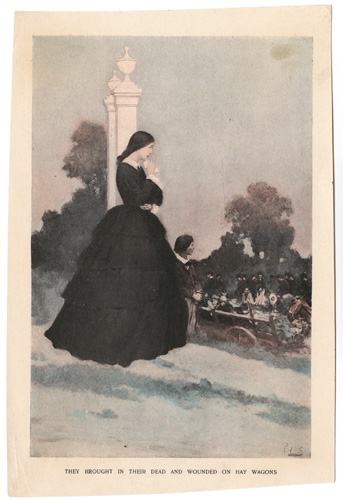
Women7
“They Brought in Their Dead and Wounded on Hay Wagons.” Public mourning became an all-too-common ritual for many women during the Civil War whose personal grief became synonymous with patriotic suffering and sacrifice. (Image courtesy Library of Virginia)


Private William W. Halloway, Co E., 21st Maine

By Wesley Cline

During the Fall of 2019, a handful of first-year Gettysburg College students traveled down to the National Archives and Records Administration in Washington, D.C. to conduct primary source research into a group of Civil War soldiers whose “dog tags” now reside in the collections of the Texas Civil War Museum in Fort Worth, Texas. This post is the third in a short series highlighting the stories of the men who wore these unique identification tags into battle.  For a short history of military identification tags, or “dog tags,” check out Savannah Labbe’s (’18)  2016 article on the evolution of the dog tag.

   Many thanks to Ray Richie, President of the Texas Civil War Museum, for his generosity in sharing these fascinating items from the museum’s collection with our students!

HallowayDogTag
Halloway’s identification ring on display at the Texas Civil War Museum

On October 13, 1862, William Halloway enlisted for a nine-month term in the 21st Maine Infantry regiment at age 34. After mustering at Augusta, the regiment marched to New Jersey and would eventually arrive by transport ship in New Orleans on January 31st, 1863. The Confederate city had fallen into Union hands the previous May. Shortly after they had disembarked, the 21st Maine proceeded to march in the direction of Baton Rouge, arriving on February 3rd, 1863. No doubt feeling warmer than he was used to in Maine, William Halloway spent the remainder of the month of February in Louisiana, peacefully serving in Company E as a private.

On March 7th, the regiment would “see the elephant,” conducting actions against Port Hudson along the Mississippi River. On March 20th, the regiment returned to Baton Rouge where it remained in the coming months, awaiting the likely order to begin assaults against Port Hudson.

That order would come on May 20th, with General Nathaniel P. Banks directing his army, including the 21st Maine, to advance towards the heavily fortified port to prepare for an attack concurrent with General Ulysses S. Grant’s assault on Vicksburg, just up the river. This action was intended to be the final Union offensive on the Mississippi River. However, not all went according to plan. Just one day after beginning its march, the 21st and the rest of the 19th Corps would encounter Confederate forces in what became known as the Battle of Plains Store, which ultimately forced the Confederates back into their defenses and cut off the 19th Corps’ retreat route. The Maine men would proceed to join over 30,000 other Federal troops, including former slaves fighting in multiple United States Colored Troops (USCT) units, in laying siege to Vicksburg and its surrounding ports and defenses.

The 21st would take part in an ill-fated assault of May 27th against the Confederate positions spanning their entire defensive line that would result in almost 2,000 Union dead, many of whom lost their lives in the ironically named “Slaughter’s Field.” Despite this setback, the Union 19th Corps remained in position, ready to again advance against the port’s earthworks. That opportunity came on June 14th, but would end in absolute disaster: The Confederate defenders inflicted over 1,800 casualties on the Union forces while themselves sustaining less than two hundred deaths. Port Hudson would hold out until Vicksburg fell on July 4th, 1863; without the major Confederate stronghold upriver in Vicksburg, Port Hudson served no practical purpose. The regiment lost 1 officer and 26 enlisted men killed and mortally wounded, and 1 officer and 144 enlisted men from disease. The 21st was sent home on July 24th, and officially mustered out on August 25th.

It is unknown if William Halloway participated in any of this fighting, as he is reported to have been diagnosed with rheumatism on May 20th, the very day the 21st began to advance towards Port Hudson. If Halloway was indeed absent from the ranks, his rheumatism ultimately may have spared his life during the spring of 1863.

Despite the war continuing for another two years, William Halloway did not reenlist after the expiration of his 9-month term that July. On April 25th, 1880, he died at 52 years old. It is possible that the rheumatism from his service had permanently damaged his body, leading to his untimely death. He left behind his wife, Larehta and his four daughters. At the time of his death, his youngest daughter was just under ten years old.


Sources:

National Park Service- Battle Details of the 21st Maine

https://www.nps.gov/civilwar/search-battle-units-detail.htm?battleUnitCode=UME0021RI

The American Civil War- The Battle of Port Hudson

https://www.americancivilwar101.com/battles/630521-port-hudson.html

American Battlefield Trust- Port Hudson

https://www.battlefields.org/learn/civil-war/battles/port-hudson

Private James B. Minturn, Co. B, 127th New York

By: Lauren Letizia

During the Fall of 2019, a handful of first-year Gettysburg College students traveled down to the National Archives and Records Administration in Washington, D.C. to conduct primary source research into a group of Civil War soldiers whose “dog tags” now reside in the collections of the Texas Civil War Museum in Fort Worth, Texas. This post is the second in a short series highlighting the stories of the men who wore these unique identification tags into battle.  For a short history of military identification tags, or “dog tags,” check out Savannah Labbe’s (’18)  2016 article on the evolution of the dog tag.

   Many thanks to Ray Richie, President of the Texas Civil War Museum, for his generosity in sharing these fascinating items from the museum’s collection with our students!

DogTag
Minturn’s gold identification pin on display a the Texas Civil War Museum

James B. Minturn was born in 1833 in New York City, New York. When the Civil War broke out, he decided to leave his work as a merchant to enlist in the Union Army on August 12, 1862. Minturn was mustered into Company B. of the 127th New York Infantry on September 8, 1862, when he was 29 years old. He was promoted to Corporal on January 10th, 1863 and then to 1st Sergeant on August 1, 1863. However, was later Minturn demoted on March 11, 1864 for reasons unknown. On August 11, 1864, he asked for a furlough to attend the Free Military School in Philadelphia, Pennsylvania. The Free Military School of Philadelphia was established in 1863 by both abolitionists and Union officers as an institution for the training of white Union soldiers to become officers of the United States Colored Troops (USCT). The school recruited their students from deeply Republican units and trained both soldiers and non-commissioned officers. Private Minturn, however, never became an officer of a USCT unit. Minturn ultimately was dishonorably discharged by the 127th New York on September 24, 1864, but proceeded to accept a commission in the 38th New Jersey Volunteers. James Minturn survived the war and was mustered out in Charleston, South Carolina on January 30th 1865.

The 127th New York Infantry Regiment, also known as the “Monitors,” was under the command of Colonel William Gurney, who organized the regiment in Staten Island, New York. After leaving New York state on September 8, 1862, the 127th served in the defenses of Washington, D.C., eventually joining John J. Abercrombie’s Division, of the 12th Corps, until February of 1863 before transferring to the 22nd Corps (Department of Washington), commanded by General Samuel P. Heintzelman, until April of 1863. The 127th participated in the April Siege of Suffolk as well as Dix’s Peninsula Campaign (June 24-July 7). After short stints in the 7th and 11th corps, the regiment served out the rest of the war, from August, 1863 through June of 1865, in the 12th corps, Department of the South, along the coast of South Carolina, where it participated in the sieges of Forts Wagner, Gregg, and Sumter in August, and in the on-going operations against Charleston. The regiment lost 35 enlisted men killed or fatally wounded and one officer and 94 soldiers to disease during its service in the Civil War.


“Battle Unit Details.” National Parks Service. U.S. Department of the Interior. Accessed February 9, 2020. https://www.nps.gov/civilwar/search-battle-units-detail.htm?battleUnitCode=UNY0127RI.

Fry, Zachery A. “Philadelphia’s Free Military School and the Radicalization of Wartime Officer Education, 1863–64.” The Pennsylvania Magazine of History and Biography 141, no. 3 (2017): 275. https://doi.org/10.5215/pennmaghistbio.141.3.0275.

Twilight of the Blue and Gray: Gettysburg College and the 1938 Reunion

By: Cameron Sauers

CWI Fellow Cameron Sauers ’21 recently interviewed Chief of Interpretation at Gettysburg National Military Park Chris Gwinn about the tour that Ranger Gwinn will lead at this summer’s conference. Ranger Gwinn’s tour is entitled “Twilight of the Blue and Gray: Gettysburg College and the 1938 Reunion” and will explore the site of the “Great Camp” at Gettysburg College, where 1,485 former Union and Confederate soldiers gathered for the final reunion of surviving Civil War veterans. Discover the stories of the veterans that attended and explore the history behind one of the most mythologized events in Gettysburg’s history.


For more information on the 2020 Civil War Institute Summer Conference, or to register, see our website! 

“The Day Has Been a Most Unfortunate One for Us”: The First Day at Gettysburg

CWI Fellow Erica Uszak ’22 recently interviewed former NPS Ranger Scott Hartwig for a preview of Hartwig’s upcoming tour at the 2020 CWI Summer Conference.

Why was there a battle at Gettysburg on July 1? How did it result in a tactical Confederate victory but operational Union success, and shape the battle of July 2 and 3? These questions and the major decisions and key actions of the battle on July 1 will be the subject of this tour. The tour will visit all the major points of the First Day’s fighting from Reynolds Woods to Barlow’s Knoll.

William H. Brierly – Private, Company A, 174th Pennsylvania Infantry Regiment

By Jaeger Held

During the Fall of 2019, a handful of first-year Gettysburg College students traveled down to the National Archives and Records Administration in Washington, D.C. to conduct primary source research into a group of Civil War soldiers whose “dog tags” now reside in the collections of the Texas Civil War Museum in Fort Worth, Texas. This post is the first in a short series highlighting the stories of the men who wore these unique identification tags into battle.  For a short history of military identification tags, or “dog tags,” check out Savannah Labbe’s (’18)  2016 article on the evolution of the dog tag.

   Many thanks to Ray Richie, President of the Texas Civil War Museum, for his generosity in sharing these fascinating items from the museum’s collection with our students!

Brierley dog tag
Brierley’s Dog Tag on display at the Texas Civil War Museum.

William H. Brierly, alternatively spelled Bryerly, was born in about 1822 in either Ireland or Lancashire, England. He immigrated to the United States and settled in Bucks County in eastern Pennsylvania, and was living there in 1862 as the American Civil War entered its second year.

As a result of the Federal Militia Act of 1862, William was drafted at age 39-40 and entered as a private into a nine-month regiment, Company A, 174th Pennsylvania Infantry Regiment (Drafted Militia) on October 2, 1862, while residing in Bucks County, Pennsylvania. Eight of the regiment’s ten companies (A, B, C, D, E, F, G, and K) were drawn primarily from eligible male citizens living in Bucks County, with Companies H and I from Northampton County. Private Brierly was mustered into federal service on October 29, 1862. The 174th Pennsylvania was organized at the general camp of rendezvous in West Philadelphia, Pennsylvania, in late October and November of that year, and on November 19 the following field officers were selected: Colonel John Nyce, Lieutenant Colonel Edward T. Hess, and Major Joseph B. Roberts. Later that month the regiment moved to Washington, D.C., then to Suffolk, Virginia, where it was assigned to duty and attached, along with the 176th Pennsylvania Infantry, to Brigadier General Orris S. Ferry’s brigade of Major General John J. Peck’s division at Suffolk, Virginia, 7th Corps, Department of Virginia. In late December the regiment was ordered south and moved to New Bern, North Carolina from December 31, 1862, to January 6, 1863, and there was attached to the 2nd Brigade, 3rd Division, 18th Corps, Department of North Carolina. The regiment, as part of the forces in North Carolina under Major General John G. Foster, was ordered to reinforce the army operating in front of Charleston, South Carolina.

Picture2
Brierly’s pension paperwork at NARA. 

The 174th sailed for Port Royal Harbor, South Carolina, on January 27, 1863, and on February 5, the regiment debarked at St. Helena Island, South Carolina, where it was attached to the 2nd Brigade, 2nd Division, 18th Corps, Department of the South. The regiment remained in camp until February 27, when it moved to Beaufort and was attached to the District of Beaufort, South Carolina, 10th Corps, Department of the South. In June, the regiment was stationed at Hilton Head, South Carolina, and attached to the District of Hilton Head, South Carolina, 10th Corps, Department of the South. On July 28, 1863, the regiment embarked for Philadelphia and was mustered out on August 7. During its nine months and nine days of service, the regiment had served on occupation and garrison duty, and Company A did not suffer any deaths, though the regiment had lost 14 men due to disease. Five died in Company F alone. According to the regiment’s final roster, of the 87 members of Brierly’s company, a staggering total of 41, or 47%, deserted while in service, likely due to low morale among the drafted men worsened by their monotonous routine of rear echelon service and the proliferation of camp disease. Private William H. Brierly was mustered out of federal service with his regiment in Pennsylvania on August 7, 1863, having seen little combat but having played a necessary role in Union operations along the South Atlantic Coast.

Picture1
Pvt. William Brierly’s headstone in Lower Saucon, Northampton County, Pennsylvania.

William Brierly married Sarah Weaver, née Moatz / Moths (born May 14, 1838) in 1867, and with her had four children, all born in eastern Pennsylvania: Mary Alice Brierly (March 17, 1868–May 3, 1936), Anna Dora Elizabeth Brierly (December 7, 1869–January 31, 1912), James Albert Monroe Brierly (December 21, 1873–December 10, 1929), and Ida Savanna Brierly (January 9, 1876–September 11, 1945). William applied for an invalid pension from Pennsylvania on November 14, 1881, but died in Bucks County, Pennsylvania on July 31, 1882, of fatal cancer of the liver. He was 59-60 years of age. The Civil War veteran was buried in the New Jerusalem Old Cemetery in Lower Saucon, Northampton County, Pennsylvania, and his grave was furnished with a U.S. government upright marble headstone that reads “Wm Bryerly CO. A. 174th PA. INF.” In 1888, his wife Sarah Brierly applied for a widow’s pension from Pennsylvania, but her pension application was denied on March 25, 1895. She died on December 6, 1899, at age 61, and was buried with her husband in the New Jerusalem Old Cemetery in Lower Saucon, Northampton County, Pennsylvania. All four of William and Sarah’s children married and had families of their own and lived out their lives in eastern Pennsylvania.


Sources:

https://www.findagrave.com/memorial/25979754/william-bryerly

https://search.ancestry.com/cgi-bin/sse.dll?indiv=1&dbid=1138&h=780701&tid=&pid=&usePU B=true&_phsrc=Pfw1850&_phstart=successSource

https://www.nps.gov/civilwar/search-soldiers-detail.htm?soldierId=4D44EA85-DC7A-DF11-BF 36-B8AC6F5D926A

http://www.pa-roots.com/pacw/infantry/174th/174thcoa.html https://www.pa-roots.com/pacw/infantry/174th/174thorg.html

http://civilwarintheeast.com/us-regiments-batteries/pennsylvania/174th-pennsylvania-infantry/ https://www.nps.gov/civilwar/search-battle-units-detail.htm?battleUnitCode=UPA0174RIX

Headstone photos courtesy of Frederich Otto and Tom Myers, findagrave.com


Speaker Interview: Sharpshooting at Gettysburg

By Dr. Ashley Whitehead Luskey

Tim Orr is an Associate Professor of History at Old Dominion University, where he teaches classes in nineteenth-century America and Civil War history. A graduate of Gettysburg College, he received his PhD from Penn State University. Prior to his arrival at ODU, Dr. Orr worked for 8 years as a seasonal park ranger at Gettysburg National Military Park. His first book, “Last to Leave the Field”: The Life and Letters of First Sergeant Ambrose Henry Hayward, Company D, 28th, was published by the University of Tennessee Press in 2010. He is the author of several book chapters and articles on the battle of Gettysburg as well as a co-author of the book Never Call Me a Hero: A Legendary American Dive-Bomber Pilot Remembers the Battle of Midway, with Laura Lawfer Orr and N. Jack “Dusty” Kleiss (William Morrow, 2017)

Photograph by Miranda Harple
Dr. Tim Orr leading a tour at a previous CWI Conference

CWI:  You’re leading our new Active Track option this year, which will focus on sharpshooting at Gettysburg. On its own, this package is shorter (weekend only) and more physically intensive, with rigorous climbs and walks mostly centered on the Union left. Before we get to the specifics of Gettysburg, can you tell us a little bit about sharpshooting and what that term meant for both the Union and Confederate armies in the early summer of 1863?

ORR: In many ways, sharpshooting was a new concept for American armies. Prior to the Civil War, taking care to aim was not something that many soldiers did. Smooth-bored weaponry did not allow for combat range beyond seventy yards, so battles often emphasized the massing of firepower, not marksmanship. (A few rifle regiments had been used during the Revolution and the War of 1812, but rarely did they have a tangible effect on the flow of battle.) During the Civil War, with the addition of a new skirmish drill manual and rifled-musket technology, Civil War infantry were required to fight at long range more and more. This, in turn, required soldiers to surmount an emotional hurdle. Quite often, soldiers considered sharpshooters as akin to murderers, and that killing a soldier when he wasn’t expecting it was dishonorable. However, that feeling died quickly. By 1863, in the Eastern Theater, sharpshooting was en vogue, and Gettysburg is an excellent battlefield to find evidence of that.

main-image
Winslow Homer, The Army of the Potomac – A Sharp-Shooter on Picket Duty, from Harper’s Weekly, vol. 7, November 15, 1862, the Metropolitan Museum of Art

CWI: Many students of the Civil War have heard of Berdan’s Sharpshooters, but their stories aren’t usually the first or second that we hear about Gettysburg–a battlefield that has many intriguing regimental narratives. How important were the sharpshooters on these fields? How did they shape the outcome of the fighting at Gettysburg and why were their contributions important?

ORR: This active-track package is going to focus primarily upon Berdan’s 1st and 2nd U.S. Sharpshooters, two of the first specialized regiments in U.S. Army history. We will allocate each day to studying a pivotal action played by Berdan’s men: the 1st U.S.S.S. at Pitzer’s Woods and the 2nd U.S.S.S. at the Slyder Farm and on Big Round Top. Both of these regiments had important roles to play. At noon on July 2, the 1st U.S.S.S. engaged Confederate infantry under Brig. Gen. Cadmus Wilcox inside Pitzer’s Woods, and the resulting combat influenced Maj. Gen. Daniel Sickles’s decision to redeploy the Army of the Potomac’s 3rd Corps to the Joseph Sherfy Peach Orchard, one of the pivotal decisions of the battle. Then, later in the day, when Maj. Gen. John B. Hood’s Confederate division arrived to sweep up the Union left flank, it encountered a stubborn skirmish line consisting formed by the 2nd U.S.S.S. During this excursion, we will, in essence, see how a handful of soldiers influenced the tide of battle. It’s a dramatic story!

20366v
Alfred Waud, Soldiers shooting from behind rock at Round Top, 1863, Library of Congress Prints and Photographs Division

CWI: What are the most common misconceptions about Civil War sharpshooters?

ORR: At the time, many soldiers in both armies despised sharpshooters, thinking them ungentlemanly. However, that stigma eroded over time, and by 1863, both armies deployed regiments of sharpshooters to augment their fighting abilities. Nowadays, I’m not sure what misconceptions about them exist. Although, I generally assume that most people believe that 1860s rural America produced the best sharpshooters. In reality, the best marksmen came from the cities, where shooting clubs tested riflemen’s skill. In some ways, the North–not the South–had the natural advantage in sharpshooting.

Speaker Interview: The Civil War in the West

By Ashley Whitehead Luskey

Megan Kate Nelson is a writer and historian living in Lincoln, Massachusetts. Her new book, The Three-Cornered War: The Union, the Confederacy, and Native Peoples in the Fight for the West, will be published by Scribner in February 2020. This project was the recipient of a 2017 NEH Public Scholar Award and a Filson Historical Society Fellowship. Nelson is the author of two previous books: Ruin Nation: Destruction and the American Civil War (Georgia, 2012) and Trembling Earth: A Cultural History of the Okefenokee Swamp (2005). She has also written about the Civil War, the U.S. West, and American culture for The New York Times, Washington Post, Smithsonian Magazine, Preservation Magazine, and Civil War Times. Her column on Civil War popular culture, “Stereoscope,” appears regularly in the Civil War Monitor. 

Megan Kate Nelson web res-2547.jpg
Dr. Megan Kate Nelson

CWI: Your new book, The Three-Cornered War, is about the Civil War in the West, but you are not writing about what we traditionally think of as the Western Theater. So can you explain how do you define “the West” in your new book, and can you tell us why this “West” is important for understanding the American Civil War?

Nelson: As all CWI attendees know, the term “the West” is most often used to describe the Trans-Mississippi theater (engagements in Missouri, Arkansas, western Tennessee, Louisiana, eastern Texas, and Indian Territory). For this reason, most maps included in Civil War history books extend only as far west as central Texas, erasing roughly 40% of the nation’s landmass. Because what could be west of “the West”? What could have happened in a place that’s not even on the map?

In The Three-Cornered War, I redraw that map of the Civil War, extending it to the Pacific Ocean and including in it not only states and U.S. territories west of the 100th meridian but also the boundaries of Native homelands.

Most of the action in The Three-Cornered War takes place in Colorado, Texas, southern California, New Mexico, and the territory that became Arizona during the war. This region (the Southwest) was a gateway to the larger West in 1861. The Confederacy wanted to seize New Mexico to gain access to California’s gold mines and Pacific ports, and to establish a base for launching additional campaigns for the states and territories of the larger West.

Henry Hopkins Sibley, a career U.S. Army man who resigned his commission to join the Confederacy, had these goals in mind when he invaded New Mexico Territory with a brigade of 3,000 Texans in the winter of 1861-62. Union colonel E.R.S. Canby brought together an army of regulars and Anglo and Hispano volunteers to defend New Mexico against this incursion.

In their subsequent clashes, both armies marched and fought through Native homelands. These communities—Chiricahua and Mescalero Apaches and Navajos, in particular—exploited this fight between the Union and the Confederacy early in the war, siphoning animals from army wagon trains and camps and retaking territories they had lost to American military and civilian settlement in the 1850s.

Once the Union defeated the Confederates and drove them back to Texas in the summer of 1862, federal troops under James Carleton turned their attention to defeating Apaches and Navajos. In order to fully win the West during the Civil War, the Union had to wrest its lands from indigenous peoples. The second half of The Three-Cornered War tracks these events through the experiences of Navajos, Chiricahua Apaches, and 1st New Mexico and 1st California soldiers who engaged in these fights.

Approaching the history of the Civil War from this often overlooked (and sometimes dismissed) vantage point reveals surprising elements of the conflict, among them that:

  • The future of the West remained a contentious issue throughout the war, just as it had been in the 1850s
  • The battles here shaped several political and economic decisions in the East, and impacted military strategies
  • The Civil War West’s battles were fought by the war’s first multiracial armies: Anglos, Hispanos, and indigenous peoples from multiple communities

It is my hope that The Three-Cornered War will encourage students and scholars of the Civil War to think more broadly about its history—and that we will start referring to the theater from the Pacific to the 100th meridian as “the West”, and to the Trans-Mississippi as, well, “the Trans-Mississippi.”

CWI: You tell the story of the Civil War in the West through nine major characters. What drew you to this methodological approach? How did the variety and accessibility of source material affect your decision? What did you learn from creating a narrative in this way?

Nelson: When I started to research the Civil War West and realized how many different campaigns there were and how many communities were involved, I faced a narrative challenge. I wanted to make sure that readers would understand the complexity of all of their actions and motivations, but I also wanted to give readers a more personal connection to the people engaged in the battles in this theater in the 1860s.

I was reading a lot of fiction at the time, and had noticed a new trend in storytelling: the multi-perspective narrative in which the reader sees events occurring from several different viewpoints.

I wondered if I could take this narrative strategy from fiction, and use historical sources to shape it. It took a while to find all 9 of the people whose stories I tell in The Three-Cornered War. I chose people whose experiences during the war were representative of their communities. But they were all also somewhat exceptional, in that they either wrote enough about their experiences to help me paint a full picture of them, or they were well-known enough that other people wrote about them.

James Carleton (the Union brigadier-general in command of the Department of New Mexico after 1862) for example, produced the most material of any of the people whose stories I tell in the book. He wrote sheaves of letters, reports, and orders every day, and the local newspaper often wrote about him, his policies, the parties he went to, and the trips he took.

James_Henry_Carleton
The harsh military policies of Brigadier General James Henry Carleton, commander of the Department of New Mexico, toward native peoples set the tone for much of the U.S. government’s future treatment of Native Americans in its quest to expand white settlement and control of western lands. (Image Courtesy Wikimedia Commons)

Juanita, on the other hand, was a Navajo woman who left no written words behind to describe her life. But she did leave the textiles she wove, and descendants to tell her story. She was also married to Manuelito, a prominent Navajo headman, and I was able to pinpoint her movements during the Civil War through the Union Army’s attention to his whereabouts in their records.

Interweaving all of these narratives together was demanding – but it was also really, really fun. I have written two previous books (Trembling Earth (Georgia, 2005) and Ruin Nation (Georgia, 2012), both traditional scholarly books with argument-driven, thematic structures.

In The Three-Cornered War I needed to let the plot drive the narrative, and integrate my arguments seamlessly into both specific and larger stories. Ultimately, my hope is that The Three-Cornered War gives readers the fullest possible sense of the Civil War in this region, while also giving them a really good read.

What I have learned in this process is that writing history is always an act of imagination, even if you are writing in a more traditional way. Historians take the materials that we have to generate a sense of the past for ourselves and for our readers, and that is, fundamentally, a creative act.

CWI: You write about Hispanic civilians and soldiers as well as Native American Indians. How do their relationships with Union and Confederate authorities and issues of race and ethnicity affect military operations in the West?

Nelson: This is one of the other meanings of the title of my book: a California soldier used the phrase “three-cornered war” to describe the battles between the Union, the Confederacy, and Native peoples. The title also refers to a war involving the North, the South, and the West, and to a series of battles fought by Anglos, Native peoples, and Hispanos.

The Union’s Army of New Mexico was the first multiracial army in the Civil War. Hispano volunteers fought in the 1st New Mexico as well as in militias. They marched and camped and fought alongside Anglo volunteers and Army regulars, and Native scouts from several different communities (Utes, Jicarilla Apaches, and Mescalero Apaches). They fought in engagements against the Confederate Texans at Valverde in February 1862, and against Chiricahua Apaches, Mescalero Apaches, Kiowas, Comanches, and Navajos in campaigns in 1863-1864.

Many Hispanos volunteered for the Union army to defend their towns, ranches, and families from invading Texans. Those who stayed on after the Texans retreated did so to join campaigns against Apaches and Navajos, whom they had been fighting in a longstanding cycle of raiding and warfare for generations before Americans’ arrival in the region.

It is important to remember that Hispano New Mexicans’ engagements with Union and Confederate forces were not monolithic. Neither were the actions of indigenous peoples.

Many Native communities in the region traded with the Anglos in their midst and made peace treaties when it suited them. They raided military forts, corrals, and wagon trains when the opportunity arose. Some, as I have noted above, worked as scouts in Union Army campaigns, mostly in fights against other indigenous peoples who were their traditional enemies. They did all of this to express and secure their sovereignty as a people, and (re)gain control over their homelands.

In the Southwest, Chiricahua and Mescalero Apaches and the Navajos were the communities who engaged most in warfare with Union troops, because it was their territories that the Union Army most wanted to control in New Mexico and Arizona.  They were important thoroughfares for trade and American settlement in the Southwest. They also provided access to mountain gulches and streams that could be panned for gold. In the summer of 1863, after gold was discovered in the mountains of the newly created Union Territory of Arizona, American and Mexican miners flooded into the region.  James Carleton subsequently tapped Joseph Rodman West to drive the Chiricahua Apaches from the Butterfield route, and Kit Carson to lead a hard war campaign against the Navajos to clear the way for miners heading west from Albuquerque.

Attention to the West leads us to rethink the Union government’s plans for the future. The Army’s Indian policy under James Carleton was to forego the treaty process and to make war upon Native peoples in order to force their capitulation and removal to reservations. Navajos and Mescalero Apaches became prisoners-of-war in this context, incarcerated on reservations that were far from their homelands. So while the Union Army was fighting for black emancipation in the East, they were fighting to force the migration and imprisonment of Native peoples in the West.

Considering the Hispano and Native dimensions of the Civil War, then, complicates our understanding of the Union Army’s “just war,” and illuminates the multiple and often contradictory elements of “the Union Cause.”

Apache Canyon Bridge-Nelson[2].jpg
Apache Canyon bridge, Glorieta Pass, NM. The March, 1862 battle of Glorieta Pass resulted in the retreat of Confederate forces from the New Mexico territory back into Arizona and Texas. (Image Courtesy of National Park Service)

Introducing the 2019-2020 Fellows!

With the academic year off to a racing start, the Civil War Institute Fellows are hard at work on their assignments for this semester! Veteran Fellows Cameron Sauers ’21 and Isaac Shoop ’21 have been joined for this year by new recruits, Gavin Maziarz ’22 and Erica Uszak ’22.  Each one of our Fellows is so excited to be engaged in their projects and sharing history with all of you!

We recently launched a new Facebook group titled “Gettysburg College’s Civil War Book Club,” where we will be discussing and debating recent works of Civil War scholarship. Fellows Gavin Maziarz, Cameron Sauers, and Isaac Schoop will be posting questions and leading the discussion in the group. Meanwhile, Erica Uszak will be writing a Killed at Gettysburg entry on First Lieutenant Elijah Hayden, Co. H , 8th Ohio.

Here on the blog, our Fellows will continue to share reflections and insights from their chosen projects. We will also continue to update the blog with posts reporting on special events both on campus and around Gettysburg.

We hope you will continue to support the Fellows by reading their posts, sharing and liking pieces, commenting, and asking any questions that these posts might provoke. We students are learning right alongside you and enjoy any opportunity to engage in thoughtful discussion about the topics at hand.

With that,

I present our 2019-2020 CWI Fellows

CWIFellows19-20

Announcing the Gettysburg College Civil War Book Club

The Civil War Institute is excited to launch its Facebook book club titled “Gettysburg College’s Civil War Book Club.” We will post an open invite on the CWI Facebook to join the group, or you can directly search “Gettysburg College’s Civil War Book Club” on Facebook. There are no fees or requirements to join the group, any and all are welcome to join us! We intend this group to be a forum for discussion and debate about recent selected Civil War scholarship. We encourage you to join our CWI Fellows in reading the selected book and be a part of the conversation. Our Fellows team will be posting discussion questions relating to the book and working to foster a discussion among group members.

We are pleased to announce that Kevin Levin’s new book Searching for Black Confederates : The Civil War’s Most Persistent Myth will be the first book discussed in our group. Levin is a historian and educator based in Boston. He is author of Remembering the Battle of the Crater: War as Murder and the award-winning blog Civil War Memory.  Levin will also be conducting a lecture, as well as “Dine-in” discussion at the 2020 Civil War Institute Summer Conference.

We will not post discussion questions in the group right away, so that those who are interested in participating can acquire a copy of the book and begin reading. Discussion questions will be posted chronologically in relation to the book, so read at your leisure and savor the enjoyment of a good book. We are very excited for this initiative and hope you are too!


css.php