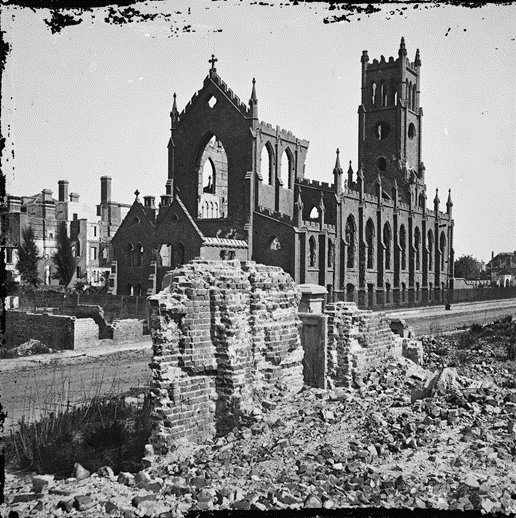
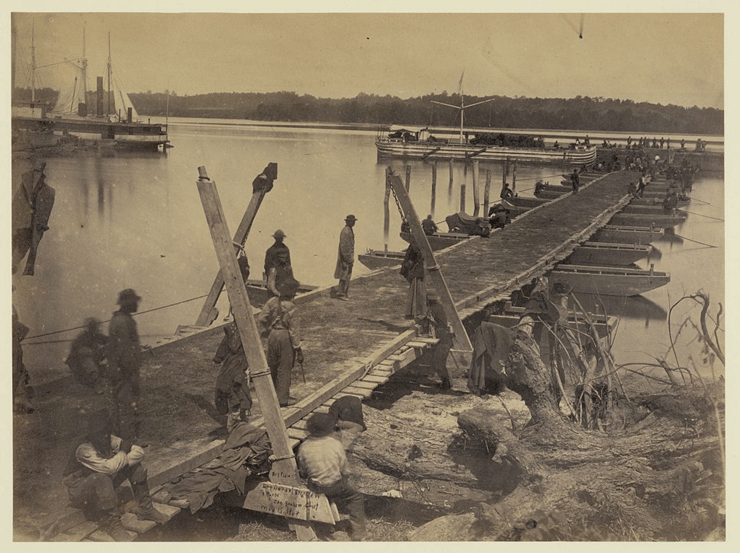
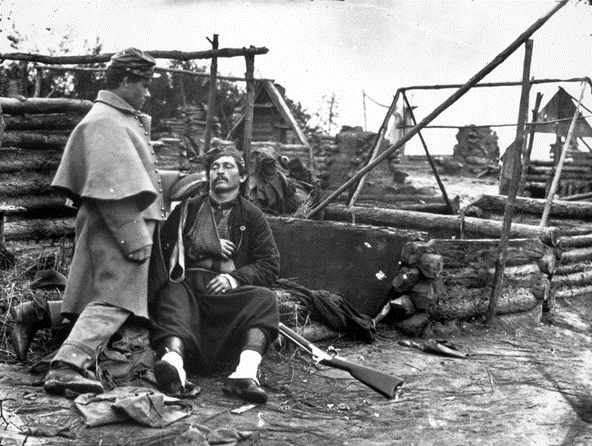
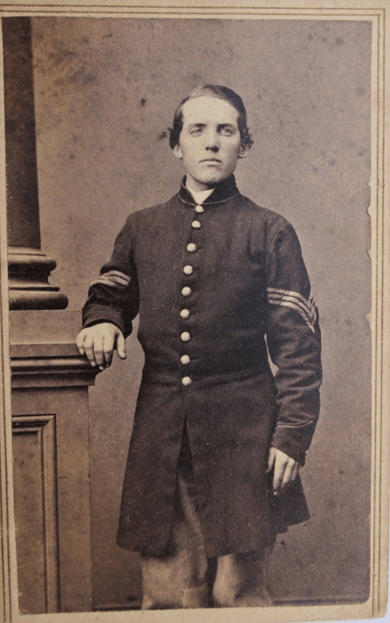
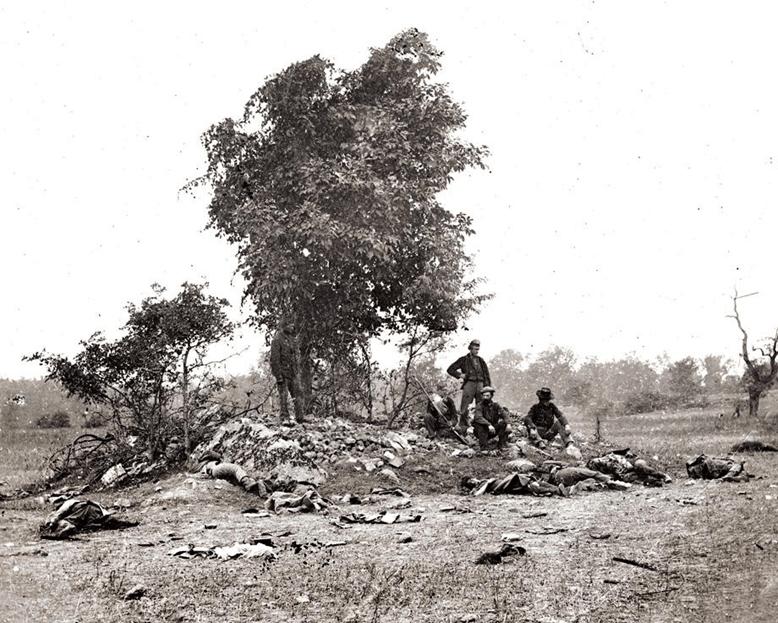
Italian immigrants and their culture have greatly impacted the historic and modern landscape of the United States. From the creation of Columbus Day to The Godfather film franchise, Italians and Italian-Americans have been prominent pieces of the melting pot that is the American experience. Before their integration in the late 20th century, Italians were spurned by the largely English-Protestant Americans of the 18th and 19th centuries. Because most Italians were Catholic and had darker skin, they were not considered white and, like Irish immigrants, were prohibited from certain jobs because of their religion. Despite these social and economic obstacles of the 18th and 19th centuries, Italians and other immigrants were eager to support their adopted country. During the American Civil War, Italians made significant contributions to the Union war effort that have been largely overlooked in military and social histories.
When Confederate General P.G.T. Beauregard officially instigated the war with his bombardment of the Federal Fort Sumter on April 12, 1861, thousands of Northern soldiers flocked to answer President Lincoln’s call for 75,000 military volunteers, swelling the force far beyond that number. Surprisingly, hundreds of officers and soldiers from the Italian Army traveled to the American legation in Turin to volunteer for the Union Army. Because of Italy’s parallel struggle for unification and liberty, Italian nationals strongly identified with the United States’ war aims. Additionally, many Italians were opposed to slavery based on their Catholic faith. Interestingly, several hundred Italians did ultimately volunteer for the Confederacy, instead choosing to identify with its claim of “States’ rights,” which the individual kingdoms in Italy proclaimed prior to unification.
In Italy, a notice published by the American delegation via the Italian government stated that the Americans did not need Italian volunteers. When word reached United States Secretary of War, William Seward about the Italians’ enthusiasm, he ordered the American foreign minister to Italy, George P. Marsh, to investigate acquiring Italian volunteers, on August 19, 1861.
Since many of the Italians who wished to join the Union Army were experienced soldiers or officers in the Italian Army, they asked to be officers in America. However, Union officials balked because they did not believe the Italians spoke English well enough to command American soldiers. Moreover, financial obstacles blocked more extensive efforts to recruit Italians for the Northern cause. By the late summer and early fall of 1861, the United States’ economy began to feel the strain of the widening conflict and could not pay the Italians’ wages or travel expenses. Therefore, few enlisted Italian soldiers could afford to emigrate to the United States. Yet, financial problems did not stop the federal government from trying to recruit a select few Italians with particular military prowess.
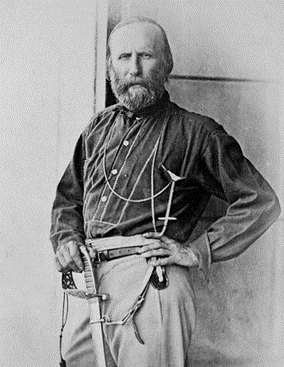
Most notably, in 1861, President Lincoln offered the famous Italian general Giuseppe Garibaldi a commission as a major general in the Union Army. In August, Seward claimed he had received a letter from Garibaldi stating his intention to accept Lincoln’s commission. Though his claims never came to fruition, as Italy continued to reel from its own civil war and Garibaldi was wracked by political controversy, he sent many of his officers to the United States. They were assigned to the command of Major General John Fremont, who served as the head of the Department of the West until 1862.
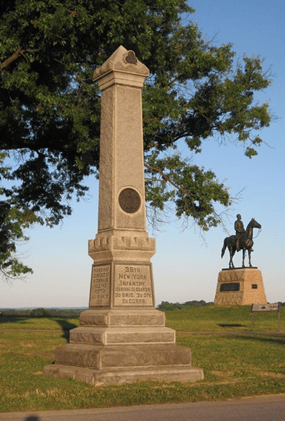
Though Garibaldi did not come to America during the Civil War proper, his galvanizing spirit and revolutionary military campaigns abroad inspired Italian immigrants and Italian-American soldiers to take up arms in America’s Civil War. In May of 1861, the 39th New York Infantry nicknamed the Garibaldi Guard, was formed in New York City. Its soldiers wore brilliant red shirts and bersaglieri plume on their caps. Standard bearers carried the Italian flag alongside the American flag when they marched. Of the regiment’s 350 immigrant troops representing a kaleidoscope of European countries, 50 were Italians, and many served with great distinction. For example, during the Battle of Cross Keys on June 29, 1862, the 39th’s active commander, Captain Odoardo (Edward) Venuti, was wounded in action while leading his men. A little over a year later, Captain Venuti was killed during the Battle of Gettysburg. His name is etched on the New York State Monument to the Garibaldi Guard on Cemetery Ridge. According to its regimental history, the 39th NY lost “119 by death from wounds, and 159 by death from accident, imprisonment or disease, of whom 94 died in prison.”[2]
Though Garibaldi was unable to support the United States’ war effort physically, he and many other Italians supported the Union’s ideological cause, particularly emancipation and the abolition of slavery. On August 6, 1863, over a year after Lincoln published the Emancipation Proclamation, General Garibaldi sent Lincoln a short but heartfelt letter stating his support for the decision:
“In the midst of your titanic struggle, permit me, as another among the free children of Columbus, to send you a word of greeting and admiration for the great work you have begun. Posterity will call you the great emancipator, a more enviable title than any crown could be, and greater than any merely mundane treasure. You are a true heir of the teaching given us by Christ and by John Brown. If an entire race of human beings, subjugated into slavery by human egoism, has been restored to human dignity, to civilization and human love, this is by your doing and at the price of the most noble lives in America.
It is America, the same country which taught liberty to our forefathers, which now opens another solemn epoch of human progress. And while your tremendous courage astonishes the world, we are sadly reminded how this old Europe, which also can boast a great cause of liberty to fight for, has not found the mind or heart to equal you.[3]
In 1860, roughly 13 percent of the American population was foreign-born. Because these immigrants mainly settled in Northern industrial states, one in every four Union soldiers was an immigrant. Recent estimates claim that 534,000 men out of the 2 million United States soldiers were foreign-born. Moreover, approximately 18 percent of soldiers had at least one immigrant parent. Immigrants or immigrant-born soldiers made up 53 percent of the United States Army.[4] Between 5,000 and 10,000 Italians or Americans of Italian descent served in the American Civil War, mainly for the United States. They contributed significantly to vital battles such as the Second Battle of Bull Run, South Mountain, Antietam, Fredericksburg, Gettysburg, and Harper’s Ferry. Major General Edward Ferrero, the highest-ranking Union officer of Italian heritage, led the 51st New York Infantry in almost all these significant battles except Gettysburg and Harper’s Ferry. Their war stories and experiences represent the collective effort immigrants from many nations put forth to fight for their new home’s ideals, to prove themselves as “true” Americans, and to affirm for their native homelands and the world that genuinely America was the last best hope for democracy on earth. As a country of immigrants, American Civil War history should include the victories and sacrifices of immigrant soldiers. Only by having their stories told will we gain a fuller picture of the vast impacts and legacies of the bloodiest war in our history.
[1] Translation: Italy United! American United; Italians chanted the former during General Garibaldi’s campaigns for unification in southern Italy. Many Italian soldiers transferred their enthusiasm for a united Italy to the fight for union during the American Civil War.
The American Civil War is one of the most widely studied areas of the United States’ history. Its battlefields are popular tourist sites, and its soldiers and generals are depicted in textbooks, paintings, and memorials across the country. The basic facts of America’s bloodiest conflict are well-documented: The Civil War between the Northern Union and the Southern Confederacy was a battle over the future of the mass enslavement of human beings and the fate of American democracy. After four gruesome years, three-quarters of a million soldiers and 50,000 civilians died, and 4 million African Americans were freed from slavery.
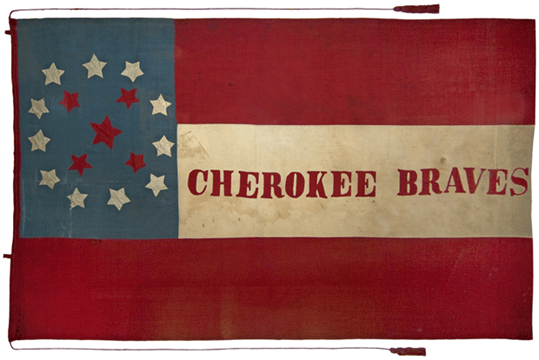
However, another hostile conflict exploded during the Civil War. Fueled by resentments and political angst from 20 years prior, the Cherokee Nation exacted revenge against the United States and the Southern states (respectively) that had destroyed their communities by participating in many battles on behalf of both the Confederacy and the Union.Not long before the war, the federal government had removed the Cherokee from their southern homes with the help of the soon-to-be Confederate state officials; by alternately taking up sides with each, the Cherokee were able to take out their anger against those whom they considered the prime oppressor of natives. As a result of that participation, however, the Cherokee Nation emerged as the second-most devastated citizenry, behind the Southern Confederacy. Already struggling from their forced removal from the southern Appalachians to Oklahoma in 1838 and 1839 during the Trail of Tears (1830-1850), the Cherokee people continued to die from diseases, hunger, exposure, and loss of land during the Civil War. Approximately one-third of the Cherokee population died between 1861 and 1865.[1]
The reasons for which the Cherokee and other Native Americans participated in the Civil War were quite different from those of white and black soldiers. Many nations chose sides or remained neutral to maintain the little land and property the government had given them. The Cherokees were the most populous of the so-called Five Civilized Tribes (Cherokee, Choctaw, Muscogee, Chickasaw, and Seminole). They were also considered the most assimilated of the tribes, commonly dressing in “white” clothing, using European farming techniques, and creating the only written Native language and newspaper.[2] Moreover, wealthy Cherokees often owned enslaved people and operated plantations. Of the 100,000 residents in western Indian Territory, 14 percent were enslaved Black Americans.[3] Because of the Cherokees’ heavy reliance on slavery, the Confederacy figured they could count on Cherokee support during the war. Additionally, some Native American nations cast their allegiance with the South because they deeply distrusted the United States federal government. This distrust, coupled with the similarities in their slaveholding political economy, resulted in the majority of the Cherokee Nation siding with the Confederacy. On 28 October 1861, a published declaration explained the Cherokee-Confederate alliance:
The Cherokee people had its origin in the South; its institutions are similar to those of the Southern States, and their interests identical with theirs. Long since it accepted the protection of the United States of America, contracted with them treaties of alliance and friendship, and allowed themselves to be to a great extent governed by their laws……
In now carrying this resolution into effect and consummating a treaty of alliance and friendship with the Confederate States of America the Cherokee people declares that it has been faithful and loyal to is engagements with the United States until, by placing its safety and even its national existence in imminent peril, those States have released them from those engagements.
Menaced by a great danger, they exercise the inalienable right of self-defense, and declare themselves a free people, independent of the Northern States of America, and at war with them by their own act. Obeying the dictates of prudence and providing for the general safety and welfare, confident of the rectitude of their intentions and true to the obligations of duty and honor, they accept the issue thus forced upon them, unite their fortunes now and forever with those of the Confederate States, and take up arms for the common cause, and with entire confidence in the justice of that cause and with a firm reliance upon Divine Providence, will resolutely abide the consequences.[4]
After the war began and an alliance was declared, previous internal wounds within the Cherokee Nation began to reopen between old rivals. Before the ethnic cleansing of the Five Tribes during the Trail of Tears, Cherokee Principal Chief John Ross had refused to sign over his nation’s land. He had relocated to Indian Territory (Oklahoma) only under President Andrew Jackson’s Indian Removal Act. Though many Cherokees saw Ross’s stance as solid and justified, an opposition group had emerged under the leadership of brothers Stand Watie and John Ridge. Calling themselves the Treaty Party, Watie recruited only 2 percent of the population to support signing over Cherokee land and relocating out west.[5] Watie and the Treaty Party signed the 1835 Treaty of New Echota, selling the nation’s territory to the federal government for $5 million. Ross and his 16,000 supporters were essentially forced to make this decision and ultimately traversed the country with the other Cherokees on the Trail of Tears.[6]
Once the Cherokees had settled into their new territory in Oklahoma, violence ensued between the two rival groups. On June 22, 1839, John Ridge, his uncle, and his cousin were murdered, most likely by Ross supporters. In response, those who supported Ridge allegedly raised funds to hire killers to murder Ross.[7] This plan was never enacted but solidified a blood feud between Watie and Ross. Moreover, the rivalry became subjected to racial tension between the Cherokees of “mixed-blood” and “full-blood.” Because Watie and members of the Treaty Party were mostly mixed-raced, Ross and his supporters questioned their loyalty to the nation and indigenous interests.[8] A fierce political fight for tribal control persisted until 1860, but Ross and the “full-blood” Cherokees maintained the nation’s leadership. An uneasy peace between Ross and Watie took hold.
Cherokee Chief John Ross (1858) Encyclopedia Britannica, https://www.britannica.com/biography/John-Ross-chief-of-Cherokee-Nation/images-videos#/media/1/510089/96901
When the Confederate government was formed in February 1861, the president of the Confederacy, Jefferson Davis, sought support from indigenous communities. Southern strategists knew protecting the Mississippi River and its surrounding fertile soil was vital to the war effort. Davis wanted to use Indian Territory and the west as a breadbasket and launching pad for military expeditions for Southern expansion. In late 1861, the Confederates made overtures to Chief Ross and the Cherokee Nation. Davis appointed the former Commissioner of Indian Affairs, Albert Pike of Arkansas, as the negotiator and Southern messenger. He was well received by the Five Tribes and found them enthusiastic about a new country.[9] Within the Cherokee Nation, Stand Watie emerged as an ardent supporter of the Confederacy. An owner of approximately 100 enslaved people, he was motivated by many of the same political and economic interests as white Southerners. On July 12, 1861, he was granted a colonel’s commission in the Confederate Army and raised 300 indigenous soldiers into the 2nd Cherokee Mounted Rifles.
However, the leadership of the Cherokee Nation was much less enthused by the impending conflict. Principal Chief Ross vocally promoted neutrality. He stated, “We [the Cherokee Nation] do not wish our homes to become a battleground between the states and our soil to be rendered desolate and miserable by the horrors of civil war.”[10] Ross believed that maintaining the federal treaties with the United States would allow the Cherokees autonomy over their land and community. The Northern government, unfortunately, chose a lackluster approach to secure the alliance or neutrality of the Cherokees and the rest of the Five Tribes. The Lincoln administration and Congress gave Ross little financial or political incentive, weakening Cherokee and broader native acceptance of neutrality. As a result, Chief Ross dramatically shifted his view of the war. After calling a conference of tribal leaders, Ross urged his people to accept an allegiance with the South.[11] A treaty was signed on October 7, 1861. Ross’s decision has been highly criticized by modern historians. However, his nation had little to no support from the United States government and was surrounded by tribal nations already aligned with the Confederacy. Additionally, Ross received pressure from the rowdy minority of Stand Watie.
Though the Cherokee Nation was finally united in its alliance with the Confederacy, internal tensions continued to mount over the question of abolition. Stand Watie was a slaveholder, and many other Cherokee elite also owned or profited from slavery, including Chief Ross. On the other side, some Cherokee opposed slavery, such as the members of the traditionalist Keetoowah Society. This political animosity further deepened the existing schism between Watie’s mixed-bloods and Ross’s full-bloods, as Watie was much more vocal about preserving the “peculiar institution.” Consequently, Cherokee men served on both sides of the American Civil War.
The war was particularly fierce in Indian Territory. For three years, the Union and the Confederacy bludgeoned each other for control of the land and the allegiance of the tribes who occupied them; neither side could obtain absolute dominance in the region. The combat intensified as the Confederates utilized the Cherokees, Chickasaws, and Choctaws in their pursuit of Arkansas. Initially, Native Americans were wary of leaving their land because they wished to use their new military status to protect their communities at home. In response, the Confederates tried to convince them to leave Indian Territory for Arkansas through lucrative economic offers, such as ensuring that the Native American soldiers promptly received their owed soldier’s pay.[12]
Under the command of Confederate negotiator, Albert Pike, two Cherokee mounted rifle units, a Choctaw-Chickasaw regiment, and a Muscogee regiment merged together to become what is known as Pike’s Indian Brigade, comprised of 2,000-3,000 indigenous soldiers. The most infamous engagement for the Cherokee was the Battle of Pea Ridge on March 7 and 8, 1862. Of the 2,500 Confederate troops involved in the Arkansas clash, almost 900 were Cherokee. The Cherokees, joined by some Texans, surprised Iowan cavalry regiments stationed on a small farm, severely wounding their lieutenant and capturing three Union guns. Notoriously, the Cherokees allegedly engaged in the scalping of dead and wounded Iowan soldiers to celebrate their small victory. However, while the Confederates celebrated, more Union troops arrived at Pea Ridge and ultimately pushed the Confederates into a retreat.
The Cherokees’ mutilations were said to have taken place in the woods, but Northern newspapers and military leaders decried the breach of conduct and pilloried Pike. He resigned from his commission in July of 1862. After the war, Pike was indicted in federal court for inciting war atrocities.[13] In the minds of Union troops, retaliation for these atrocities was the only solution. Captain Oliver Hazard Perry Scott of the 3rd Iowa Cavalry fumed, “There was two of them infernal Indians taken prisoner, and we have seen one that was killed. I wish it had been the last of that race. There was quite a number of our men scalped by them, two of our company…. There will be no quarter shown them after this, that is certain.”[14]
As the war continued, the Cherokee Nation remained burdened with political divisions. While Watie and his 2nd Mounted Rifles remained fervently loyal to the Confederate cause, Ross and the 1st Cherokee Mounted Rifles began to waver after the Confederate victories in the West began to slow in the Fall of 1862. Ross and Union-leaning natives thought of recasting their lots with the North. As a result, a majority of the 1st Cherokee soldiers deserted and allied with the United States in October of 1862. The rest of their regiment was dissolved and absorbed into that Colonel Watie’s command. Chief Ross traveled to Washington, D.C. one year later to ask President Lincoln for clemency, which he received. Ross’s three sons soon joined the Union Army. In contrast, Watie was the last Confederate colonel to surrender at the war’s end.
Less than 30 years after the Trail of Tears, the Cherokee Nation and other Native Americans had been dealt another deadly blow. Thousands of indigenous people had died due to the American Civil War. Because there were no thorough census records of the native population in Indian Territory, it is unknown how many indigenous people perished, but some historians estimate the death rate was 50 percent of the populations in Oklahoma and Arkansas. After the war, the Office of Indian Affairs (OIA) calculated 14,000 surviving Cherokees in Indian Territory, a decline from 21,000 before the Nation joined the conflict. Commissioner of Indian Affairs, D.N. Cooley laid bare the harsh reality of the war’s repercussions for the nation, stating, “[The Cherokee] need food, clothing, tools, everything in fact, to begin life again.”[15]
In addition to their physical and material losses, the Cherokee faced stark social deterioration. Unionist supporters and former Confederate allies exacted violence and retribution against one another. The OIA Southern superintendent stated that the Cherokee Nation’s enmity was so potent that “no human power can reconcile” the fractious community. He estimated that 10,500 Cherokees remained loyal to the United States while 6,500 had joined the Confederacy. Many pro-Confederate Cherokees remained estranged from the larger Cherokee Nation and Indian Territory altogether during the postwar years, including Stand Watie. He would die during the legal process to retain his pre-war home on September 16, 1871, in present-day Delaware County, Oklahoma.[16] His archrival, Chief Ross, died in Washington, D.C., on August 1,1866. Despite the significant indigenous death toll as a result of the war, neither the Confederate states nor the federal government ever officially acknowledged the vital role of indigenous military participation in the conflict. Particularly after the alleged atrocities at Pea Ridge, white government officials once again saw Native Americans as “savages” in need of taming.
The struggle to rebuild the Cherokee Nation continued for decades after the Civil War. Because of federal reconstruction treaties foisted onto the Five Tribes, the Cherokee and other indigenous communities lost more of their autonomy and strength. The first treaty abolished African slavery in tribal nations—a necessary measure, but one which dealt a heavy economic blow to many Cherokee. The second treaty concession established an intertribal council on which the superintendent of the OIA would serve as chief executive. The third treaty demanded that all five nations acquiesce their land in various locations for the construction of railroads.[17]The United States exploited the nations’ vulnerable positions to extract more land concessions. The Cherokee Nation was forced to concede more territory to the federal government to relocate additional, unwanted indigenous communities from across the country into Indian Territory. Moreover, the Five Tribes were no longer in control of the distribution of their land and were forced to give tribal citizenship to Native Americans of other tribes as the United States government pushed indigenous people of different regions into Indian Territory. OIA and government officials believed this policy would lessen chances of intertribal warfare and harassment. To add insult to injury, no federal preference was given to those who remained loyal to the United States. All Native Americans were seen as equally fastidious and expendable. In 1865, the federal government told the chiefs of the Five Tribes that they had forfeited any tribal rights, land claims, and compensation once they joined the Confederacy. All members of the tribe who allied with the South were punished as traitors.
Freedmen camped in Cherokee territory “Cherokee Nation Seeks Cherokee Freedmen Stories, Photographs,” Antoinette Grajeda, Arkansas Soul, February 4, 2022, https://argotsoul.com/2022/02/cherokee-nation-seeks-cherokee-freedmen-stories-photographs/
The American Civil War enveloped the entirety of the United States. Native Americans were too often caught in between two belligerent nations who did not truly care for their interests. The United States government had repeatedly violated treaties, while the Southern states had pushed the Five Civilized Tribes out of the region. Wedged between a rock and a hard place, the Cherokee and other nations tried to retain some semblance of unity, heritage, and autonomy as they were yanked between two self-serving actors. The Civil War considerably altered the fragile socio-political system of the Cherokee Nation, as it reopened existing wounds between two diametrically opposed leaders. Seen as mercenaries or convenient cannon fodder, the Cherokee Nation and other Native American tribes gained very little from their participation in the American Civil War. Furthermore, in an ironic twist, now that the nature of future western settlement had been determined through a war in which natives had played a significant role, native lands became tantalizing targets for national expansion and beacons for individualistic profiteering in the newly reunited America. As such, the war for indigenous rights and freedom would continue for centuries.
Cherokee Family (1935) Domain unknown https://www.pinterest.com/pin/cherokee-family-1935–466826317626266124/
[1] Grace Steele Woodward, The Cherokees, (Norman: University of Oklahoma Press, 1963).
War breeds victims. Whether the victims are mutilated soldiers, widowed spouses, childless parents, or parentless children, war will always create sorrow. The American Civil War claimed the lives of 750,000 soldiers by 1865. This figure does not account for the incalculable suffering of the American civilians who now had to navigate a world without their loved ones. Perhaps the most vulnerable segment of civilian victims was the orphaned children. The war left tens of thousands of children orphaned or “half-orphaned,” meaning the children lost a father but still had a mother.[1] According to the US Census Bureau, the number of orphaned children housed in orphanages rose from 7,700 in 1850 to 60,000 in 1880.[2]
Between 1861 to 1865, many of the farms and much of the infrastructure within the Confederate states were damaged and destroyed by enormous battles and bombardments. As a result, many Southern children experienced the pain of war firsthand. For example, two of Virginia’s most prominent orphan asylums were the Richmond Female Humane Association (RFHA) and the Richmond Male Orphan Asylum (RMOA). Though established before the Civil War, these organizations came to fruition during the conflict and Reconstruction. They were typically run by boards of directors as well as a president. Before the war, organizations like the RFHA and RMOA would often reserve placement for children of wealthy or upper-middle class parentage. After war was declared, the care of orphaned children of Confederate soldiers quickly became a societal badge of honor, and the RFHA and RMOA began to accept poorer children. Because of this expansion, the orphanages educated their charges in skills that would supply economic or social value to their larger communities, such as sewing, housework, or physical labor.[3]
As the war intensified, Southern business owners, homemakers, and others turned increasingly to child labor as slavery eroded and young men left for the battlefield. In 1862, the RMOA reported that 22 boys had left its facility, “including four runaways, and the remainder ‘having been placed in positions more advantageous under the circumstances, or having been returned to their mothers, who needed aide, and could find them employment in these trying times.’”[4] After the abolition of slavery and the war’s end, white orphanages would advertise their wards as better labor alternatives to the newly freed African Americans. Asylums also utilized this avenue to increase the number of children they could house, leasing children to apprenticeships, factories, and farms opened beds.
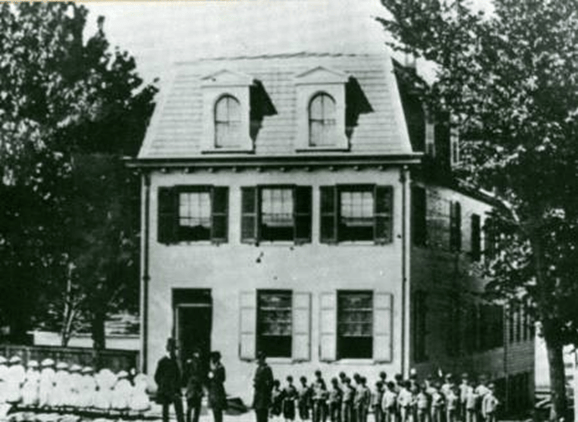
Richmond Male Orphan Asylum at 1900 Amelia St., 1909 (“It’s All Relative: Richmond Families (1616-2016)” exhibit at The Valentine, Oct. 13, 2016-June 18, 2017, in Richmond, Va. The Valentine. No. P.74.35.01.)
During Reconstruction, the RFHA and the RMOA tried a new tact to raise money from the few remaining wealthy elite. They prominently linked the practice of aiding the orphaned children of Confederate soldiers to Southern patriotism and Lost Cause ideology. By donating money, clothing, and other goods to these needy children, claimed the orphan asylums, Southerners maintained their fallen heroes’ dignity and honor.
On the other side of the Mason-Dixon Line, the Northern states also faced the challenge of caring for dependent children. Pennsylvania, for example, contributed the second largest number of soldiers to the United States Army (New York was first). The state lost approximately 15,000 men to combat or mortal wounds. Many men who came home later died from wartime injuries or maladies. If one includes in the state’s total death count those who perished from disease and these other delayed factors, that number exceeds 30,000 soldiers.[5] Therefore, thousands of children were orphaned, half-orphaned, or lived in homes that could not sustain them.
During the antebellum era, the United States experienced a wave of social and civil movements spurred by the Second Great Awakening from 1790 to 1840. In the North, the Awakening hammered home community outreach and benevolence concepts based on Evangelical and Protestant theology. Philosophical thoughts such as Transcendentalism promoted the creation of utopian communities and espoused the recognition of human dignity. After 1840, the Second Great Awakening had indeed awakened vital social missions such as the Temperance Movement, abolitionism, prison and asylum reform, and care for the poor and orphaned.
Additionally, within Pennsylvania and other northern states, a powerful pro-elementary education movement took hold during the antebellum era. At a banquet in Gettysburg, Pennsylvania, in 1826, Congressman Thaddeus Stevens decreed, “Education. May the film be removed from the eyes of Pennsylvania and she learn to dread ignorance more than taxation.”[6] The embrace of widespread childhood education helped grow support for other “morality-improving” benevolent institutions such as orphan asylums throughout the North in the lead-up to the war. Additionally, by the beginning of the Civil War, American perceptions of poverty and “the poor” were shifting significantly due to the reverberations of the Second Great Awakening and its emphasis societal uplift and reform. (It wasn’t until the late nineteenth century that such reform efforts became more intertwined with the mission of social control). As state and federal governments passed laws more compassionate to this segment of the population, such as ending both debtors’ prisons and the imprisoning of children in adult jails, many Americans categorized the poor into “deserving” and “undeserving.” Widows and orphans were considered the epitome of the “deserving” poor.[7] The “undeserving” poor were gamblers, alcoholics and the chronically unemployed. Unfortunately, at the time of the Civil War, many orphanages were privately- or church-owned, located in the country, or unequipped to handle the number of orphans created by the war. As a result, in late 1864, Pennsylvania and other states established official asylum systems that were controlled and maintained by the state. However, although Northern and Southern states tried to implement improved options for orphan childcare, institutional violence, and neglect still managed to fall through the cracks.
One of the most famous examples of orphan abuse took place at the National Homestead in Gettysburg, Pennsylvania. The establishment of the Homestead was inspired by the death of Union Sergeant Amos Humiston. Humiston was killed during the Battle of Gettysburg with a photograph of his three children in his pocket. The image was found by a local girl and was later published in newspapers by Dr. John F. Bourns, in an effort to return to photograph to Humiston’s family. His widow eventually reclaimed the image. Moved by the Humistons’ story, Dr. Bourns decided to launch a fundraiser for the family and to construct a widows’ and orphans’ home. The Homestead was opened in 1866 with great support from prominent veterans like General Ulysses S. Grant. However, it began to slide into infamy.
In the 1870s, the headmistress, Rosa J. Carmichael, abused the orphans in her care. She constructed a dungeon, complete with chains, in the Homestead’s basement for those she deemed mischievous or unruly. As the stories leaked into town from former wards, Carmichael was charged with neglect and cruelty in 1876. The townspeople called for the closure of the Homestead, and by 1877, it was permanently shuttered.
General U.S. Grant with orphans of the National Homestead (In Errol Morris, “Whose Father Was He?” Part Three. New York Times, https://archive.nytimes.com/opinionator.blogs.nytimes.com/2009/03/31/whose-father-was-he-part-three/)
Despite such instances of neglect and abuse of white orphans, overall, the orphan experience was vastly different for African American children and the formerly enslaved children. They experienced racism and neglect in both the North and the South. Black children were not permitted in Southern asylums such as the RFHA and the RMOA and were usually subjected to harsh labor and apprenticeships throughout the country. In the Northern states, separate orphanages and organizations were founded for Black children. One of the most prominent African American orphanages was the Howard Orphanage and Industrial School in New York City. When enslaved women escaped the South before and during the Civil War, they were often forced to relinquish their children to find work. These children would either be relegated to servitude somewhat akin to slavery, forced into homelessness, or housed in jails with adults. In 1866, a widowed Black woman named Sarah Tillman decided to take in 20 African American children in Manhattan. She gained support from a Black Presbyterian minister named Henry Wilson, and they founded an orphan asylum.
African American school children; Howard Orphanage and Industrial School (Schomburg Center for Research in Black Culture, Photographs and Prints Division, The New York Public Library. New York Public Library Digital Collections. Accessed February 22, 2023. https://digitalcollections.nypl.org/items/510d47df-fd06-a3d9-e040-e00a18064a99)
Theirs was a challenging mission, as racism was rampant in the North. For example, in 1863, the Quaker New York Colored Orphan Asylum was explicitly targeted and burned to the ground during the city’s draft riots and had yet to be rebuilt by 1866. Soon after its opening, the orphanage entered financial turmoil and was forced to indenture its wards into service. This practice was highly criticized by female abolitionists and black community leaders, who were specifically concerned about the fate of Black children. In the late 1890s, the asylum added trade school to its core mission, empowering its wards to make money and learn valuable professional skills. The Howard Orphanage and Industrial closed in 1918, but its benefactors rerouted their finances toward improving Blacks’ educational opportunities throughout New York and the country.
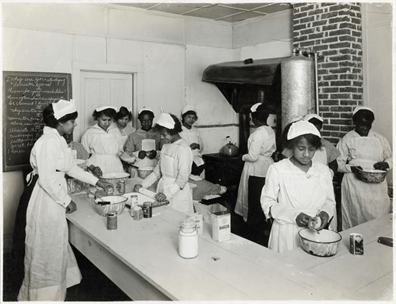
Girls learning to bake at the Howard Orphanage and Industrial School (c. 1900) (Schomburg Center for Research in Black Culture, Photographs and Prints Division, The New York Public Library. New York Public Library Digital Collections. Accessed February 22, 2023. https://digitalcollections.nypl.org/items/510d47df-fd14-a3d9-e040-e00a18064a99)
The America Civil War forever altered the United States’ physical and social landscape. Not only were cities and communities destroyed, but over half-a-million men were dead, and millions of enslaved people were free. Amongst the chaos of battle and its aftermath, the nation’s most vulnerable children were in dire need. Because of the war, federal and local organizations began implementing networks and foundations to care for orphaned and disadvantaged populations. By no means free from classism, racism, and abuse, the United States had set up a new path towards universal concern for citizen welfare and relief.
[1] James Marten, ed. Children and Youth During the Civil War Era. (New York: New York University Press, 2012), 173-174.
[2] Susan Whitelaw Downs and Michael W. Sherraden. “The Orphan Asylum in the Nineteenth Century.” Social Service Review 57, no. 2 (1983): 272–90. http://www.jstor.org/stable/30011640.
[3] Marten, Children and Youth During the Civil War Era, 173.
[5] Frederick H. Dyer, A Compendium of the War of the Rebellion, Vol. 1, Number and Organization of the Armies of the United States (New York: Thomas Yoseleff Publisher, 1959), 12.
[6] Sarah D. Bair, “Making Good on a Promise: The Education of Civil War Orphans in Pennsylvania, 1863–1893.” History of Education Quarterly 51, no. 4 (2011): 460–85. http://www.jstor.org/stable/41303897.
“…none of the bounties of Providence when abused, are capable of producing greater evil to the human family [than opium].”
Moses Clarke White (Yale medical student), 1854
“Opium… bound me up with cords that God only knows how often I tried to break, and as many times failed.”
Albert W. Henley (Confederate Army surgeon), 1879
The United States’ opioid epidemic has cracked and destroyed communities across the nation, particularly in the Appalachian and Northeast regions. In 2019 alone, 70,630 people died from drug overdoses, while 1.6 million Americans were diagnosed with an opioid abuse disorder.[1] These numbers are unprecedented and have forced the federal government to declare a public health emergency. However, America’s battle against opioids and opioid addiction began 157 years ago with the conclusion of the Civil War.
The Civil War killed 750,000 young men and maimed approximately one million more. Soldiers returned home from the blood-soaked fields of Fredericksburg, Gettysburg, Vicksburg, and Richmond, carrying both physical and emotional wounds. During the antebellum era and the war itself, opium, a substance derived from poppy seeds, was distributed to soldiers suffering from bullet wounds, amputations, or chronic diarrheal illnesses. Many women also relied on opium to help relieve cramping and, like Mary Todd Lincoln and famed South Carolina diarist Mary Chesnut, to combat anxiety, depression, or “general nervousness.”[2] It was often administered in a powder or pill form that was consumed orally by the patient.[3] However, as the opium-based drug, morphine became more common and hypodermic syringes were made available, physicians and army doctors began to administer the drug intravenously. This was the quickest and most reliable way to relieve the phantom pain of an amputated limb, the pounding of a bullet wound, or severe diarrhea or coughing.
For Civil War doctors, opium and other opiates were a miracle treatment. A Confederate medical handbook stated that “opium is the one indispensable drug on the battlefield—important to the surgeon, as gunpowder to the ordnance.”[4] After the war, an estimated 400,000 soldiers were addicted to opium.[5]
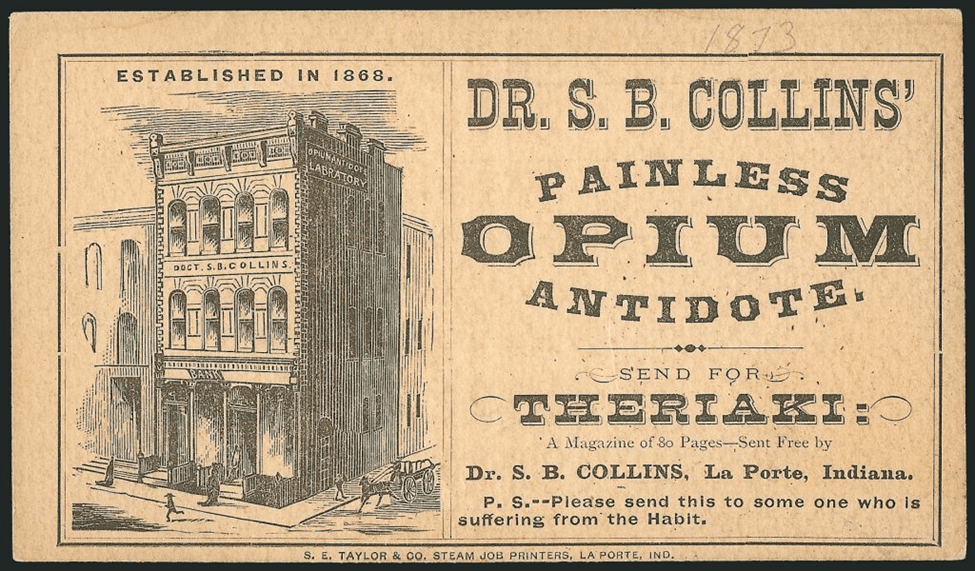
In the North, after the declaration of war in 1861, the US Army began to requisition enormous quantities of opium: Approximately 5.3 million pills and 2.8 million ounces of “opiate preparations.” Surgeons were encouraged to prescribe opium to soldiers for most illnesses and pain. In 1864, though the Confederate Army struggled to obtain medical supplies, physicians of the 2nd NC Military hospital included opium in 40% of their prescriptions.[6] Doctors and scientists were aware of drug dependency and addiction, at least in the most basic sense. It was understood that the more a patient is given a drug, the more resistant their body will become. However, opium was the best treatment solution for ghastly wounds and camp maladies. Because of the exorbitantly high rates of opiate prescriptions, post-war America had to grapple with a new, internal war. Some historians estimate that hundreds of thousands of Americans, both civilians and veterans alike, were addicted to opium by the 1890s.[7]
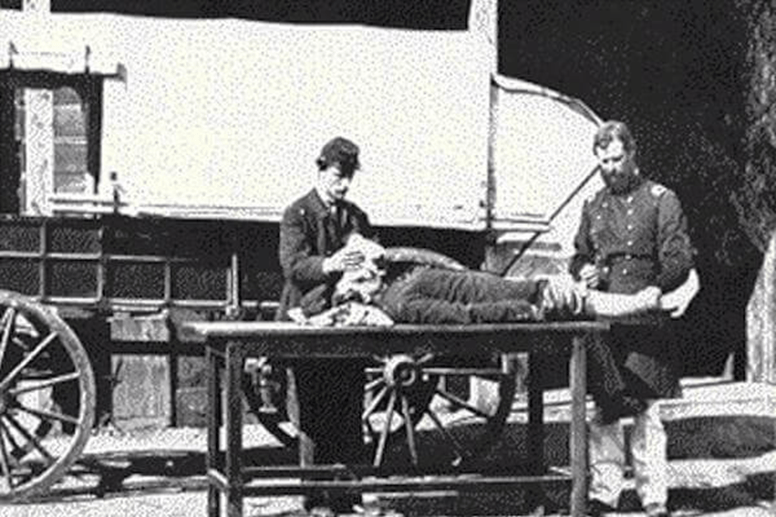
Union doctors administering opium to a wounded soldier
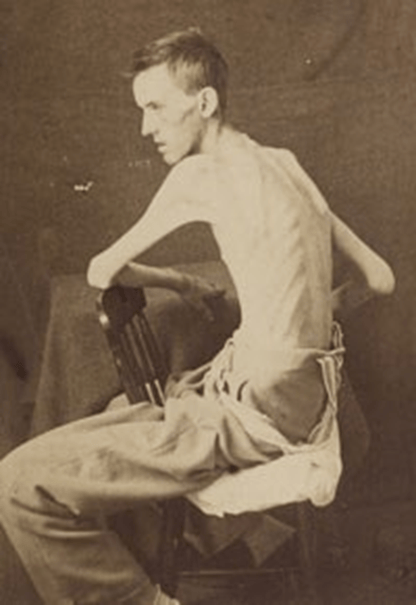
In 1876, an anonymous Union veteran published an autobiography of his opium addiction called Opium Eating: An Autobiographical Sketch. The soldier volunteered for the army in 1861 at the age of sixteen. He enlisted as a drummer because of this age, but his eagerness to fight caught the attention of an officer, who asked him to accompany the regiment to Stone’s River. The soldier later fought at Chickamauga on September 19, 1863, where he was captured with 5,000 other soldiers. After a three-week detainment in Richmond with little food, the soldier and his comrades were sent to the notorious Andersonville Prison in Georgia, where the prisoners were starved, abused, and executed. “ANDERSONVILLE! Dread word! Dread name for cruelty, and patriots’ graves, I stand paralyzed before thy horrid gates,”[8] the soldier recalled. The soldier was eventually transferred from Andersonville in September 1864 to Florence Prison in Charleston, South Carolina due to the military threat posed by General Sherman’s infamous “March to the Sea.”. In early 1865, he and his surviving prisoners were sent to Wilmington, North Carolina as part of a prisoner exchange with the Union Army. The soldier was free.
Andersonville Prison Survivor
“On getting home,” he wrote, “and taking inventory of myself, I found that I was but a skeleton.”[9] Sores broke out over his body, and he had difficulty consuming food. His most potent problem, however, was insomnia. He asked a doctor to prescribe him a sleeping draught, most likely laced with opium, to help him sleep. The doctor was reluctant, but eventually capitulated. “I felt that the sleep would, even with taking it, much more than counterbalance all evil effects that would likely arise from the medicine, and I determined to procure it if possible,” the soldier wrote.[10] The soldier was able to avoid addiction at this time, but he was soon wracked by stomach pains and excruciating migraines. With trepidation, he consulted his town’s physician, who insisted on treatment via hypodermic injection. The soldier said he did not want morphine, to which the physician claimed the medication was opiate-free. His health slowly improving, the soldier returned to the physician only to discover that he was being secretly dosed with a morphine mixture via injections. He recalled, “The doctor soon found he had an elephant on his hands,—saw that I was in the habit; became tired of my regular calls for hypodermical injections, and endeavored to shake me off. After giving him fully to understand his culpability in the matter, we parted.”[11] Now officially an addict, the soldier began to purchase his opiates from a drugstore. The soldier’s account of the desperate hold that the drug now contained over his body is heart-wrenching:
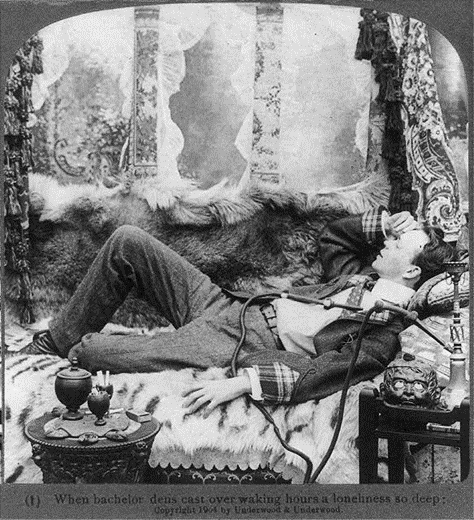
“I discovered that the power to fight and overcome great obstacles in this life, and which had always served me in my struggles theretofore, and which I relied upon then, was the very first thing destroyed by the enemy, namely, the will. Here I was, then, an opium eater. The outward effects and injurious properties of the drug soon made themselves manifest: what was I to do? Quit it, some may say; but no one well posted upon the opium habit would use those words, so hard and feelingless. A reply like this, I think, would betray more wisdom and humanity: “Your case is wellnigh hopeless; I can give you no encouragement whatever; do your utmost to release yourself from the unhappy predicament in which you have been placed; and may God help you, for I fear you will need other help beside your own.”[12]
“When bachelor dens cast over waking hours a loneliness so deep,” c. 1904. Courtesy of the Library of Congress.
The unknown “opium eater” continues his sketch by documenting the psychological battle he waged against his addiction. He details the cycle of pain, craving, relief, and shame that define the addict’s existence. In the 19th century, opium addicts, particularly men, were believed to be unmanly, weak-willed, and cowardly. They had few avenues for recovery or support. Often, if a person wanted to quit opium, they would have to endure unsafe withdrawal or “cold turkey” recovery, leading to more health issues or even death. The United States soldiers, who had survived so much death and bloodshed, were now engaged in an all-encompassing internal fight to heal their minds and bodies. Their struggle reveals that the American population has never been truly free from drug abuse and addiction. From the aftermath of the Civil War to the crack-cocaine epidemic of the late 1980s to the current Opioid Crisis, the United States continues to battle against the dark and dismal road of addictive drugs. Only time will tell if politicians and experts learn from the 157-year-old crisis that started the deadly pursuit.
In the days, weeks, and months following the Battle of Gettysburg, journalists and newspaper editors feverishly attempted to recapture the full details, implications, and meaning of the massive fight that had transformed one small, formerly obscure, south-central Pennsylvania town into a household name. While some reporters struggled to ascertain the exact facts of the battle amidst the chaotic aftermath, others wrote with clear political agendas intended to sway the hearts and minds of their readership and, in turn, bolster their respective side’s support for the war effort. Still others searched for meaning in the aftermath through the prisms of religion, world history, and other lenses. In this mini-series, students will explore the myriad ways that 19th-century newspapers, throughout the North and South, “re-fought” the Battle of Gettysburg, its factual components, and its larger significance in print in the immediate aftermath of the fighting.
Although originating from the same victorious North—and originally, the same exact newspaper—two accounts of the Battle of Gettysburg from the New York Times and the Delaware Gazette demonstrate remarkably different narrative tones, in addition to dramatic differences in factual reporting. Variances in publication date, unfolding access to battle facts, the evolving political agendas of each article, and the different types of correspondents who contributed to each article likely are responsible for these differences.
Printed on July 6, 1863, the New York Times “The Great Battles” portrays the Union victory in overwhelmingly glowing terms, with fiercely proud (though false) claims that the Union army had taken the lives of several key Confederate generals and soundly beaten the enemy at every turn, though at great loss to the Army of the Potomac as well. Because correspondence networks and telegraph lines were still in their infancy, more prominent news outlets such as the Times had greater access to recent, if sometimes inaccurate, information than local papers and were all too eager to print it if it boosted their political agenda. As such, the July 6thTimes article zealously declared “the death[s] of [James] Longstreet and [A.P.] Hill” while also proclaiming that every rebel “charge was repulsed with great slaughter.” The New York Times most likely printed this incorrect announcement for two reasons. First, they wanted to be the first paper to report this potentially war-altering information to the country. Such a laurel would give the paper fame and clout. Second, the deaths of Generals Longstreet and Hill would have not only crippled the Confederate high command and southern morale but also would significantly bolster the sagging spirits of the Northern home front far more than merely trumpeting a general victory over a faceless enemy.
The July 6 Times article tries to assert its claims of truthful reporting of the facts by utilizing the actual dispatches of Union General Meade to Secretary of War Henry Halleck and a message from President Lincoln to the nation’s citizens. Because Lincoln urged Americans to revere the battle-worn troops and the Union victory, the succeeding reports would have wanted to echo this message throughout their chronology. At a time when Northern support for the war effort had been waning, emphasis on the glorified heroics of the Federals during a three-day slaughter was of paramount political importance.
The Times’s actual battle accounts are written by “special correspondents” present during the fight. One such reporter, Samuel Wilkinson (known at the time for his unusually authentic and trustworthy journalism), wrote on July 3, “At the headquarters at which I write, sixteen of the horses of General Meade were killed by a shell. The house was completely riddled…… While I write the ground about me is covered thick with rebel dead, mingled with our own.” This eyewitness report has a more somber tone than the initial headlines and subheadings of the front-page articles. Fitting within the overarching tone of the article, Wilkinson does applaud the heroics of the Union soldiers. However, he also includes stories of woundings and deaths, along with descriptions of the corpses. His more sobering perspective could be attributed to his position as a news reporter versus a member of the high command delivering an official military report or correspondence: Unlike Meade or Lincoln, politics did not demand that he hide the graphic nature of the battle’s human destruction, thus allowing him to report in a more holistic “view from the trenches” style.
Wilkinson’s section of this article likely also differs even from those of other fellow field correspondents due to his witnessing his own son’s graphic wounding and death during the battle. Wilkinson was not only a first-hand witness to the great battle but a personal victim of its tragic perils. Certainly, when comparing Wilkinson’s account with that of any non-eyewitness journalist’s reporting, Wilkinson’s writing stands out for its unique ability to accurately capture the full physical and emotional scope of the soldier’s experience under fire than could that of any journalist writing from the safely of their offices in New York. Nevertheless, Wilkinson’s section of the article is but one within an overall glorious retelling of the resoundingly victorious Union army.
In comparison, the Delaware Gazette’s July 17, 1863 article, “The Gettysburg Battle” adopts a much more somber tone, depicting the battle, and particularly Pickett’s Charge, as anything but an inevitable Union victory, but rather a desperate and closely contested action in which both sides lost dearly. The two articles do share some similarities: The latter article does indeed make sure to glorify as enshrined “in the imperishable annals of the brilliant in history” for both the enormous destruction it inflicted on the enemy and the bravery of Union troops under extreme fire, and of course, the former article indeed includes first-hand, sobering accounts of battlefield woundings and deaths. However, the latter article in the Delaware Gazette delves much more deeply into the moments of uncertainty that the northern troops faced, the ebb and flow of battle, and the battle’s unparalleled destruction than does the earlier, more celebratory piece.
The Delaware Gazette begins its report by stating that the Battle of Gettysburg was “the most hotly contested and destructive engagement of the great rebellion.” Later in the account, the reporter recognizes the significant struggles of the Union Army. He does not hide that the soldiers had to fight mightily to defeat the Confederates. He describes the Federals’ reaction to Pickett’s Charge: “Our men looking with astonishment while fighting with great vigor; their line was dangerously weak; the defenses were not formidable. A few men gave way; our advance, in some instances slightly faltered.” Although the writer is still promoting the heroism of the Union men, he does not deny their setbacks during the Confederate attack and the very real moments of peril, panic, and doubt that many Union defenders felt when a wave of Confederates temporarily broke through their line at the Angle.
What is interesting is that, although re-published in the Delaware Gazette, this latter account was originally pulled from none other than the New York Times. This was a common practice in the 19th and early 20th centuries, as small newspapers often took their facts and reporting cues from national news outlets. Given that both articles stemmed originally from the Times, it makes a comparative analysis of the tone and content all that more interesting. These two Northern newspaper sources demonstrate the complexities and difficulties of reporting news in the 19th century, specifically on noteworthy news of the ongoing war. Often, biases or agendas, incomplete information, and unpredictable acquisition of new facts muddied the waters for reporters seeking to inform the public, and invariably, the unique perspective of each and every contributor to each article shaped the tone and content of individual pieces in significant ways. These two competing narratives of the facts and human impact of the Battle of Gettysburg provide just one example of the murky contours of journalism during the Civil War.
“The Gettysburg Battle,” Delaware Gazette, Delaware, OH, July 17, 1863.
“The Great Battles,” New York Times, New York, NY, July 6, 1863
“War at the best, is terrible, and this war of ours, in its magnitude and in its duration, is one of the most terrible.”
Abraham Lincoln (1864)
“Rwanda can be a paradise again, but it will take the love of the entire world to heal my homeland. And that’s as it should be, for what happened in Rwanda happened to us all – humanity was wounded by the genocide.”
Immaculee Ilibagiza
From 1861 to 1865, the American Civil War destroyed nearly 2% of the population of the United States. Approximately 750,000 young men were killed in combat or were withered by disease. In 1994, in an east African country no larger than Maryland, 1 million men, women, and children were systematically murdered by a nationalist extremist movement in just 100 days. It was the most efficient genocide in human history: The Rwandan Hutu government had slaughtered roughly 25% of Rwanda’s population.
Though one cannot compare genocide to a civil war, both the United States and Rwanda were forced to cope with mass devastation and death. America had to construct national cemeteries to handle the abundance of corpses. The federal government began to hammer out policies to secure the freedom of the formerly enslaved and outlined the bones of Reconstruction for the South. Rwanda, however, did not have the luxury of a government after the killings ceased. Fighting their own civil war, the genocidal Rwandan government had been usurped. The Rwandan Patriotic Front (RPF), composed of Rwandan refugees from prior persecutions, had returned to liberate their people. To secure freedom for all Rwandans, the soldiers had to try to bury 1 million corpses and exact justice on the perpetrators. Rwanda, unlike the United States, had no government to accomplish these tasks.
In the fall of 2021, I had the privilege to spend one semester in Kigali, Rwanda to study the 1994 Genocide Against the Tutsi and the peacebuilding processes that were generated from the aftermath. My fellow students and I met with genocide survivors, perpetrators, and academic experts who helped bring the sorrow, suffering, and healing of the genocide to the forefront of our minds. We also visited five genocide memorials, which included mass grave sites, victims’ skulls and other bones, clothes, and, in the case of the Murambi Genocide Memorial Centre, 900 preserved corpses.
Preserved Bodies of Victims of the 1994 Genocide Against the Tutsi, Murambi Genocide Memorial Centre, Murambi, Rwanda
For Westerners, it may seem sacrilegious, disrespectful, or exceedingly grotesque to display such things in a public memorial. Rwanda has been criticized by (Western) museum officials and others for these exhibits. However, other countries damaged by genocide, such as Cambodia, instituted similarly graphic memorial displays. For Rwanda, their memorials, while sites of honor for victims are warnings to Rwandans and visitors. As genocide survivor and author Immaculee Ilibagiza wrote, “what happened in Rwanda happened to all of humanity.” Rwandan memorialization does not merely emphasize individuals but rather the whole communal loss of 1 million innocent citizens. There are no statues of RPF generals or other prominent people of that time. Memorialization centers on egregious atrocities to provide a warning to the world. A wall of a church classroom stained with children’s blood is a more effective memorial tool of genocide than a marble stone or statue.
The United States took a vastly different approach to memorialize the bleak memories of those killed during the American Civil War. Monumentation began almost immediately after Lee’s surrender to General Grant in Appomattox, Virginia in April 1865. Some of the first battlefield monuments were erected in Manassas, Virginia to commemorate the first land battle of the war and the Second Battle of Manassas in August 1862. Union soldiers dedicated the monuments “to the patriots” who gave their lives for their country. The ceremony included songs, poems, and various speeches. Northern organizations such as the Grand Army of the Republic (GAR) began to buy sections of battlefields to erect regimental markers, monuments, and other statues. These ceremonies usually included immense patriotic fanfare, veteran reunions, and large crowds.
Patriots Monuments, Manassas National Battlefield Park
Civil War memorialization and memory continued in a steady stream in the proceeding years and decades. While many of these efforts stemmed from legitimate concerns about how to properly honor the dead (and aging veterans) and turn collective mourning into remembrance, they became a tool for political and social influence. Organizations like the United Daughters of the Confederacy (UDC) and the Sons of Confederate Veterans (SCV) sought to portray their own versions of why the South fought and were ultimately forced to surrender and to preserve the Lost Cause narrative. Many Confederate monuments were erected during the Jim Crow Era and the Civil Rights Movement of the 1960s. They were seen as solid reminders of the key underpinnings of the slaveholding Confederate nation and who should be included as a citizen in that nation. Therefore, memorialization of the Civil War, particularly for the South, was to foment an almost nostalgic longing for the “simpler” times of the 19th century while also glorifying the martial masculinity and sacrifices of their soldiers.
Mississippi State Monument, Gettysburg National Military Park
When comparing the memorialization intents and practices of the United States and Rwanda, significant differences emerge. Rwanda’s memorials are not patriotic, vainglorious reminders of the country and its leaders. Instead, they are rooted in despair and shame. They serve to prevent the past through shocking evidence. American Civil War memorials and monuments, however, are often created to preserve the greatness of a particular regiment, general, or military action. Battlefields, though advertised as places of history and bloodshed, are also marketed as scenic places for hiking, birdwatching, or sunsets. The Gettysburg National Military Park’s website, for example, includes a three-and-a-half-minute video of the landscape and various available tourist activities set to a light, lilting soundtrack. It is not until almost halfway through the video that it shows the numerous unknown graves of dead soldiers. This does not mean that the park does not care about the 7,000 soldiers killed during the engagement. However, it provides evidence that many Americans view Civil War battlefields as seductively beautiful and peaceful. They do not always think about the horrific human carnage since it is not always starkly represented. Though there may be photographs of the dead or wounded, museums or other sites do not usually present the most horrifying aspects.
Genocide Victims’ Clothing in Nyamata Church, Massacre Site Memorial, Nyamata, Rwanda
Rwanda does not shy away from the carnage. Visitors are strongly encouraged to confront the realities of the 1994 Genocide and its aftermath. At the Gysozi Genocide Memorial in Kigali, Rwanda, a giant sign saying “kwibuka” stands on the main grounds. It means “remember.” Just as national Holocaust museums and memorials bear signs proclaiming, “Never Again,” Rwandans want visitors to remember the death and destruction. By contrast, the Civil War commemorations often draw living historians, reenactments, or other commercial tourist activities. Though sometimes beneficial to the amateur, youth, and more sensory-oriented consumer experience, one must ask if a visitor is genuinely grasping the full scope of damage and loss incurred by the war, as it is sometimes presented in a more sanitized and light-hearted way.
Again, a civil war differs markedly from genocide in innumerable ways, from the reasons for killings to how it was executed to the general “rules and standards” that shaped its scope and whom it could kill in certain situations to the hard reality that, unlike the Rwandan Genocide, the American Civil War produced a clear and positive victor that ultimately shepherded the nation further down the path of progress. However, both the 1994 Genocide Against the Tutsi and the American Civil War tore down nations and lives. The people left behind had to clear the ashes and rebuild. The countries decided to cope with the detrimental losses in contrasting ways that were affected by differences in the period, political currents, and other factors. Although the Civil War and the 1994 Genocide were vastly different catastrophes, how the post-conflict governments and communities chose to remember (or forget) and preserve their painful pasts is illuminating. Memorialization can both help and hinder the healing of a fractured nation and can shape a nation’s future reckoning with both new and lingering conflicts for better or for worse. In the words of Holocaust survivor and Nobel Peace Prize winner Elie Wiesel, “For in the end, it is all about memory, its sources and its magnitude, and, of course, its consequences.”
This semester, CWI Fellow Lauren Letizia ’23 is analyzing the numerous roles, cultural significance, and lasting impacts of a cross-section of Civil War photographers upon American society. While some may be familiar to avid readers of Civil War history, others represent lesser-known, but equally as important photographers whose methods, mediums, and end-products helped shape the way Americans understood and made meaning out of the war’s swath of destruction and those who participated in it. We are delighted to share her third and final piece in this series with you!
The CWI would like to express enormous thanks to Ron Perisho for his generosity in sharing the majority of the images featured in this mini-series, as well as the invaluable sources and insights he has provided to make this blog series possible!
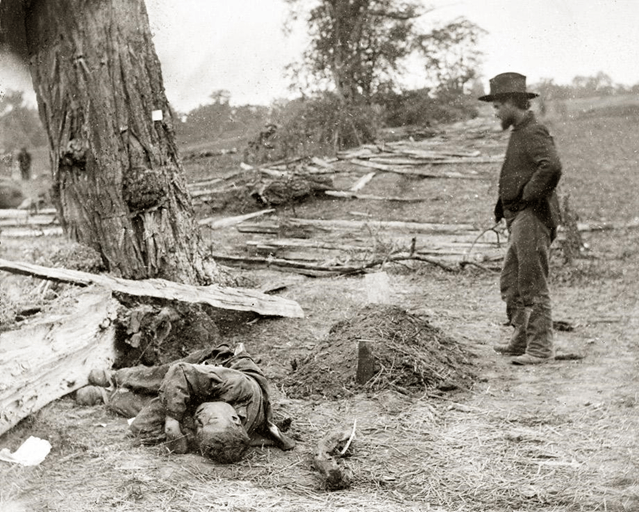
The enormity of the American Civil War’s scope and toll upon humanity is nearly impossible for many to fully comprehend today. The Union military consisted of approximately three million soldiers while the Confederacy’s ranged from 750,000 to one million men. Four million former slaves were set free from bondage and began to pursue their previously forbidden American dream. And even for those not fighting on the front lines of battle or seeking their first taste of freedom, the Civil War altered the lives of all who lived through it, defining the nation and its population for generations. With 750,000 men dead and well over one million wounded, war-time suffering often became tragically anonymous. Mass graves, unknown burial sites, and collective memorials were the orders of the day. However, photography became an important mechanism to revive the names and faces of many participants and victims of the Civil War. One relatively little-known duet of images captures the toll of the conflict on a small town and its martial heroes.
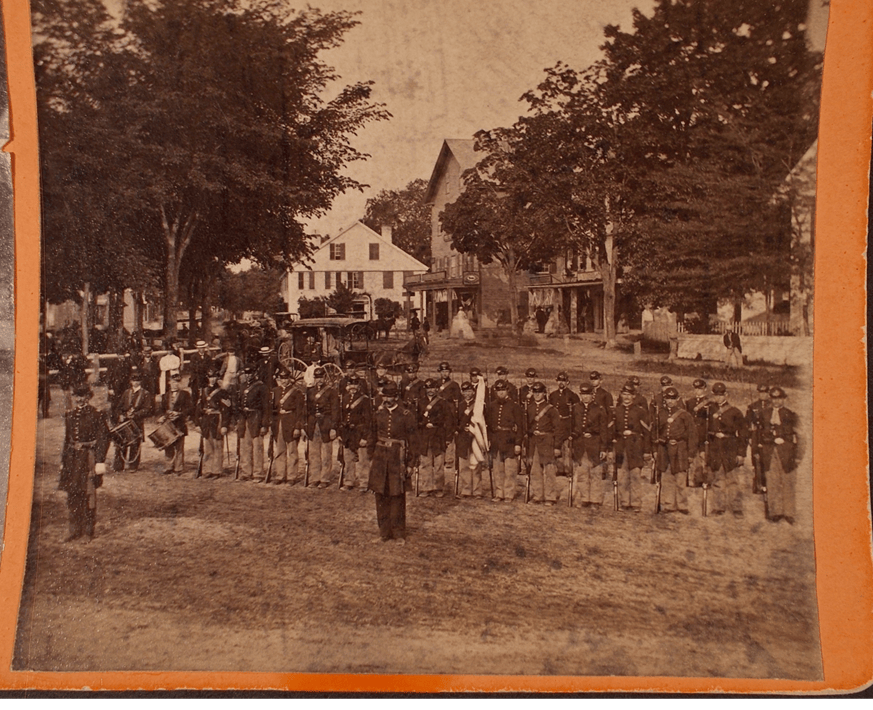
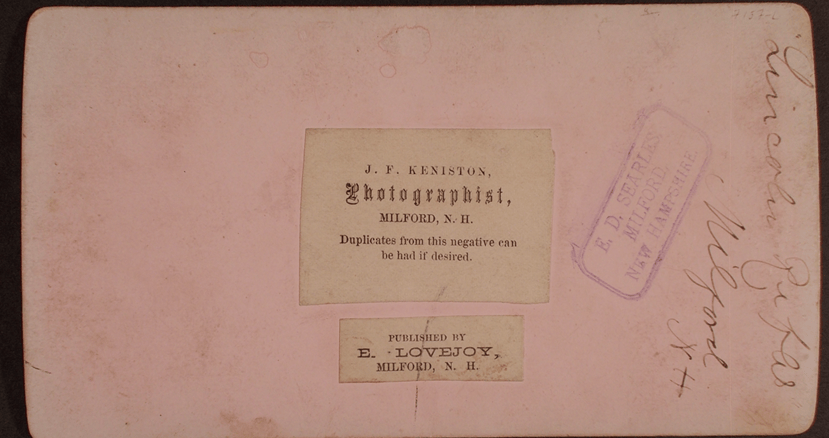
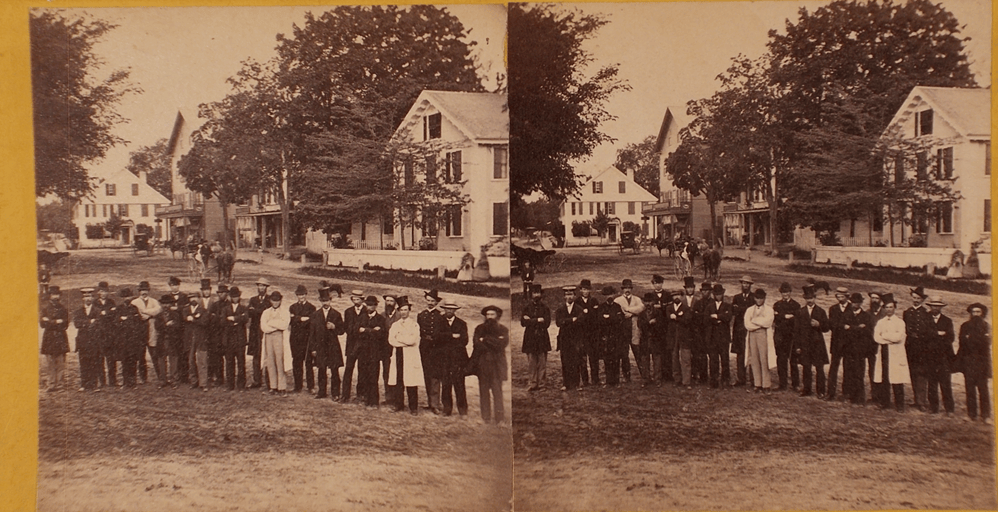
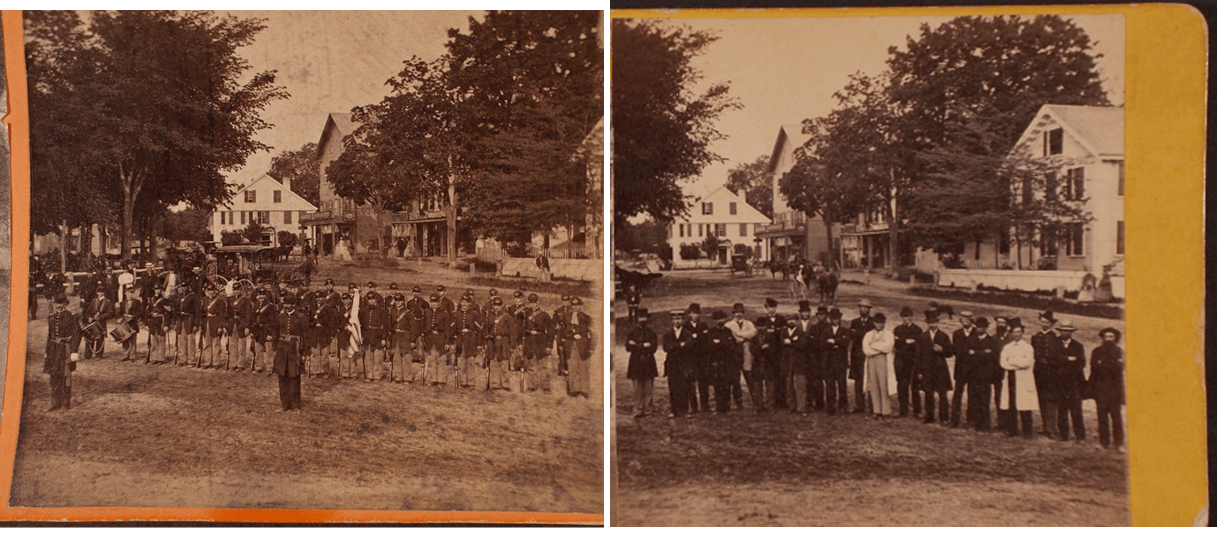
New Hampshire photographer, J.F. Keniston and publisher, E. Lovejoy printed and sold numerous stereo-view photographs of the below-featured local unit, self-identified as the Lincoln Rifles. The photograph below was taken in Milford, New Hampshire, in 1861. The subjects number about 32 soldiers.
Courtesy of Ron Perisho’s personal Civil War photograph collection.Back of stereo view card 1861 Lincoln Rifles photograph. Courtesy of Ron Perisho’s personal Civil War photograph collection.
Milford is a small town in south-central New Hampshire near the Souhegan River. Prior to the Civil War, it was well-known for its strong abolitionist views, with many residents openly vocalizing their dissent against slavery. Because of this abolitionist enthusiasm, the town was a vital stop on the Underground Railroad. Additionally, Milford was home to some of the largest granite quarries in the United States. Milford granite was used to build the pillars of the US Treasury Department in Washington D.C. Because of the importance of granite, Milford was nicknamed “Granite Town.” Additionally, in the 19th century, Milford followed the trend of other New English states in developing a prominent textile industry. The quarries and textile mills were the main employers for Milford residents, and thus the likely place of employment for at least some of the Lincoln Rifles.
During the war, many of Milford’s residents eagerly volunteered for the Union army. According to local researcher and historian David Nelson, 196 Milford citizens served in the military and 60 were killed; 40 of those dead were never recovered to be buried in their hometown. Keniston’s 1861 photograph of the Lincoln Rifles displays the passion and patriotism of the quaint town which has eagerly turned out an entire company of sharp-looking, fresh-faced recruits who stand at attention behind a U.S. flag, ready to fight for Union and a permanent end to the scourge of slavery. Fellow townsfolk take in the patriotic scene from the background.
Likely named in honor of their immediate reply to President Lincoln’s April 15, 1861 call for 75,000 troops to help put down the southern rebellion, the Lincoln Rifles were most likely attached to the 2nd Regiment of the New Hampshire Infantry—the longest serving New Hampshire regiment during the war. The regiment was formally organized in May, 1861 and mustered out in 1865, with the vast majority of the originally three-month enlistees quickly re-upping their contracts to serve for an additional three years. The 2nd New Hampshire was engaged in the First Battle of Bull Run in 1861; the Battle of Seven Pines, the Second Battle of Manassas, and the Battle of Fredericksburg in 1862; the Battle of Gettysburg in 1863; and the Battles of Cold Harbor, Petersburg, and Fair Oaks in 1864. In 1865, the 2nd New Hampshire occupied the trenches outside of Richmond, Virginia until the Confederate evacuation in early April of 1865. Of the approximately 1,000 men who enlisted in the 2nd New Hampshire, the regiment lost a whopping 15 officers and 163 enlisted men, either killed or mortally wounded, and 6 officers and 166 men from disease.
Attached to a unit that endured some of the bloodiest battles of the entire war, the Lincoln Rifles suffered great losses during their four years on the front lines. Keniston’s second image of the unit’s survivors, taken a few years after the Civil War ended, and in the same spot as the 1861 picture, hauntingly captures that suffering. In the second image, the group numbers about 22 men.
Courtesy of Ron Perisho’s personal Civil War photograph collection.
The war veterans stare at the camera with their arms folded or tucked defiantly into their jacket pockets. They stand loosely grouped together in a far more causal way than in their formal unit photograph of 1861. Most starkly, they are missing nearly one-third of the soldiers photographed in the first year of the Civil War. Few civilians can be seen in the background, and those present appear merely to be going about their daily chores; none stand by in reverent awe of these former combatants. For them, life has moved on .
It is not known if the smaller number of men is due to a low turnout for the gathering, or if the reduced number represents the casualties that the Lincoln Rifles suffered during their service. Based on the men’s somber affect, it is most likely the latter. The men were clearly organized to re-stage their 1861 portrait, but with a specific narrative to convey. Keniston’s photograph vividly depicts the human cost of war without displaying corpses of grievous wounds . In a way, his method of photographing the civilian-dressed veterans in the same location as their initial 1861 image–without their commander in the foreground and without many of their former comrades–makes the true cost of war that much more apparent, and the long shadows of even a victorious war effort that much more haunting. Despite the grievous death toll of the war, most soldiers who served ultimately survived, living face-to-face not only with the triumph of victory, but also with the tragedies of the conflict. One wonders what these veterans thought and felt as they once again posed in front of Keniston’s camera. Did they picture the men who were no longer by their sides? Did they ponder how the war likely changed their outlook on their military service? Did they reflect back on the early-war excitement, idealism, and romance that likely swelled the hearts of many in their 1861 portrait with sadness? Cynicism? Pride? These questions and numerous others like them hint at the main message of the Lincoln Rifles’ stereo-view photographs. As the infamous Confederate cavalry officer, Nathan Bedford Forrest once stated, “War means fighting, and fighting means killing.” But, what far-reaching impacts did that killing have on those who had made it out alive?
This semester, CWI Fellow Lauren Letizia ’23 is analyzing the numerous roles, cultural significance, and lasting impacts of a cross-section of Civil War photographers upon American society. While some may be familiar to avid readers of Civil War history, others represent lesser-known, but equally as important photographers whose methods, mediums, and end-products helped shape the way Americans understood and made meaning out of the war’s swath of destruction and those who participated in it. We are delighted to share her second piece in this series with you!
The CWI would like to express enormous thanks to Ron Perisho for his generosity in sharing the majority of the images featured in this mini-series, as well as the invaluable sources and insights he has provided to make this blog series possible!
With the innovative rise of photography as a means through which to document war, many aspiring 19th-century photographers flocked to infamous Civil War battlefields to capture the perfect image. Whether depicting a decimated landscape or mutilated soldiers, Civil War photography proved to have an eager audience both during and after the conflict. The photographers’ desire to display the consequences of what sometimes felt like “total” war opened a new chapter in the portrayal of death, destruction, and human suffering. However, despite these photographers’ pursuit of provocative imagery in the aftermath of a cataclysmic battle such as that at Gettysburg, many Civil War photographers manufactured scenes to better evoke the theme they sought. One such photographer was Peter S. Weaver, from Hanover, Pennsylvania, a borough located thirteen miles east of Gettysburg.
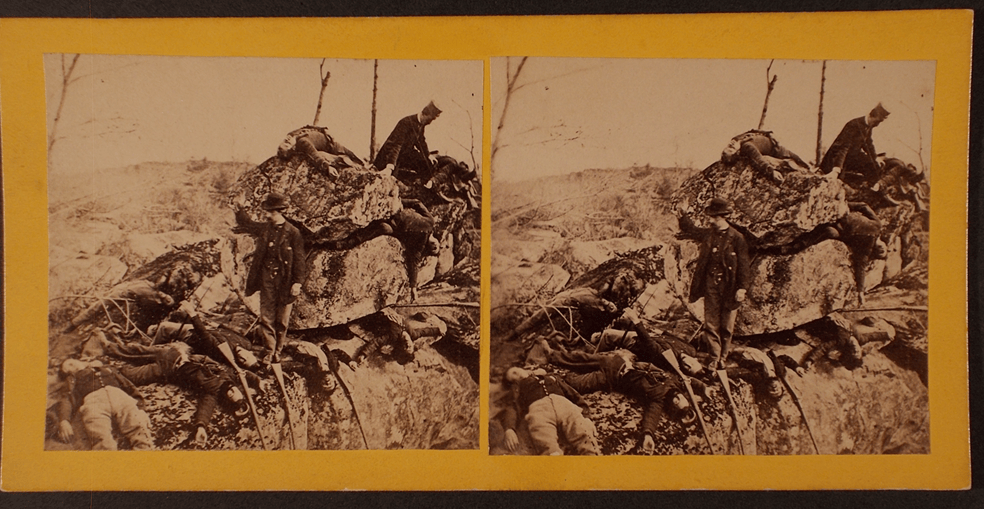
“Photographs at Gettysburg” collection by Peter S. Weaver: 11 November, 1863. (Courtesy of Ron Perisho)
The above stereo view image was taken on the Gettysburg battlefield in November of 1863. It depicts nine dead Union soldiers lying among the boulders of Little Round Top, with two Union doctors named Chamberlain (right) and Lyford (center) surveying the carnage. These “dead” soldiers, however, were very much alive. One of the “bodies” is believed to be military musician, Jacob Shenkel (lying to right of Dr. Lyford), of the 62nd Pennsylvania Infantry. During the Battle of Gettysburg, Shenkel aided the wounded and, after the battle, was ordered to serve as a hospital attendant at the famed military hospital, Camp Letterman, located just outside the Gettysburg borough. Staging scenes after pivotal battles were not unusual during the Civil War. Often, photographers moved dead bodies to distinct positions or locations. Alexander Gardner’s famous image of a dead rebel sharpshooter at Gettysburg is a perfect example of this practice. Gardner moved the body to craft a dramatic story about the romantic death of an expert sharpshooter slain at his post, killing implement still by his side.
“‘Home of a Rebel Sharpshooter’: Gettysburg 1863,” by Alexander Gardner.
Peter Weaver also subscribed to this methodology. When representing war, nothing is more impactful to a civilian audience than seeing heaps of dead young men, lying amongst rocks and dirt. This portrayal lays bare (in this instance, with dramatic exaggeration) the shocking reality that many soldiers’ deaths were not glorious, romantic, or sentimental. Rather, soldiers regularly died in ghastly positions, atop nightmarish landscapes, for the gawking eye of the public to behold. Weaver’s photograph was originally produced on large plates, but the above image was reprinted as a stereo view print, making it more suitable for consumers and mass reproduction.
To a modern viewer, the idea of staging war photographs, repositioning soldiers’ bodies, and asking living soldiers to play dead might seem extremely unethical or immoral. However, Weaver and other Civil War photographers wanted their images to convey their own view of the war, its purpose, and its consequences. Weaver’s above-shown image from his “Photographs at Gettysburg” collection was taken on November 11, 1863, long after the Union dead were initially interred, then reinterred, and just eight days before President Lincoln delivered his now iconic “Gettysburg Address” at the dedication of the new Soldiers’ National Cemetery. Although Weaver couldn’t possibly have known what Lincoln would say in the cemetery, nor anticipate the enormous staying power of those words when he initially staged this image, the photograph visually came to demonstrate the powerful message of Lincoln’s speech: Brave and devoted Union soldiers here gave their lives by the thousands in sacred sacrifice to preserve freedom and the “last best hope” for democratic government; the American people could not possibly let such sacrifices be in vain. Whether it was executed with or without artistic integrity, and even though Weaver may have initially staged the photo for mere “shock and awe” value as a “collector’s item” from the great battlefield at Gettysburg, the image became widely popular in the wake of Lincoln’s address. Thus, Weaver’s photograph added not only to the general public’s understanding of the immense human carnage wrought by the Civil War, but also to the larger meaning of the human sacrifices made in the name of some of the most cherished political ideals over which any men, anywhere, ever fought.
Photographer William H. Tipton also played a crucial role in portraying the aftermath of the Battle of Gettysburg. Born in Gettysburg, Pennsylvania, he studied photography from the early age of 12 with Charles and Isaac Tyson, both of whom were some of the first photographers to capture images of the Gettysburg battlefield. After the epic three-day collision ended on July 3, 1863, Tipton allegedly helped renowned photographer, Mathew Brady with capturing some of the most iconic images of the battlefield. Tipton became known for his landscape images, but his photographs of the battlefields of Gettysburg, Antietam, Fredericksburg, and Spotsylvania remained his most famous.
“The Implements of Modern Warfare” (front), copyright 1876, by William Tipton. (Courtesy of Ron Perisho)Definitions of the “Implements of Modern Warfare” (back of photoprint). (Courtesy of Ron Perisho)
This Tipton stereo view photograph card, “Implements of Modern Warfare,” stands out among Tipton’s other photographs for its unique display of 50 diverse artillery and mortar shells collected from the Gettysburg battlefield, as well as a chair used by Union General George Meade during the battle, and a musket (right of cabinet) used by local hero, John L. Burns. Burns was a veteran of the War of 1812 who, at 69 years old, became a volunteer civilian combatant at Gettysburg when he grabbed his old 1812 musket and ran to the front lines to help stave off the Confederate advance on July 1. He was wounded but survived to become both a local and national icon. On the back of the card, Tipton identified each artifact and piece of ordnance, including where it was found and its weight. The Civil War saw many advances in weaponry and manufacturing, hence its reputation for exceptionally bloody and brutal combat for that time. Muskets, rifles, and artillery became more accurate and more deadly. By highlighting many of the types of ordnances and materiel employed to facilitate such death and destruction in the neatly aligned rows of a well-organized cabinet, Tipton has transformed his war narrative from one focused on graphic human suffering to a fascinating, almost trivia-esque inventory of the tools of modern warfare. The contrast between the organized display and the bedlam caused by these implements’ bombardments and barrages evokes a jarring, yet necessary distance between the actual victims of war and passive audiences on the home front—a distance reassuringly mediated by allusions to some of the surviving, grand heroes (national and local) of the battle whose related relics sit, stoically, in the forefront of the display.
Shells and ammunition like the fifty implements displayed in the above image manufactured war scenes and facilitated the crafting of photographers’ own personal or cultural narratives about the war just as Weaver’s image of the fake dead soldiers did. Both seek to appeal to a curious public which consumed news, imagery, artifacts, and even their own visual “memorabilia” of the war at a sometimes-insatiable rate from which photographers such as Weaver and Tipton sought to profit. And, though Weaver’s photograph does not truly depict the dead of Gettysburg, when paired with Tipton’s image, the two images powerfully showcase, for easy commercial collectability, both the implements of modern warfare and their consequences. Furthermore, such images provided these two native sons of greater Gettysburg with a means to craft unique, individual narratives about the national meaning and cultural legacies of the battle that left lasting scars on their local community.
Works Referenced
Frassanito, William A. Early Photography at Gettysburg. Gettysburg, Pa: Thomas Publications, 1995.
Tipton, William H., Timothy H. Smith, and William A. Frassanito. Gettysburg’s Battlefield Photographer: William H. Tipton: Selected Images from the Collections of the Adams County Historical Society. Gettysburg, PA: Thomas Pub., 2005.
This semester, CWI Fellow Lauren Letizia ’23 is analyzing the numerous roles, cultural significance, and lasting impacts of a cross-section of Civil War photographers upon American society. While some may be familiar to avid readers of Civil War history, others represent lesser-known, but equally as important photographers whose methods, mediums, and end-products helped shape the way Americans understood and made meaning out of the war’s swath of destruction and those who participated in it. We are delighted to share her first piece in this series with you!
The CWI would like to express enormous thanks to Ron Perisho for his generosity in sharing the majority of the images featured in this mini-series, as well as the invaluable sources and insights he has provided to make this blog series possible!
On June 16, 1864, during a speech in Philadelphia, Pennsylvania, President Abraham Lincoln stated to the gathered crowd, “War at the best, is terrible, and this war of ours, in its magnitude and in its duration, is one of the most terrible.” When the war drew to a bloody conclusion a little over a year later, the United States had to contend with not only 700,000 dead, but millions of wounded and maimed soldiers. As the development of weaponry progressed, soldiers had received wounds of even greater magnitude. Clinical Union photographer, Dr. Reed Brockway Bontecou captured the horrifying, grisly, and gruesome physical wounds of the war. Using a purely medical and realistic approach to his photography, Reed shared a horrid glimpse of war that was not always as directly presented by the gallery photographers of the period.
The Civil War was the first sustained conflict to be documented through photographs in American history. Famous photographers such as Matthew Brady, Alexander Gardner, and Timothy O’Sullivan dropped the destruction and casualties of the war on Northern civilians’ doorsteps by publishing their photographs in newspapers, galleries, and selling prints for profit. Often, Brady and others would stage their scenes for specific cultural or political purposes by moving bodies or asking surviving soldiers to play dead. The medical photographs of R.B. Bontecou include none of these tactics. Instead, they portray the atrocities of the Civil War as plain and unfiltered as if one is in the room with these wounded soldiers.
Dr. Bontecou was the Surgeon-in-Charge of the Harewood U.S. Army General Hospital in Washington, D.C. He is credited with taking the largest number of photographs of wounded soldiers during the war. Afterward, he donated many of his photographs to the Army Medical Museum and published some of them in medical journals. For Bontecou, his personal and intimate knowledge of these patients’ maimed bodies made their grievous wounds not subjects to appease the public’s morbid curiosity about war, but rather important case studies through which other medical professionals might learn to treat, and perhaps save the lives of, future wounded soldiers. However, in disseminating his images to medical museums and journals, he joined a cadre of other medical photographers who would also, perhaps unintentionally, disperse their records and accounts to the civilian public. Many doctors took photos of their wounded soldiers, and some even sent amputated limbs to other institutions for further study and display. Although such actions were largely undertaken to further the field of medicine, the ensuing commercialization and public showcasing of those soldiers’ most private and grievous wounds would unintentionally dehumanize the young men, turning them into mere case studies and/or helpless subjects, shockingly exposed to the gawking public, rather than medical patients entitled to their privacy and dignity. The original purpose of the photos was to document the pre-and post-operative progression of Bontecou’s patients. Often, each image was labeled with the soldier’s name, regiment, wound, where the wound occurred, and his current condition. He also treated many soldiers who suffered from gangrene or other viral diseases. Bontecou wanted to use the grim photographs to teach other physicians how to care for war wounds and other camp diseases. After the war, he organized his photo into albums, categorizing each by which body part was wounded (from head to foot), and then alphabetized the patients’ names, creating a novel “catalogue” of the medical consequences of warfare.
Though Bontecou’s images were not developed as art or as a cultural statement about the Civil War intended for the gawking eyes of public consumers, they are expertly posed and positioned for a public audience. The soldier is often seated in a chair in front of a blank background while holding a chalkboard with his name and regiment. He stares directly at the viewer with a blank, sober expression. The photographs were published as cartes de visite (CdV), making them easy to produce and display multiple images at a time. Bontecou’s collection of wounded soldiers’ photographs was not replicated in accuracy and artistry until the latter years of the First World War. Because of Bontecou’s work, he transformed clinical and medical photography into an unintended but invaluable art form, one that can truly bring the grotesque consequences of war to the home front.
David R. Templeton- Co. A, 46th NY Regiment “Age 16, was admitted to [Harewood Hospital] April 5th 1865, with gunshot wound of the head. Ball hit left temple, just back of outer angle of eye, grazing malar bone and eyeball, destroying sight; passed off producing flesh wound of the tip of the nose. Was wounded at Petersburg April 2nd 1865. He is now well, June 1st, 1865.” -Description by R.B. Bontecou Charles Harris- Co. A, 31st US Colored Troops (New York) Private Charles Harris was 24 years old when he was wounded at the Battle of the Crater in Petersburg on July 30, 1864. He was shot in the right leg and the left ankle. He was a soldier in one of the specially trained USCT units ordered to attack Confederate forces after the explosion that created the infamous crater. In Harris’ regiment, the 31st NY, 54 were wounded, 31 were killed, and 13 went missing in action. He was discharged from Harewood Hospital on 1 December 1865.
This semester, CWI Fellow Lauren Letizia ’23 is analyzing the numerous roles, cultural significance, and lasting impacts of a cross-section of Civil War photographers upon American society. While some may be familiar to avid readers of Civil War history, others represent lesser-known, but equally as important photographers whose methods, mediums, and end-products helped shape the way Americans understood and made meaning out of the war’s swath of destruction and those who participated in it. Stay tuned for her three comparative blog profiles highlighting the lives and works of some of these fascinating individuals!
The CWI would like to express enormous thanks to Ron Perisho for his generosity in sharing the majority of the images featured in this mini-series, as well as the invaluable sources and insights he has provided to make this blog series possible!
In his famous book, Specimen Days, Civil War field hospital assistant-turned-writer, Walt Whitman wrote that “the real war will never get into books.” After four years of bitter conflict, millions of dollars of destruction, 700,000 soldiers dead, and millions more wounded, the United States knew that theirs was an experience that was brutally new to the land of proclaimed freedom, liberty, and pursuits of happiness. Though many tried, words and written recollections or reports struggled to capture the scope of grief and horrific bloodshed stretching from south-central Pennsylvania to Texas. Partly considering this new reality, the American public turned to the newly blossoming and unique medium of war photography.
Though photography existed prior to the Civil War, the war was the first conflict in which photography was a main documentary tool to chronicle the devastating epoch. Photographers would brave the gory aftermath of grim battlefields and establish themselves within military encampments to capture the true face of the war. Many of these photographs were then translated into engravings or sketches and printed in newspapers, hung in original form in galleries, or sold for commercial benefit in small print form to a curious public. Never had images of war causalities, razed towns, or other forms of human suffering of the frontlines been distributed to the home front. Many of these photographs countered the Victorian idea of romanticized battlefield assaults or glorious charges and good deaths, stripping American society of the civilian naivete towards combat. Some of the most iconic pioneers of this new industry were Mathew Brady, Timothy O’Sullivan, and Alexander Gardner, who would ultimately gain a significant following and great acclaim for their images. Surprisingly, they were met by a largely receptive audience that desired to view the scourge of war in all its gloom and gore. (It should be noted, however, that many of the original images were often “sanitized” in their transposition into the engravings and sketches that made the major newspapers, while other images were carefully doctored to present a certain narrative of the war which, while clearly grim, still sought to fit within certain acceptable tropes of nineteenth-century sentimental culture in order to appease a paying viewership). Several photographers, most notably Alexander Gardner and Mathew Brady, also set out to capture–and succeeded with great fanfare–the official presidential portraits of Abraham Lincoln and the official military portraiture of iconic generals such as Robert E. Lee and others that still dominate that public consciousness.
Ironically, despite his own severe visual impairment, Mathew Brady’s collection of photographs from the fields of Gettysburg, Pennsylvania made him a household name. His images were extremely popular in metropolitan galleries in New York, and later, in Washington, D.C. His first series, “The Dead of Antietam” shocked the American public, as it was the first such visceral representation of the war dead to meet Northern civilians’ eyes. However, despite their relative popularity, his photos did not sell nearly enough for a sustainable income, and Brady was forced to eventually declare bankruptcy. In 1875, the federal government obtained Brady’s Civil War negatives for $25,000. Alexander Gardner, a Scottish-born former assistant to and protégé of Brady, likewise struggled with financial insecurities (as well as how to carve out an independent identity from his former boss), but managed to produce some of the most iconic shots of the war, including the last posed photograph of Lincoln in February of 1865, images from his funeral and the hanging of the conspirators, as well as his famed (though pricey) “Photographic Sketch Books of the War,” published in 1866. Adding to the financial troubles of Brady, Gardner, and their peers was that fact that, both during and after the war, local photographers such as Gettysburg’s own Isaac and Charles Tyson, William Henry Tipton, and others would often supplement their own collection of self-captured negatives by copying the prints of Brady or Timothy O’Sullivan’s images and selling them to tourists and other curious Americans eager to have a memento of America’s deadliest war. These relatively inexpensive “knock-off” prints padded the pockets of local photographers but did little to sustain the fortune of the original photographer himself. Brady’s and Gardner’s financial struggles were not unique to Civil War photographers. Many of them failed to create a stable income, while others often died relatively young from long-term exposure to the chemicals used to develop their photographs.
Interestingly, despite the seemingly genuine and realistic nature of these photographers’ wildly popular images, many Civil War battlefield photographers staged their famous images. Some even asked surviving soldiers to play dead in sunken roads or on rocks to manufacture riveting images. Other photographs, such as Gardner’s well-known image of the dead Confederate sharpshooter at Gettysburg, were shot by moving bodies to different locations or positions. However, regardless of these questionable maneuvers, these well-known images, as well as other not so famous photographs, allowed civilians to view the ramifications of war in vivid display and in copious amounts, shaping their conceptions not only of warfare but also of the evolving meanings of death, suffering, and sacrifice
Civil War photography was also used for more practical military and medical purposes, such as the documentation of wounds and medical treatments, military engineering practices (made famous by Union engineer A.J. Russell), and the organization of topographical information. However, after the war, even some of these more “pragmatic” photographs would be released to the public and showcased in museums and galleries. Photographers with both Union and Confederacy loyalties were active in the field. For instance, George Barnard of Mississippi and Connecticut transplant George S. Cook photographed the war from the Southern perspective starting from the beginning of the war. Yet, the most well-known images and their photographers hailed from the North, with many early apprentices and protégés of Brady and Gardner, such as John Reekie and James Gibson, blossoming during the latter part of the war.
“Roman Catholic Cathedral of St. John and St. Finbar (Broad and Legare Streets) Destroyed in the Fire of December 1861.” Charleston, SC, George BarnardPontoon Bridge built by USMRR in Construction Corps in Belle Plain, VA. Published in May 1864, A.J. Russell
The actual task of capturing battlefield and war photographs was not an easy endeavor. Photographers had to carry their cumbersome equipment, including their darkroom, as well as their sensitive chemistry through tough terrain by horse-drawn wagons. These challenging conditions made the actual development process of photographs exceedingly difficult, as the prints were extremely light sensitive and the dirt, debris, and weather anomalies photographers faced on the road and out into the field complicated the process at every turn. At the beginning of the war in 1861, photographers used a method called wet-plate photography, which chemically coats an image onto glass with a chemical called collodion. It was time-consuming work, as the chemicals were mixed and applied by hand. The negatives of the images needed 5 to 20 seconds of stationary light exposure. Hence, there are no action photographs of the Civil War.
“The Sick Soldier” (1863), Mathew Brady Wounded Union Zouave soldier in Confederate hands.
However, as the years progressed, photographers began to develop new ways to view images. One of the most influential methods was the printing of photographs in stereo view. These were three-dimensional images that were captured by a twin-lens camera that shot a photograph with two separate lenses. This methodology mimicked the way in which the human eyes see the same image from different angles of the head. The images were then developed using the wet-plate process. Once this step was completed, the photographer would put the two stereo images on a viewing card, known as a stereograph or stereo view card that could be inserted into publicly available viewers to create a 3D image. Additionally, in the later years of the war, a process called albumen printing was the dominate form of photographic development. This included the soaking of paper in fermented chloride and egg white, letting it dry, then soaking the paper in a solution of silver nitrate. The paper would then be placed in a frame directly touching the negative of the image. It was then dried using sunlight.
One of the most popular forms of photographic publication and printing was the Cartes de Visite (CdVs). A CdV is a photographic print pasted on paper to a larger card (2-1/2’’ by 4’’) They were mostly used in albumen prints since the 1850s. CdVs became incredibly popular during the Civil War, as they were cheap and easy for families and soldiers to carry in pockets or purses. CdVs were used to capture both portraits and battle scenes, which gave them a universal and accessible appeal. As the war progressed, it became possible to print larger CdVs, such as those iconic prints of Atlanta after General Sherman’s march, portraits of President Lincoln, Lee, and other known generals and their staff.
CdV print of a young Union sergeant, Johnston Brothers Studio NY
The photographic advances of the 1860s and the novel ways in which photographers captured the Civil War ignited a new age for both the art and science of photography. Civil War photography went on to inspire scores of war-time photographers during modern wars such as World War II and Vietnam. The horrific scale and scope of the Civil War was, combined with the public’s desire for a wide-scale, so-called “authentic” and “genuine” record of warfare popularized the photographic medium throughout the war years and well beyond. As photographers found their niche audiences, be it within the circles of wealthy purchasers of the so-called “sketchbooks,” or amongst upper class socialites who craved the stereo views of the latest battle images for their parlor guests, the middling-class visitors to urban galleries, or the readers of major newspapers or collectors of cartes-de-visites, they continued to adapt their mediums to the scope and scale of the war. In doing so, they helped, in vital ways, to set the tone for the ways in which the war was presented to the civilian public (both national and international), and thus shaped, in no small way, the cultural meanings and enduring legacies of the costliest war of the nineteenth century.
Alexander Gardner’s Photographs of the Battle of Antietam (September 1862) Top Image: “Burial Crew at Work” Bottom Image: Confederate Soldier remains unburied beside a buried Union Soldier