Pay Them Gratitude and Respect: Remembering the Civil War’s Prisoners of War

By Elizabeth Smith ’17

On Friday, April 8, President Barack Obama issued a proclamation in which he designated April 9 as National Former Prisoner of War Recognition Day. “We salute the selfless service members throughout our history who gave their own liberty to ensure ours,” the president declared, “and we renew our commitment to remaining a Nation worthy of their extraordinary sacrifices.”

10448786_800669723279245_4262014867699204442_n
A very small part of the National Cemetery located on site at Andersonville National Historic Site. Photo taken by author.

For the American Civil War, the prisoner of war story is often summed up in one word: Andersonville. The mythos surrounding this infamous prison site has, for many, become the determining factor to understanding the Civil War prisoner-of-war story, but the story is far more complex than one place. At the beginning of the war, a prisoner exchange system had to be set up in order to exchange prisoners. This happened on July 22, 1862 in what would become known as the Dix-Hill Cartel, and set up the system of equal exchange. Any soldiers not exchanged would be issued parole, meaning the soldier would remain in a parole camp and not take up arms until properly exchanged. Continue reading “Pay Them Gratitude and Respect: Remembering the Civil War’s Prisoners of War”

A Thaddeus Stevens Musical: A 19th Century Hamilton?

By Megan McNish ’16

If you read my last post on the Broadway musical Hamilton, you’ve already read my waxing admiration of the show and might also remember that I listen to the soundtrack non-stop. The musical has shown the world the power that music has as a teaching tool. As someone interested in nineteenth century American history, I long for a Hamilton-esque musical regarding the Civil War era. One of the reasons Hamilton is so successful is its ability to draw connections between past and present issues, and that can be done easily for nineteenth century America. Women’s rights, slavery, immigration, emancipation, and workers’ rights are all issues that plagued the nineteenth century and, in many ways, we deal with their legacy today. I have thought long and hard about how a musical about the nineteenth century would be executed and on whose life it would focus. The obvious choice would be to focus on Abraham Lincoln. Our sixteenth president’s story has equal parts success and personal tragedy. Lincoln, however, does not satisfy me as the protagonist in the way that Hamilton does. His story has been told many times over and. Comparatively speaking, retelling Lincoln’s story would be a similar choice to telling Washington’s story in the context of the Revolutionary War era.

Stevens the Musical [82946].png
Parody image by author. Original copyright of Hamilton:  An American Musical.
Continue reading “A Thaddeus Stevens Musical: A 19th Century Hamilton?”

A Middle East Perspective: Civil War Memory in Syria and at Home

By Annika Jensen ’18

Last summer, while on a trip with the Eisenhower Institute’s Inside the Middle East program, I stood at the Israeli edge of the Golan Heights and heard a bomb explode across the border in Syria. We had spent the day within several miles of the war-ravaged nation with all remaining quiet until that moment, and while none of us wanted to admit it, we had the smallest hope that we might catch a glimpse of the conflict. However, when the sound of the detonation roared across the hills, excitement was replaced by a sense of fear and grief. I had lived a year in Gettysburg, yet I had never felt so close to a battlefield.

The wall of an abandoned hospital on the Syrian-Israeli border. Photograph by the author.

Gazing from the Golan Heights across the Syrian border held a certain degree of spectatorship; though it is morbid to articulate, we were all waiting for something to happen, as if conflict were equivalent with entertainment. Though it may not be just to compare our experience with the picnicking politicians at First Bull Run, waiting around for excitement and glory then fleeing in a panic, I certainly felt an observer of war. Perhaps many of us were too desensitized by the commonality of violence in our omnipresent media outlets to be affected. None of us felt particularly unsafe or even frazzled; we were too far from the sound to gauge whether any damage had been inflicted, and even if we had we never would have seen it. Nonetheless, the day was spent feeling a little more wary. Continue reading “A Middle East Perspective: Civil War Memory in Syria and at Home”

The Missing Link: The Search for the Connection Between Young Americans for Freedom and Charles Willoughby

By Jeff Lauck ’18

Last semester, Gettysburg College was abuzz with controversy over the ultra-conservative messages that the Young Americans for Freedom organization was spreading around campus. As the Compiler’s unofficial, wannabe muckraker, I wanted to dive into the discussion. My entry point was a rumor that a reactionary Gettysburg College alumnus helped establish the organization in the 1960s. I jumped at the opportunity to uncover the link.

Gettysburg graduate and right-wing officer Charles Willoughy '14 in 1918. Photograph courtesy of the Library of Congress, via Wikimedia Commons.
Gettysburg College graduate and right-wing army officer Charles Willoughy ’14 in 1918. Photograph courtesy of the Library of Congress, via Wikimedia Commons.

The only information I had to work with was his name, Charles A. Willoughby, and the fact that he was one of General Douglas MacArthur’s prodigies. A quick Google search revealed that Willoughby was indeed involved in YAF. However, the only sources were blogs and books that also claim that Willoughby was involved in the assassination of President John F. Kennedy. These are obviously not the most reliable sources. The search also revealed ample evidence that Willoughby was an ultra-conservative with connections to fascists. He was good friends with conservative icons like Billy Hargis and John Rousselot and even testified before Joseph McCarthy’s House Committee on Un-American Activities to try to label an elderly woman as a “communist subversive.” He also idolized Francisco Franco and Benito Mussolini. Yet this doesn’t prove he was involved in YAF; it merely proves that he was an extreme right-winger. I was determined to find hard evidence to support a link to YAF. Continue reading “The Missing Link: The Search for the Connection Between Young Americans for Freedom and Charles Willoughby”

Lost Cause in the Oval Office: Woodrow Wilson’s Racist Policies and White-Washed Memory of the Civil War

By Jeff Lauck ’18

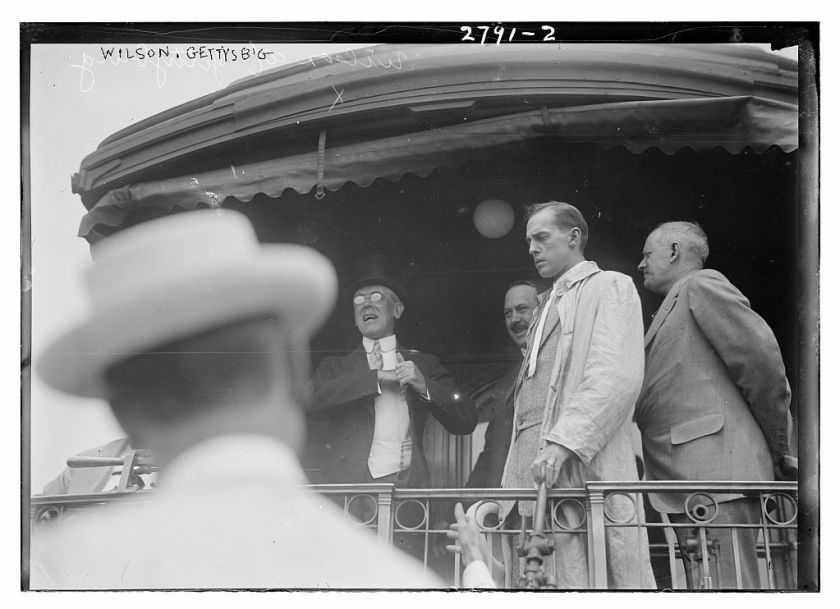
For the past several weeks, students all across the nation have opened up discussions on race relations on university campuses and in American culture at large. The latest battlefield in the fight for greater inclusion is Princeton University, where protestors from the Black Justice League staged a 32 hour sit-in at the president’s office. Princeton University, traditionally viewed as a bastion of progressivism and liberal ideology, is coming under fire for its reverence for perhaps their most famous graduate, President Woodrow Wilson. Wilson graduated from Princeton University Class of 1879 and served as president of the school from 1902 until 1910, after which he was elected Governor of New Jersey and subsequently the 28th President of the United States.

13859v
President Woodrow Wilson addresses the crowd at the 50th Anniversary Blue & Gray Reunion at Gettysburg in 1913. Photo courtesy of the Library of Congress.

At a superficial level, Princeton seems entirely justified in venerating their well-accomplished graduate. However, as the Black Justice League has pointed out, President Wilson has also left a legacy of racism in his wake. In July 1912, Wilson enlisted the help of African American civil-rights leader William Monroe Trotter to increase his prospects among the black community during his campaign for the presidency. In exchange, Wilson promised to promote fairness for all Americans. During the first year of Wilson’s presidency, Trotter again visited Wilson to follow up on his promise. Trotter brought with him prominent civil-rights leader Ida B. Wells as well as documented proof of a policy of segregation in federal offices. Trotter and Wells were dismissed with “vague assurances” from the president. In a third meeting in the Oval Office in 1914, Trotter escalated his rhetoric, charging that the president himself was promoting Jim Crow policies in the federal government. Wilson responded by arguing that segregation was put in place to benefit blacks and should not be seen as a “humiliation” for the African American community. The conversation quickly took a turn for the worse and Trotter and his delegation were escorted out of the White House, tempers flaring. Continue reading “Lost Cause in the Oval Office: Woodrow Wilson’s Racist Policies and White-Washed Memory of the Civil War”

Living History or LARPing? The Case of Vox’s Modern Victorians

By Alex Andrioli ’18

Sarah A. Chrisman and her husband, Gabriel, love the late Victorian era. Like many lovers of history, the Chrismans have a specific time period they enjoy studying more than others. For them, it’s the 1880s and 1890s. However, they take their research a little more seriously than most. They don’t just take their work home with them, they live their work.

In an article for Vox, Sarah Chrisman wrote, “Everything in our daily life is connected to our period of study, from the technologies we use to the ways we interact with the world.” She and her husband live in Port Townsend, Washington in a house that was built in 1888. They have replaced many modern appliances with “period-appropriate” appliances like the electric refrigerator that came with their house when they bought the property. They now have an icebox that they stock with block ice that dribbles into a drip tray that requires being emptied once or twice a day depending on the season. Along with this icebox, the Chrisman house is stocked with a mechanical clock that needs to be wound every day, fountain pens and ink, electric light bulbs that are based on the original patents of Edison and Tesla, oil lamps, mortars and pestles, a hairbrush that has a 130-year-old design, and toothbrushes that have natural boar bristles. These, among other items, are what make up the Chrismans’ Victorian paradise.

512px-SirJohnLaveryARally1885
An 1885 painting depicting a woman playing tennis in fashionable Victorian clothing. Did the woman in this painting have the same opinion of her clothing as Chrisman? “I became so accustomed to the presence and movements of my skirts, they started to send me little signals about my proximity to the objects around myself.” Painting by Sir John Lavery, via Wikimedia Commons. Sir John Lavery. “A Rally.” 1885.

Continue reading “Living History or LARPing? The Case of Vox’s Modern Victorians”

Vandalism and Symbolism

By Steven Semmel ’16

The world of social media has been buzzing over the topic of the Confederate flag, creating a scary divide of opinions over it. The whole debate/argument started over the shooting in Charleston, South Carolina. The shooter had the Confederate flag posted all over his social media sites, creating some disturbing images of hatred. Instead of focusing on the race war the shooter was trying to start, many focused on the Confederate Flag he had in his pictures online. Tempers flared and many sought the removal of the Confederate flag from in front of the Capital Building in Charleston during the funerals of the victims.

However, this was just the beginning. Soon many people wanted more, to remove the flag all across the country. Apple, Amazon, eBay, and Walmart joined the event by removing Confederate flag items from being sold. The announcement made many people feel that their “Southern Heritage” was being suppressed and people were “too soft and offended by too many things in today’s society.” Then the Gettysburg National Park Service announced the removal of sole Confederate flag merchandise from their book store. The same people now thought that the government was trying to oppress the Southern perspective of the Civil War and were going to remove Confederate flags from all museums. The people for the removal thought it was about time that the flag was removed because it stood for slavery and a national divide. They also brought in the argument that Germany banned the Nazi flag from flying, so why was the Confederate flag still flying to this day. But what does this flag mean and what is the appropriate way to respond to this debate? Continue reading “Vandalism and Symbolism”

Memory on Parade: The Gallipoli Centenary and Anzac Day Commemoration

By Kevin Lavery ’16

On April 25, 2015, record crowds were drawn from across Australia and New Zealand to the annual Anzac Day celebrations. This year’s commemoration was extra special, for it marked the one hundredth anniversary of the First World War’s Gallipoli campaign. Several of my primary news sources reported heavily on the festivities and it all got me thinking again about how people rally around these patriotic, semi-historical holidays even if the holidays are often distorted reflections of the historic events that they are meant to commemorate.

The United States does not have a perfect parallel to Anzac Day, but the way in which our own national identity is constructed around certain annual holidays like Memorial Day and the Fourth of July–and around certain locations such as Gettysburg and Washington, DC–does present us with some loose parallels that we can work with to discuss some of the issues at play. I realize that comparisons can be problematic tools when dealing with history, but I also think that understanding such commemorations as a global phenomenon is essential to recognizing the scale and spread of the issues involved. Continue reading “Memory on Parade: The Gallipoli Centenary and Anzac Day Commemoration”

Flags of Some of Our Fathers, Part 1: Ideas Don’t Die Easy

By Matt LaRoche ’17

I lied in the title. Ideas don’t die. Period. Once thought, they stay thought, failing the death of the species. However, that’s not to say that they stay recognizable, as time and circumstance make use of them in unforeseeable ways. And that is not to say that symbols are not co-opted and recycled with regularity. However, it is to say that no generation can allow a lack of foresight, or the complacency of memory, to allow such ideas and symbols to go un-scrutinized.

The so-called Rebel Flag. Wikimedia Commons.

What am I on about? I would say that, for Americans, no ideas could afford to go unexamined more than the ill-defined ones that fall under the notion of “Confederacy.” I cannot say that, however, because these ideas are global, and even our familiar symbols—the flags that hold sway over some of our hearts as attractive faces of a positive good or a personal, emotional history—are no longer ours. They belong to the world and to the ages. Thus, it is everyone’s urgent responsibility to call to attention and scrutinize ideas—and their hallmarks—that do not reflect our modern conceptions of morality or sensibility, or that simply don’t make sense. Continue reading “Flags of Some of Our Fathers, Part 1: Ideas Don’t Die Easy”

Controversial Commemoration: Remembering the Varied Legacies of Nathan Bedford Forrest

By Logan Tapscott ’14

Over the winter break, I participated in an immersion trip to Alabama to learn about the Civil Rights Movement and visited cities like Birmingham, Montgomery, and Selma that played an important part in the movement. Despite the past, I did not expect to encounter such a racially charged atmosphere fifty years after the push for desegregation and equality in the South. I also did not anticipate a controversy over a statue dedicated to Nathan Bedford Forrest. Forrest was born in 1821 in Tennessee and, with no military education, was later promoted Lieutenant General and became a controversial figure in the American Civil War. Historians and Civil War scholars continue to debate Forrest’s complex legacy. While famous for sending a Confederate division to what is referred to as the Fort Pillow Massacre in 1864, Forrest was regarded as an important commander for his guerilla warfare-style tactics and for creating and practicing the doctrine and tactics of mobile warfare. Throughout the former states of the Confederacy, mostly throughout Tennessee, people have erected statues of him and named public spaces after him. In the past ten years, people have debated about Forrest’s legacy and whether a commemoration is suitable, especially in Southern cities with a predominately black population, including Selma, Alabama.

nbf phot

Continue reading “Controversial Commemoration: Remembering the Varied Legacies of Nathan Bedford Forrest”

css.php