
The Power of Passion: How a Lack of Momentum is Dooming New Hampshire Battle Flags

By Savannah Rose ’17

In my last post, I looked at preservation of Civil War artifacts at the local level, but not even at the state level do these items receive the attention they need. I spent my winter break back home in New Hampshire and decided to take a visit to our capitol building to visit the Hall of Flags. I have seen and read about the Hall before, but I hadn’t visited it in a few years. I arrived at the capitol building after a few hours of driving, opened the large doors to the governmental building, and immediately arrived in the Hall of Flags, all ranging from the Civil War to Vietnam.
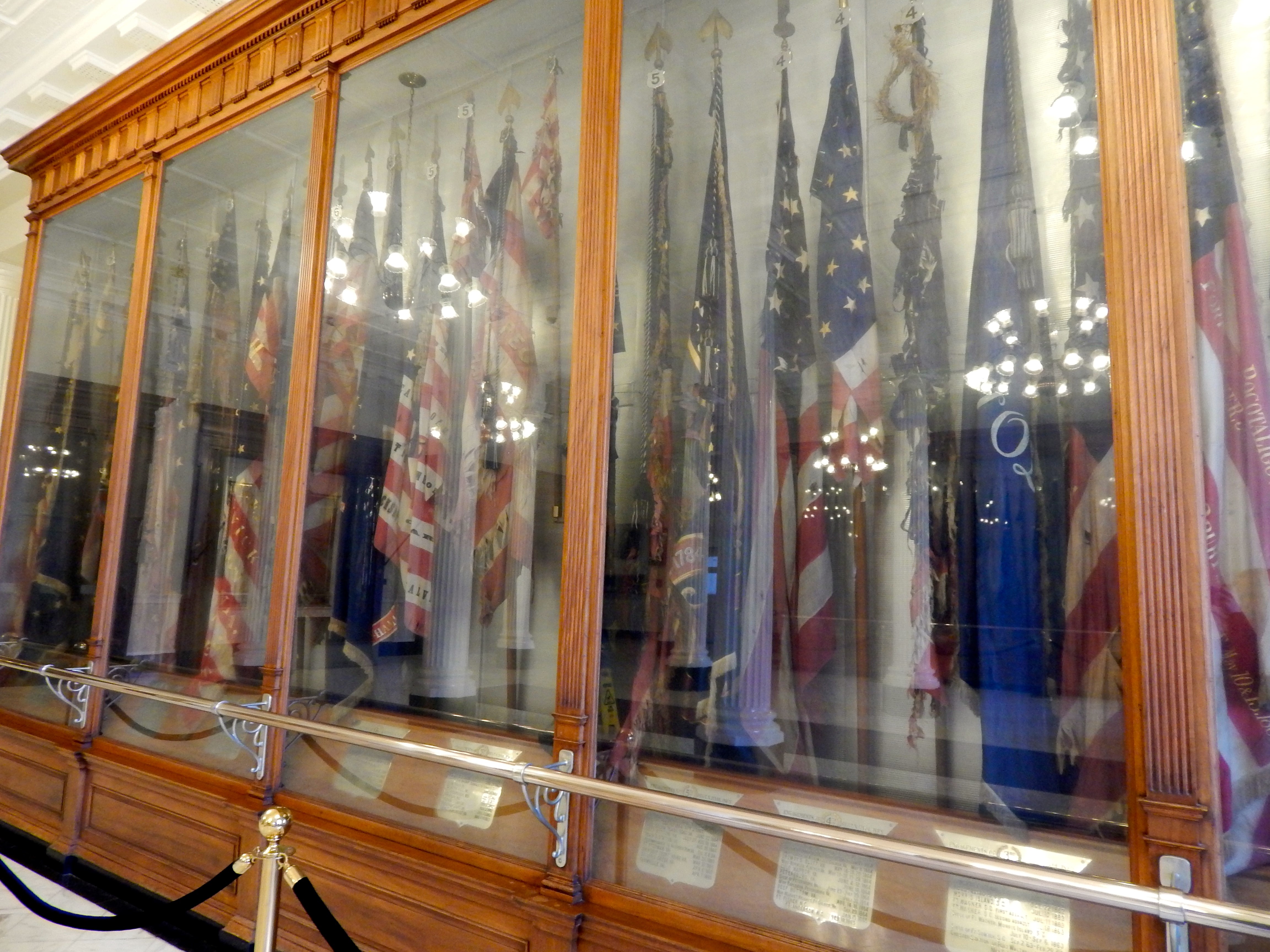
The Hall of Flags contains 107 battle flags ranging from the Civil War to the Vietnam War. Photo courtesy of author.
The Hall of Flags contains 107 battle flags ranging from the Civil War to the Vietnam War. Photograph by the author.

The State House has possession of battle flags from regiments deriving from the state of New Hampshire from more than 150 years ago. The first flags came to the State House in 1866, months after the last shots of the Civil War were fired. The flags resided in the Concord City Hall, entering their current home in the state capitol building in 1900, and have not been touched since. Straight from the battlefield, the flags create a magnificent exhibit of loyal colors, showing the pride the state had for its citizens who fought in more than five different wars. The flags are tattered, faded, and worn out, not solely due to bullet holes and bloodstains, but by the way they are presented to visitors. Continue reading “The Power of Passion: How a Lack of Momentum is Dooming New Hampshire Battle Flags”

A Nurse’s Life: Review of Clara Barton, Professional Angel

By David Bruce Smith

Clara Barton: Professional Angel
By Elizabeth Brown Pryor
444 pp. University of Pennsylvania Press
$27.50

Sometimes, Clara Barton defied men of military might to pass through Civil War battle lines, and nurse “her” boys.

She had no formal medical training, but Barton was palliatively precocious, and titanically talented in raising robust quantities of resources and relief supplies.

1531
Image courtesy of University of Pennsylvania Press.

Elizabeth Brown Pryor’s 1987 Clara Barton, Professional Angel, remains the most definitive biography of the future founder of the American Red Cross, but some of what is divulged is not flattering.

Barton was youngest of five siblings. Her miller-farmer father adored her, but her mother was critical, and to Clara “her very identity was submerged in the priorities of the rest of the grown-up family…” Continue reading “A Nurse’s Life: Review of Clara Barton, Professional Angel”

This Month in Civil War History: February 2016

By Jeff Lauck ’18

071381pv
The Lincoln Birthplace cabin in Hodgenville, KY, circa 1940. Photo courtesy of the Library of Congress.

Click the play button below in order to listen to “This Month in Civil War History” for February 2016. You can also scroll down to read through the transcript if you would prefer to read it. This report is also airing on WZBT 91.1 FM throughout this month. Thanks to WZBT for their help in producing this piece.

Transcript:

Continue reading “This Month in Civil War History: February 2016”

To Be Or Not To Be: A Kentucky Battlefield’s Drive to Become a National Park

By Elizabeth Smith ’17

On January 4, 2016 a large group of people met in the theater of the Mill Springs Battlefield Visitor Center in Nancy, Kentucky. Only a few weeks shy of the 154th anniversary of the small Kentucky battle, these individuals gathered on the chilly night to attend a public forum in support of the addition of Mill Springs into the National Park system.

Eliz 2
On January 4, people gathered to attend a public forum at the Mill Springs Battlefield Visitor Center. Photograph taken by author January 2016.

The Battle of Mill Springs occurred on January 19, 1862 between Confederate forces under Felix Zollicoffer and Union forces under George H. Thomas. The battle begin in the early morning fog and would continue for four hours in a cold rainstorm. Men from Mississippi, Tennessee, Kentucky, Ohio, Minnesota, Indiana, and Alabama would meet at the fields near Logan’s Crossroads where they would engage in a short but influential fight that would see the death of Zollicoffer supposedly at the hands of Speed Fry. Though small compared to later battles, Mill Springs would become the first major Union victory since First Bull Run, help to stop the Confederate defensive line in the West, and gain nationwide recognition for George H. Thomas and Speed Fry. Continue reading “To Be Or Not To Be: A Kentucky Battlefield’s Drive to Become a National Park”

Why Historic Houses Suck: An Anarchist’s Guide to the Unorthodox Museum

By Alex Andrioli ’18

Picture in your head a historic house museum that you have visited.

Did you picture Mt. Vernon or Monticello? How about the historic house that you grew up down the road from? Did images of antiques and display cases flash through your mind, or was it the velvet rope barriers, musty smell, creaky floorboards, and dusty signs? I bet a majority of these things popped into your head because that’s what many people remember after they leave a historic house museum. I know that I have! The historical value of the museum is short term, but the memory of a musty old home you visited once as a kid will last you a lifetime. But it doesn’t have to be this way!

118415pv
The Dyckman Farmhouse is a Dutch Colonial style farmhouse that was built around 1784 and still resides in the same location that is now Broadway & 204th Street on Manhattan Island in New York City. It opened as a museum in 1916 and is the last farmhouse in Manhattan. Photograph by the Historic American Buildings Survey, via the Library of Congress.

When historic house museums started popping up in the late nineteenth and early twentieth centuries their purpose was to educate immigrants about “American values and patriotic duties.” As the years went by and the surrounding communities changed, the museums stayed the same. As a result, historic house museums have been experiencing a steady decline in visitors and funding over the years. However, people like Franklin D. Vagnone and Deborah Ryan are on a mission to revive interest and relevance in these museums. Continue reading “Why Historic Houses Suck: An Anarchist’s Guide to the Unorthodox Museum”

Saving Colonel Cross: How Money Determines Which Histories Are Preserved

By Savannah Rose ’17

This summer, I spent my weekends volunteering at the Lancaster Historical Society near my hometown in northern New Hampshire. I went to elementary school in Lancaster and suffered through lessons on local history, but it wasn’t until I arrived at college that I discovered an interesting piece of Lancaster’s heritage. I learned that the commander of the “Fighting Fifth” NH, Colonel Edward E. Cross, was born and buried in Lancaster, an astonishing and exciting discovery that brought the Civil War back to my hometown.

After discovering this, I anxiously waited to go home to see what belongings of Cross Lancaster had in its possession, only to be incredibly disappointed by what I found. The grave of Colonel Cross is currently locked away from the public, rarely open for viewers to enter the cemetery. I was understanding of this as it was a private cemetery, but nothing could prepare me for what I found at the historical society. The historical society, operating out of a house in town, was closed the first summer I came home forcing me to wait a year to see the artifacts relating to Cross. Last summer was the first time I saw the artifacts of Colonel Cross, all together in a pantry-sized case.

CWI Cross
Colonel Edward E. Cross’s artifacts reside in this small closet within the Lancaster Historical Society. Stacked on top of each other, the artifacts have to endure the temperatures of a New Hampshire winter. Photo courtesy of the author.

Continue reading “Saving Colonel Cross: How Money Determines Which Histories Are Preserved”

Fortenbaugh 2015: The Historian’s Biggest Fear: A Numerical Approach to the Past

By Jules Sebock ’18

Every November 19, the anniversary of Lincoln’s Gettysburg Address, the Robert Fortenbaugh Memorial Lecture is presented in honor of a late Gettysburg College professor. Each year, a distinguished scholar gives a presentation with the goal of offering a lecture that is understandable to the general public while maintaining its historical integrity.

Joining the likes of Kenneth Stampp, Drew Gilpin Faust, and Elizabeth Fox Genovese, Joseph T. Glatthaar of the University of North Carolina at Chapel Hill delivered this year’s 54th annual Fortenbaugh Lecture. “When I think of the incredible historians that have given this lecture, I’m absolutely honored,” he said of the distinction.

Joseph Glatthaaredited
Dr. Joseph T. Glatthaar.

Continue reading “Fortenbaugh 2015: The Historian’s Biggest Fear: A Numerical Approach to the Past”

"We Can Not Dedicate, We Can Not Consecrate, We Can Not Hallow This Ground": But We’ll Certainly Try

By Jules Sebock ’18

When Pennsylvania Governor Andrew Curtin and local attorney (and Gettysburg College alumnus) David Wills set out to create a final resting place for the dead of the Battle of Gettysburg, renowned orator Edward Everett was the clear choice as the dedication ceremony’s keynote speaker.  Wills’s formal invitation to President Abraham Lincoln read thus:  “It is the desire that, after the Oration, you, as Chief Executive of the Nation, formally set apart these grounds to their Sacred use by a few appropriate remarks.”  From that phrase, the Gettysburg Address would be born.

IMG_3002
The speakers at this year’s Dedication Day event. Photograph by the author.

Since that day, the world has both noted and remembered the President’s words.  Each year at the National Cemetery, this remembrance is epitomized in the annual Dedication Day ceremony.  This event is notable for both its solemn commemoration and its distinguished guest speakers. The keynote address was given this year by humorist and storyteller Garrison Keillor, known best as the host of the radio show A Prairie Home Companion. Continue reading “"We Can Not Dedicate, We Can Not Consecrate, We Can Not Hallow This Ground": But We’ll Certainly Try”

CWI Radio Report: Dedication Day and Remembrance Day 2015

By Jeff Lauck ’18

10708636_10152479310138107_8371047935726462836_o
Luminaria at Gettysburg National Cemetery, 2014.

UPDATE: The Dedication Day ceremony has been moved to the College Union Building at Gettysburg College due to inclement weather.

Click the play button below in order to listen to Jeff’s special report on this week’s Civil War commemorations here in Gettysburg. You can also scroll down to read through the transcript if you’d prefer. This report will be airing on WZBT throughout this week. Thanks to WZBT 91.1 FM for their help in producing this piece.

Continue reading “CWI Radio Report: Dedication Day and Remembrance Day 2015”

“A Foe as Dangerous as Armed Rebels”: A Review of Harold Holzer’s "Abraham Lincoln and the Power of the Press"

By Alex Andrioli ’18

The beauty of the history field is that we can build upon the foundations of our predecessors and continually improve how we remember and explore the past. This allows for historians to delve deep into a particular subject that is often overlooked, but still has powerful significance. Harold Holzer, the winner of the 2015 Gilder Lehrman Lincoln Prize, accomplishes such a task in his book, “Lincoln and the Power of the Press: The War for Public Opinion.”

Holzer pairs the familiar subject of Abraham Lincoln with the relatively unexplored relationship Lincoln possessed with the ‘social media’ of the nineteenth century: the newspaper. Journalism was, and still is, a force to be reckoned with that could make or break a politician’s career. Politics and the press walk hand-in-hand, and Lincoln realized this. “Our government rests in public opinion,” Lincoln claimed. “Whoever can change public opinion can change the government.”

Beginning in the 1700’s, improved printing techniques and “political enthusiasm” brought about the wide popularity of newspapers. Politicians harnessed the “power of the press” to reach a larger audience and spread political beliefs. Papers that sided more with a particular politician or ideology attracted loyal readership and the funds of political parties. Holzer’s work illustrates the “vigorous, often vicious” world of the nineteenth century press that could “distort” the lens through which the public accessed and viewed politics. Continue reading ““A Foe as Dangerous as Armed Rebels”: A Review of Harold Holzer’s "Abraham Lincoln and the Power of the Press"”

css.php