“We Can Never Forget What They Did Here”: What Draws People to Gettysburg?

By Jen Simone ’18

“I am so sick of hearing about the Civil War every single day.”
“I didn’t expect there to be so many history nerds at this school.”
“I don’t get why so many tourists come to a little place like Gettysburg.”

I hear constant complaints from fellow Gettysburg College students about how tired they get of hearing about the Civil War. What did they expect coming to Gettysburg College, situated in one of the most visited historic towns in America? More importantly, what is so wrong with hearing about the Civil War so often? I decided that I wanted to investigate—why are so many people drawn to this small town in rural Pennsylvania? What draws millions of people to take time out of their busy lives to explore this special place? I’m hoping that my findings will convince college students that it is worth exploring this history-rich town and maybe for once, get them to stop to read the interpretative markers while they’re out jogging on the battlefield instead of simply passing by.

What draws people again and again to this battlefield? Photograph by author.

I conducted my whole investigation by walking up to random people I met in town and asking them all the same simple question: “Why are you here?” I expected to get very similar answers throughout all of my interviews and was ready to keep a tally of people visiting because they are either history buffs or because they have never been to Gettysburg before and just thought they should visit and see what all of the hype is about. I was shocked, however, for no two responses I received were the same. Continue reading ““We Can Never Forget What They Did Here”: What Draws People to Gettysburg?”

The Music of “1865” in 2015: A Civil War Musical Retrospective by Anonymous Four

By Meg Sutter ’16

Last Sunday, the Lutheran Theological Seminary Chapel was packed full of people eager to see the world-renown a capella group Anonymous Four for their final touring season. For nearly thirty years, the four women who make up the group have performed around the world with their unique style and sound. This season, Anonymous Four invited Bruce Molsky, “one of America’s premier fiddling talents,” to join them for their “1865” concert celebrating the end of the Civil War through their own interpretation of Civil War music. The event, co-sponsored by the Civil War Institute and the Sunderman Conservatory of Music, opened with remarks by the Civil War Institute’s Dr. Jill Titus, on the importance of analyzing and studying music when trying to understand the culture of the Civil War Era.

The Anonymous Four
The program for Anonymous Four’s “1865” concert. Photograph courtesy of author.

Continue reading “The Music of “1865” in 2015: A Civil War Musical Retrospective by Anonymous Four”

Report from the Headquarters: A Reflection on the Lee’s Headquarters Public Forum

By Elizabeth Smith ’17

On October 6, approximately seventy people gathered at the Gettysburg Visitor’s Center to attend a public forum discussing the future of the site commonly referred to as Lee’s Headquarters. The property is located on Buford Avenue near the Lutheran Seminary and the Seminary Ridge Museum. On July 1, 1863, the area was the site of several artillery pieces, part of the Union retreat route through the town, and on July 2nd and 3rd, it would serve as Confederate General Robert E. Lee’s headquarters. After the battle, the site would serve as one of the first automotive tourist spots for the millions of visitors who traveled to view the first day’s battlefield. Small cottages, motels, and eventually the Quality Inn would emerge to cater to the mass of tourists.

Photograph by J. Stephen Conn, via flickr.com.
Photograph by J. Stephen Conn, via Flickr.

The forum began with information relating to the work and reports that have already been completed regarding the Lee’s Headquarters site. These reports detailed what, if any, adverse effects the demolition of the buildings currently on the site—specifically the old Quality Inn motel—would have on the environment and future archeology. The tentative answer is that the removal of the motel would have no such effects. Representatives from the Civil War Trust, the organization that purchased the land, spoke about their goals for the Lee’s Headquarters’ site. Their mission is to either demolish or remove the buildings on the site to another location in order to restore the view of the first day’s battlefield, replant the orchard that use to be on the site, put in period-accurate fences, and create a simple battlefield trail that will tell the story of the battle, the headquarters, and the tourist industry that thrived in the years following the battle. Continue reading “Report from the Headquarters: A Reflection on the Lee’s Headquarters Public Forum”

The Intersection of Art and Public History: Schmucker Art Gallery’s Newest Exhibit

By Jeff Lauck ’18

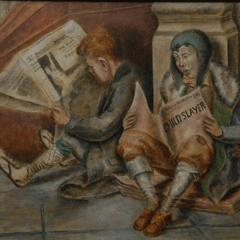
“‘Pray For the People Who Feed You’: Voices of Pauper Children in the Industrial Age” is the newest exhibit to be featured in the Schmucker Art Gallery at Gettysburg College. The exhibit was curated by Gettysburg College senior Rebecca Duffy ’16, and is the culmination of her three semester International Bridge Course (IBC) program. At its opening on Friday, October 2, Duffy discussed her experiences with the IBC program and the process she went through in putting together this unique project.

Grist For the Mill, by Minna Citron. This painting, currently in the “Pray For the People Who Feed You: Voices of Pauper Children in the Industrial Age” exhibit in Schmucker Art Gallery depicts two impoverished children who read about the world events that unfold around them.
Grist For the Mill, by Minna Citron. This painting, currently in the “Pray For the People Who Feed You: Voices of Pauper Children in the Industrial Age” exhibit at Schmucker Art Gallery depicts two impoverished children reading about the world events unfolding around them.

Duffy is an Art History and History double major with a minor in the new Public History program. In designing her project, she wanted to incorporate elements of each of her areas of study. Duffy was also influenced by her work as a Pohanka Intern at Petersburg National Battlefield and Fredericksburg and Spotsylvania National Military Park. The International Bridge Course program at Gettysburg College offers students the opportunity to work with a faculty mentor over a three semester period, with the middle semester being conducted through the study abroad program. Continue reading “The Intersection of Art and Public History: Schmucker Art Gallery’s Newest Exhibit”

Re-Thinking James Buchanan

By Ryan Nadeau ’16

On Saturday, September 19th, local citizens, historians, Civil War enthusiasts, and the rare college student alike converged at the LancasterHistory.org Campus of History for the second day of the President James Buchanan National Symposium. The theme for the symposium was “The Worlds of Thaddeus Stevens and James Buchanan: Race, Gender, and Politics in the Civil War Era,” thus it featured the lives of two of Lancaster, Pennsylvania’s most prominent historical residents and two of the most colorful characters of the Civil War era.

A photo of Wheatland, taken from the back yard. The house served as James Buchanan’s Lancaster home, located just next to the LancasterHistory.org Campus of History. Photograph by author.

The tone for the day’s discussions was perhaps set out from the beginning by Gettysburg College’s own Professor Michael Birkner as he introduced the first panel, alleging that the traditional historical narratives of the era, such as the unshakable legend of Buchanan dithering away his presidency as the Union collapsed, are old and tired. Instead, he went on to say, we should make way for a body of new, fresher, and more contentious scholarship – one that shall continue to grow thanks in large part to the scholars on hand at the event.

To summarize the full proceedings of the day’s event would be a task far unsuited for a blog post. As such, rather than going through the details of each historian’s paper point-by-point, here are what I believe to be the most pertinent themes and topics of the symposium: Continue reading “Re-Thinking James Buchanan”

President Lincoln Finds a Permanent Seat on Campus: The Dedication of the New Abraham Lincoln Statue Outside Stevens Hall

By Jeff Lauck ’18 

Students, faculty, and visitors to Gettysburg College have likely noticed the most recent addition to our campus. Last Friday, a brand new bronze statue of President Abraham Lincoln was dedicated outside Stevens Hall. The statue, which stands nine feet tall, depicts a seated President Lincoln signing the Emancipation Proclamation and was designed by Stanley Watts, who also designed the Lincoln statue outside the Gettysburg Public Library on Baltimore Street. The statue unveiling comes almost 153 years to the day when President Lincoln issued the preliminary Emancipation Proclamation, which gave the Confederate States 100 days to return to the Union before emancipation would become law.

The statue dedication was preceded by a luncheon and panel discussion on the significance and legacy of the Emancipation Proclamation. Dr. Michael Birkner moderated the panel, which featured Dr. Scott Hancock, Dr. Jill Ogline Titus, and Dr. Peter S. Carmichael. Dr. Carmichael began the discussion by explaining the context for the Emancipation Proclamation. According to Dr. Carmichael, as the war carried on, Lincoln realized that slavery was severely undermining the Union war effort and that emancipation was therefore a necessary tool to achieve victory. On September 22, 1862, a few days after the Union victory at Antietam, he issued the preliminary Emancipation Proclamation. Upon issuing the final document on January 1, 1863, Lincoln declared: “I never, in my life, have felt more certain that I was doing right, than I do in signing this paper.” Continue reading “President Lincoln Finds a Permanent Seat on Campus: The Dedication of the New Abraham Lincoln Statue Outside Stevens Hall”

Striking the Balance: Bringing Peace to the Battlefield of Preservation

By Matt LaRoche ’17

Most Gettysburg residents took note this past winter when the Appalachian Brewing Company’s branch restaurant near the Lutheran Seminary closed. The Civil War Trust bought the land for its historical value; the structure and an adjacent hotel surround the Mary Thompson House, General Lee’s Headquarters during the battle. From the moment of purchase, the plan had been to demolish the buildings, sow grass, and transfer the four-acre lot to the National Park Service as a prized addition to the park. Most onlookers probably think that the tale is told as soon as the land is bought, cleared, and promised to the park. However, that thinking only pans out in a vacuum. In reality, the results of this purchase—as with any large purchase of land in a community—cannot be foreseen. Too many different actors are involved in and affected by something as simple as the demolition of a couple of businesses and the placing of a conservation easement on a property. And for those who stand to be affected by this purchase, controversy is pervasive and understandable.

A modern photograph of Lee's Headquarters at Gettysburg (l) with the Appalachian Brewing Company and a glimpse of The Quality Inn to its right. Appalachian Brewing Company.
A modern photograph of Lee’s Headquarters at Gettysburg (l) with the Appalachian Brewing Company and a glimpse of The Quality Inn to its right. Appalachian Brewing Company.

Continue reading “Striking the Balance: Bringing Peace to the Battlefield of Preservation”

The Hope of Appomattox

By Emma Murphy ’15

Throughout the sesquicentennial, I have often found myself wondering what the end of the 150th anniversaries and the surrender at Appomattox would bring to present Civil War memory. What lessons do we take away from that small stuffy room in the McLean House, with the fate of the nation hanging in the balance?

Photo credit to the author.

I was fortunate enough to attend the 150th anniversary of the surrender at Appomattox Courthouse on April 9. Purposely decked out in all Gettysburg College and Civil War Institute attire, I eagerly awaited the many discussions and debates between me and fellow visitors. I had imagined the historic site to be crawling with Lost Causers and neo-Confederates. But to my surprise, as the crowd began cramming in front of the stage at 1 o’clock, the time when General Lee had arrived exactly 150 years before, the focus shifted to the importance and overall historical context of the ground on which we stood. As Robin Snyder, the Acting Superintendent of Appomattox Courthouse National Historic Site, took the stage, she made the connection between 1865 and 2015 in one word.


Hope. Continue reading “The Hope of Appomattox”

The Unfinished Work: Slavery Today

By Kevin Lavery ’16

2.7 million. That’s an estimate for the number of slaves in the world today. The true number is probably higher, even though the United States abolished slavery 150 years ago. Most of today’s slaves go unseen and unaided, victims of an opaque system of exploitation that conspires to keep them oppressed.

Photo by Ira Gelb. Via Flickr.
Photo by Ira Gelb via Flickr.

Last month, the Gettysburg College chapter of Free the Slaves hosted “The Unfinished Work,” a conference that brought together students and activists from across the country to discuss what can be done to fight modern slavery. These modern-day abolitionists—spiritual successors of William Lloyd Garrison and Frederick Douglass—came together to talk about a perverted institution that certainly did not end with the Civil War. We all know that the legacy of slavery haunts the moral conscience of the United States, but we cannot afford to forget that slavery itself remains with us, albeit in a different set of forms. Continue reading “The Unfinished Work: Slavery Today”

James Buchanan and the Coming of the Civil War: Complicating the Image of the ‘Do-Nothing’ President

By Ryan Nadeau ’16

While ranking presidents is often a controversial exercise open to great amounts of interpretation, all rankers—and I say this with a certainty I’m usually loath to use when making historical remarks—rank James Buchanan low. Very low. If not dead last, second to last. If not that, third to last. Certainly and absolutely no higher than the bottom five. This is altogether a direct reflection of his perceived status as a president who, when confronted with the brewing Civil War that would kick off as he left office, sat on his hands and did absolutely nothing.

“Portrait of James Buchanan,” Wikimedia Commons.

Taken out of the context surrounding the coming of the Civil War, this may come as a surprise. Buchanan’s political resume was, and remains, altogether wonderful, having served in numerous diplomatic posts, the House of Representatives, Senate, and as Secretary of State before his election. As unfortunate employers occasionally find, however, experience does not strictly make a successful employee. Unfortunately, Buchanan’s employer was the citizenry of the United States. Continue reading “James Buchanan and the Coming of the Civil War: Complicating the Image of the ‘Do-Nothing’ President”

css.php