John Wilkes Booth: A Sister’s Memoir

By David Bruce Smith

John Wilkes Booth: A Sister’s Memoir By Asia Booth Clarke Edited by Terry Alford 151 pp. University Press of Mississippi $18.63
John Wilkes Booth: A Sister’s Memoir
By Asia Booth Clarke
Edited by Terry Alford
151 pp. University Press of Mississippi $18.63

A gypsy read John Wilkes Booth’s palm and predicted tragedy. “Ah, you’ve a bad hand; the lines all cris-cras [sic]. It’s full enough of sorrow. Full of trouble. Trouble in plenty, everywhere I look. You’ll break hearts . . .  You’ll die young, and leave many to mourn you . . . but you’ll be rich, generous and free with your money. You’re born under an unlucky star . . . you’ll make a bad end . . .  You’ll have a fast life—short, but a grand one. Now, young sir, I’ve never seen a worse hand, and I wish I hadn’t seen it, but every word I’ve told is true by the signs. You’d best turn a missionary or a priest and try to escape it.”

Afterwards, when the prophecy fulfilled, the Booth family was denounced for Abraham Lincoln’s assassination and never forgiven by the country. They were hunted, hounded, and harassed for the rest of their lives. Asia Booth Clarke immigrated to England to dodge the deluge, because she was “personally unknown…” there, and never returned–permanently. Continue reading “John Wilkes Booth: A Sister’s Memoir”

Stewarding Our Lands: Historical Preservation in Gettysburg

By Matt LaRoche ’17

Photo credit to Philip Pane ’17.

In recent decades, more and more time, energy, and resources have been put towards saving large tracts of our historical heritage. This surely appears self-evident to residents of a place like Gettysburg, which has seen the boundaries of the park grow exponentially thanks to the National Park Service, as well as to the actions of various private organizations and individuals.[1] However, the conservation is far from complete. Not every  “vision-place of souls”[2] has been saved. However, while every parcel of preserved land is a gift to the American people, much preserved land still waits to be properly rehabilitated and made a meaningful part of the national tapestry.

Continue reading “Stewarding Our Lands: Historical Preservation in Gettysburg”

Remembrance Day…But Remembering What?

By Sarah Johnson ’15

In conversation with other CWI Fellows last week, we began discussing the strangeness of the annual Remembrance Day Parade. Originally conceived as a way to recreate the procession to the cemetery in 1863 to hear the Gettysburg Address at the dedication of the Soldier’s National Cemetery, it seems to have morphed into something different all together. If we are honoring a recommitment to the preservation of Union, why do Confederate reenactors march in the parade? If we are simply celebrating the soldiers of both sides of the Civil War, why does the parade end at the site of the address that rededicated the nation to Union emancipationist victory and a “new birth of freedom?” To sate my curiosity, I decided to go out on assignment and interview people before the parade began. I interviewed spectators and reenactors alike and asked them the following questions: 1) Is the parade a yearly tradition for you? and 2) What are you here celebrating and remembering today? Here is what I found:

Photo credit to the author.

Continue reading “Remembrance Day…But Remembering What?”

History Alumni Lecture: Historic Homes and Audience

By Megan McNish ’16

"Panoramic image made from five photos taken Aug 2007 at Stratford Hall Plantation and merged together with AutoStitch," original uploader MamaGeek. http://commons.wikimedia.org/wiki/File:StratfordHallPlantationPano.jpg
“Panoramic image made from five photos taken Aug 2007 at Stratford Hall Plantation and merged together with AutoStitch,” original uploader MamaGeek.
http://commons.wikimedia.org/wiki/File:StratfordHallPlantationPano.jpg

On the evening of October 8 in Gettysburg College’s Joseph Theater, Paul Reber ’82 spoke on the historic house museum. Reber presented for the History Department’s annual Alumni Lecture, despite the fact that when he was at Gettysburg College, he was a Political Science major. As Dr. Shannon, chair of the History Department, said, Reber eventually saw the light. Reber spent the majority of his talk speaking on various historic house museums he has had experience with, including Mount Vernon, the White House, and Stratford Hall, where he is the current director. Stratford was the home of the Lee Family on the Northern Neck in Virginia and is one of the sites of the Civil War Institute’s Brian C. Pohanka Internship Program. Stratford has a particularly interesting history. When it was taken into the hands of the historic preservation community in the 1930s, the home closely resembled what it had been like when Robert E. Lee was born there. During this period, however, the structure was restored to its Colonial appearance. Reber and his staff are attempting to restore various rooms in the home to their appearance based on various periods of the Lee family ownership.

Continue reading “History Alumni Lecture: Historic Homes and Audience”

Hell Before Breakfast … after dinner.

By Megan McNish ’16

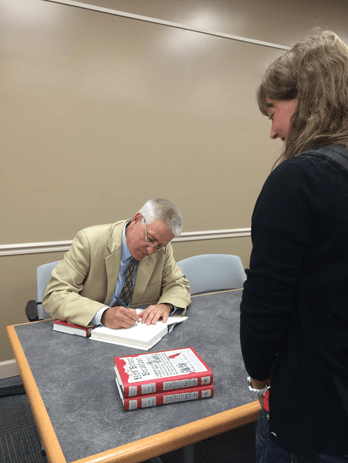
On Tuesday evening Gettysburg College’s Civil War Institute and Eisenhower Institute welcomed Robert Patton, grandson of the famous World War II General George Patton, to speak on his new book Hell Before Breakfast. Patton was welcomed to the college by Susan Eisenhower, granddaughter of the famous World War II general Dwight Eisenhower. Ms. Eisenhower expressed her excitement to hear about the book. Hell Before Breakfast follows a few exceptional American war correspondents from 1854 through the turn of the twentieth century and its title draws from Civil War general William T. Sherman’s comment on the death of a war correspondent that soon there would be “reports from Hell before breakfast.” Sherman, Patton chuckled, was clearly not a proponent of these correspondents.

patton

Continue reading “Hell Before Breakfast … after dinner.”

“Years of Anguish” at Fredericksburg and Spotsylvania National Military Park

By Avery C. Lentz ’14

Back in February of 2014, I was rather surprised to receive a phone call from a Mr. John Hennessey, head of interpretation at Fredericksburg and Spotsylvania National Military Park. John had been chatting with my advisor, Dr. Peter Carmichael, and had heard the story about my interesting ancestry and its connection to the Battle of Gettysburg. John then called me after getting my information from Professor Carmichael and invited me to be a part of the “Years of Anguish” Program that was being held at the Salem Baptist Church on April 5th, 2014. The themes of the panel were presidents, generals, and descendants of the American Civil War and John invited me to share the story of my ancestors’ involvement in the war as part of the lecture. I was truly honored and hit with a jolt of excitement when I realized that I would be telling my story to a crowd of people who were just as passionate about the Civil War as I was.

Continue reading ““Years of Anguish” at Fredericksburg and Spotsylvania National Military Park”

“The Scorpion’s Sting”: Dr. James Oakes and the 2014 Lincoln Lyceum Lecture

By Meg Sutter ’16

The annual Lincoln Lyceum Lecture took place on Thursday, March 27th at 7:30pm in Gettysburg College’s Mara Auditorium. This year’s Lincoln Lyceum guest speaker was Dr. James Oakes, two- time winner of the Lincoln Prize for his books The Radical and the Republican: Frederick Douglass (2008 Prize) and Abraham Lincoln and the Triumph of Antislavery Politics and Freedom National: The Destruction of Slavery in the United States, 1861 -1865 (2013 Prize). He has previously taught at Princeton University and Northwestern University and is currently the Distinguished Professor of History at the Graduate Center of the City University of New York.

Dr. James Oakes

Continue reading ““The Scorpion’s Sting”: Dr. James Oakes and the 2014 Lincoln Lyceum Lecture”

Lincoln’s Triumph: A Lecture by Allen C. Guelzo

By Avery Lentz ’14

On the night of March 5th, 2014, a crowd of Gettysburgians and devoted fans filtered into a small auditorium to hear Dr. Allen C. Guelzo who was giving his final lecture in his Abraham Lincoln lecture series, a four-part analysis about the president’s rise to power to his death. The fourth and final lecture focused on President Lincoln’s triumphs in his presidency and many of the challenges he overcame in the last two years of his life. Dr. Guelzo began with talking about the issuance of the Emancipation Proclamation and its reception in the Union and in the Confederacy. Lincoln received angry and confused questions about why the war should be fought for slave freedom rather than just the country’s reunion. Also, the Proclamation’s wider acceptance was hindered by the string of Union military failures that seemed to plague the eastern Army of the Potomac: George McClellan’s failure to pursue Lee’s Army of the Northern Virginia after the tactical draw at Antietam in September 1862, Ambrose Burnside’s major blunder at Fredericksburg in December 1862, and Joseph Hooker’s large failure at the hands of Lee at Chancellorsville in May 1863.

Continue reading “Lincoln’s Triumph: A Lecture by Allen C. Guelzo”

Special Guest Book Review: A Blaze of Glory by Jeff Shaara

By David Bruce Smith

A BLAZE OF GLORY:
A NOVEL OF THE BATTLE
OF SHILOH
By Jeff Shaara
448 pp. Ballantine Books Trade Paperback
$16.00

Within a year after the start of the Civil War, the cohesion within the Confederate army was wearing away. Defeats from the Union forces were on the upsurge; they were trounced at Fort Donelson, and overwhelmed in Fort Henry. Tennessee appeared to be lost, but the much-loved rebel commander-in-chief, General Albert Sidney Johnston, envisioned a decisive turnaround in Shiloh that would arrest his bad fortune, and assure the country of its destiny–as he saw it: a nation of slaveholders.

Continue reading “Special Guest Book Review: A Blaze of Glory by Jeff Shaara”

css.php