
The Occupation of the South: An Interview with Andrew Lang

By Ashley Whitehead Luskey

Andrew Lang
Dr. Andrew Lang. Image courtesy of Mississippi State University.

Over the course of this year, we’ll be interviewing some of the historians scheduled to speak at the 2016 CWI conference about their upcoming talks and their thoughts about Reconstruction and its legacies.  Today, we’re speaking with Andrew Lang, Assistant Professor of History at Mississippi State University. Lang is the author of Waging Peace in the Wake of War: United States Soldiers, Military Occupation, and the American Civil War Era (currently under contract with Louisiana State University Press), as well as several scholarly essays.

CWI: What roles—political, economic, social—did the U.S. military play in the reconstruction of the South during the postwar occupation of the region?  What was the nature of its interactions with Confederate veterans? With women? With free blacks?  What regional variations did members of the U.S. military encounter during its occupation of the South in the Reconstruction era?

LANG: The U.S. military played a substantial role in the Reconstruction South. Following Confederate surrender, the Army was demobilized at a stunning, rapid pace, yet the institution retained important war powers which had guided Union arms to victory during the Civil War. In many ways, the Army assumed peacetime responsibilities with which it had rarely before been tasked, especially in politics and civil-military relations. The American tradition had long viewed a powerful military establishment, wielding strong political, economic, and societal influence, with suspicion. And yet it seemed that Union victory would not be assured without a substantial military force to maintain peace in the wake of wartime destruction while also ensuring the safety of freedpeople, southern Unionists, and Republicans who inhabited the South in the months and years after Appomattox. Serving as a formal peacekeeping force, overseeing elections and constitutional conventions, regulating local courts, policing the countryside, and engaging in a degree of counterinsurgency, the Army was perhaps the most important institution in the South during the Reconstruction era. This was true especially in managing the post-emancipation order. After playing a key part in the processes of wartime emancipation, the Army performed a crucial role in running the Freedmen’s Bureau, safeguarding African American rights, negotiating labor contracts and challenging the re-authorization of old planter regimes, acting as a buffer between freedpeople and former slave owners, and serving as a refuge to which freedpeople, notably women, could turn to report white transgressions and violence. As with most military occupations, the Army found that its presence in the South was welcomed warmly in some places and with much more hostility in others. Southern Unionists—white southerners who had opposed the Confederacy—as well as those pockets of the South that had long been under wartime military supervision, welcomed Union soldiers as forces of stability and protection. Some white southerners got along amicably with Union occupiers, while others expressed abject hatred and defiance, usually in areas hardly touched by Union patrols or in regions of formerly concentrated slave holding. Ironically, some evidence suggests that former Confederate soldiers—but certainly not all—were inclined to give Union soldiers the least amount of trouble. However, the occupiers eventually learned that some of those who had once filled the ranks of rebel armies were also those who joined the clandestine terror organizations that spread political and racial violence across the region. Continue reading “The Occupation of the South: An Interview with Andrew Lang”

Lost Cause in the Oval Office: Woodrow Wilson’s Racist Policies and White-Washed Memory of the Civil War

By Jeff Lauck ’18

For the past several weeks, students all across the nation have opened up discussions on race relations on university campuses and in American culture at large. The latest battlefield in the fight for greater inclusion is Princeton University, where protestors from the Black Justice League staged a 32 hour sit-in at the president’s office. Princeton University, traditionally viewed as a bastion of progressivism and liberal ideology, is coming under fire for its reverence for perhaps their most famous graduate, President Woodrow Wilson. Wilson graduated from Princeton University Class of 1879 and served as president of the school from 1902 until 1910, after which he was elected Governor of New Jersey and subsequently the 28th President of the United States.

13859v
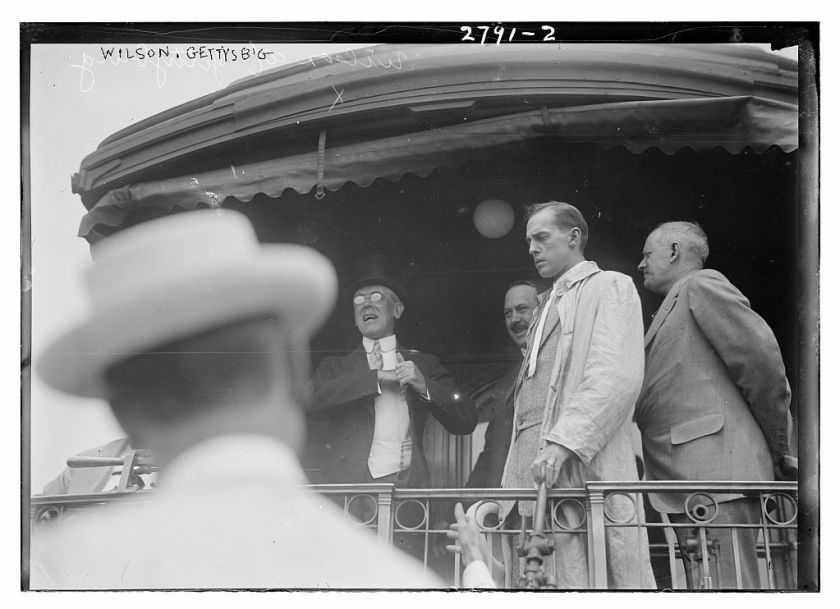
President Woodrow Wilson addresses the crowd at the 50th Anniversary Blue & Gray Reunion at Gettysburg in 1913. Photo courtesy of the Library of Congress.

At a superficial level, Princeton seems entirely justified in venerating their well-accomplished graduate. However, as the Black Justice League has pointed out, President Wilson has also left a legacy of racism in his wake. In July 1912, Wilson enlisted the help of African American civil-rights leader William Monroe Trotter to increase his prospects among the black community during his campaign for the presidency. In exchange, Wilson promised to promote fairness for all Americans. During the first year of Wilson’s presidency, Trotter again visited Wilson to follow up on his promise. Trotter brought with him prominent civil-rights leader Ida B. Wells as well as documented proof of a policy of segregation in federal offices. Trotter and Wells were dismissed with “vague assurances” from the president. In a third meeting in the Oval Office in 1914, Trotter escalated his rhetoric, charging that the president himself was promoting Jim Crow policies in the federal government. Wilson responded by arguing that segregation was put in place to benefit blacks and should not be seen as a “humiliation” for the African American community. The conversation quickly took a turn for the worse and Trotter and his delegation were escorted out of the White House, tempers flaring. Continue reading “Lost Cause in the Oval Office: Woodrow Wilson’s Racist Policies and White-Washed Memory of the Civil War”

Holding the High Ground at Harpers Ferry

By Andrew Vannucci ‘15

This post is part of a series featuring behind-the-scenes dispatches from our Pohanka interns working on the front lines of history this summer as interpreters, archivists, and preservationists. See here for the introduction to the series.

Dwight Pitcaithley’s article, “A Cosmic Threat: The National Park Service Addresses the Causes of the American Civil War,” discusses the evolution of interpretation at Civil War parks that has moved toward a more complete, nuanced telling of Civil War history and the backlash against it. Before recent changes in NPS policy, most parks focused their interpretation solely on the military elements of their story. Groups like the Sons of Confederate Veterans interpreted this as appropriate deference towards honoring the men that fought in these battles. They saw moves toward setting battles in the context of social history (i.e., slavery) at these parks as taking attention away from and detracting from the sacrifices made by Confederate soldiers.

A memorial dedicated in 1931 by the Sons of Confederate Veterans to honor the memory of Heyward Shepherd, a free African American, and the first person to die in connection with John Brown’s Raid. Photo credit Andrew Vannucci.

There is no doubt that military history is the essential component in programming at battlefield sites. Often, the most significant story to be told at battlefield sites is about the battle that took place there, the men who fought there and the men who died there. Hearing these stories and honoring veterans is important, but without setting these battles within a greater historical context battles loses their meaning in the bigger picture of American history. The preservation of an accurate historical memory and understanding of the war and the preservation of the physical sites themselves are equally important tasks. Pitcaithley’s article makes clear that Lost Cause influences contributed to the avoidance of this broader picture for a long time, but current programming at Harpers Ferry National Historical Park reveals just how substantial the transformations of recent years have been. Continue reading “Holding the High Ground at Harpers Ferry”

Vandalism and Symbolism

By Steven Semmel ’16

The world of social media has been buzzing over the topic of the Confederate flag, creating a scary divide of opinions over it. The whole debate/argument started over the shooting in Charleston, South Carolina. The shooter had the Confederate flag posted all over his social media sites, creating some disturbing images of hatred. Instead of focusing on the race war the shooter was trying to start, many focused on the Confederate Flag he had in his pictures online. Tempers flared and many sought the removal of the Confederate flag from in front of the Capital Building in Charleston during the funerals of the victims.

However, this was just the beginning. Soon many people wanted more, to remove the flag all across the country. Apple, Amazon, eBay, and Walmart joined the event by removing Confederate flag items from being sold. The announcement made many people feel that their “Southern Heritage” was being suppressed and people were “too soft and offended by too many things in today’s society.” Then the Gettysburg National Park Service announced the removal of sole Confederate flag merchandise from their book store. The same people now thought that the government was trying to oppress the Southern perspective of the Civil War and were going to remove Confederate flags from all museums. The people for the removal thought it was about time that the flag was removed because it stood for slavery and a national divide. They also brought in the argument that Germany banned the Nazi flag from flying, so why was the Confederate flag still flying to this day. But what does this flag mean and what is the appropriate way to respond to this debate? Continue reading “Vandalism and Symbolism”

The Double Disadvantage: African American Women in White Male Memory

By Megan McNish ’16

In darkness the boat crept up the river, silent as death. The captain in charge was sure of himself, sure of the information on which he was acting and of those guiding him up the narrow river. The young woman, somewhere on the ship, was the most reliable woman in the region. As the sun rose over the horizon, the boats pulled up to the ferry dock and the soldiers departed. The slaves were ready and at first word flocked to the boats, pushing and shoving to make their way on board. In the chaos that followed, the two small boats managed to get away with close to 300 captives. After it was all over, newspapers announced the Combahee Ferry Raid’s success and its most famous participant, Harriet Tubman.

This subject may be familiar to some of you who follow the Compiler closely, as Becky Oakes wrote about the Combahee Ferry Raid a few years ago (see Becky’s post for a more thorough treatment of the event). It was undeniably an impressive feat. Tubman managed over the period of a few months to gather enough information to steal slaves right from the plantation and, though the event was fairly well known in its time, it is virtually absent from American historical memory today. Harriet Tubman’s role in the marginalized world of slaves is remembered, but her role in aiding the United States Military is all but forgotten.

Combahee River Raid. Harper’s Weekly, July 4, 1863.

Continue reading “The Double Disadvantage: African American Women in White Male Memory”

“Dixie,” the Unofficial National Anthem of a Lost Confederacy

By Meg Sutter ’16

"Sheet music from the 1900s for 'Dixie,' showing four singers in blackface," Wikipedia Commons.
“Sheet music from the 1900s for “Dixie”, showing four singers in blackface,” Wikipedia Commons.

This post is the second part in a series on Civil War music. [Read part 1 of the series.]

Many Americans are familiar with the tune “Dixie’s Land” as the unofficial anthem of the Confederacy during the Civil War. Despite the song’s ties to the Confederacy, it is still a popular tune even today. Some, like poet and critic Babette Deutsch in the 1920s, have even argued that it is more popular than the “Star Spangled Banner.” Deutsch writes that “the national anthem never is sung with the same hearty joy and strong emotion with which an audience, even of Northerners, greets [‘Dixie’].” Deutsch’s early twentieth century interpretation of this phenomenon is very likely dependent on the era in which she wrote it, but even today there are those in the South who rally for “Dixie” more than for the “Star Spangled Banner.”

Yet despite the song’s popularity, it seems that the majority of the American public is not aware of the long and somewhat unexpected history of “Dixie.” Even of those who know “Dixie” was actually written by a Northerner, how many are aware of its origins as a minstrel song functioning to draw comedic attention to the role of black slaves on Southern plantations? “Dixie’s” history has largely been obscured by time and the Lost Cause, and so it is significant not only to note the complex history of the tune, but also to raise questions about why such a song became the most popular rally cry of the Confederacy in the first place.

Continue reading ““Dixie,” the Unofficial National Anthem of a Lost Confederacy”

“Consternation was depicted on all their countenances”: Gettysburg’s African American Community and Confederate Invasion

By Brian Johnson ’14

On June 15, 1863, Albert Jenkins’s Confederate cavalry brigade became the first of Lee’s men to enter the North when it crossed the Potomac River and headed for Chambersburg, Pennsylvania. Lee had issued strict orders forbidding his men to damage or confiscate private property unless it was a requisition made for necessary supplies, and overseen by authorized Confederate staff. Jenkins’s men half-heartedly obeyed, and scoured the area for anything valuable, including African Americans, fugitive or legally free, who might be sold into slavery. One horrified Chambersburg resident watched local blacks attempt to hide in cornfields only to have troopers chase them down through the young stalks. Others capitulated after troopers fired at them. When Lee arrived in Chambersburg on June 27, his horror at scenes of looting and robbery compelled him to reissue his order concerning private property. But he made no mention of over 200 captured African-Americans – some of whom had been born in Chambersburg – removed south by Jenkins’s cavalry. On the same day in nearby Mercersburg, one startled local watching fugitive-filled wagons roll towards Maryland asked a guard how he could do such a thing. Confederates, he replied, were simply “reclaiming their property.” Continue reading ““Consternation was depicted on all their countenances”: Gettysburg’s African American Community and Confederate Invasion”

The Storm Breaks: Gettysburg’s African-American Community During the Battle

By Brian Johnson ’14

By late June 1863, though rebel troops had already occupied Gettysburg briefly, the threat to the borough grew still more ominous. Rebel troops had cut the town’s railroad lifeline to the north by destroying a bridge across Rock Creek, and convinced the local telegraph operator to flee with his equipment. The new isolation from news accentuated scattered reports of large forces, rebel and federal, approaching the borough from all directions. When federal cavalry arrived on June 30 to take up defensive positions west of town, Gettysburg residents sensed a looming battle. Continue reading “The Storm Breaks: Gettysburg’s African-American Community During the Battle”

Calm Before the Storm: Gettysburg’s African-American Community Before the Battle

By Brian Johnson ’14

African-Americans have always been a part of Gettysburg’s community fabric. Slaves belonging to Samuel Gettys, the area’s first settler, arrived as early as 1762 to build one of the first local taverns. Samuel’s son James, who founded Gettysburg in 1786, also owned slaves, including Sydney O’Brien. After her owner’s death, O’Brien obtained her freedom, and in purchasing a small lot along South Washington Street helped establish the borough’s African-American neighborhood. The free black community continued to grow over the first decades of the nineteenth century as Pennsylvania’s policy of gradual emancipation effectively ended slavery in the state by the 1840s. And with uniquely promising economic, social, and educational opportunities, Gettysburg attracted black residents, free and enslaved, from a number of neighboring states.

Biggs 1
South Washington Street, the center of Gettysburg’s African-American community. U.S. Army Military History Institute.

Continue reading “Calm Before the Storm: Gettysburg’s African-American Community Before the Battle”

The Harris Family’s Tale of Woe on the Erie Canal

By Tiffany Santulli ’13

In 1850 terror swept through the African American population with the updated installment of the Fugitive Slave Act. Now all citizens were required to aid in the capture of any fugitive slaves they encountered, or face heavy fines or even jail time. While this law was directed toward runaway slaves, free black people still had a great deal to fear. Anyone could accuse them of being a runaway slave and if they were brought before a judge the law worked against them because the court would receive more money if a black person were declared a slave rather than free. The threat of the Fugitive Slave Act forced many free black people in the lower free states, such as New Jersey and Pennsylvania, to abandon their homes and push northwards to escape the scope and reach of slave bounty hunters and accusatory neighbors.

One of these black families who fled was the Harris family. Catherine Harris, William Harris, and their three year old daughter left their home in Philadelphia, Pennsylvania and headed north towards Canada. In Albany, New York, the Harris family boarded a ship to travel on the Erie Canal during the chilly month of October. Little did this family know that this journey would ruin their lives.
harris family
Continue reading “The Harris Family’s Tale of Woe on the Erie Canal”

css.php