"Competing Memories of the War": An Interview with Dr. Caroline Janney

By Ashley Whitehead Luskey

Over the course of this year, we’ll be interviewing some of the prominent historians scheduled to speak at the 2016 CWI Summer Conference about their upcoming talks and their thoughts about Reconstruction and its legacies. Today, we’re speaking with Dr. Caroline Janney, Professor of History at Purdue University. Janney is the author of Burying the Dead But Not the Past: Ladies Memorial Associations and the Lost Cause (University of North Carolina Press, 2008), and most recently, the multi-award-winning Remembering the Civil War: Reunion and the Limits of Reconciliation (University of North Carolina Press, 2013).

Caroline Janney

CWI: How did Reconstruction shape the public memory of the Civil War? Who participated (or was not allowed to participate) in the shaping of Civil War memory and why?

JANNEY: Memory is a multi-faceted process that is at its heart about contemporary events. That is, the way in which people (northern and southern, black and white) thought about the war between 1865-1877 was in response to what was happening between 1865-1877. One of the best examples of how the policies of Reconstruction – or at least the uncertainty of what lay ahead – affected memory is the Lost Cause. Because former Confederate men were fearful of being charged with treason, southern white women took the lead in memorializing the Lost Cause. By invoking their maternal obligations to care for the dead, they were able to create Confederate cemeteries and establish the practice of Memorial Days as early as 1866. Continue reading “"Competing Memories of the War": An Interview with Dr. Caroline Janney”

On the Road: A Summer Odyssey in Dixie

By Jeff Lauck ’18

Jeff 1
My friends Julia Kerr ’18, Meredith Staats ’18, and Cameron Kinard ’18 at our campsite in Fredericksburg, Virginia. Photo courtesy of the author.

All summer long, readers of The Gettysburg Compiler were treated to posts from Pohanka interns documenting their research and experiences at historical sites across the country. While I did not participate in the Pohanka internship program this summer, I did take a few of my friends on a week-long camping trip to visit a couple of the interns and see them in action. Our plan was to drive from Connecticut to Harrisburg, PA, where we would stay with friends for the night, then drive to Fredericksburg, VA to tour the Civil War battlefields there and around Richmond.

The trip was memorable for a number of reasons. First, a camping trip with friends presents its own slew of challenges and opportunities. As the only experienced camper and trip planner, I quickly gained the nickname “mom,” a name that has stuck long since we made it back home. We also learned that summers in Virginia are hot, humid, and prone to scattered thunderstorms. All of these challenges were made worse by the fact that we were staying in a tent and two of our party had never before been on a camping trip. Despite one near-collision with a dump truck on a narrow back road in Virginia and a single case of Lyme disease, we all managed to make it home safely. Continue reading “On the Road: A Summer Odyssey in Dixie”

Unfortunate Events and Special Circumstances: Why the Rupp Family Tells the Civilian Experience at Gettysburg

By Savannah Rose ’17

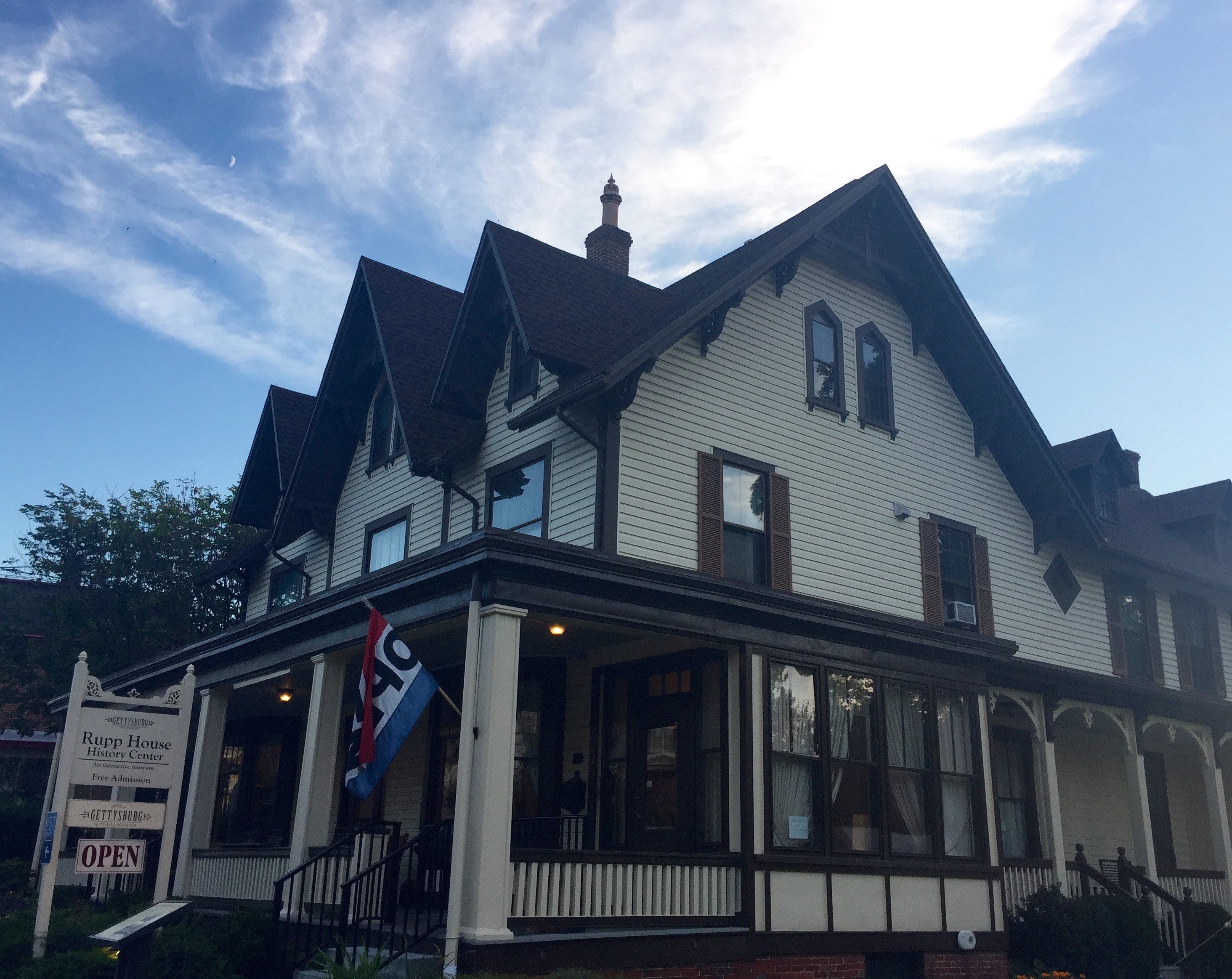
Is the Jennie Wade story important to remember? Is she the ideal image of the civilian experience during the Battle of Gettysburg? When it comes to the civilian experience at Gettysburg, tourists flock to the Jennie Wade House Museum to hear the tale of a young girl caught in the crossfire of a major battle. Wade’s circumstances were unusual for the battle, but her story is better known due to its excitement and tragedy than because of its representativeness. The lesser-known story of the Rupp family gives us a better idea of what civilians experienced when the two armies entered their town. Like most families during the battle, the Rupps escaped danger by avoiding the conflict, emerging unharmed. So what was the civilian story of the Battle of Gettysburg? Whose struggle better conveys the civilian experience? Is it the tragic story of a single civilian casualty, or the experience of a family that hid in their basement to escape harm?

The Rupp Tavern, currently owned by the Gettysburg Foundation, stands at the intersection of Baltimore and Steinwehr Avenue. Photo by the author.

Continue reading “Unfortunate Events and Special Circumstances: Why the Rupp Family Tells the Civilian Experience at Gettysburg”

The Original Birthplace of George Washington

By Max Zammataro ‘16

This post is part of a series featuring behind-the-scenes dispatches from our Pohanka interns working on the front lines of history this summer as interpreters, archivists, and preservationists. See here for the introduction to the series.

Looking back at American history, George Washington was a monumental figure to a significant portion of our citizens. As a founding father of our country, historians and relatives of President Washington have long wanted to properly document and share his birthplace with the American public. Memorializing where President Washington was born and raised acknowledges the great service he did for our country. Over the past 150 years, there has been an ongoing investigation into where exactly George Washington was brought into the world. There have been conflicting arguments because there was no definitive proof of his birthplace. The original structure where he was born, in Popes Creek Virginia, was burnt to the ground in 1779, leaving archaeologists with minimal artifacts to work with, such as pieces of china, hinges, a candle, a silver teaspoon and a bunch of keys. The lack of solid historical evidence disabled investigations to conclude exactly where President Washington was born. The lack of proper documentation and technology in the past also made it significantly harder to keep track of the facts.

As time passed, a number of people have claimed that they know exactly where George Washington was born. The information many of these parties have provided conflicts with what others were led to believe. George Washington Parke Custis, adopted grandson of George and Martha Washington, was the first to take the initiative to mark the site of the original birth house, placing a stone slab inscribed with the date of George Washington’s birth. The problem was that without proper documentation of the actual house, Custis was escorted to the spot where there were a few bricks laid to supposedly mark the spot of George Washington’s birthplace. Unfortunately, this was not necessarily factual, but for the time being it was marked as the birthplace. As the years passed, Custis’s slab was moved numerous times and chipped away at. Later it was released by the Daily National Intelligencer in 1857 that another chimney that was part of a smaller separate structure had been found on the site. It was located in the same vicinity as the original chimney marked by Custis. While these may appear to be minor details, they are significant because those “interpreting” the site were sharing incorrect information with early visitors.

One must acknowledge that these early historians and interpreters were trying their best to preserve and share what little information they had with American citizens even though the information itself was incorrect. This misinformation continued for such a long time because historians had no other way of checking the historical data other than going off the records available to them. The questions surrounding the actual birthplace of George Washington were misinterpreted for so long was because there were few artifacts to support the authenticity of the site. It wasn’t until a nearby site was excavated that additional information surfaced reshaping the story of Washington’s birthplace. This archeological data made it clear that Custis was incorrect in locating the site of the birth home. He was working with less than perfect information so cannot be blamed for the inaccuracies. He was just trying to share what he thought to be his grandfather’s story with his county. Continue reading “The Original Birthplace of George Washington”


Holding the High Ground at Harpers Ferry

By Andrew Vannucci ‘15

This post is part of a series featuring behind-the-scenes dispatches from our Pohanka interns working on the front lines of history this summer as interpreters, archivists, and preservationists. See here for the introduction to the series.

Dwight Pitcaithley’s article, “A Cosmic Threat: The National Park Service Addresses the Causes of the American Civil War,” discusses the evolution of interpretation at Civil War parks that has moved toward a more complete, nuanced telling of Civil War history and the backlash against it. Before recent changes in NPS policy, most parks focused their interpretation solely on the military elements of their story. Groups like the Sons of Confederate Veterans interpreted this as appropriate deference towards honoring the men that fought in these battles. They saw moves toward setting battles in the context of social history (i.e., slavery) at these parks as taking attention away from and detracting from the sacrifices made by Confederate soldiers.

A memorial dedicated in 1931 by the Sons of Confederate Veterans to honor the memory of Heyward Shepherd, a free African American, and the first person to die in connection with John Brown’s Raid. Photo credit Andrew Vannucci.

There is no doubt that military history is the essential component in programming at battlefield sites. Often, the most significant story to be told at battlefield sites is about the battle that took place there, the men who fought there and the men who died there. Hearing these stories and honoring veterans is important, but without setting these battles within a greater historical context battles loses their meaning in the bigger picture of American history. The preservation of an accurate historical memory and understanding of the war and the preservation of the physical sites themselves are equally important tasks. Pitcaithley’s article makes clear that Lost Cause influences contributed to the avoidance of this broader picture for a long time, but current programming at Harpers Ferry National Historical Park reveals just how substantial the transformations of recent years have been. Continue reading “Holding the High Ground at Harpers Ferry”

Silent Guardian: The 15th New Jersey Monument

By Elizabeth Smith ‘17

This post is part of a series featuring behind-the-scenes dispatches from our Pohanka interns working on the front lines of history this summer as interpreters, archivists, and preservationists. See here for the introduction to the series.

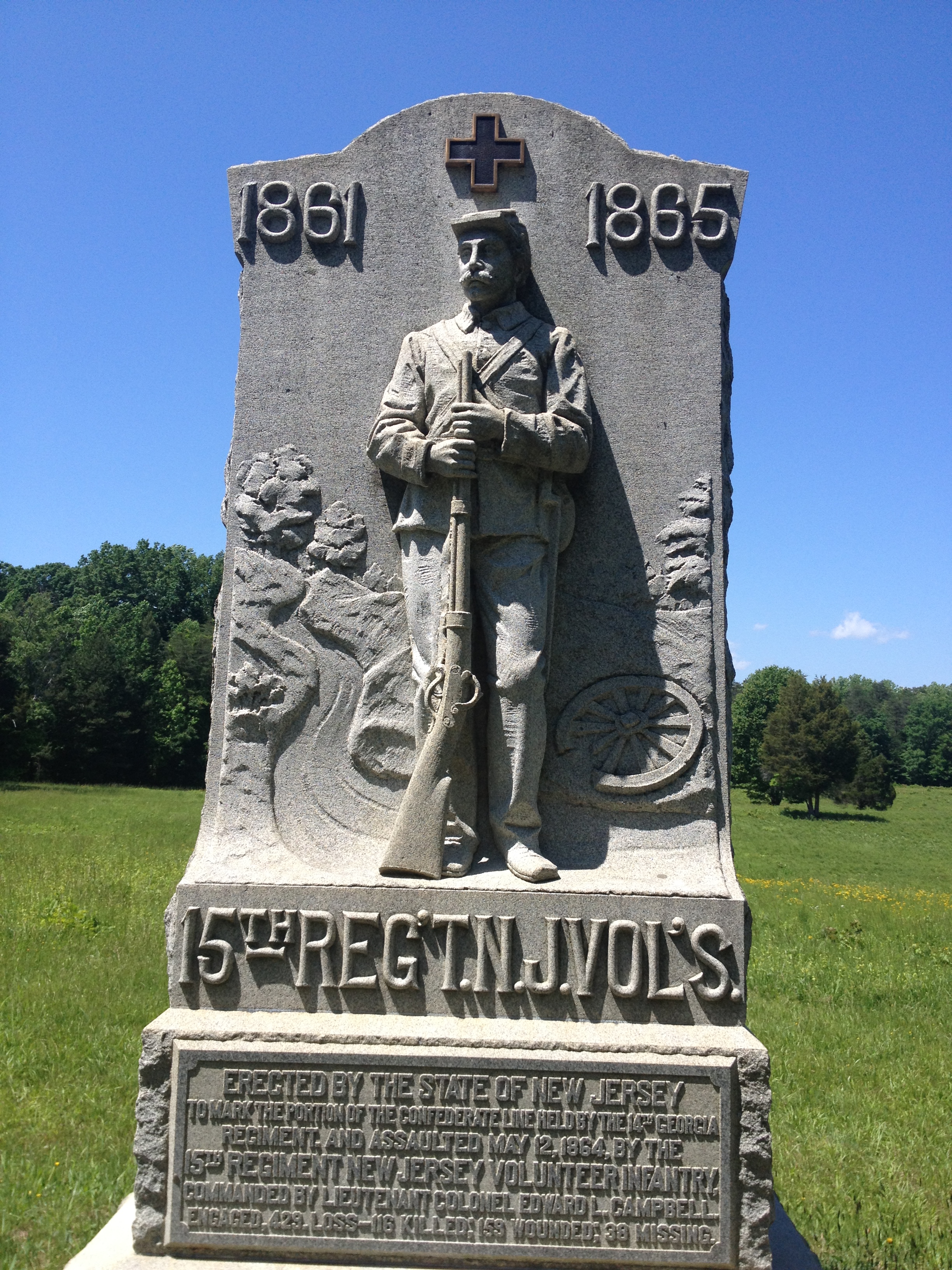
The 15th New Jersey Monument. Photo credit Elizabeth Smith.

He stands at rest, knees slightly bent, musket casually leant back. His hands loosely grip the barrel, one over the other, calm but prepared. His mustached face looks with weary eyes over the slaughter ground. In the background can be seen trees alongside a winding dirt road and a solitary wheel—perhaps from a cannon—beside his left leg. He stands immobile, forever gazing over the picturesque landscape, the beautiful green of the earthworks, the scene of hell on earth just 150 years ago.

The Battle of Spotsylvania Courthouse, known for the infamous Muleshoe Salient and the Bloody Angle, was fought May 8-21, 1864, immediately following the Battle of the Wilderness. On May 12, the twenty-two hours of continuous hand-to-hand combat at what would become known as the Bloody Angle would earn Spotsylvania a place in the history books. It is over this portion of the heaviest fighting that the 15th New Jersey Monument stands.

In his article “The Politics of Memory: Black Emancipation and the Civil War Monument”, Kirk Savage discusses how monuments do much more than just memorialize a unit or person, they memorialize an idea. From the idea of slavery to states’ rights to emancipation, monuments speak through both what they say and what they do not say. For this post, I will be discussing the 15th New Jersey Monument in light of Savage’s article. Continue reading “Silent Guardian: The 15th New Jersey Monument”

Making a Statement: The Alabama Memorial at Gettysburg

By Matt LaRoche ‘17

This post is part of a series featuring behind-the-scenes dispatches from our Pohanka Interns working on the front lines of history this summer as interpreters, archivists, and preservationists. See here for the introduction to the series.

Every generation has plenty to remember about its time spent shaping the human story. But despite this, some generations are better at writing their stories than others. Or perhaps some generations leave more unfinished work for their descendants to sift through. Either way, the legacy of the Civil War still lays heavy on our shoulders. Here at Gettysburg, in particular, the memory of the nation coalesces around a few days in a July long gone. The remembrance began the day after, with letters home, official reports, and raw thoughts scrawled across diary pages. But the years kept coming. New people and new events shaped the nation, while old people and past events faded, their specifics murky, and their significance uncertain. New generations knew the war meant something, but what? That is the question that every generation since has sought to answer in the style and sense of its time. The further time crept from the trial of the Civil War, the more new people with new interests and new agendas could proclaim their answers on old fields with new monuments and new speeches.

 The Alabama State Monument at Gettysburg was dedicated in November 1933, and eschews any mention of the causes or results of the war, focusing solely on themes of heroism and duty. Photo courtesy Wikimedia Commons.

The Alabama State Monument at Gettysburg was dedicated in November 1933, and eschews any mention of the causes or results of the war, focusing solely on themes of heroism and duty. Photo courtesy Wikimedia Commons.

Kirk Savage’s article, “The Politics of Memory: Black Emancipation and the Civil War Monument,” examines how this trend shaped the immediate post-war years. By revealing how a template Civil War monument emerged to serve both sides after the war—a very select celebration of unbroken white manhood on both sides—Savage helps illustrate the fundamentally political nature of memorialization. After the war, both North and South began to enshrine the war in the most emotionally and politically efficacious ways possible. While monuments still reflected some level of sectional divide, they almost universally ignored the black perspective on the war and its significance, regarding it as irrelevant, if not outright toxic. Northern and Southern political interests could largely coexist so long as they both ignored this key dimension of the war years and their aftermath. People North and South could still take solace in knowing why their loved ones died by attaching any one of a number of explanations to the same stock pedestal, with the same marble soldier set to stand tall on that explanation for eternity. This tacit agreement left much unresolved baggage for later generations. Continue reading “Making a Statement: The Alabama Memorial at Gettysburg”

The Meade Pyramid’s Shifting Sands

By Jacob Ross ‘15

This post is part of a series featuring behind-the-scenes dispatches from our Pohanka Interns on the front lines of history this summer as interpreters, archivists, and preservationists. See here for the introduction to the series.

In his essay, “The Politics of Memory: Black Emancipation and the Civil War Monument,” Kirk Savage describes a phenomenon in which the plastic arts of memory can re-appropriate blocks of bronze and stone meant to convey a certain message about the Civil War and change their meaning entirely. There is no better materialization of this theory than the Meade Pyramid located on the Fredericksburg Battlefield. The 400-ton granite structure constructed near Prospect Hill had the original intent of marking the location of General “Stonewall” Jackson’s headquarters; however, in time the purpose of the monument shifted to denote the location of a small, but unique, Union success on the Fredericksburg Battlefield – General Meade’s breakthrough of the Confederate lines. It is this monument’s new purpose which provides its modern namesake.

The pyramid was built in 1898 by a partnership between the Confederate Memorial Literary Society (CMLS) and the Richmond, Fredericksburg, and Potomac Railroad. The intent of the monument’s purpose was clear even in the initial stages of design. R.F.&P. Railroad employee John Rice was charged with visiting the mammoth Confederate memorial pyramid at Hollywood National Cemetery in Richmond in order to take measurements in an attempt to build a scaled-down duplicate by the tracks at Prospect Hill. From personal experience, the Hollywood Cemetery Pyramid sits in the epitome of “Moonlight & Magnolia” romanticism, but its location is isolated in a tucked away small portion of the vast cemetery. The Meade Pyramid, however was placed right beside the railroad tracks with the primary goal of serving as a landmark-memorial to the most geographically diverse audience Fredericksburg regularly experienced – those travelers passing through town by rail. If nothing else, it is safe to say that the pyramid embodied romantic Confederate memory and placed it at a location of highest public exposure. Continue reading “The Meade Pyramid’s Shifting Sands”

Noble Sacrifice or Meaningless Death? Interpreting the 116th PA Monument

By Sarah Johnson ’15

Any visitor to the Gettysburg battlefield will no doubt be almost overwhelmed with the numbers of monuments and memorials to various Union and Confederate units strewn about the field. Sculpted soldiers with sabers, rifles, even fists raised in defiance of the enemy, ever charging forward into the heat of battle are commonplace. In the case of most Union monuments, a culture of just victory and celebration of noble sacrifice emanates from gray stones and bronze figures. One monument, however, tucked along Sickles Avenue in the Rose Woods, portrays a different message. The monument of the 116th Pennsylvania, erected by regimental survivors in 1888, is the only monument at Gettysburg that depicts a dead soldier. While other monuments, such as the Freemason monument at the Soldier’s National Cemetery, the Louisiana state monument, and the Mississippi state monument depict wounded soldiers, these monuments are accompanied by themes of fraternity and noble sacrifice as the focal point rather than the fallen soldier himself.

These two examples of Confederate monuments at Gettysburg feature wounded soldiers, but in each there is a focal point of another theme. In the Louisiana monument, the wounded soldier clutches his heart while Spirit Triumphant flies overhead. The Mississippi monument depicts a comrade standing over his fallen brother wielding his rifle as a club against oncoming attackers. Images courtesy of Wikimedia Commons.

Recruited from the Irish-American population of Philadelphia, the 116th was a part of the famed Irish Brigade. At the Battle of Chancellorsville, the 116th performed well by rescuing a Maine battery from capture. For this action, the 116th’s commander, Major St. Clair A. Mulholland, received the Medal of Honor. By the battle of Gettysburg, the 116th had been reduced to barely four companies. During the morning of the July 2, the 116th moved in to support the right flank of the III Corps and fought in various support capacities throughout the day. At the end of the battle, the 116th had lost two men killed, twelve wounded, and eight missing. Continue reading “Noble Sacrifice or Meaningless Death? Interpreting the 116th PA Monument”

A Take on Appomattox

By Brianna Kirk ’15

On April 9, 1865, Palm Sunday, Robert E. Lee and Ulysses S. Grant met in the front parlor of Wilmer McLean’s house in the little village of Appomattox Court House to discuss the status of their two armies. After swapping stories of the days of their Mexican War service, the two men finally penned their names on terms of surrender, effectively ending the American Civil War. Grant, magnanimous towards the now defeated Confederates, and Lee, humble in his loss, ushered in the era of reconciliation that would bandage up the past four bloody years and push the reunited country forward together as one.

Lee and Grant meet at Appomattox Court House to settle terms of surrender. Wikimedia Commons.

Most Americans are familiar with this depiction of the way the Civil War’s end happened, basking in the intense moment of genuine reconciliation and healing, all feelings of animosity and politics pushed aside. The meaning of the Civil War, we’ve been told, was decided upon that day when Grant and Lee met. Appomattox has become interchangeable with peace, progress, and reunion in the American consciousness. Continue reading “A Take on Appomattox”

css.php