This is the second in a three-part series on the legacy of the Civil War at the Virginia Military Institute. You can also check out part one to read about VMI’s struggle for survival in the years immediately after the war. You can access part three at the bottom of this post.
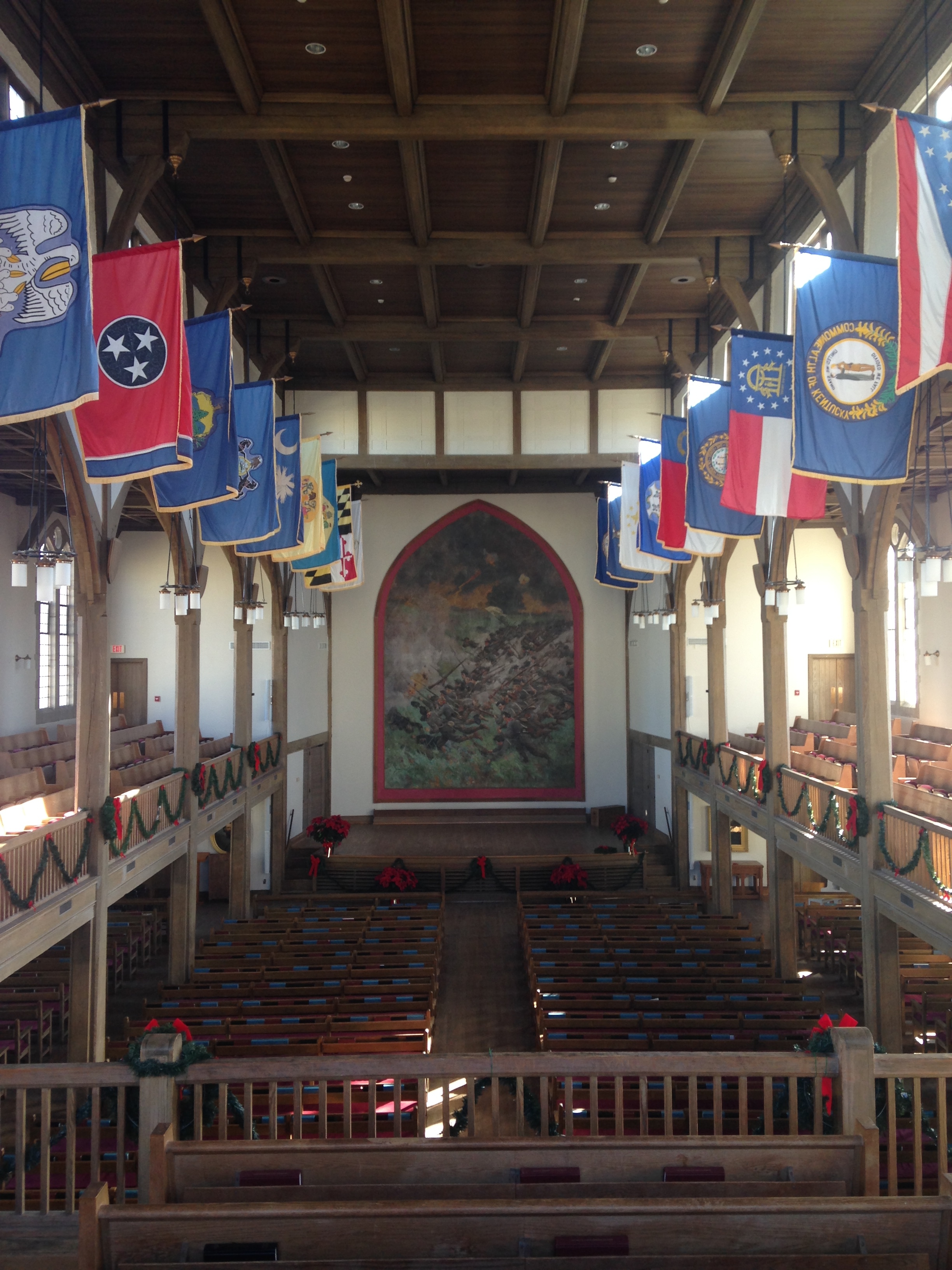
Jackson Memorial Hall, home of the VMI Chapel, is a sacred space on a secular campus. Stark wooden pews face the front of the chapel, gothic-style lanterns hang alongside state flags from the exposed-beam ceiling, and a mural depicting the charge of VMI’s New Market Cadets hangs prominently as the focal point. The stuffed hide of Little Sorrel, Stonewall Jackson’s horse, stands one level below in the VMI Museum. Yet an even more unexpected item exists in this multi-purposed hall: a plaque honoring Henry Algernon du Pont, the Union artillery captain who shelled the Institute in June of 1864. Fifty years of sectional healing following this destruction resulted in changes not only for the Institute but throughout the reuniting nation. I’ll begin with du Pont’s story.
Inside Jackson Memorial Hall. Photo courtesy of the author.
Henry Algeron du Pont’s father was a West Point classmate of Francis Smith, the VMI superintendent who successfully advocated for VMI’s rebuilding in 1865 and again for its very existence in 1868. Du Pont graduated from West Point and rose to the rank of captain in the Army of the Shenandoah. His Union artillery encountered the VMI cadets on the battlefield at New Market in May 1864. One month later in Lexington, VA he fired his cannons at the cadet barracks that housed VMI’s students, including Cadet Thomas Martin of Charlottesville, VA. This would not be du Pont’s last experience with the Virginia Military Institute. Continue reading “The Literal Reconstruction of VMI: Reunion, Restitution, Remembrance”
Last summer, while on a trip with the Eisenhower Institute’s Inside the Middle East program, I stood at the Israeli edge of the Golan Heights and heard a bomb explode across the border in Syria. We had spent the day within several miles of the war-ravaged nation with all remaining quiet until that moment, and while none of us wanted to admit it, we had the smallest hope that we might catch a glimpse of the conflict. However, when the sound of the detonation roared across the hills, excitement was replaced by a sense of fear and grief. I had lived a year in Gettysburg, yet I had never felt so close to a battlefield.
The wall of an abandoned hospital on the Syrian-Israeli border. Photograph by the author.
Gazing from the Golan Heights across the Syrian border held a certain degree of spectatorship; though it is morbid to articulate, we were all waiting for something to happen, as if conflict were equivalent with entertainment. Though it may not be just to compare our experience with the picnicking politicians at First Bull Run, waiting around for excitement and glory then fleeing in a panic, I certainly felt an observer of war. Perhaps many of us were too desensitized by the commonality of violence in our omnipresent media outlets to be affected. None of us felt particularly unsafe or even frazzled; we were too far from the sound to gauge whether any damage had been inflicted, and even if we had we never would have seen it. Nonetheless, the day was spent feeling a little more wary. Continue reading “A Middle East Perspective: Civil War Memory in Syria and at Home”
Dr. Andrew Lang. Image courtesy of Mississippi State University.
Over the course of this year, we’ll be interviewing some of the historians scheduled to speak at the 2016 CWI conference about their upcoming talks and their thoughts about Reconstruction and its legacies. Today, we’re speaking with Andrew Lang, Assistant Professor of History at Mississippi State University. Lang is the author of Waging Peace in the Wake of War: United States Soldiers, Military Occupation, and the American Civil War Era (currently under contract with Louisiana State University Press), as well as several scholarly essays.
CWI: What roles—political, economic, social—did the U.S. military play in the reconstruction of the South during the postwar occupation of the region? What was the nature of its interactions with Confederate veterans? With women? With free blacks? What regional variations did members of the U.S. military encounter during its occupation of the South in the Reconstruction era?
LANG: The U.S. military played a substantial role in the Reconstruction South. Following Confederate surrender, the Army was demobilized at a stunning, rapid pace, yet the institution retained important war powers which had guided Union arms to victory during the Civil War. In many ways, the Army assumed peacetime responsibilities with which it had rarely before been tasked, especially in politics and civil-military relations. The American tradition had long viewed a powerful military establishment, wielding strong political, economic, and societal influence, with suspicion. And yet it seemed that Union victory would not be assured without a substantial military force to maintain peace in the wake of wartime destruction while also ensuring the safety of freedpeople, southern Unionists, and Republicans who inhabited the South in the months and years after Appomattox. Serving as a formal peacekeeping force, overseeing elections and constitutional conventions, regulating local courts, policing the countryside, and engaging in a degree of counterinsurgency, the Army was perhaps the most important institution in the South during the Reconstruction era. This was true especially in managing the post-emancipation order. After playing a key part in the processes of wartime emancipation, the Army performed a crucial role in running the Freedmen’s Bureau, safeguarding African American rights, negotiating labor contracts and challenging the re-authorization of old planter regimes, acting as a buffer between freedpeople and former slave owners, and serving as a refuge to which freedpeople, notably women, could turn to report white transgressions and violence. As with most military occupations, the Army found that its presence in the South was welcomed warmly in some places and with much more hostility in others. Southern Unionists—white southerners who had opposed the Confederacy—as well as those pockets of the South that had long been under wartime military supervision, welcomed Union soldiers as forces of stability and protection. Some white southerners got along amicably with Union occupiers, while others expressed abject hatred and defiance, usually in areas hardly touched by Union patrols or in regions of formerly concentrated slave holding. Ironically, some evidence suggests that former Confederate soldiers—but certainly not all—were inclined to give Union soldiers the least amount of trouble. However, the occupiers eventually learned that some of those who had once filled the ranks of rebel armies were also those who joined the clandestine terror organizations that spread political and racial violence across the region. Continue reading “The Occupation of the South: An Interview with Andrew Lang”
This winter, the Gettysburg Compiler will be releasing weekly posts as part of a Mercy Monday feature that will cover issues of medical history, gender and race relations, historical memory, and other themes depicted in the new PBS series Mercy Street.
Recently, I had the opportunity to interview Lisa Wolfinger, the executive producer and co-creator of Mercy Street. She kindly agreed to be interviewed by the Gettysburg Compiler about her work on the series. Wolfinger also participated in a recent conversation on local public radio station WITF’s Smart Talk program alongside the CWI’s Jill Titus and Ian Isherwood. You can hear their discussion online at WITF’s website.
Lavery: What got you interested in working on a historical drama like Mercy Street?
Wolfinger: I majored in European History at Sussex University in England and have always been passionate about history. Fact is often more dramatic than anything we could invent. Early in my filmmaking career I was given the opportunity by History Channel to produce documentary specials about early American history and had little to no visual material to work with. So I had to find a new way to tell these stories within the confines of a documentary format and fell back on what I knew and that was drama. (I was very involved in theater in college.) Continue reading “Lisa Wolfinger, Executive Producer of PBS’s Mercy Street, Talks History and Memory”
George Washington was a revolutionary founding father. He served as the commander-in-chief of the Continental Army through eight years of war, turned down the opportunity of becoming sovereign of the newly-formed United States, established the precedent for future presidents, and voluntarily stepped down from office after two terms. Though it took many men to conceive and found the United States of America, Washington is the poster child of the revolution and the spirit of 1776. Washington embodies the basic American spirit, so it is no wonder why both the North and South staked a claim on the “Father of our Country” as civil war loomed.
In times of devastating war, people often turn to something that gives them hope and strength to justify their cause to fight. During the American Civil War people looked to the heroes of the American Revolution because it was the “apex of heroism” that bestowed liberty onto the American people. Soldiers of the Civil War were sons and grandsons of the Revolutionaries who shared admiration in their beloved leader, George Washington, with their descendants. As a result, Washington’s lasting legacy forced him to campaign long after he took his dying breath.
Photo Courtesy of the Library of Congress. George Washington. 1890.
Two decades before the Irish Brigade covered itself with glory, an earlier unit of Irish immigrants had won renown for its service during the Mexican American War. Calling themselves the Saint Patrick’s Battalion, these men marched under a flag of brilliant emerald decorated with Irish motifs: a harp, a shamrock, and the image of Saint Patrick.
Unlike the Irish Brigade, however, the Saint Patrick’s Battalion fought against the U.S. Army. Led by the disgruntled Irish immigrant John Riley, this elite battalion was comprised of roughly two hundred Irish-American deserters who pledged their loyalty to General Santa Anna and the Mexican government. When Los San Patricios were defeated and captured by U.S. forces, fifty-seven deserters were sentenced to hang for their crime.
In American memory, Riley is a traitor, a deserter, and a mercenary. But this summer while exploring County Galway, Ireland, I stumbled upon a monument to his memory given to his hometown by Mexico in recognition of his service. The experience delivered to me some perspective. To pass judgment on Riley and his men, we must understand their times.
Although surprising to American sensibilities, the people of Mexico gave this monument to Clifden, Co. Galway, in honor of John Riley (or Reilly) for his service as commander of the Saint Patrick’s Battalion. Photograph by the author.
You don’t need to be a rocket scientist to observe one fact about Mars: it has a lot of rocks. While each is typically given a name based on protocols of scientific classification, many are known by informal, often humorous names like “Grandma” and “Space Ghost.” And now on Mars, there’s a rock for fans of Civil War history—“Chamberlain,” named of course for Joshua Lawrence Chamberlain, the hero of Little Round Top.
Joshua Lawrence Chamberlain is now on Mars.
Aileen Yingst, the NASA scientist who named the rock, is a resident of Brunswick, Maine—the southern Maine town where JLC notably spent most of his adult life. And to this day, his presence there is inescapable. In Brunswick’s old town center, one can find pictures honoring him in numerous nearby restaurants, including one explicitly named for him. A local ice cream store reminds visitors to recycle their dishes because “Joshua Chamberlain would.” A bronze statue of him stands in a highly visible location close to the gates of the local Bowdoin College—the institution which Chamberlain attended as a student, taught at as a professor, and later served as president. Continue reading “Joshua Chamberlain on Mars: Chambermania and Beyond!”
For the past several weeks, students all across the nation have opened up discussions on race relations on university campuses and in American culture at large. The latest battlefield in the fight for greater inclusion is Princeton University, where protestors from the Black Justice League staged a 32 hour sit-in at the president’s office. Princeton University, traditionally viewed as a bastion of progressivism and liberal ideology, is coming under fire for its reverence for perhaps their most famous graduate, President Woodrow Wilson. Wilson graduated from Princeton University Class of 1879 and served as president of the school from 1902 until 1910, after which he was elected Governor of New Jersey and subsequently the 28th President of the United States.
President Woodrow Wilson addresses the crowd at the 50th Anniversary Blue & Gray Reunion at Gettysburg in 1913. Photo courtesy of the Library of Congress.
At a superficial level, Princeton seems entirely justified in venerating their well-accomplished graduate. However, as the Black Justice League has pointed out, President Wilson has also left a legacy of racism in his wake. In July 1912, Wilson enlisted the help of African American civil-rights leader William Monroe Trotter to increase his prospects among the black community during his campaign for the presidency. In exchange, Wilson promised to promote fairness for all Americans. During the first year of Wilson’s presidency, Trotter again visited Wilson to follow up on his promise. Trotter brought with him prominent civil-rights leader Ida B. Wells as well as documented proof of a policy of segregation in federal offices. Trotter and Wells were dismissed with “vague assurances” from the president. In a third meeting in the Oval Office in 1914, Trotter escalated his rhetoric, charging that the president himself was promoting Jim Crow policies in the federal government. Wilson responded by arguing that segregation was put in place to benefit blacks and should not be seen as a “humiliation” for the African American community. The conversation quickly took a turn for the worse and Trotter and his delegation were escorted out of the White House, tempers flaring. Continue reading “Lost Cause in the Oval Office: Woodrow Wilson’s Racist Policies and White-Washed Memory of the Civil War”
Over the course of this year, we’ll be interviewing some of the prominent speakers scheduled to speak at the 2016 CWI conference about their upcoming talks and their thoughts about Reconstruction and its legacies. Today, we’re speaking with Kathryn Shively Meier, Assistant Professor of History at Virginia Commonwealth University. She is the author of Nature’s Civil War: Common Soldiers and the Environment in 1862 Virginia (University of North Carolina Press, 2013). Dr. Meier is currently working on a biography of General Jubal Early.
Dr. Kathryn Shively Meier. Image courtesy of Virginia Commonwealth University.
CWI: What are the core elements and ideas that comprise the “Lost Cause?” When and why did it emerge, who were some of its prime architects and supporters, and in what forms did it manifest itself?
MEIER: The Lost Cause, or the collective Confederate memory of the Civil War, most notably emphasizes states’ rights, rather than slavery, as the cause of the war. In the words of Jubal A. Early, a former Confederate general and key architect of the Lost Cause, “During the war, slavery was used as a catch word to arouse the passions of a fanatical mob . . . but the war was not made on our part for slavery.” Early’s 1866 assertion directly opposes the declarations of secession passed by several seceding states in 1861. For example, Mississippi’s declaration of secession read, “Our position is thoroughly identified with the institution of slavery–the greatest material interest of the world.” Other primary tenets of the Lost Cause include the claim that secession was legal, the portrayal of slavery as benign, an explanation of Confederate defeat chiefly as the result of inferior manpower and materiel, the glorification of Robert E. Lee and his lieutenant Thomas “Stonewall” Jackson, and the practice of extolling Confederate soldiers and Confederate women. Continue reading “The Legacy of the Lost Cause: An Interview with Kathryn Shively Meier”
On November 21, a small contingent from the 26th PEMR or PCG—Gettysburg College’s reenacting group—gathered early in the morning in Union uniform and civilian dress outside of the Appleford Inn. With a flowered wreath in hand, the small group made their way down Chambersburg Street. There, in sight of the Dollar General and the Segway Tour office, they laid the wreath at the base of the monument, which features a young college boy, musket in hand, as he marches off to battle. The group of students read the history of the unit and had their pictures taken, an annual tradition that has become a prominent memory in the minds of the student reenactors.
The monument to the 26th Pennsylvania Emergency Militia Regiment. Photography by the author.
For many, Civil War reenacting serves as a way to remember the Civil War. With reenactments ranging from large scale events like Gettysburg to small town living histories, thousands of men and women from all around the country—indeed, from all around the globe—choose to wear wool uniforms and day dresses and reenact this period of history. Reenacting, though controversial as a medium of public history, serves as a way for many people of all different ages, ethnicities, and backgrounds to remember the American Civil War and the soldiers who served. Continue reading “The Grand Parade: Remembering the American Civil War”