The Hope of Appomattox

By Emma Murphy ’15

Throughout the sesquicentennial, I have often found myself wondering what the end of the 150th anniversaries and the surrender at Appomattox would bring to present Civil War memory. What lessons do we take away from that small stuffy room in the McLean House, with the fate of the nation hanging in the balance?

Photo credit to the author.

I was fortunate enough to attend the 150th anniversary of the surrender at Appomattox Courthouse on April 9. Purposely decked out in all Gettysburg College and Civil War Institute attire, I eagerly awaited the many discussions and debates between me and fellow visitors. I had imagined the historic site to be crawling with Lost Causers and neo-Confederates. But to my surprise, as the crowd began cramming in front of the stage at 1 o’clock, the time when General Lee had arrived exactly 150 years before, the focus shifted to the importance and overall historical context of the ground on which we stood. As Robin Snyder, the Acting Superintendent of Appomattox Courthouse National Historic Site, took the stage, she made the connection between 1865 and 2015 in one word.


Hope. Continue reading “The Hope of Appomattox”

From the CWI to the Green and Grey

By Eric J. Mink

In this third of our three-part series on the CWI conference scholarship program, NPS historian Eric Mink reflects on the program’s impact on his decision to pursue a career in public history.

NOTE: Applications to participate in the 2017 High School Student Scholarship Program are due February 15 at 4:00 pm.

Brochures from the 1987 Civil War Institute Summer Conference.

I first attended the Civil War Institute Summer Conference at Gettysburg College on a student scholarship in 1987. As a rising high school senior, the Institute opened my eyes to see battlefields and Civil War history in a different way and it proved to be a formative experience that would help to define both my educational and career paths.

When I was eleven, my family moved to Gettysburg. For me, it was a wonderful place to grow up and indulge an interest in the Civil War. My family’s house sat just half a block from the fields across which Lee sent his divisions on July 3, 1863. I poured over my father’s copy of William Frassanito’s photographic study of Gettysburg and rode my bike to find the same rocks pictured in the wartime images. I first heard about the Institute from my high school history teacher, Terry Fox, who knew of my interest in the Civil War and suggested that I apply for one of the student scholarships offered by the Institute. When I was fortunate enough to receive a scholarship sponsored by the Lincoln Group of D.C., I honestly did not know what to expect from the conference and certainly had no idea how much I would come to value that one week’s experience. Continue reading “From the CWI to the Green and Grey”

“Children of the Damned”: An Indie Band Remembers Andersonville

By Heather Clancy ’15

When alternative band Quiet Hounds released Megaphona in 2012, they presented an album peppered with an impressive range of styles, from folksy ballads to pseudo-manic hipster club tunes. The album’s most unexpected choice, though, came in the form of its closing song, “Beacon Sun.” In it, the band’s lead singer carries a mournful melody. A hypnotizing rhythm runs through the track, underscored by the tattoo of a lethargic tambourine. Indeed, the track is more akin to a jazzed-up hymn than anything else, an impression that is not surprising to listeners once they heave themselves out of the indie haze long enough to catch the song’s lyrics.

Quiet Hounds, in a promotional shot for their album Megaphona.

Continue reading ““Children of the Damned”: An Indie Band Remembers Andersonville”

When Worlds Collide: A Public Historian at the CWI Conference

By Shannon Moeck

NOTE: Applications to participate in the 2015 Public Historian Scholarship Program are due March 15.

As a Park Ranger for Cedar Creek and Belle Grove NHP, a major component of my job is to interpret the 1864 Shenandoah Valley Campaign.  Over the years of employment and through my personal research, I have developed a quality overview understanding of the fall 1864 Shenandoah Valley Campaign.  The next phase in my career development is to broaden my understanding and delve deeper into the experience of the war, both inside and outside the Valley.  In 2013, I attended the Future of Civil War History conference hosted by Gettysburg College.  That was the first conference I ever attended and it was one of the best professional experiences I have had to date.  My personal takeaway was enormous.  The opportunity to hear speakers such as Peter Carmichael, David Blight, and Troy Harman was incredible.  Peter Carmichael drove home the significance of interpreting those who were wounded or died on the battlefield.  From his words I began incorporating that message in my programs.  From the conference I developed friendships and professional relationships with attendees.

Having won the scholarship for the 2014 CWI conference afforded me the opportunity to build on the experience I had at the 2013 Conference. Being awarded the Public Historian Scholarship to attend the 2014 CWI conference presented a wide array of panels focusing on 1864 during the Civil War; those panels helped me pursue the objective of a deeper insight and understanding of the Civil War. Working at a small park with a limited staff does not give me a lot of chances to talk to a wide variety of people with diverse backgrounds about the complexities of the Civil War. This conference filled that void and gave me the ability to have meaningful conversations with a diverse group of public historians, educators, students, and history enthusiasts.  This conference helped me gain deeper understanding of the Civil War in 1864. All of the above provided a direct and positive impact not only on how I interpret the Civil War, but also expanded my perspective and understanding of the many operations that occurred in 1864. I brought these lessons back to work where I continue the dialogue with my colleagues, volunteers, and the visiting public.

Attendees at the 2014 CWI Summer Conference. Photo credit to the author.

Continue reading “When Worlds Collide: A Public Historian at the CWI Conference”

Stewarding Our Lands: Historical Preservation in Gettysburg

By Matt LaRoche ’17

Photo credit to Philip Pane ’17.

In recent decades, more and more time, energy, and resources have been put towards saving large tracts of our historical heritage. This surely appears self-evident to residents of a place like Gettysburg, which has seen the boundaries of the park grow exponentially thanks to the National Park Service, as well as to the actions of various private organizations and individuals.[1] However, the conservation is far from complete. Not every  “vision-place of souls”[2] has been saved. However, while every parcel of preserved land is a gift to the American people, much preserved land still waits to be properly rehabilitated and made a meaningful part of the national tapestry.

Continue reading “Stewarding Our Lands: Historical Preservation in Gettysburg”

“The Battle of Cold Harbor & the Soldier’s Psyche”: An Interview with Ashley Luskey

By Emma Murphy ’15

Ashley Luskey will be speaking at the 2014 Civil War Institute’s Summer Conference on the War in 1864 during which she will give a lecture on Cold Harbor and its contested memory. Luskey is currently a Park Ranger at Richmond National Battlefield and is working towards her PhD in History at West Virginia University. In anticipation of the Summer Institute, Ashley Luskey answered student questions about her research, her lecture topic, and her connection with Gettysburg College and the Civil War Institute. Let’s see what she has in store for us this summer:

Luskey

Continue reading ““The Battle of Cold Harbor & the Soldier’s Psyche”: An Interview with Ashley Luskey”

Junior Rangers to History Enthusiasts

By Emma Murphy ’15

With my internship at Richmond National Battlefield Park landing in the middle of the sesquicentennial of the Civil War, I have been fortunate enough to experience the world of public history during a major anniversary. However, going to school at Gettysburg College during the same anniversary provides me the academic side of historical interpretation. There has been a great debate about the connection between these two worlds. Whether this connection exists or not has been the question of the summer for me, and while working with Richmond National Battlefield Park, I believe I have found my answer:

Children.

Emma at Tredegar Iron Works
Emma at Tredegar Iron Works, Richmond National Battlefield Park

Continue reading “Junior Rangers to History Enthusiasts”

Gettysburg 150th Commemoration

By Avery C. Lentz ’14

It is almost impossible to comprehend the fact that 150 years ago today, the town of Gettysburg, Pennsylvania was still rebuilding itself from the destruction, death, and decay that resulted from the climactic battle between the Union Army of the Potomac and the Confederate Army of Northern Virginia on July 1-3, 1863. I must say that it was a tremendous honor to have worked with the National Park Service so far this summer and I look forward to the rest of it. Without a doubt, the 150th Anniversary of the Battle of Gettysburg was my true test of the summer, and it was an extremely rewarding and, at times, trying experience. To describe the events that took place during the anniversary, I suppose I should start from the beginning.

The anniversary officially kicked off on June 30th, when throughout the day, the NPS and Gettysburg Foundation staff began to receive the mass amounts of the visitors that were flooding the town. While most of the permanent staff members began their anniversary programs with specific key moment stations, I was still assigned to my normal schedule, which for that Sunday included giving my 10:30 a.m. Third Day Program, which is basically a walking tour of the High Water Mark at the Angle on Cemetery Ridge. I had my biggest group yet of over forty-five people and it was extremely well received by them, especially those who were visiting Gettysburg for the first time. The big climax to the 30th was the commemorative kickoff at Meade’s Headquarters in the evening, where the U.S. Army Brass Band was accompanied by a 21 gun salute from howitzers.

Avery 2
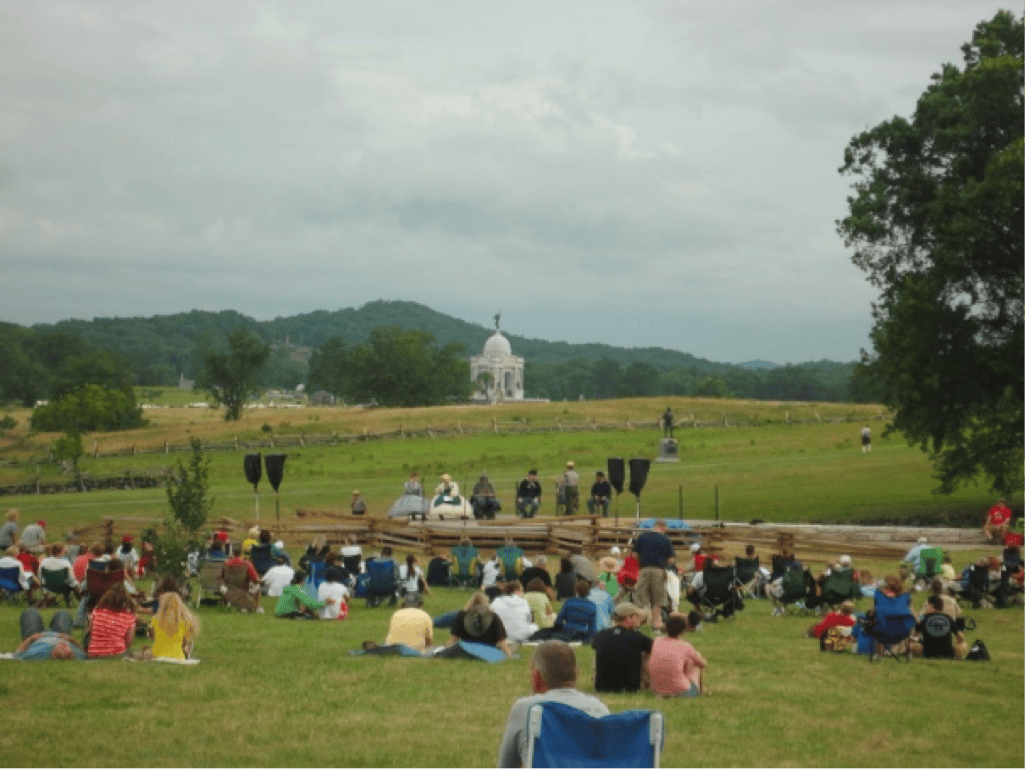
Part of crowd at one of the Voices programs, which concluded each day of the anniversary

Continue reading “Gettysburg 150th Commemoration”

Interpretation and Revelation: A Training Odyssey

By Bryan Caswell ’15

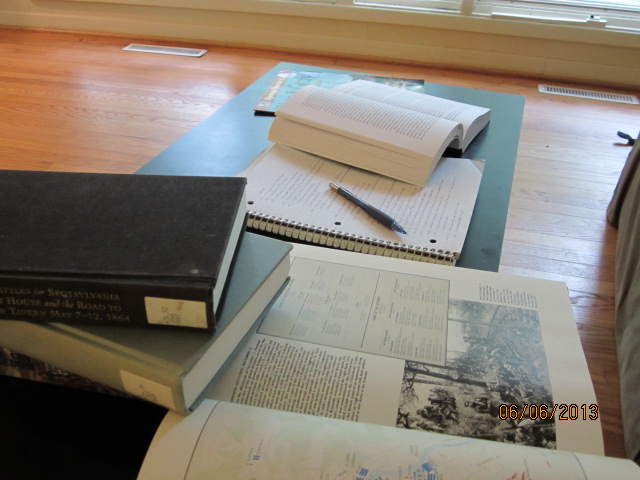
Three weeks of training. Just the thought of what awaited me in my first days as an intern at Fredericksburg and Spotsylvania National Military Park made me want to groan. Yes, yes, I realized that we all needed to be introduced to the National Park Service and walked through the policies of the park, working the information desk, assisting visitors, and other administrative trivialities. But could that not be accomplished in a few days? When would we get to what I was really interested in, what I couldn’t wait to do and what (I thought) I didn’t need any preparation for? When would I start giving walking tours?
021
Continue reading “Interpretation and Revelation: A Training Odyssey”

Profile of Senior CWI Fellow Gabby Hornbeck

By Emily Weinick ‘13

“I came here for the history department and the conservatory, but I didn’t know much about the Civil War,” admitted CWI fellow Gabby Hornbeck. Four years later, Hornbeck has interned at two National Military Parks on Civil War battlefields, has reenacted in battles as a civilian and soldier with the Pennsylvania College Guard, and is actively involved with other Civil War groups on campus including the Civil War Club, the Civil War Theme House, and the Civil War Institute.
OLYMPUS DIGITAL CAMERA Continue reading “Profile of Senior CWI Fellow Gabby Hornbeck”

css.php