Sorting Through the Layers of History

By Amelia Benstead ‘16

This post is part of a series featuring behind-the-scenes dispatches from our Pohanka interns working on the front lines of history this summer as interpreters, archivists, and preservationists. See here for the introduction to the series.

The confusion as to what site is truly the actual birthplace of George Washington stems from a variety of circumstances that combined to create a perfect storm of inaccuracy. In some cases, facts have been ignored in order to benefit those involved, conclusions have been drawn too heavily on eyewitness accounts which ultimately proved inaccurate, and investigations have coincided with important events, such as Washington’s 200th birthday, which would have been a controversial time to raise questions about whether the site being commemorated as his birthplace was actually the correct location.

The confusion first stems from the fact that George Washington Parke Custis wanted to place a marker on the site to commemorate where George Washington was born. Since the house had originally burned down, leaving very little evidence there had ever been a house on the site, especially not in what direction it had been pointing, he placed the marker in a location that he more or less guessed at, making conjectures that were unable to be supported by what he could see of the remaining building. From there, many people made additional conjectures based off of where Custis placed the marker. When contradictory information turned up, it was frequently downplayed or ignored because it would have caused too much upheaval at an inopportune time. This was exactly what happened when contradictory information was physically unearthed in an archeological dig just prior to Washington’s 200th birthday. Continue reading “Sorting Through the Layers of History”

Antebellum Spiritualism and the Civil War

By Kyle Schrader ‘16

This post is part of a series featuring behind-the-scenes dispatches from our Pohanka interns working on the front lines of history this summer as interpreters, archivists, and preservationists. See here for the introduction to the series.

Victorian Séance circles to commune with the dead were popular expressions of Spiritualism. Photo Courtesy
Victorian Séance circles to commune with the dead were popular expressions of Spiritualism. Photo Courtesy Wikimedia Commons.

Spiritualism in Antebellum America prepared many Americans to actually accept the deaths of loved ones in a superior way. In books such as This Republic of Suffering by Drew Gilpin Faust, Spiritualism and its infusion into American society is seen to have enabled many Americans to come to terms with loved ones’ deaths through the belief that a “Spirit World” existed and that life after death was better. Unlike the other Christian movements of the nineteenth century and earlier, however, the Spiritualist movement guaranteed and, indeed, “proved” the existence of an afterlife to many people (even those as mainstream as President Lincoln).

As a Pohanka intern at Seminary Ridge Museum, Kyle Schrader is spending his summer researching antebellum spiritualism. Photo credit Kyle Schrader.

Though Spiritualism may have had an effect on the Civil War, the War’s effect on Spiritualism was far greater. The War caused the movement to cease many of its activities, reducing its public presence and awareness as the war raged on. When the war ended, people sought comfort in national pride, spiritual unity, and organized religion. Spiritualism was far too unorganized (as the founders wanted) to attract people after being out of the public spotlight for so long. Thus began the recantation movement that damaged Spiritualism’s strength and nearly disbanded the movement altogether. Continue reading “Antebellum Spiritualism and the Civil War”

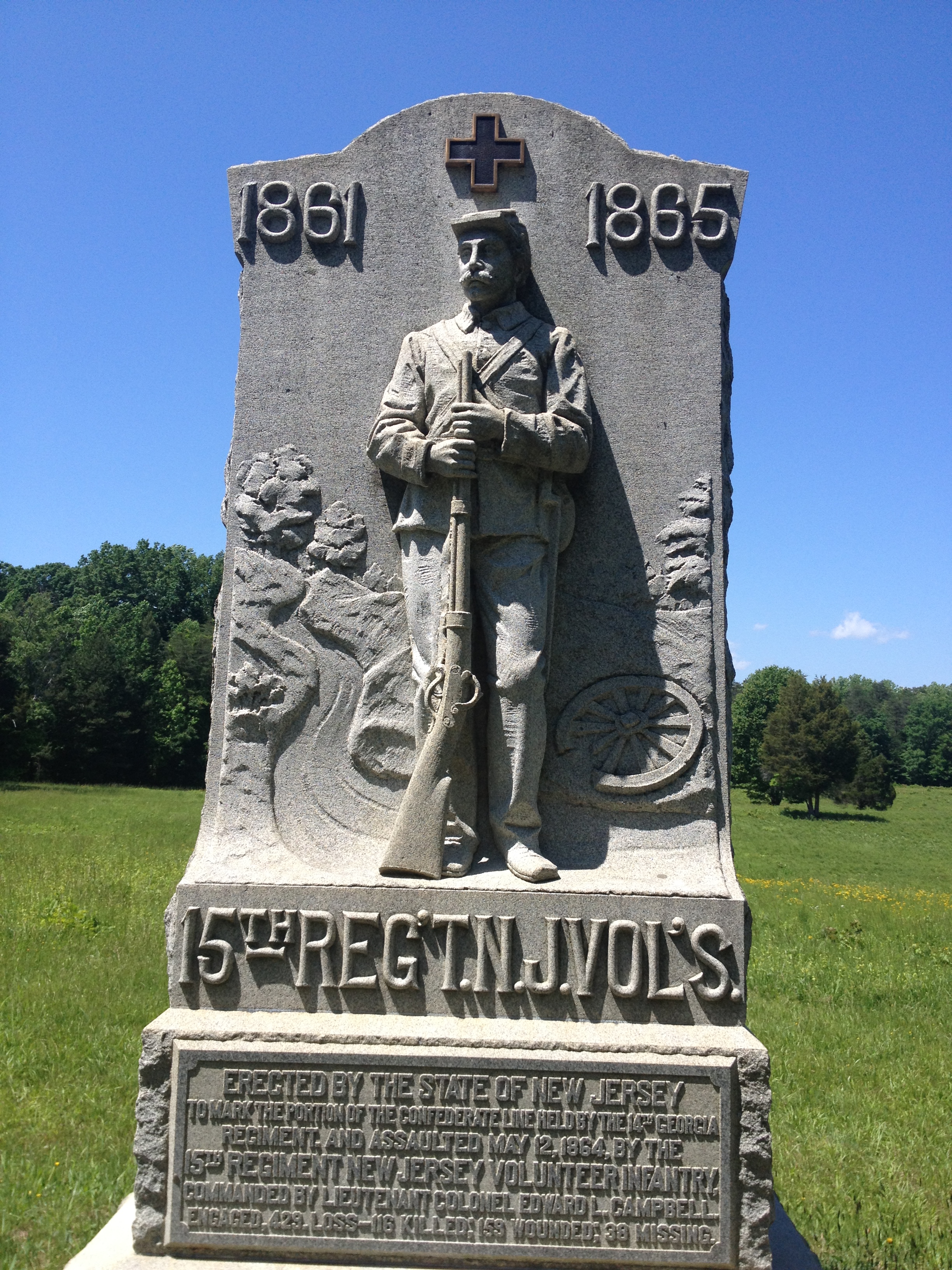
Silent Guardian: The 15th New Jersey Monument

By Elizabeth Smith ‘17

This post is part of a series featuring behind-the-scenes dispatches from our Pohanka interns working on the front lines of history this summer as interpreters, archivists, and preservationists. See here for the introduction to the series.

The 15th New Jersey Monument. Photo credit Elizabeth Smith.

He stands at rest, knees slightly bent, musket casually leant back. His hands loosely grip the barrel, one over the other, calm but prepared. His mustached face looks with weary eyes over the slaughter ground. In the background can be seen trees alongside a winding dirt road and a solitary wheel—perhaps from a cannon—beside his left leg. He stands immobile, forever gazing over the picturesque landscape, the beautiful green of the earthworks, the scene of hell on earth just 150 years ago.

The Battle of Spotsylvania Courthouse, known for the infamous Muleshoe Salient and the Bloody Angle, was fought May 8-21, 1864, immediately following the Battle of the Wilderness. On May 12, the twenty-two hours of continuous hand-to-hand combat at what would become known as the Bloody Angle would earn Spotsylvania a place in the history books. It is over this portion of the heaviest fighting that the 15th New Jersey Monument stands.

In his article “The Politics of Memory: Black Emancipation and the Civil War Monument”, Kirk Savage discusses how monuments do much more than just memorialize a unit or person, they memorialize an idea. From the idea of slavery to states’ rights to emancipation, monuments speak through both what they say and what they do not say. For this post, I will be discussing the 15th New Jersey Monument in light of Savage’s article. Continue reading “Silent Guardian: The 15th New Jersey Monument”

Opportunities for Interpretation

By Jesse Campana ‘18

This post is part of a series featuring behind-the-scenes dispatches from our Pohanka interns working on the front lines of history this summer as interpreters, archivists, and preservationists. See here for the introduction to the series.

The premier and most illustrious Founding Father George Washington has gone down in history as a great American hero. From sparking the French and Indian War to being the Commander and Chief of all Continental Forces in the American Revolution and eventually the first President of the United States, the man truly was inspiring. Although George Washington has the esteemed honor of having hundreds of biographies written about even just the smallest sections of his life, several key details continue to elude 21st century readers. Nobody actually knows exactly what his birthplace home looked like, and for generations the location itself was unknown. This convoluted history of George Washington’s Birthplace has not only stumped historians, but also locals, family members, and government officials for the past 200 years. Continue reading “Opportunities for Interpretation”

Interpreting Civilian Experiences in Fredericksburg

By Jennifer Simone ‘18

This post is part of a series featuring behind-the-scenes dispatches from our Pohanka Interns working on the front lines of history this summer as interpreters, archivists, and preservationists. See here for the introduction to the series.

Battlefields administered by the National Park Service are in a process of transformation. Administered originally by the War Department, interpretation at many battlefield sites has for years been marked by the military actions that occurred on the ground, from orders given to regiment positions to how flank attacks work. The National Park Service now is working to expand the horizons of interpretation on battlefields. Though military history is still greatly (and rightly) emphasized and members of the US Armed Forces still travel to battlefields to study tactics or communication, military history is no longer the only topic of focus at many parks.

This is a relatively new concept, only being overtly implemented in the last two decades, so many visitors still arrive at the parks expecting a program entirely focused on the military history of the site. While it is certainly not a problem that many visitors are most greatly interested in military history, too few come to the parks looking to also learn about the social, political, and economic histories of the war as well. At Fredericksburg and Spotsylvania National Military Park where I am interning this summer, we conduct “History at Sunset” programs each Friday at 7pm, lasting up to two hours. These programs have very specific topics, ranging from animals in war to the trail taken by Stonewall Jackson’s amputated arm. NPS Ranger Beth Parnicza has noticed that attendance at these programs is greatly dependent upon the type of history that the specific program reflects. Programs about street fighting in the town of Fredericksburg will draw two hundred people, while programs about slavery will likely only bring eighty. Is this because people are simply more interested in military history or because visitors are still stuck in the old mindset that these parks are only about the military history and they therefore do not look for or expect anything else? Continue reading “Interpreting Civilian Experiences in Fredericksburg”

Go Tell The Yankees: The New Jersey Monument and the Battle for Memory at Andersonville

By Blake Altenberg ‘17

This post is part of a series featuring behind-the-scenes dispatches from our Pohanka Interns working on the front lines of history this summer as interpreters, archivists, and preservationists. See here for the introduction to the series.

 The prison site of Andersonville, also known as Camp Sumter, is today just an empty field in picturesque Southwest Georgia. The only physical remains of the original site are the earthworks that surrounded the camp to protect Camp Sumter from a cavalry raid or an attack by Sherman’s Army. It is hard to fathom that nearly 45,000 men lived in this field at one time or another over a fourteen-month timeframe and of those nearly 13,000 perished. The 30% fatality rate for those who came through the gates make it the single deadliest site of the Civil War. The men’s cries for water, food and their pleas for someone to come and put an end to their horrific suffering are just echoes now. Yet their story lives on and the battle for memory at Andersonville still rages.

Large numbers of people pass through the prison site and museum at Andersonville, and all have reactions to the site one way or another. Some of the more interesting reactions come from white southerners. They are either disgusted with Captain Wirz – the Confederate commanding officer of the camp – and hold him accountable for the prisoners’ suffering, ashamed that their beloved South could induce such horrors and suffering. However, some residents are dismissive, make excuses and try to justify the actions of Captain Wirz. They put the blame of the camp’s existence itself to General Grant and the Northern officials for their refusal to reinstitute the exchange program, which is true. These Southerners commonly come up to the information desk angered by the museum and cite Northern Civil War Prison Camps such as Elmira and Point Lookout as a point of comparison. Their argument is “The South by 1864 did not have the resources to feed these men, the North had the assets and they let the Southern Soldiers starve in their camps. They should have reinstated the prisoner exchanges or this would not have happened.” They almost always storm out of the building. Why does this museum and National Park Service facility bring out such emotions in many visitors? Simply put, Andersonville for many Americans is synonymous with suffering and death in the Civil War. Thus, many of the monuments erected by the Union states, unlike those at most Civil War sites and battlefields, do not convey a sense of victory, but of sacrifice and somber reflection.

A view of the soldier perched atop Andersonville’s New Jersey Monument. Photo credit Blake Altenberg.

Continue reading “Go Tell The Yankees: The New Jersey Monument and the Battle for Memory at Andersonville”

One Town, Many Histories

By Meghan Eaton ‘18

This post is part of a series featuring behind-the-scenes dispatches from our Pohanka Interns working on the front lines of history this summer as interpreters, archivists, and preservationists. See here for the introduction to the series.

The National Park System is made up of over 474 parks, ranging from heritage sites and historical parks to historical trails, memorials, monuments, and the list goes on. There are many layers of history and many different stories present at each National Park, and it is important that each park’s whole story is shared with its visitors. In 1998, thanks to the “Holding the High Ground” initiative, Civil War battlefield parks began to make a concerted effort to broaden their interpretation to highlight social, economic, and cultural issues related to the war. This effort was undertaken in order to help visitors understand the Civil War in a broader context than just from a military prospective.

The Heyward Shepard Monument is the most controversial monument in the park. Erected in the 1930s by the United Daughters of the Confederacy, it provides a Lost Cause perspective on John Brown's raid. Photo credit Meghan Eaton.
The Heyward Shepard Monument is the most controversial monument in the park. Erected in the 1930s by the United Daughters of the Confederacy, it provides a Lost Cause perspective on John Brown’s raid. Photo credit Meghan Eaton.

Civil War battlefields have been preserved since the 1890s. With early battlefield parks established so close to the end of the war, their interpretation focused mainly on military history and steered clear of the causes of the war. Yet over the past fifteen years, this way of thinking has changed dramatically. Harpers Ferry National Historical Park, for example, focuses on interpreting and teaching the park’s history in many different lights. The park has six main historical themes: John Brown, Industry, Civil War, Natural Resources, Civil Rights, and Transportation. Although the town of Harpers Ferry switched hands eight times between 1861-1864, the site also has over 300 years of history that is interpreted just as much as its Civil War history. Continue reading “One Town, Many Histories”

The Appomattox Campaign as a Nexus for History

By Jon Danchik ‘17

This post is part of a series featuring behind-the-scenes dispatches from our Pohanka Interns working on the front lines of history this summer as interpreters, archivists, and preservationists. See here for the introduction to the series.

For decades, it was an established truth that Civil War battlefield parks focused solely on military affairs, and not on any of the societal factors that contributed to bringing about the conflict. Though today parks emphasize a variety of reasons for the war – most prominently slavery – the reason that such discussion was absent for so long lies in the continuation of something which the war sought to remedy: a divided nation.

Public opinion on the Civil War and its relationship to slavery was bitterly divided due to many groups of people, most of whom had some connection to and therefore a measure of pride in the Confederacy, not being able to accept that the war was fought, first and foremost, for the preservation of a system dependent upon slavery. Because slavery is now acknowledged as an evil, connecting it to the Confederate cause made it hard for descendants and enthusiasts to take pride in Confederate heritage. As a result, Confederate heritage groups utilized their numerical strength to wield a significant amount of political muscle, pushing an agenda stressing that battlefield parks should focus solely upon military affairs. Not wanting revered battlefields upon which their ancestors bled for victory to become “sites of shame,” those with Confederate ties agitated such that the National Park Service did not dare even attempting to speak of the War outside of its basic martial composition. Indeed, the parks, influenced by such groups, mostly told the story of what happened, not why.

The ApCo visitor center includes a movie theater, and used to show a film called “Honor Answers Honor,” which, as its name suggests, focused only on military actions and courage on the battlefield. It is an incomplete telling of the full story, while the newer film, “With Malice Toward None,” covers all this ground and more, including what caused the war in the first place. “With Malice Toward None” has more or less completely taken over the spot “Honor Answers Honor” once occupied, being on the top of the switchboard and the film shown to visitors. This shows how ApCo’s narrative and the goals behind it have changed over time. Photo credit Jonathan Danchik.

Continue reading “The Appomattox Campaign as a Nexus for History”

Interpretive Decisions at the Stone House

By Thomas Nank ‘16

This post is part of a series featuring behind-the-scenes dispatches from our Pohanka Interns working on the front lines of history this summer as interpreters, archivists, and preservationists. See here for the introduction to the series.

In her article “The Birthplace of a Chief: Archaeology and Meaning at George Washington Birthplace National Monument,” author Joy Beasley discusses the complex history of the birthplace of our first President. Beasley traces the evolution of the interpretation of the site as influenced by many diverse groups and individuals. I have seen similar interpretive confusion recently during my internship at Manassas National Battlefield Park centered on the historic Stone House.

Little definitive information survives on the specific uses of the Stone House during the two battles fought at Manassas, thus giving rise to interpretive confusion surrounding the building. Photo courtesy Wikimedia Commons.

Continue reading “Interpretive Decisions at the Stone House”

Antietam – The Maryland State Monument and Reconciliation

By Sam Kauker ‘16

This post is part of a series featuring behind-the-scenes dispatches from our Pohanka Interns working on the front lines of history this summer as interpreters, archivists, and preservationists. See here for the introduction to the series.

Though its monuments are not nearly as numerous as those at Gettysburg, Antietam National Battlefield is still dotted with hundreds of monuments that commemorate those who fought and died in the struggle between North and South. Most of the monuments here reflect that struggle; there are monuments to northern states and regiments, and then there are other monuments, though much fewer, that memorialize those soldiers who fought for the Confederacy. There is one monument here that breaks the mold. It does not focus as much on the fighting of the battle as it does on the reunification and reconciliation that occurred afterward.

The Maryland Monument at Antietam Battlefield was dedicated in 1900 to demonstrate reconciliation between citizens torn apart by the war. Photo credit Sam Kauker.

The Maryland state monument is one of the main attractions for visitors, in no small part because it commemorates the soldiers that fought and died defending their own land. This monument is unique because it is a memorial not to either Union or Confederate soldiers, but to men from both sides. In the Battle of Antietam, Marylanders fought in both the Confederate Army of Northern Virginia and the Union Army of the Potomac, killing each other on the ground that they both called home. Continue reading “Antietam – The Maryland State Monument and Reconciliation”

css.php