
Students of Battle: Michael Colver, Horatio Watkins, and Pennsylvania College in the Crosshairs of Battle

By Alexander Dau ’22

War on the Doorstep: Civilians of Gettysburg

By late June of 1863, alarms warning of approaching Confederate forces were nothing new for the 2,400 residents of Gettysburg. Living just ten miles from the Mason-Dixon line, small-scale raids, kidnappings of freed-people, and rumors of an imminent clash between the two great armies had long plagued the borough and its surrounding community.  Nevertheless, none of these events could prepare Gettysburgians for the ferocious 3-day fight between 165,000 soldiers in early July of that year that would transform the lives and lands of Gettysburg’s civilians forever. However, these civilians’ experiences were not monolithic; while some were defined by tragedy and blight, others included remarkable episodes of perseverance, successful pragmatism, and creative profiteering.  This blog series profiles the lives of diverse Gettysburgians who were forced to confront the war at their very doorsteps, each on their own terms, whose stories speak to the kaleidoscope of experiences of civilians struggling to survive, and thrive, along the Pennsylvania-Maryland border during the Civil War.
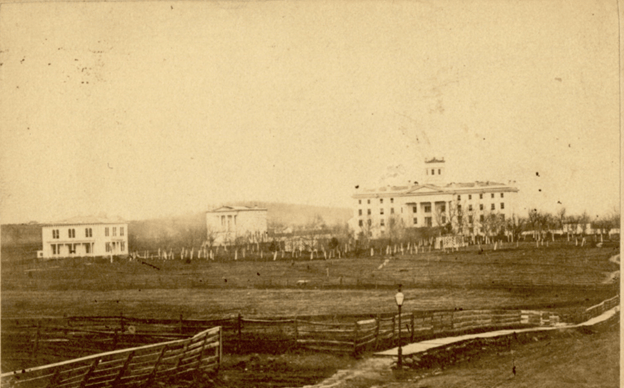
Pennsylvania College (now called Gettysburg College) as it appeared in 1862, one year before the battle. Pennsylvania Hall is the building on the right.

For most students, college is a stressful time. But no amount of stress, previously or afterward, compares to that experienced in July of 1863 by the students of Pennsylvania College (now Gettysburg College), whose classes were interrupted by the largest battle in the western hemisphere. Two of those students were Michael Colver and H.J. Watkins, whose stories highlight just some of the many chaotic and bewildering experiences that many of Gettysburg’s youth endured during their three days of terror, as well as how they sought to make themselves useful to those in need during the great contest.

Michael Colver was originally from Olivet, Pennsylvania and was a member of the class of 1863, meaning he was a senior during the time of the battle. Horatio J. Watkins, meanwhile, was from Hagerstown, Maryland and a year below Colver. Both boys must have been educated young men, as enrollment requirements for the College at the time included, “an examination on Caesar, Virgil, the Greek Reader, Adam’s Latin Grammar, Sophocles’ Greek Grammar, English Grammar, Ancient and Modern Geography, Arithmetic and Loomis’ Ele-mentary Algebra” as well as “testimonials of good moral character.” Yet it was not just academics that Colver and Watkins were interested in. As their experiences during the battle showed, both had an intense curiosity about combat—a trait they shared with many other Gettysburg youth. At several moments, they put themselves in perilous situations in order to get a better view of the battle. However, despite this fascination with combat, the young men’s stories also reveal the depth of their compassion for humanity, as both Colver and Watkins would treat wounded men from both sides during and after the battle.

July 1, 1863 began as usual for the students of Pennsylvania College. Watkins was in class in Pennsylvania Hall when a U.S. Signal Corps officer interrupted and requested access to the cupola to make observations. Due to the disruption, the class was dismissed. As Watkins exited the building he encountered Colver. Both students began to hear shooting and Colver proposed that they go to the top of the cupola of the Lutheran Seminary to get a better look at what was going on. Watkins said that they should get permission from the faculty first, but Colver brushed the suggestion aside and they both made their way to the Seminary. They were joined by several other students and together they witnessed the early fighting to the north of town. However, they were forced to vacate the cupola when a Confederate shell passed nearby. At this point Colver and Watkins became separated. Instead of trying to find a place to hide, Colver and Watkins actively sought out danger as they had not yet satisfied their curiosity.

Colver and another student, Alexander Miller, proceeded to Cemetery Ridge just south of town in order to obtain another observation point of the battle. Here they encountered a Union chaplain who told them to either help out or head home. Before Colver could reply, an artillery shell landed nearby and he became separated from Miller. Colver then wandered the town for several hours, hiding wherever he could. He appeared to find relief at the home of the Swisher family (which still stands today on Taneytown Road, south of town) and was able to get supper. But the arrival of Union troops from the Twelfth Corps forced him to go on the move once again. By the evening he finally found a place to stay – a cabin full of wounded Northern soldiers. Colver helped with the dressing of their wounds, for which the soldiers awarded him the endearing title of “doctor,” and it was here that he stayed the night. After enduring a day of horror and terror, the soldiers certainly appreciated the help that the young Colver provided, and Colver himself must have been pleased to have been able to find a way, even as a mere college student, to help the men he was so eager to see in combat.

Watkins, meanwhile, was also acting the role of doctor. After leaving the Seminary, he made his way to the railroad depot to help the wounded, including Lieutenant Colonel Mark Flanigan of the 24th Michigan. As evening approached, Watkins found shelter in a cellar in town, along with several wounded Union troops. That night, Confederate soldiers attempted to break in, but were unable to do so. In the morning, the Confederates returned while Watkins was outside. One of them stole his watch and it was only after pleading with an officer that Watkins was able to get it back. Learning his lesson from his encounter with the Rebels, Watkins decided to stay in the cellar for the rest of the day. While many civilians after the battle would recall that the Confederates were surprisingly civil and polite in Gettysburg, some angrily noted that the Southern soldiers were a bunch of ruffians who pillaged their homes and either taunted or disrespected the townsfolk. Watkins’s experience matched those in the latter category.

That same morning, Colver left his cabin and sought a less crowded place to hide. He found a stone house south of town where he was reunited with Miller. Seemingly satisfied with what they had seen of battle, Colver and Miller stayed in their shelter for the remainder of the fighting. But for Watkins, the ordeal was not over. On the third day of battle, he made his way to his old boarding house owned by the Minnighs on the west side of town and stayed the night. The willingness of the Minnighs to take in Watkins, and the Swishers with Colver on the first day, highlights an important aspect of the College students’ experiences during the battle. When the fighting began, most Gettysburg residents (who had not fled town altogether) were able to seek shelter in the cellars of their homes. But this was not possible for the students. Their home had been the College, which was converted into a Confederate hospital on the first day of battle, leaving the students homeless. Therefore, they had to rely on the townspeople to take them in and provide them with shelter. As the stories of Colver and Watkins highlight, many were willing to do this —not only for the wandering students but also for fellow residents who deemed the location of their homes unsafe, and were forced to spend their days “house-hopping” as refugees within their own town. The generosity of the various “hosts” thus provided vital safety for those who otherwise would have been left out in the crossfire of battle.

Around midnight, a Confederate soldier who had been wounded in the head broke into the Minnighs’ house and began to act strangely, holding his eyes open and screaming into a mirror. As the only man in the house at the time, Watkins seized the man and tossed him out before slamming the door shut, doubtless unnerved by the experience, but likely proud of his ability to protect the vulnerable other occupants of the home. When morning came, Watkins saw that the Confederates had fled and made his way towards the College. Along the way, he took a knife from a drunken Confederate soldier who had been left behind. He may have done so in order to procure a souvenir of his experiences during the great battle, or perhaps it was his way of exacting a small bit of revenge upon the invaders who had devastated his adopted town. He also might have viewed the knife as an essential means of protection in the wake of his unsettling experiences with the Confederates the previous night. On that same day, Colver and Miller also emerged from their sanctuary only to be told (falsely) that Confederates were preparing to shell the town. Even after the battle was over there, chaos and confusion abounded, and with no one knowing what to expect next, many civilians feared the worst. Taking these rumors for fact, the two students returned to the stone house, where they remained until Monday, July 6.

Like all citizens of Gettysburg, the students of Pennsylvania College faced significant clean-up duties after the battle. During the battle, the College had served as a hospital and there were still many wounded remaining – around 700 according to Colver. All of the students’ books and school supplies had been tossed into the College president’s house while the rooms of Pennsylvania Hall were occupied by the wounded, mainly Confederates. When Colver entered his room he found three men, one on the bed and two on the floor. The cries and moans of the wounded echoed down the halls. For the students, it must have been unnerving and bewildering to find their adoptive home occupied by enemy soldiers and converted into such a miserable and grim place. But there was no time to complain, as for each minute that passed, more and more soldiers were dying, and for students such as Colver and Watkins, it did not matter that those suffering were the enemy. As they had done several days previously, Colver and Watkins began to help treat the wounded to the gratitude of the Confederates. The young men’s curious readiness to help those from the enemy army may be related to the fact that after graduating, Colver and Watkins both became ministers. Perhaps their compassion toward the Rebels was rooted in deeper, pre-existing moral and religious beliefs that led to their sense of duty and willingness to help others, no matter who they were.  (Conversely, perhaps the students merely felt moved both by simple necessity, combined with nineteenth century notions of duty toward humanity, to help the wounded Confederates, and it was those humbling experiences immersed in suffering and death that drove the students toward the ministry). The College would remain a hospital for several weeks. As a result, the faculty decided to forgo final examinations and immediately graduate the class of 1863, which doubtless pleased Colver, who had already experienced the greatest physical and emotional test of his life.

After graduating, Colver would marry and move out to the midwest, frequently changing his residence. The College alumni records list him as living in Minnesota, Indiana, Illinois, and Ohio in the second half of the nineteenth century. It seems that his eagerness to wander and observe, which had shown itself during the battle, were still with him. Watkins initially stayed in Pennsylvania before moving to, and eventually settling in Lockport, New York. He would marry the daughter of German immigrants and had eight children with her. Despite moving away, neither student forgot his experiences. In the 1902 edition of the Spectrum, the yearbook of Gettysburg College, both Colver and Watkins recounted their stories a full thirty-nine years after the battle. Towards the end of his narrative, Colver reflected on the significance of the battle for Gettysburg College students. Interestingly, he did not write about the horrors of the battle and its aftermath, nor of the fear that he felt. Instead, he wrote how proud Gettysburg College students should be that their campus was the site of a great Union victory that should forever swell their hearts with great feelings of patriotism. Colver, it seems, did not want to remember, or at least publicly dwell upon the suffering that he and the men he helped went through. Perhaps those memories were something he wanted to forget, or at least reflect upon merely in private. Instead, he wanted the college community to focus on the ultimately positive outcomes of the battle, and how those trying three days served to make both himself and his community stronger and united in their shared experience of playing host to such a renowned Union victory. Although it is this version of his battle experience—the story that Colver wanted to tell—that dominates the college’s printed records of what the battle was like and what it meant to those students who experienced it, it is the other version of Colver’s narrative that ultimately provides a far more complex lens into the life-changing impact of those three days in July upon those who had, for better or worse, chosen Gettysburg as their adoptive educational home.
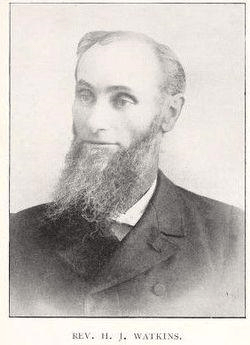
H.J. Watkins, later in life
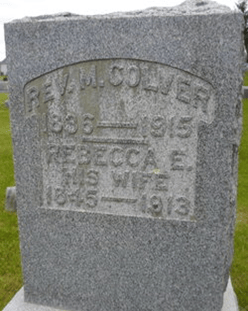
Michael Colver’s grave, Orangeville, Illinois

No One is Safe: The Story of Henry Spangler’s Family at Gettysburg

Arguably one of the most iconic civilian names associated with the Gettysburg landscape, the Spanglers were one of the largest and wealthiest families in the area. However, unlike many of their neighbors, not a single member of their expansive family had served in the war prior to July of 1863, granting their pristine and bucolic farms a measure of relatively rare “wartime immunity.” All of that changed when their numerous farms became the sitess of some of the most vicious fighting and iconic moments during the battle of Gettysburg. Jessica Roshon (’23) illuminates the story of Henry Spangler’s family and reveals both the tragically ironic and horrifically indiscriminate nature of warfare in this profile of a family forced to come to terms with the personal devastation of civil war for the first time in July of 1863.

By Jessica Roshon ’23

War on the Doorstep: Civilians of Gettysburg

By late June of 1863, alarms warning of approaching Confederate forces were nothing new for the 2,400 residents of Gettysburg. Living just ten miles from the Mason-Dixon line, small-scale raids, kidnappings of freed-people, and rumors of an imminent clash between the two great armies had long plagued the borough and its surrounding community.  Nevertheless, none of these events could prepare Gettysburgians for the ferocious 3-day fight between 165,000 soldiers in early July of that year that would transform the lives and lands of Gettysburg’s civilians forever. However, these civilians’ experiences were not monolithic; while some were defined by tragedy and blight, others included remarkable episodes of perseverance, successful pragmatism, and creative profiteering.  This new blog series profiles the lives of diverse Gettysburgians who were forced to confront the war at their very doorsteps, each on their own terms, whose stories speak to the kaleidoscope of experiences of civilians struggling to survive, and thrive, along the Pennsylvania-Maryland border during the Civil War.

No matter how far and safe non-combatants saw themselves from the conflict, the Civil War always managed to find itself on the doorstep of countless helpless civilians. Henry Spangler’s family was no exception: They had no specific reason to believe the war would come to their very home, and, despite the fact that they lived along the tenuous boundary between North and South, unlike many families, no one from the Spangler clan was serving. Unfortunately war is impersonal, destroys everything it touches, and can appear on one’s doorstep at any time as it did for Henry Spangler’s family.

Henry’s family was one of three wealthy Spangler households in Gettysburg—all of which would become famous witnesses to history in July of 1863. Although he owned a 156-acre farm on the Emmitsburg Road, Henry was renting the property out to tenant Jacob Eckenrode in 1863. (This farm would become the infamous “stepping off point” for the Armistead’s brigade during the July 3rd Pickett-Pettigrew assault.) Instead, Henry lived on a farm owned by his father, Abraham that was located behind Culp’s Hill during the time of the battle. Abraham and his wife, Elizabeth resided west of town on Chambersburg Pike, between Willoughby Run and Herr’s Ridge, on a farm he had purchased in 1855. Henry’s older brother, George, also owned a farm south of the Culp’s Hill farm along the Baltimore Pike that was used by the Union Army as an artillery park for reserve batteries as well as a hospital for the Union 11th Corps. (It was also in the summer kitchen at George’s farm that Confederate General Lewis Armistead would famously die after his July 3rd wounding during “Pickett’s Charge.”) Abraham’s farm—that is, the July 1863 home of Henry and his family–would become host to several bloody and iconic battlefield landmarks such as Spangler Meadow, Pardee Field, and most famously, Spangler’s Spring, whose cool, pure water famously drew thirsty and bloodied men from both armies toward its sustenance during the battle.

The war-time residence of Henry Spangler encompassed 130.84 acres, all of which were purchased by the United States government on March 28, 1955. The main house was constructed around 1820 and made of brick and stone. The central part of the home was two stories, with an extension on the west side which tapered down to a height of one story. This section was eventually raised to meet the rest of the house in 1880. In addition to the house, a blacksmith shop lay about 20 yards to the west and the property held a barn as well. Several additional outbuildings were constructed after the battle, such as a large summer kitchen, small brick smokehouse, and a structure which functioned as a toolshed and chicken house.

In July of 1863, Henry Spangler, his wife Sarah (whom he had married in 1855), and their four children, Calvin, Alice, Anna, and William, lived at the Abraham Spangler farm. A day before the battle began, a Union officer arrived at the home and asked Sarah Spangler to take her family and flee out of fear for their safety. After packing some belongings, Sarah departed with her children to the nearby village of Two Taverns in a spring wagon, but Henry decided to stay at home in the cellar to try to protect the home from ransacking soldiers. General Slocum’s 12th Corps of the Union Army eventually arrived at the property on July 1st where they constructed earthworks above the spring and remained until the next day. Slocum was then called away temporarily, leaving the earthworks virtually unoccupied due to General George Greene’s inability to reach the area. Consequently, Confederate Brigadier General George Steuart’s brigade arrived on the scene unopposed but was quickly swept up in a series of attacks and counterattacks until the firing slowly died away into the night. The fighting resumed early the following morning when the 12th Corps attacked Steuart’s men from the west and rained artillery fire from the Baltimore Pike down on the earthworks where the Confederates were trapped. At the climax of the battle, the 2nd Massachusetts and the 27th Indiana regiments were incredulously ordered to charge Steuart’s Virginians after a series of miscommunications. The results were devastating. While charging through what is now known as Spangler’s Meadow, the Union troops were under blistering musket fire from three sides and suffered heavy losses. Colonel Ario Pardee of the 147th Pennsylvania led a far more successful charge across a nearby field which now bears his name. 1200 Confederates were reported dead, 500 taken prisoner, and many more were wounded as a result. After seven more hours of brutal fighting, General Edward “Allegheny” Johnson ordered Steuart to retreat and reform at Rock Creek, which allowed the Union troops to reoccupy the earthworks and proceed with retrieving the wounded and burying the dead. The last troops to march through the Spangler farm were Union soldiers involved in the repulse of “Pickett’s Charge” on their way to the “Angle” atop Cemetery Ridge.

When Sarah and her family returned, they found the property in complete ruin. Soldiers had cleared the home of food and bed clothes. One of the family’s best horses and all their cows were stolen. All of the fences had been torn down and the crops severely damaged. Union and Confederate bullets littered the ground. The house itself was partially damaged due to its use as a field hospital where countless men soaked the floorboards and stained the furniture with blood. Their corpses and amputated limbs were buried across the property. Despite all this destruction and bloodshed, a tale of brotherhood and comradeship managed to arise from the property. Reports emerged of truces being called between the opposing forces in order to fill up their canteens and cups. These stories likely originated from veterans reminiscing on their experiences and fit neatly into the post-war Lost Cause narrative of reconciliation. However, as comfortable as this little story is, it is highly unlikely that this event actually occurred because of the location of the spring and the vicious fighting which occurred around it. Romanticizing this portion of the battle does not change how thousands of men lost their lives and wounded men screamed in agony for their comrades in an attempt to find them, ironically on a farm owned by a “war immune” family.

The story of Henry Spangler, and every branch of the Spangler family in the Gettysburg area, is an intriguing one because it is a story that is common, yet still shocking at the same time. Countless civilians had their property and lives destroyed by the war, but the contrast between peaceful farmland and roaring guns, cool flowing springs, and the screams and flowing rivers of blood from the dying remains chilling, nonetheless.

Above the Call of Duty: Josephine Rogers (Josephine Miller)

By: Lauren Letizia

War on the Doorstep: Civilians of Gettysburg

By late June of 1863, alarms warning of approaching Confederate forces were nothing new for the 2,400 residents of Gettysburg. Living just ten miles from the Mason-Dixon line, small-scale raids, kidnappings of freed-people, and rumors of an imminent clash between the two great armies had long plagued the borough and its surrounding community.  Nevertheless, none of these events could prepare Gettysburgians for the ferocious 3-day fight between 165,000 soldiers in early July of that year that would transform the lives and lands of Gettysburg’s civilians forever. However, these civilians’ experiences were not monolithic; while some were defined by tragedy and blight, others included remarkable episodes of perseverance, successful pragmatism, and creative profiteering.  This new blog series profiles the lives of diverse Gettysburgians who were forced to confront the war at their very doorsteps, each on their own terms, whose stories speak to the kaleidoscope of experiences of civilians struggling to survive, and thrive, along the Pennsylvania-Maryland border during the Civil War.

It is often said that in hard times we discover the true characters of our neighbors. While some become distant and aloof during times of terrible hardship or fear, others demonstrate courage, kindness, and selflessness. The latter phenomenon is exemplified in the story of Gettysburg civilian, Josephine Rogers, also known as Josephine Miller. A young woman at the time of the great battle, she risked her own life to help young soldiers in need of sustenance and shelter.  Interestingly, as she did so, she simultaneously defied traditional gender norms and fulfilled them in ways that proved not only celebratory, but were also memorialized by those who witnessed her selfless actions.

Josephine Rogers’s small farmhouse was located on the edge of the Emmitsburg Road, south of Gettysburg. It was owned by her relatives, Peter and Susan Rogers. There is some dispute as to Josephine’s familial relationship with Peter and Susan. Some accounts list her as a niece, while others state she was a granddaughter or adopted daughter. Josephine would eventually marry her neighbor, William J. Slyder on October 25, 1863, with whom she soon moved to Ohio.  But on the second day of fighting, the entire Rogers family was still occupying their small farmhouse. As the violence began to intensify in the vicinity of the Rogers home, Union General J.B. Carr, commanding a brigade of New Yorkers stationed closest to the home, requested that Josephine and the Rogers leave immediately. However, 18-year-old Josephine refused to flee, telling the general she had a batch of bread baking in the oven. She reassured him she would leave after the bread was finished. This decision is lyrically described Harvard University graduate, Edgar Foster Davis’s poem published in 1912:

The war cloud is gath’ring o’er Gettysburg vale,

Portending hoarse thundering and death-dealing hail;

The solid earth trembles, and the rent is the air,

With the rushing of squadrons, —the loud trumpets blare.

The clanking of arms, and the shouting of men,

And the neighing of steeds from each echoing glen;

But unheeding the din and unhindered by dread

Josephine Miller is baking her bread.

Around 1:00 pm on July 2, General Daniel Sickles ordered the 3rd Army Corps to leave its position on Cemetery Ridge and move into the valley along the Emmitsburg Road, seeking to thwart a supposed Confederate march to Washington D.C. and move his troops to what Sickles considered to be a less vulnerable position along the high ground immediately above the Emmitsburg Road. The men of the 1st Massachusetts began to move into the Rogers’s fields and towards the farmhouse. At approximately 2:00, the men started to smell the scent of fresh bread, and as they arrived in position, they saw Josephine removing the loaves from the oven. Noting the soldiers’ desperate hunger, Josephine quickly sliced the loaves and distributed them to the Union soldiers. Three hours later, the Confederates open fired on the newly stationed 3rd Corps, bombarding the 1st Massachusetts, and Josephine Rogers, with shells. Despite the increasingly perilous situation, Rogers kneaded, baked, and sliced more loaves of bread for the troops. The officers offered her compensation, but she vehemently refused. To show their thanks, as Josephine’s flour supply dwindled, some soldiers volunteered to steal more from General Sickles’s commissary stores. They also returned with a supply of raisins, currants, and a sheep. Josephine Rogers stayed in her home for two days, not only feeding the soldiers, but also caring for the dying and wounded.

On July 3, the infamous artillery duel between the two armies shook the foundations of Josephine’s farmhouse. The Confederate infantry began to advance against the Union line, with some southerners marching directly through the Rogers’s fields. Just as General Carr had found Josephine hard at work by her stove, the Confederates incredulously noted Josephine Rogers once again baking bread amidst the hailstorm of lead flying about her.

Over the course of the now iconic Pickett-Pettigrew charge, many Confederate soldiers died near Josephine’s home. When the smoke had cleared, the home still stood but was marked with bullets and scarred by artillery shells. Seventeen bodies were removed from the farmhouse and the cellar. Additionally, many wounded soldiers, both Union and Confederate, had crawled into Josephine’s home to seek a haven from the bloody storm. Josephine cared for and comforted them as best she could, no matter what color uniform they wore.

Josephine Rogers, with her iron stove and loaf of bread, in front of the 1st MA monument (1886)

Josephine Rogers’s actions at Gettysburg symbolize both the breaking and fulfilling of traditional 19th-century gender roles. By obstinately refusing the orders and protective offers of powerful men and remaining in her home in the midst of battle, she directly contradicted the image of the meek and passive housewife who depended on masculine aid in the face of danger, and did not hesitate to attend to the mangled bodies of strange men. However, in other critical ways, she also fulfilled the roles expected of a 19th-century woman: She remained in her home to carry out her domestic responsibilities of baking, nursing the men under her roof, and (in true “Republican motherhood” style) literally propping up men to perform their “proper” civic and martial duties. Though she did all of this in spite of the horror and bullets swirling around her, Josephine represented the pinnacle of 19th-century feminine duty to home and to country. For both her defiance of and dedication to such gender norms, she earned a permanent place in the hearts of the men she interacted with on those two famous July days.

As the Civil War drew to a gruesome finale in 1865 and the nation struggled to heal, many people never knew about the heroic and altruistic actions of Josephine Rogers. However, the surviving troops of the 1st Massachusetts could not forget her. After the war, she was named an honorary member of the 3rd Corps, the only woman to receive such an honor. On July 2, 1886, when General Carr’s brigade reunited in Gettysburg, they invited Josephine Rogers to attend. They sought out her current whereabouts and mailed an invitation to her new home in Dayton, Ohio. Josephine agreed to travel back to her old home to once more to see the men she had aided. During the reunion, the Massachusetts men dedicated a monument to their unit’s actions at Gettysburg across the road from the Rogers’s house. Josephine was granted a privileged seat on the official ceremonial stand at the dedication. During the ceremony, some of the veterans moved the legendary black stove that Josephine had so famously used to bake bread for the soldiers under fire from the farmhouse and set it in front of the new monument. Josephine posed for a photo next to the stove with a loaf of bread in her hand. Josephine’s beloved stove has been lost to history, and the Rogers house no longer stands, having been torn down in the 1880s. Now, only a small plaque bearing the family name and a square-shaped picket fence remain to mark the homestead. Few people know the name or story of Josephine Rogers, but her heroic deeds speak to us over the generations from the memoirs and histories of the soldiers whose lives she touched, whose bodies she healed, and whose hunger she unflinchingly risked her life to quell; the import of her actions to those soldiers is forever enshrined in the rolls and records of the 1st Massachusetts, in the dedication speeches for the monument that still stands across the road from her homestead, and in the photos of her proudly posing by her stove with the veteran Bay Staters who made sure she would not be forgotten by history. Blending traditional 19th-century gender roles with the pragmatism necessitated by war, Josephine’s unlikely actions speak to her patriotism, but also her humanity, which she refused to sacrifice to the horrors and affronts of war. 

css.php