In the days, weeks, and months following the Battle of Gettysburg, journalists and newspaper editors feverishly attempted to recapture the full details, implications, and meaning of the massive fight that had transformed one small, formerly obscure, south-central Pennsylvania town into a household name. While some reporters struggled to ascertain the exact facts of the battle amidst the chaotic aftermath, others wrote with clear political agendas intended to sway the hearts and minds of their readership and, in turn, bolster their respective side’s support for the war effort. Still others searched for meaning in the aftermath through the prisms of religion, world history, and other lenses. In this mini-series, students will explore the myriad ways that 19th-century newspapers, throughout the North and South, “re-fought” the Battle of Gettysburg, its factual components, and its larger significance in print in the immediate aftermath of the fighting.
Imagine a small-town ice cream shop– a local place on the main drive through town. It’s small and welcoming, with brightly painted walls and today’s special flavors exhibited on a chalkboard out front. It’s a spot to stop in and enjoy some quality ice cream with the family, somewhere to get out of the sun and enjoy some sweets, a place to relax and enjoy your vacation.
It’s a place like Cone Sweet Cone, situated on Baltimore Street, in historic Gettysburg. However, like many other places in Gettysburg, this ice cream shop serves up its sweet treats with a side of history. When you walk through the doors, on your right you’ll see a glass display case with photos and memorabilia relating to aviation during the Second World War–some for sale, others for decoration only. A table stands across from this display, just a few feet from the ice cream bar. On this table lie a plethora of unassuming wooden pieces, each one stamped with the name of an historic location within Gettysburg. The way the shop is situated, your eye is inevitably drawn to them as you wait in line for your ice cream. Your stop for a sweet treat now is imbued with a distinctly historic association—an association authenticated by a slip of paper lying next to the wood fragments that explain the significance of the objects, their historic credence, and why they are for sale in this shop.
The fragments are from a tree that witnessed President Abraham Lincoln’s procession down the same street that the ice cream shop stands upon on November 19, 1863, while en route to the newly created Soldiers National Cemetery to deliver his famed Gettysburg Address. Clearly, these are no ordinary bits of wood; rather, they are tangible pieces of the past—hand-held witnesses to some of the most important events in Gettysburg’s, and the nation’s, history. Surely you must take one home with you!
These pieces of wood, like much of historic Gettysburg, offer an “authentic” and tangible connection with the town’s history which, when held in one’s palm, seem to offer an immediate transplant to the past–an avenue of escape from the modern, commercialized present into the dramatic historic events that transformed the town into a national icon. People who are standing in line waiting for ice cream will suddenly find themselves thinking not about what flavor to get, but about the trees which stood just opposite where they are now, and what great events they bore witness to. The casual visitor who might think they had “left the past behind” when exiting Gettysburg National Military Park is now reminded that, in fact, the battle’s history surrounds them wherever they go in the town itself. Suddenly, their carefree ice cream purchase has taken on an entirely new and specialized meaning, which they can remember and share with others through the purchase of one of the storied wood fragments; in turn, their unexpected encounter here with history is thus associated with the enjoyable sensory experience of ice cream eating at Cone Sweet Cone in particular—the historical and the commercial thus reinforcing each other.
The store’s blending of an offer of historic authenticity with the light-hearted consumerism inherent in visiting an ice cream shop is brilliant. The majority of people who stop by this ice cream shop will be tourists, and many will, in their travels throughout the town, be looking to take home something with them to remember their trip and their encounter with one of the nation’s most cherished historic sites. What better commemorative item to purchase, then, than a piece of a real witness tree?! In a town filled with t-shirts, mugs, and snow globes, the authenticity of this historic piece of wood is all the more enticing and thrilling. Furthermore, with so many different historic stampings to choose from on the various wood fragments, why not collect them all? You may walk into this shop hoping for ice cream, but you might just walk out with a piece—or two or three–of Gettysburg’s history in your pocket.
“War at the best, is terrible, and this war of ours, in its magnitude and in its duration, is one of the most terrible.”
Abraham Lincoln (1864)
“Rwanda can be a paradise again, but it will take the love of the entire world to heal my homeland. And that’s as it should be, for what happened in Rwanda happened to us all – humanity was wounded by the genocide.”
Immaculee Ilibagiza
From 1861 to 1865, the American Civil War destroyed nearly 2% of the population of the United States. Approximately 750,000 young men were killed in combat or were withered by disease. In 1994, in an east African country no larger than Maryland, 1 million men, women, and children were systematically murdered by a nationalist extremist movement in just 100 days. It was the most efficient genocide in human history: The Rwandan Hutu government had slaughtered roughly 25% of Rwanda’s population.
Though one cannot compare genocide to a civil war, both the United States and Rwanda were forced to cope with mass devastation and death. America had to construct national cemeteries to handle the abundance of corpses. The federal government began to hammer out policies to secure the freedom of the formerly enslaved and outlined the bones of Reconstruction for the South. Rwanda, however, did not have the luxury of a government after the killings ceased. Fighting their own civil war, the genocidal Rwandan government had been usurped. The Rwandan Patriotic Front (RPF), composed of Rwandan refugees from prior persecutions, had returned to liberate their people. To secure freedom for all Rwandans, the soldiers had to try to bury 1 million corpses and exact justice on the perpetrators. Rwanda, unlike the United States, had no government to accomplish these tasks.
In the fall of 2021, I had the privilege to spend one semester in Kigali, Rwanda to study the 1994 Genocide Against the Tutsi and the peacebuilding processes that were generated from the aftermath. My fellow students and I met with genocide survivors, perpetrators, and academic experts who helped bring the sorrow, suffering, and healing of the genocide to the forefront of our minds. We also visited five genocide memorials, which included mass grave sites, victims’ skulls and other bones, clothes, and, in the case of the Murambi Genocide Memorial Centre, 900 preserved corpses.
Preserved Bodies of Victims of the 1994 Genocide Against the Tutsi, Murambi Genocide Memorial Centre, Murambi, Rwanda
For Westerners, it may seem sacrilegious, disrespectful, or exceedingly grotesque to display such things in a public memorial. Rwanda has been criticized by (Western) museum officials and others for these exhibits. However, other countries damaged by genocide, such as Cambodia, instituted similarly graphic memorial displays. For Rwanda, their memorials, while sites of honor for victims are warnings to Rwandans and visitors. As genocide survivor and author Immaculee Ilibagiza wrote, “what happened in Rwanda happened to all of humanity.” Rwandan memorialization does not merely emphasize individuals but rather the whole communal loss of 1 million innocent citizens. There are no statues of RPF generals or other prominent people of that time. Memorialization centers on egregious atrocities to provide a warning to the world. A wall of a church classroom stained with children’s blood is a more effective memorial tool of genocide than a marble stone or statue.
The United States took a vastly different approach to memorialize the bleak memories of those killed during the American Civil War. Monumentation began almost immediately after Lee’s surrender to General Grant in Appomattox, Virginia in April 1865. Some of the first battlefield monuments were erected in Manassas, Virginia to commemorate the first land battle of the war and the Second Battle of Manassas in August 1862. Union soldiers dedicated the monuments “to the patriots” who gave their lives for their country. The ceremony included songs, poems, and various speeches. Northern organizations such as the Grand Army of the Republic (GAR) began to buy sections of battlefields to erect regimental markers, monuments, and other statues. These ceremonies usually included immense patriotic fanfare, veteran reunions, and large crowds.
Patriots Monuments, Manassas National Battlefield Park
Civil War memorialization and memory continued in a steady stream in the proceeding years and decades. While many of these efforts stemmed from legitimate concerns about how to properly honor the dead (and aging veterans) and turn collective mourning into remembrance, they became a tool for political and social influence. Organizations like the United Daughters of the Confederacy (UDC) and the Sons of Confederate Veterans (SCV) sought to portray their own versions of why the South fought and were ultimately forced to surrender and to preserve the Lost Cause narrative. Many Confederate monuments were erected during the Jim Crow Era and the Civil Rights Movement of the 1960s. They were seen as solid reminders of the key underpinnings of the slaveholding Confederate nation and who should be included as a citizen in that nation. Therefore, memorialization of the Civil War, particularly for the South, was to foment an almost nostalgic longing for the “simpler” times of the 19th century while also glorifying the martial masculinity and sacrifices of their soldiers.
Mississippi State Monument, Gettysburg National Military Park
When comparing the memorialization intents and practices of the United States and Rwanda, significant differences emerge. Rwanda’s memorials are not patriotic, vainglorious reminders of the country and its leaders. Instead, they are rooted in despair and shame. They serve to prevent the past through shocking evidence. American Civil War memorials and monuments, however, are often created to preserve the greatness of a particular regiment, general, or military action. Battlefields, though advertised as places of history and bloodshed, are also marketed as scenic places for hiking, birdwatching, or sunsets. The Gettysburg National Military Park’s website, for example, includes a three-and-a-half-minute video of the landscape and various available tourist activities set to a light, lilting soundtrack. It is not until almost halfway through the video that it shows the numerous unknown graves of dead soldiers. This does not mean that the park does not care about the 7,000 soldiers killed during the engagement. However, it provides evidence that many Americans view Civil War battlefields as seductively beautiful and peaceful. They do not always think about the horrific human carnage since it is not always starkly represented. Though there may be photographs of the dead or wounded, museums or other sites do not usually present the most horrifying aspects.
Genocide Victims’ Clothing in Nyamata Church, Massacre Site Memorial, Nyamata, Rwanda
Rwanda does not shy away from the carnage. Visitors are strongly encouraged to confront the realities of the 1994 Genocide and its aftermath. At the Gysozi Genocide Memorial in Kigali, Rwanda, a giant sign saying “kwibuka” stands on the main grounds. It means “remember.” Just as national Holocaust museums and memorials bear signs proclaiming, “Never Again,” Rwandans want visitors to remember the death and destruction. By contrast, the Civil War commemorations often draw living historians, reenactments, or other commercial tourist activities. Though sometimes beneficial to the amateur, youth, and more sensory-oriented consumer experience, one must ask if a visitor is genuinely grasping the full scope of damage and loss incurred by the war, as it is sometimes presented in a more sanitized and light-hearted way.
Again, a civil war differs markedly from genocide in innumerable ways, from the reasons for killings to how it was executed to the general “rules and standards” that shaped its scope and whom it could kill in certain situations to the hard reality that, unlike the Rwandan Genocide, the American Civil War produced a clear and positive victor that ultimately shepherded the nation further down the path of progress. However, both the 1994 Genocide Against the Tutsi and the American Civil War tore down nations and lives. The people left behind had to clear the ashes and rebuild. The countries decided to cope with the detrimental losses in contrasting ways that were affected by differences in the period, political currents, and other factors. Although the Civil War and the 1994 Genocide were vastly different catastrophes, how the post-conflict governments and communities chose to remember (or forget) and preserve their painful pasts is illuminating. Memorialization can both help and hinder the healing of a fractured nation and can shape a nation’s future reckoning with both new and lingering conflicts for better or for worse. In the words of Holocaust survivor and Nobel Peace Prize winner Elie Wiesel, “For in the end, it is all about memory, its sources and its magnitude, and, of course, its consequences.”
The role of the state of California is often seen as inconsequential to the momentous events of the Civil War occurring thousands of miles east. However, despite its distance from the larger conflict, California reflected the sectional division of the period. Indeed, Southern California[1], particularly Los Angeles and the surrounding areas, can be seen as a “forgotten front” of the Civil War, a secessionist stronghold that has faded in the collective consciousness of historical memory, but which speaks to both the universality of cultural and political division within the United States. As in the eastern portion of the country, demographic variance brought about the split between Unionists and Confederate sympathizers, creating an environment mirroring the needs and concerns of Easterners engulfed by the raging secession crisis and outbreak of war. Even after Appomattox, Southern California’s experience during this period represented a microcosm of a post-war United States attempting to grapple with the challenge of unsettled questions following the war, mainly the role of former Confederates in American political society and the nature of “reconstructing” the Union.
Only ten years old on the eve of the Civil War, California was still a developing state in 1860. Between 1847 and the first federal census (conducted in 1860), the population had almost tripled to approximately 308,000.[2] Despite this growth, however, there was still no rail link to the east, making the state feel isolated from the rest of the country (legislation creating the Transcontinental Railroad would be passed during the wartime years, and it would be finished in 1869).[3] Nevertheless, a fierce sectionalism permeated the state just as it did much of the country.
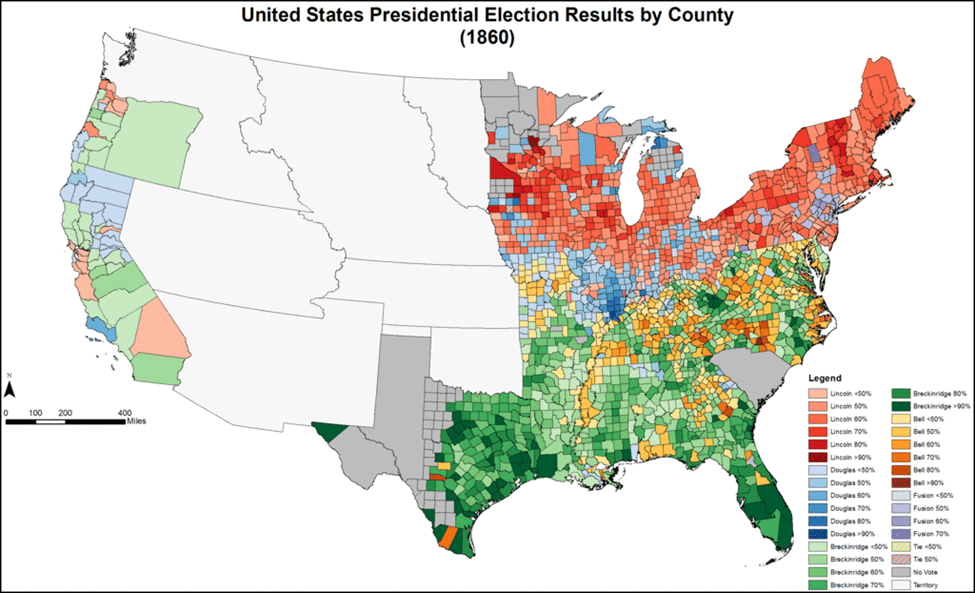
One of the best examples of the divisions within California is the results of the 1860 election. While generally, the trend was that either Lincoln or Stephen Douglas won the more populated counties while John Breckinridge took the more rural ones, the details are more complex. In Northern California, the voting patterns were far more diverse across the area than in the South; Lincoln handily won all of the counties in the Bay Area (with the exception of San Mateo), Douglas won a majority of the counties in the inland north and parts of the coastal north (as well as Sacramento), and Breckinridge won most of the central inland counties and a portion of the northern coast.
On the other hand, with the exception of two counties, all of Southern California voted for Breckinridge. Despite this monolithic appearance, the voting patterns of the Southern Californian counties are interesting: One of them, Santa Barbara County (present day Santa Barbara and Ventura Counties, following its split in the early 1870s) voted heavily for Stephen Douglas, the Northern Democrat, aligning itself more with the rural Northern Californian counties than its neighbors, while the other, San Bernadino County (which included portions of modern-day Riverside County) voted for Lincoln, aligning itself with the more-populated coastal Bay Area.
While more research is needed to reach a conclusion about why these two counties voted the way they did, the numbers are shocking! The Sacramento Daily Union reported that, within Santa Barbara County, Breckinridge received 123 votes (about 26%), while Douglas got 305 (about 64%), Lincoln got only 46 (just under 10%), and Bell did not get a single vote. On the other hand, in San Bernadino County, Breckinridge received 192 votes (about 23%), Douglas 224 (about 27%), Lincoln 307 (about 37%), and Bell 98 (about 12%). Compared to their neighbor, Los Angeles County, where Breckinridge received 686 votes (about 39.5%), Douglas received 494 votes (about 28.5%), Lincoln received 352 votes (about 20%), and Bell received 201 votes (about 11.5%), the difference is clear.[4] The significant variances in voting patterns amongst these three counties might speak to larger national trends revealing the non-monolithic political sentiments even within regions, demonstrating that beyond the larger political developments across 1860s America, things were more complex than they seemed at even the most local of levels.
Even within individual counties, political sentiments were extraordinarily diverse. For example, once the war broke out, the city of San Bernadino became a staging and training ground for secessionists and Confederate sympathizers, despite the larger county supporting Lincoln by a margin of 10%. On the other hand, in some areas, such as the precinct of Agua Mansa in the southern portion of the county, where Lincoln won nearly 91% of the vote, Republican support was extraordinarily strong. These examples alone highlight that the 1860 election in California merits significantly more research because of the unusual circumstances surrounding the ways in which citizens voted, both across a singular state and within particular regions and counties of that state.
1860 Election by County (Courtesy of Wikimedia Commons)
At this point in California’s history, the majority of the population lived in the north, either in Sacramento or the Bay Area, where most of the people who had moved west during the Gold Rush settled. On the other hand, Los Angeles was still a relatively unpopulated area, with only 9,221 people reported in Los Angeles County on the 1860 census. Indeed, unlike the sprawling city of the modern day, the “city” of Los Angeles had a population of 4,385 in 1860![5] Unlike Northern California, which was settled by people from all over America and the world seeking their fortune during the Gold Rush (and thus, largely did not hold distinct connections to the antebellum plantation culture), many Southern Californians had traveled West from Southern, slaveholding areas. These ensuing cultural differences became even more evident when, in 1859, the state legislature approved dividing California in two, with the northern half slated to remain “California” while the southern half[6] was to become “Colorado Territory.” This motion, however, became lost in the shuffle of national politics as tensions over slavery grew more inflamed in Congress.
The demographic and cultural differences between the “settled” north and more frontier-like south informed the vastly diverging political attitudes of the two halves of the state. In 1861, the pro-Southern sentiments of Los Angeles visibly manifested in early 1861. Following Albert Sidney Johnston’s resignation from the US Army, General Edwin Sumner was placed in charge of the Department of the Pacific, noting shortly thereafter that “dissatisfaction in the southern part of the State is increasing and becoming dangerous and it is necessary to throw reinforcement into that section immediately.”[7] Indeed, Sumner ordered troops from Fort Mojave in Arizona to Los Angeles, posting them, along with troops from Fort Tejon, near the town, anticipating an uprising. Sending Federal troops to garrison in the Los Angeles area was paramount, since, at the time, the only Federal outpost was a one-man quartermaster depot operated by Winfield Scott Hancock, the sole military presence in Los Angeles.[8] To the Union war effort, retaining control of Southern California was necessary. Not only could it provide an easy path for Confederate forces to invade the northern part of the state and seize the natural resources there (namely gold to finance their war effort), but it would also open a series of harbors that Southerners could use to circumvent the Union blockade of their ports.[9]
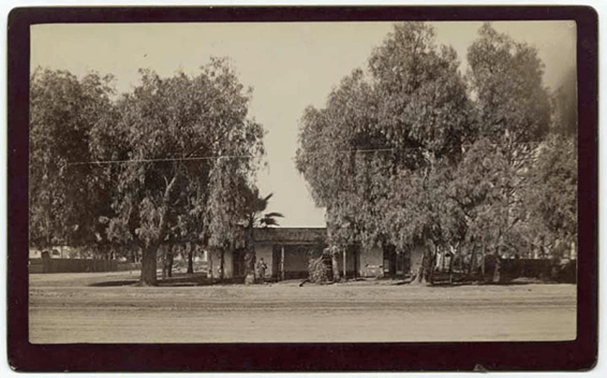
Hancock’s armory warehouse, the sole US Military posting in Los Angeles at the outbreak of war (courtesy of the California State Library).
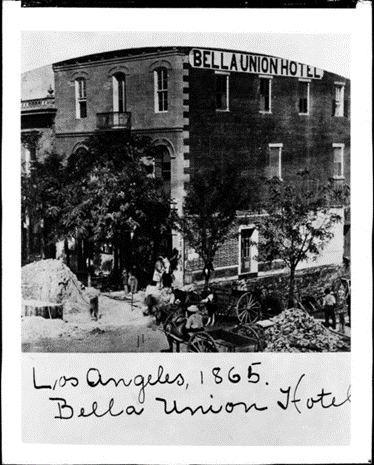
Sumner’s concerns of internal unrest were indeed justified. Upon hearing of the shelling of Fort Sumter, many Southern Californians began flying the Bear Flag of the California Republic, now a clear sign of their support for states’ rights and secessionism.[10] Furthermore, the Bella Union Hotel, one of the most highly regarded hotels in Los Angeles, placed a large portrait of P.G.T. Beauregard, the commanding general at Fort Sumter, in their lobby, celebrating the Southerner who had achieved the Confederacy’s first victory. As the war progressed, pro-secessionist sentiments grew so strong that the city of Los Angeles canceled its July 4th celebrations in 1863 and 1864 as a protest against the Union.[11]
Bella Union Hotel, pictured in 1865 (courtesy of the California History Collection at the USC Library)
In fact, most prominent Angeleños were pro-secession. Local Unionist rancher Jonathan Warner wrote to the Sacramento Daily Union in April 1862, lamenting that
“All our judges are secessionist [Hayes and Dryden] or at least strongly tinctured with it. Our Sheriff [Tomás Sanchez] is a secessionist; our Deputy Sheriff [Andrew King] ditto; our County Clerk [John Shore] ditto – in one word, all our own public officials, with the exception of the District Attorney [Ezra Drown] and County Surveyor [William Moore] are secessionists, root and branch.”[12]
Besides public officials, the media in Los Angeles was also sympathetic to the South. Henry Hamilton, the publisher of the Los Angeles Star, actively fostered secession, having fiercely criticized Lincoln even prior to his election. Hamilton published regular articles promoting states’ rights, white supremacy, and, following the Emancipation Proclamation, published an editorial stating that,
“By the stroke of his pen, Mr. Lincoln frees every slave in rebeldom — robs every master of his servant, every household of its property. Was ever such an outrage perpetrated in the name of law, or such foul perjury committed, as by this man, sworn to maintain the Constitution and govern by the laws.”[13]
Hamilton was not the only figure spreading Confederate rhetoric in Los Angeles. Edward Kewen, a former Attorney General (the state’s first) and native Mississippian, along with Senator Milton Latham (who had been elected as Governor in 1859 and held the position for five days before resigning to take the Senate position) regularly spoke out on behalf of the Confederate cause, holding rallies in the city outside of a popular saloon.[14]
Beyond simply expressing their support for the Confederacy, Angeleños tried to openly fight against the Federal Government. In March 1861, Los Angeles County Undersheriff Andrew King (who would be arrested for “treasonable expressions” in 1862) raised the Los Angeles Mounted Rifles, a pro-secessionist militia based in El Monte.[15] This group (often called the “Monte boys”) included several other county officials, including King’s boss, Sheriff Tomás Avila Sanchez. However, Federal forces quickly confiscated their arms, rendering this group useless shortly after its formation.[16]
While the Monte boys were quickly broken apart, other groups remained a threat to the Federal military. Prior to Sumner’s move of Federal troops to Los Angeles, in May 1861, Hancock learned that over fifty men were planning to meet at the Plaza in the center of Los Angeles, raise the pro-secession Bear Flag over the courthouse, and presumably, raid his armory.
Bear Flag design similar to what Californian Secessionists might have flown (courtesy of Wikimedia Commons)
However, at the same time, the Los Angeles Mounted Rifles, the sole Confederate military unit that was raised in a free state, was planning to escape Los Angeles, cut through Arizona Territory, and arrive in Texas, where they could join the Confederacy. Their fellow rebels’ plan to take Los Angeles concerned the leaders of the Mounted Rifles, who did not want Federal attention upon them as they planned to leave California. As such, Sheriff Sanchez, a high-ranking member in both groups, persuaded the Monte boys to postpone any demonstration of force in Los Angeles, allowing those who wished to go east and fight, including Alonzo Ridley, another Undersheriff of Los Angeles, to leave and serve with Johnston (indeed, Ridley was by Johnston’s side when the General died at Shiloh).[17]
Despite their public advocation of secessionism, most of the Confederates of Los Angeles remained in office, likely due to their local popularity. Tomás Sanchez was re-elected as Sheriff in 1863 and 1865, serving in the position until 1867. Henry Hamilton was elected to the state Legislature. Cameron Thom, one of the Mounted Riflemen, became a captain in the Confederate Army, returned to Los Angeles after the war, and served as mayor of the city from 1882 to 1884.[18] Astonishingly, the state did not ratify the Fourteenth Amendment until 1959, and only ratified the Fifteenth Amendment in 1962 after the Democrat-dominated legislature rejected it in 1870. As was true across much of the defeated South, Confederate sympathizers still managed to prevail within the state long after the guns fell silent. Some historians, including Heather Cox Richardson, have argued that the outstanding issues behind the Civil War remained contested in the West, most notably the nature of state versus federal authority. For example, according to Richardson, many southern Democrats believed that the geographic isolation of the region meant that it was the only location free from the “dictatorial” Republican government in Washington, suggesting that the post-war West was the natural ideological successor to the idea of “states’ rights” so central to the Confederate mythos and thus, a location for former Confederates to continue fighting for their “Lost Cause.” Perhaps none can summarize the nature of these attitudes better than King, who declared vehemently in 1865, “we have been and are yet secessionist.” Indeed, the strong sympathy towards the South in a postbellum California demonstrates how, though now transformed to become political and ideological, the battles of late 19th-century America extended across the continent to the embattled forgotten front.
[1]In this article, Southern California is defined as the historical counties of San Luis Obispo, Santa Barbara, Los Angeles, San Bernadino, and San Diego.
[4]It is worth noting that in 1864, Lincoln received about 42% of the vote in Los Angeles County, about 80.6% in Santa Barbara County, and about 32.7% of the vote in San Bernadino County, all of which represented significant changes within the voter base from the prior election, suggesting a broader change in attitudes amongst Southern Californians (mostly in favor of Lincoln and the war effort) over the course of the Civil War.
Richardson, Heather Cox. West from Appomattox: The Reconstruction of America after the Civil War. Yale University Press, 2007. http://www.jstor.org/stable/j.ctt1npj8s.
By Ziv Carmi ’23, Emily Jumba ’24, and Dr. Ashley Whitehead Luskey
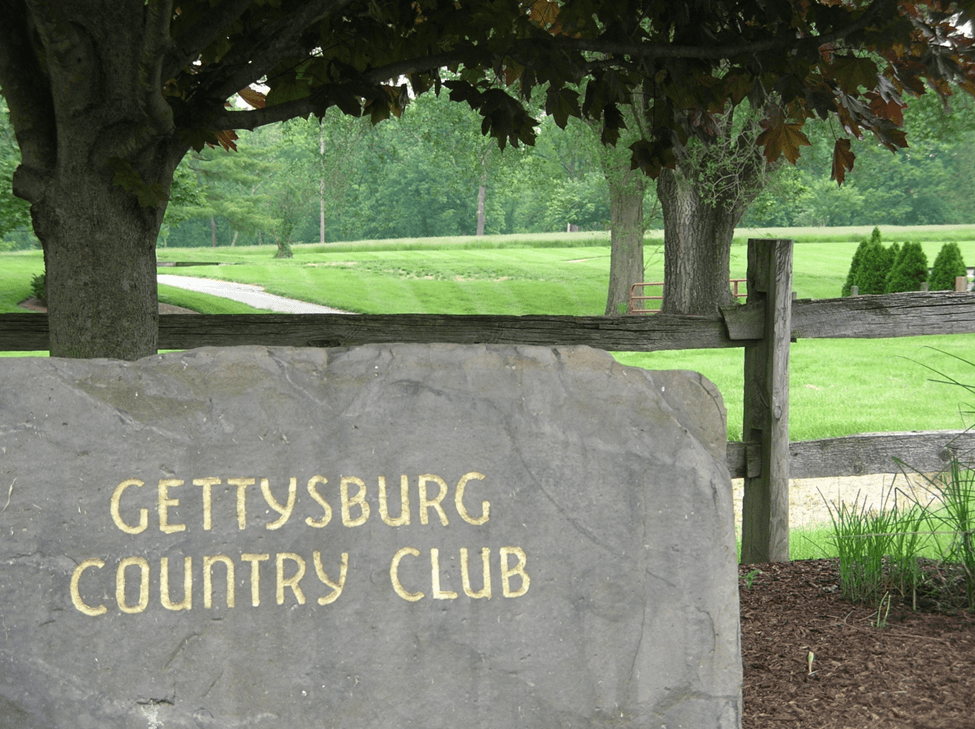
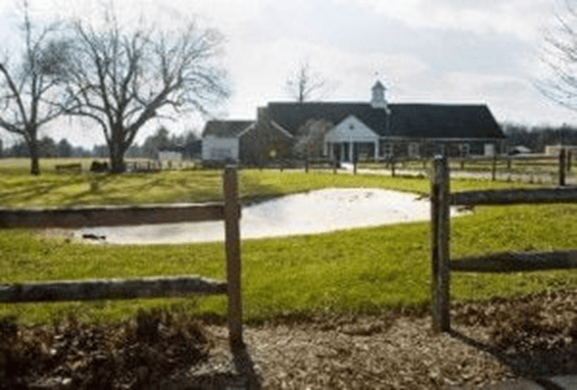
Modern-day viewshed into the historic and pastoral open fields of the former Abraham Spangler farm and former country club, where Trone Rental Company proposes to construct eight 1-3 story buildings containing 112 apartment units (Gettysburg National Military Park)
Approaching Gettysburg National Military Park from the west along the historic Chambersburg Pike (Rt. 30) is, in many ways, a journey through time. That journey carries one past the iconic “First Shot Marker” where Illinois cavalryman, Marcellus Jones famously lowered his rifle and delivered the first volley at General A.P. Hill’s advancing Confederate column, thus officially opening the Battle of Gettysburg. The journey continues past rolling farm fields and historic brick structures, including the stately Herr Tavern, which bore witness to the first major standoff between Union cavalry and Confederate infantry—a confrontation which would eventually push Union troops eastward toward the borough in the face of an overwhelming enemy. Continuing along that famed highway will quickly bring you to the site of some of the most brutal fighting of the entire Battle of Gettysburg, along the slopes of Willoughby Run and on up into Herbst Woods. The beginning of that fighting occurred on the outskirts of what was then the Abraham Spangler farm, now home to two one-story stone structures containing the Gettysburg Day Spa and the pastoral, open fields behind it that once housed the Gettysburg Country Club. While admittedly no longer “pristine” landscape due to the former development of the country club and its two buildings, the land retains an undeniable historic character that both enables the visitor to place oneself back amidst the battle’s melee there on that fateful morning of July 1, 1863, and to prepare oneself for entry into the core boundary of Gettysburg National Military Park—a path traversed by millions of visitors who, ever since the guns fell silent, have begun their impactful sojourns onto the battlefield in that very spot.
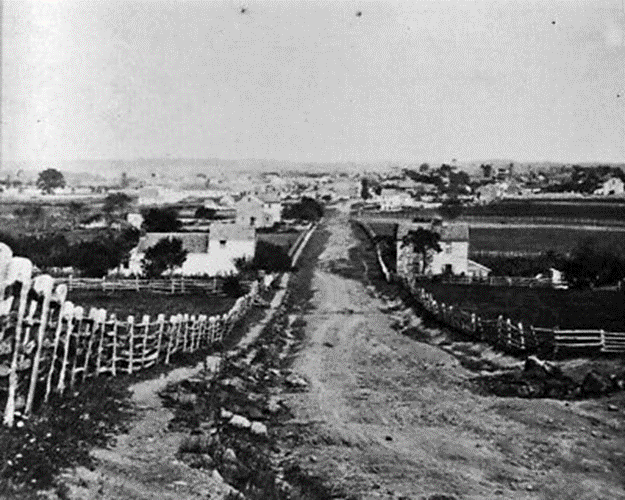
The historic Chambersburg Pike, 1863, leading into Gettysburg, along which the first major fighting of the Battle of Gettysburg unfolded (Library of Congress)
This is unquestionably hallowed ground, but today, it is threatened ground. While the National Park Service managed to acquire over 100 acres of battlefield land just to the south of the property in question in 2011, currently, Trone Rental Company of Hanover is vigorously pushing forward a proposal to build an apartment complex on top of the former Abraham Spangler farm. The plan for the “Residences at Willoughby Run” calls for the construction of eight buildings, containing 112 rental units, atop 14.5 acres of the ground across which numerous brigades of Confederates surged forward and backward in heated contest with Federals during their thrust towards the town. The significance of this fighting on July 1, 1863 alone merits its worth for preservation and interpretation. Indeed, this terrain is integral in understanding the experiences of both Union and Confederate soldiers on July 1st and how the battle lines for the ensuing two days would come to be drawn.
In addition to its impact on the historic landscape, this apartment complex would pose an enormous detriment to the tourist experience here in Gettysburg. A series of eight, 1-3 story buildings directly adjacent to the NPS park boundary would obscure the historic viewsheds around the core battlefield which, even with the two currently extant, low-lying stone buildings and parking lot, is still partially preserved. It also would tarnish the ambiance both entering and leaving the park which is essential for quiet reflection and contemplation of the historic landscape and the significant fighting that took place there. With both commercial and residential construction projects such as these continuing to encroach further upon the battlefield, heritage tourism—and, in turn, its monetary payout for the town—will surely suffer. While some commercial progress and municipal improvements must certainly be allowed to move forward for the viability of the town and its current residents, the construction of an additional 112 rental apartment units atop historic ground and directly adjacent to the core of arguably America’s most iconic battlefield hardly merits inclusion on that list of improvements.
Additionally, local students (such as the two co-authors of this piece) who regularly use the Gettysburg battlefield as an outdoor classroom will assuredly feel the negative impact of this project, should it be allowed to move forward. For example, every Fall, the Civil War Institute’s Student Fellows visit the site of the former Emanuel Harmon farm, the NPS-owned battlefield property directly adjoining the land currently in jeopardy, to study both key battle actions between the 26th North Carolina and members of the famed Iron Brigade, as well as the civilian experience of war and how the aftermath of the battle impacted local Gettysburgians’ livelihoods. While on site, CWI faculty utilize the historic viewscape to depict the brutal fighting that enveloped the entire area, establishing the magnitude of the battle of Gettysburg within the context of the destruction of civilian properties which served as either obstacles to the fighting, potential safe places in which to take cover, or even sharpshooter nests during the battle. CWI faculty also use the entirety of both the former Harmon and Spangler farms to interpret the entrepreneurship with which several of Gettysburg’s residents, including Emanuel Harmon, responded to the aftermath of war in an attempt to rebuild their lives: Directly adjacent to the currently endangered property, Harmon helped to establish the Katalysine Springs water bottling company to market the water derived from a supposedly “magical spring” along the banks of nearby Willoughby Run with “healing” powers that were “witnessed by wounded soldiers themselves” in the wake of the battle. The popularity of the springs eventually resulted in the 1869 construction of the sprawling Springs Hotel, a magnificent, 3-story, 250-room resort overlooking the springs which attracted some of the wealthiest socialites, politicians, and war veterans well into the 20th century before falling victim to fire. (We would also be remiss not to mention both the Harmon and Spangler properties’ association with President Dwight D. Eisenhower, who regularly frequented the golf course at the Gettysburg Country Club during his residence in Gettysburg). With apartment buildings looming on the horizon, critical educational and interpretive exercises such as these would become infinitely more difficult and significantly less impactful
Furthermore, the traffic that this project will inevitably create—both by the construction of the complex and by apartment residents themselves—near the intersection of Route 30 and Country Club Lane will only further decrease the quality of visitors’ experiences as they traverse the battlefield. Additionally, the influx in traffic poses serious concerns about driving and walking hazards along the already highly trafficked Route 30 and the narrow, winding Country Club Lane. Numerous residents of this neighborhood have already registered similar concerns in previous public forums and township meetings, with some also citing that part of the allure of moving to and living in Gettysburg in the first place was to escape the sprawl and hubbub of metro areas such as Washington, D.C. and Baltimore; large-scale construction projects such as these ruin a key part of what makes Gettysburg not only a special and enjoyable place to visit, but a fulfilling place in which to live. The National Park Service has also expressed concerns about environmental damage, pollution, and other associated hazards to natural resources resulting from this project.
One of the two extant, low-lying stone structures from the old country club on the former Abraham Spangler farm. Brutal fighting surged across the landscape and the fields and woodline abutting it on July 1, 1863. The proposed new apartment complex would obliterate this landscape. (Civil War Talk)
In addition to the many local residents who have spoken out against the apartment construction, the American Battlefield Trust is currently fighting to block further movement on the proposal with a nationally circulated petition. However, on September 27, the Board of Supervisors will meet for a public hearing at the Cumberland Township Municipal Building to decide whether or not to allow the project to move forward. The time to act and make your voice heard about this highly consequential matter is NOW! For the sake of locals who call Gettysburg home; for tourists who flock to our town ritualistically to explore, to contemplate, and to understand; and for students who regularly refer to the battlefield as one of the best outdoor classrooms in America, it is clear that this proposed project should be strongly reconsidered so that the entirety of the hallowed ground at Gettysburg remains preserved.
Bibliography
Dalton, Andrew I. Beyond the Run: The Emmanuel Harmon Farm at Gettysburg. Gettysburg: Ten Roads Publishing, 2013.
By late June of 1863, alarms warning of approaching Confederate forces were nothing new for the 2,400 residents of Gettysburg. Living just ten miles from the Mason-Dixon line, small-scale raids, kidnappings of freed-people, and rumors of an imminent clash between the two great armies had long plagued the borough and its surrounding community. Nevertheless, none of these events could prepare Gettysburgians for the ferocious 3-day fight between 165,000 soldiers in early July of that year that would transform the lives and lands of Gettysburg’s civilians forever. However, these civilians’ experiences were not monolithic; while some were defined by tragedy and blight, others included remarkable episodes of perseverance, successful pragmatism, and creative profiteering. This blog series profiles the lives of diverse Gettysburgians who were forced to confront the war at their very doorsteps, each on their own terms, whose stories speak to the kaleidoscope of experiences of civilians struggling to survive, and thrive, along the Pennsylvania-Maryland border during the Civil War.
Daniel Klingel (Clingle/Kelingel) was born around 1839 to Daniel and Sarah (Salome) Klingel in Mount Joy, Pennsylvania. Daniel was the third oldest of their seven children. His siblings were John, William, Catherine, Alfred, Sarah, and David. Klingel’s father was a shoe and boot maker. The family also hosted five additional young boarders in the 1850s: Henry Tellers, David Lohr, David Drowery, James Topper, and Susanna Little. They ranged in age from 17 to 24 in the 1850 Census. It is possible that the gentlemen worked as apprentices in Klingel’s shop, and that Susanna helped care for the children of the house. They also could have been boarders whom the family took in for additional rental income. Daniel Klingel would grow up to achieve the free labor dream of owning land, which he acquired through hard work and moral living. Tragically and quite ironically, his triumph would be undone in the battle that raged across his land in the name of protecting that same free labor ideology, forever changing both his socio-economic status and personal fortunes.
As a young man, Klingel followed in the footsteps of his father and became a farmer and a shoemaker who produced both boots and shoes. His hard work paid off, eventually earning him enough money to procure his own residence and establish himself as a proudly independent member of Pennsylvania’s free labor society. On August 30, 1860, he married Hannah S. Eyler. Klingel’s younger brother, Albert, was among the first men in Pennsylvania to be drafted to fight for the Union. He mustered into Company H of the 165th Pennsylvania on November 8, 1862. Daniel and Hannah purchased their Gettysburg farm in April of 1863 from an attorney, Jacob Benner, never suspecting the tragedy and tumult that would soon present itself on their very doorstep. They also owned Klingel’s Boot and Shoe Emporium on Baltimore Street in Gettysburg. When the Battle of Gettysburg began, the young family was still at their farm, where they rode out the first day of fighting. The 63rd Pennsylvania took up a position south of their farm along the Emmitsburg Road in an attempt to block a Confederate advance. On July 1st, Daniel helped to nurse fourteen to sixteen wounded Confederate soldiers that had been brought to his home. They occupied its bottom floor. Perhaps Klingel was helping them out of a nineteenth-century belief in the common humanity of the “enemy,” feeling the need to ease their suffering, despite their being invaders. It is also possible that Klingel was forced to nurse the soldiers by their comrades, as had happened with other civilians during the battle. If such were the case, it may have furthered Klingel’s already growing resentment towards the invaders of his community and front door.
On the morning of July 2nd, he fled with his family (Hannah, and their two young children Samuel and Catherine) across the Trostle Farm to Little Round Top, which Klingel (ironically) believed would be a “safe spot” out of the way of the core fighting. On their way, the family was stopped by an officer who at first attempted to take Klingel’s hat, but then proceeded to pay for it when Klingel protested. During the chaos of the battle, soldiers and civilians sometimes crossed paths, and in some instances such as this one, the civilians refused to let the soldier run rough-shod over them. Klingel refused to hand over his hat just because a soldier demanded it. He had already given over his new family home to wounded soldiers and knew it was likely that more of his property would be destroyed in the fighting; to hand over one of his prized personal effects without protest or remuneration seemed an unnecessary and embarrassing step too far for Klingel. Additionally, the ever forward-thinking Klingel may well have already been fretting about what the impending battle would do to his personal finances, and he could not afford to merely give his possessions away for free.
Daniel Klingel left his family at the base of Little Round Top, and then returned homewards to save his and Hannah’s better clothing. Likely fretting over the future of the family’s cherished finery and again with an eye to the future financial ramifications of the battle, Klingel may have been intent on salvaging their most beloved possessions from sure destruction not only for their own use, but also for possible sale to help recoup their losses after the battle. If Kingel were to leave such items at home, it was possible that they would be used for bandages in the makeshift hospital that his home had turned into, or perhaps just be destroyed or stolen by the soldiers occupying the house. However, on his way back to his home, Klingel was stopped in the woods by his neighbor Reverend Joseph Sherfy, who warned him that intense fighting had moved onto the Klingel farm.
Klingel made his way back to his family and found a muddied soldier’s cap along the way, which he took. This new acquisition had the potential to make him a dangerous target for enemy abuse, as he was wearing part of a military uniform; however, Klingel’s actions once again somewhat reflect his previously demonstrated refusal to just hide in fear during the battle. Back at Little Round Top, he ran into Union soldiers whose reconnaissance of the ground he helped by identifying key features on the landscape and locations at which he had seen Confederate soldiers gathering. Both before and during battle, both at Gettysburg and in myriad other conflicts, civilians were regularly called upon to perform a variety of ad hoc military roles such as those that Klingel experienced in nursing and scouting. Civilians were not just passive observers of the battle, as they often became important, active agents in how the battle was to unfold, whether they wanted to or not.
Afterwards, upon realizing that Little Round Top might well soon become enveloped in heated fighting, Klingel continued on with his family to a friend’s home along Rock Creek. Like many other Gettysburg civilians who fled their homes, but not their town, during the battle, the Klingels found themselves a constantly mobile unit, relying on the kindnesses and generosity of friend networks who would continue to shelter and shuttle along vulnerable families to protection throughout the bloody contest.
After the Klingel family fled, Major Tremain examined Klingel’s property and reported back to Major General Daniel Sickles. Sickles proceeded to commence his infamous plan of rejecting Major General George Meade’s orders that sought to keep his men posted on Big and Little Round Top, and instead marched out to the advance position of the Peach Orchard. Brigadier General Joseph Carr ordered his troops to use the Klingel home for cover as some of them took up sinister sharpshooting positions. Some of his men from the 16th Massachusetts quickly broke holes in the walls to allow them to shoot out of, turning the once charming domestic abode into a veritable fort for organized killing. Brigadier General Andrew Atkinson Humphreys joined Carr there. Eventually, the 11th New Jersey, 72nd New York, 73rd New York, 120th New York, 12th New Hampshire, and 16th Massachusetts would maneuver into Klingel’s apple orchard. The 11th New Jersey and 120th New York faced devastating losses as they made a stand against the waves of Mississippians and Alabamians. Late in the day, Brigadier General Cadmus Wilcox, commanding the Alabama Brigade, ultimately led his troops in overrunning the Klingel Farm, routing the Union troops, and forcing Humphreys’s division into a dangerous, pell-mell retreat toward Cemetery Ridge.
The Confederates continued to hold the farm and use the house for cover until the famed Pickett-Pettigrew assault on July 3rd. Prior to the assault, Confederates employed Klingel’s southern field as an artillery emplacement with guns menacingly aimed at the Union lines along Cemetery Hill. For the most part, however, on this day, the farm proved not a protective bastion nor a strategic gun emplacement, but rather a frustrating obstruction in the path of the advancing Confederate columns, who had to break formation to march around the farmhouse. During the course of a battle, locations could quickly and suddenly shift from holding key strategic significance or shelter to actively impeding one side’s fighting abilities.
When Klingel returned to his farm after the battle on July 4th, he found Union officers sitting around his kitchen table, who had taken most of his supply of flour. They were likely resting after the fighting and trying to sort through the mountain of tasks to attend to in the aftermath of the fight. The windows of the house were shattered and the walls were riddled with bullet holes, in addition to the gaping holes they bore that were created by the ramming of Union soldiers who had crudely constructed their sharpshooter nests there. Klingel also found his crops, shoemaking tools, and fences destroyed, his cattle missing, and dead soldiers scattered across his property. Klingel would later claim the loss of 3.5 acres of corn, 3.5 acres of oats, 2 acres of timothy grass, damage to his orchard, and a missing cow. He also claimed that there were “rifle pits” dug across his property.
After the battle, Klingel and Sherfy worked together to make cakes from some flour that they had scrounged up for the soldiers. Across the battle-scarred borough and its outlying farms, neighbors regularly banded together in those post-battle days in an attempt to help each other survive, begin to rebuild, and try to recoup their losses. Klingel later recorded that he shared some of the cakes he made with a sick soldier who had not eaten for two days, but not as a free hand-out: the soldier paid Klingel a whopping five dollars for half of a cake. Here, Klingel once again demonstrated his ingenuity in finding even small ways to make up for some of the damages that his farm had suffered during the battle. If a soldier was willing to pay five dollars for a piece of cake, Klingel was more than ready to accept the payment. Such recompense also helped to restore a sense of agency and control to Klingel in the midst of a situation where chaos seemed to run riot. His wife, Hannah, also began baking bread for the soldiers and even set up a system whereby officers could pay her in advance for a place on a running waiting list to receive the next loaf. Meanwhile, as it had on July 1st, the house also continued to serve as a field hospital in the days following the battle, with the family helping out by continuing to bake for the soldiers and attend to their wounds. Some of the dead soldiers that the Klingels had found on the property were also temporarily interred where they lay during this time, turning the once fertile farm into a charnel house. In 1933, human remains were still being discovered on the Klingel property, along with uniform buttons and the remnants of cartridge boxes—a testament to the hard fighting around the property and the macabre scenes across the farm in the battle’s wake. Excavators from the National Park Service believe that the bodies were those of two men from Wilcox’s Alabama brigade.
For Daniel, one of the greatest tragedies of the aftermath was the hard fact that the family had been living on their farm for only about three months before carnage swept through the property; the self-made Daniel Klingel, who had worked so hard to become an independent free laborer, and had only recently achieved his freeholder dreams, was literally being unmade by a battle and a war fought across his property to secure such free labor dreams for all in perpetuity. Klingel filed a federal claim for $880 in 1868, but was denied most of the money, only receiving a paltry $2 for some hay that had been taken by an officer. Klingel’s life had been a prime example of the free labor ideology dream. He had worked hard, maintained a good moral character, and managed to purchase land of his own to work on, becoming self-sufficient. He even had his own shoe business to supplement his income. Klingel’s fortunes were completely undone by the battle, which left all of his hard work in ruins. Despite the federal government supposedly championing free labor, it was still hesitant to reimburse even those civilians who had previously upheld those ideals for damages incurred by the biggest battle waged in the name of Union, democracy, and free labor unless those civilians could definitively prove that their damages were caused by Union troops themselves. The United States government was leery of creating a morally degenerate pauper class that was dependent on government handouts, and, true to free labor ideals, expected people to be able to pull themselves out of their financial woes through work hard and self-reliance. Additionally, with more than two years of astronomic war-related expenses weighing on the federal government, the public coffers were not exactly overflowing with extra funds with which to compensate inconvenienced civilians.
Despite (or perhaps, in light of) his personal misfortunes the previous year, Daniel ultimately enlisted in Company G of the 209th Pennsylvania Infantry on September 6, 1864. He may have enlisted because he needed the financial boost that a soldier’s bounty would provide to support his family after the devastating losses during the battle. It is also possible that he enlisted out of a desire to gain revenge for the destruction that the Confederates had caused to his family life that he worked so hard to build up. However, he soon received a medical discharge on March 19, 1865 after being diagnosed with heart disease. Upon returning home, Klingel found that, surprisingly, his fences had been completely fixed and his orchards were once again thriving. Perhaps Hannah and their neighbors had worked together to rebuild, reminiscent of how Sherfy had come to help bake bread for the soldiers in the days after the battle.
However, Klingel’s ongoing personal financial burdens from the war, coupled with his ill health, ultimately forced him to sell the property to Joseph J. Smith on March 29, 1867 and move his family back to Mount Joy (where he was born). In addition to these financial and health problems which contributed to his sale of the farm, Klingel also had several crushing memories associated with the land, causing him to seek out a new start for his family: first, just three months after purchasing the land, a major battle was fought across it, destroying much of the farm that Klingel had worked to build up. Then, in September of that same year, as the family was starting to recover, their young daughter, Catherine passed away. Not even a year later, the Klingels’ infant son John Elmer Ellsworth (named, interestingly, in patriotic honor of the famous first Union officer to die in the Civil War) also passed away, just days before Daniel Klingel mustered into the 209th Pennsylvania. Soon after Klingel returned home from his military service, he and Hannah had a daughter named Sarah, who passed away later that year. The Klingel family had faced tragedy after tragedy in that home, starting almost as soon as they moved in, which may well have driven them to move elsewhere. Klingel had actually attempted to rid himself of the land shortly after being discharged from the army in 1865, but was unable to sell it until 1867 at public auction.
In November of 1867, back in Mount Joy, Hannah gave birth to another son, who was named Harry. However, the family faced tragedy again a few months later when Hannah passed away on February 18, 1868. Harry would only outlive her for five more months before also passing away. Despite this successive wave of unrelenting tragedy, by 1870, Daniel Klingel had remarried, to Mary E. Conover. Their first son, Allen, who was born in 1870, only lived for five months. In 1872, they had another son, Daniel, who passed away at nine months of age. Their later sons, George and Robert did survive to adulthood. Between his two marriages, Daniel had lost six children and his first wife in a ten year span, with only four of his children surviving to adulthood. Despite having achieved the free labor dream early in his life, Daniel’s personal fortunes had tanked at every turn continuously almost immediately after becoming a freeholder.
The Klingels resided in Mount Joy through the 1870 Census, which lists Daniel’s personal estate value at $2,575, and his real estate value at $5,000. He had seemingly recouped his financial losses from the Battle of Gettysburg by then, but at the same time was struggling through significant emotional duress after the deaths of so many loved ones and continued to battle his heart issues. In addition, his socio-economic status had suffered as a result of his sale of the Gettysburg farm, as he was no longer the self-sufficient landowner of free labor dreams, but merely the owner of a store whose health was in rapid decline.
Between the 1870 Census and 1885, the Klingel family again moved, this time to Baltimore in another attempt to start anew. There, he opened a new shop on Madison Avenue. However, Klingel’s health continued to deteriorate. Adding to his list of troubles, he was forced to reckon with the early death of his second wife, Mary who passed away at a mere 39 years of age, in 1883. In one of the few success stories of his post-Gettysburg life, on September 10, 1890, he received a military pension for complete medical disability as a result of the heart problem that had caused him to be medically discharged in 1865. Nevertheless, the pension proved bittersweet; while it provided necessary money to help support the aged and infirm Klingel, it meant that he would spend the rest of his life as a dependent of the federal government—the exact opposite fortune that he had once dearly held as a free laborer and landowner in April of 1863. This socio-economic retreat would not have been lost on Klingel, who had sacrificed both his home to a battle fought in defense of democracy and free labor ideals, and his health in large part to the stresses and grief that accompanied his successive property and familial losses. Despite every attempt to plan ahead for financial hardship and fight for self-reliance, before, during, and in the immediate wake of the battle, and despite his numerous attempts to begin anew after successive financial and personal losses, Daniel Klingel realized that hard work and moral living could only take one so far in what Abraham Lincoln famously called “the race of life.” Successes could be fleeting, and precarious at best. For Daniel Klingel, fortune simply was not in his favor. On August 17, 1893, Klingel passed away and was buried in Evergreen Cemetery, back in Gettysburg—the place in which he both enjoyed the first glimmers of free labor’s successes, and saw those glimmers forever snuffed out.
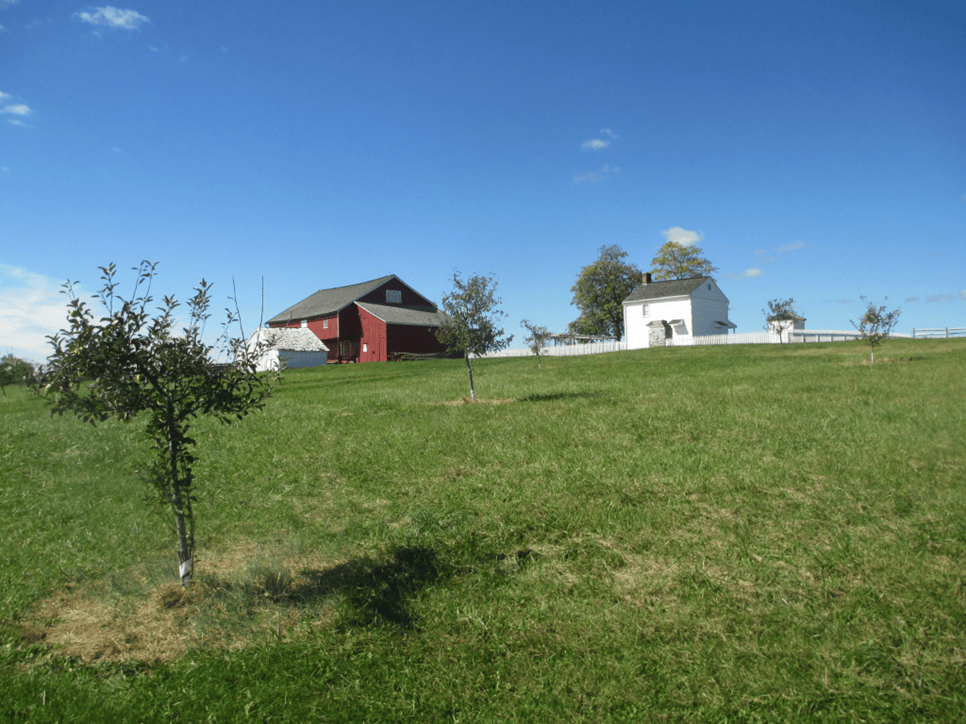
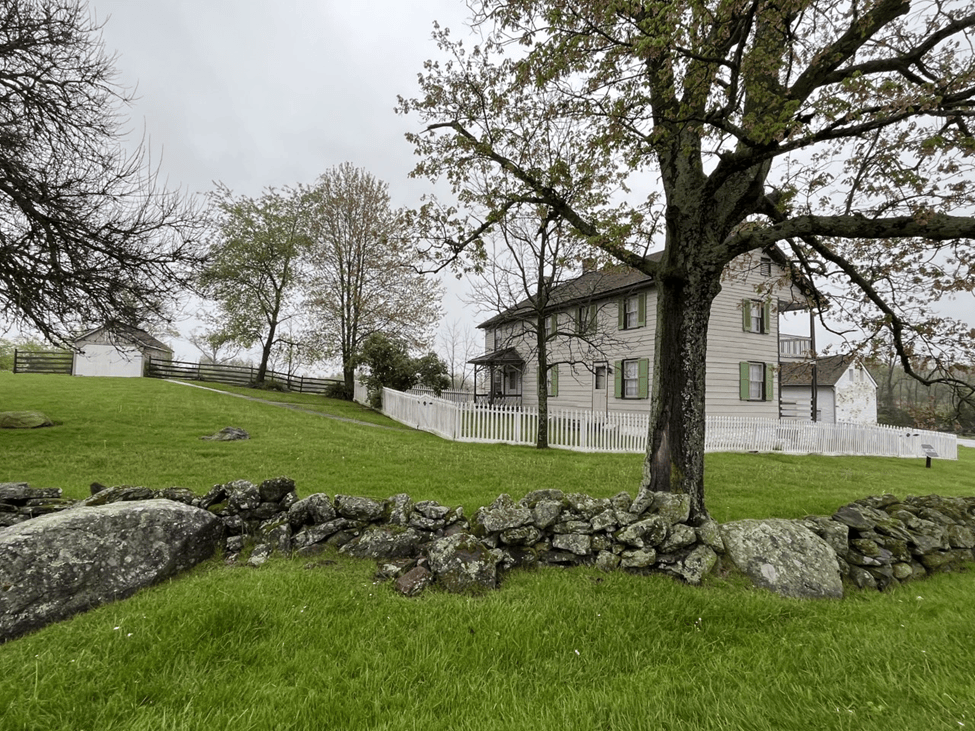
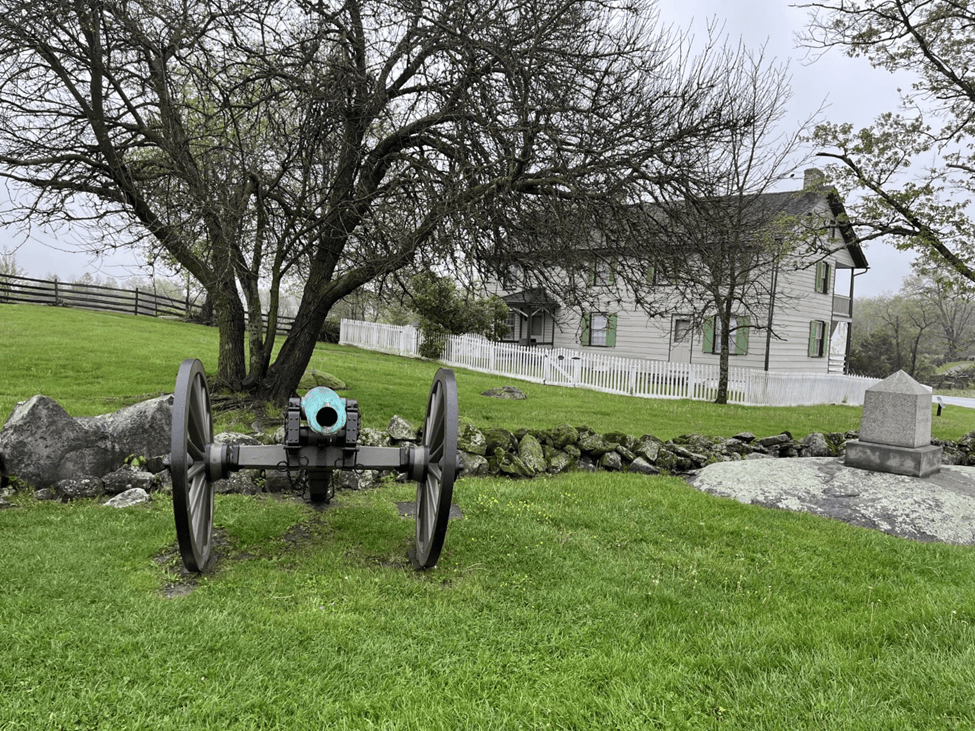
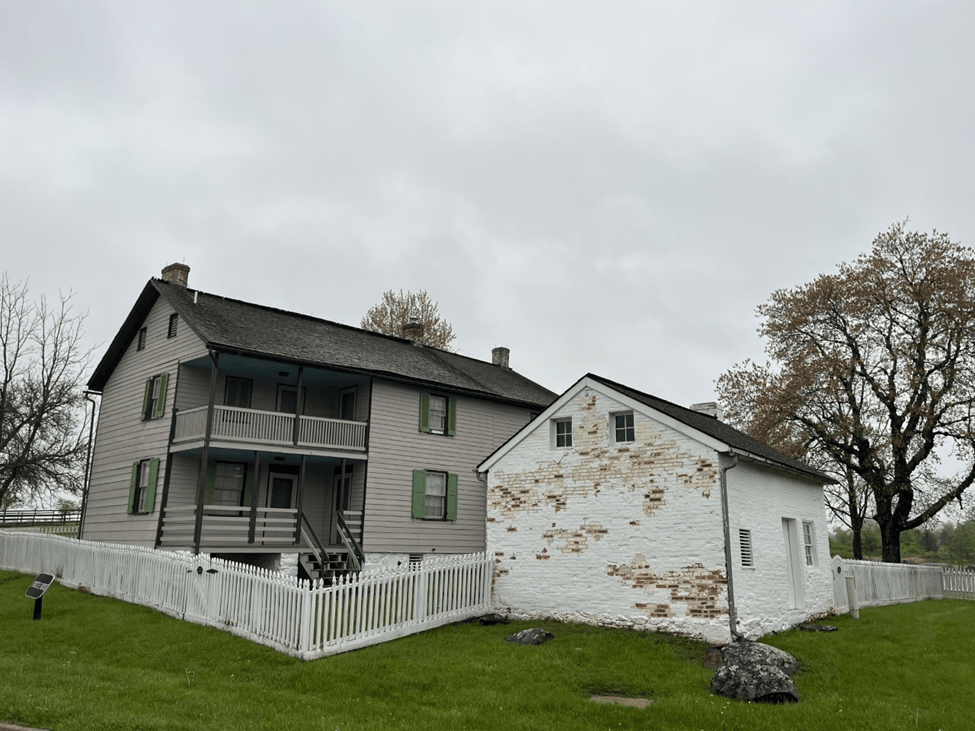
The Klingel farm house in Gettysburg, where the family rode out the first day of the battle.The rear of the Klingel farm from the perspective of Sickles Avenue. The Klingels fled this direction, towards the Trostle Farm, on the second day of the battle (photo credit https://www.agedwoods.com/wp-content/uploads/2017/11/IMG_3212.jpg)The nearby Trostle farm, which the Klingel family fled across, in the direction of Little Round Top on July 2nd.
By late June of 1863, alarms warning of approaching Confederate forces were nothing new for the 2,400 residents of Gettysburg. Living just ten miles from the Mason-Dixon line, small-scale raids, kidnappings of freed-people, and rumors of an imminent clash between the two great armies had long plagued the borough and its surrounding community. Nevertheless, none of these events could prepare Gettysburgians for the ferocious 3-day fight between 165,000 soldiers in early July of that year that would transform the lives and lands of Gettysburg’s civilians forever. However, these civilians’ experiences were not monolithic; while some were defined by tragedy and blight, others included remarkable episodes of perseverance, successful pragmatism, and creative profiteering. This blog series profiles the lives of diverse Gettysburgians who were forced to confront the war at their very doorsteps, each on their own terms, whose stories speak to the kaleidoscope of experiences of civilians struggling to survive, and thrive, along the Pennsylvania-Maryland border during the Civil War.
Abraham (Abram) Trostle was born between 1821 and 1822 to Peter and Sussanah Trostle in Straban, Pennsylvania. His parents belonged to the Christ Evangelical Lutheran Church. Abraham was the second oldest of their four children. Like his parents, Abraham eventually became a farmer, although most of the duties in running the farm eventually fell to his wife as he battled mental illness and alcoholism. Peter Trostle acquired what would later become the Trostle family farm in Gettysburg, Pennsylvania from David Troxell in 1839 through Troxell’s will. (The property came as payment for debts owed between Troxell and Trostle). He decided to keep both this new property and his own farm in Straban Township. Peter would later give the 144-acre Gettysburg farm to Abraham, who had moved there with his family at some point before the 1850 census. In addition to the land, which encompassed 144 acres just south of the borough, east of the Emmitsburg Road, the farm included a farmhouse, a barn, and a springhouse. The farm would be engulfed by intense combat on the 2nd day of battle, sustaining significant damage, but still standing and operable in the wake of the fight; the farm was a fitting symbol of its unflappable family matriarch, Catharine, who herself bore the heavy burdens and scars of an embattled marriage, and of the war fought on her very doorstep, but whose survival and ultimate success bespoke of a remarkable inner strength.
Abraham Trostle married Catharine Walter at Gettysburg’s St. James Lutheran Church on January 15, 1844. Later in their marriage, Catharine would feature as the head of the household for decades, defying typical gender roles of the time. They had eleven children together, of whom the following ten survived to adulthood: George, Lydia, Conrad, Mary, (Abraham) Isaiah, Margaret, Ephraim, Peter, Layton, and Sarah. According to the 1850 census, Daniel and Christian Sandy, who were respectively 16 and 11 years old, also lived on the farm with the Trostles and their young children. Both Sandy children reportedly had at least some schooling. Daniel worked as a laborer and was likely a farmhand. Christian did not have a listed occupation. Perhaps she helped Catharine with domestic work and caring for the other children. It is also possible that the Trostles took the Sandy children in as borders, especially if their family was undergoing financial hardship and could not support them at the time. Neighbors within the small community of Gettysburg often assisted each other, not just during the battle and its aftermath, but also as a part of daily life.
In 1859, Abraham found local infamy in the Adams Sentinel and General Advertiser. According to these two papers, the local court had found Abraham guilty for assaulting Edward Ziegler and ordered him to pay a $5.00 fine, as well as their court fees. While $5.00 was a significant amount of money, it was not necessarily a major financial burden on the Trostle family, whose real estate was valued at a modest but stable $5,200, and his personal estate at $1,500, just a few months later in the 1860 census. Instead, being brought to court for the assault would have proven far greater of a humiliation, as it negatively reflected on Abraham’s temperament and respectability. Further tarnishing the family name, he also began building a reputation for public drunkenness. Abraham was not the only man in town who had a proclivity for drink (others included James Leister and Joshua Thompson, the deceased husbands of the famed Lydia Leister and Mary Thompson). It is possible that Abraham resorted to drinking due to the stresses and struggles of balancing his farm and family’s financial well-being; however, if he struggled, the family still managed to remain rather well-off by then.
Later in his life, Abraham was diagnosed as having an (unidentified) mental illness. Perhaps he used alcohol to try to treat the symptoms of this mental illness that he struggled with. Regardless of the cause, Abraham’s drinking habits would have negatively reflected on both him and Catharine. Likely perceived by others as unable to properly care for his family and maintain a respectable and moral lifestyle, Abraham’s growing reputation put more pressure on Catharine to assume the duties of head of house, which in turn further contributed to Abraham’s sense of emasculation.
Interestingly, when Abraham’s father wrote out his original will, Peter Trostle initially left the Gettysburg property to Abraham, but later amended it in 1860. Instead, he decided that the farm was to be held in trust for Abraham, rather than Abraham actually inheriting it in his name. This noticeable change was likely due to Abraham’s growing reputation for vice. In effect, Catharine took control of running the farm as Abraham continued to become less able to do so. Such official legal responsibilities for the estate would have directly challenged the traditional gender roles that she had previously expected to fulfill in life. In addition to maintaining their home as a wife and mother, she became more responsible for finances and the overseeing of manual labor, which traditionally fell under the purview of men during the nineteenth century. While quickly teaching herself how to manage the family’s finances, Catharine also had to endure the deteriorating nature of their public reputation, which was crumbling under the weight of Abraham’s vices and the state of his household affairs; suddenly, it was Abraham who was dependent upon his wife, and not vice versa. Additionally, owning property was a key tenet of free labor ideology, which championed an individual’s ability to make his way up the rungs of the socio-economic ladder through hard work, moral living, and determination. By losing his land inheritance and the ability to own and operate property under his personal name, Abraham’s social status would have sunk even further in the community. Tragically, these developments likely created even more internal strife for Abraham, which certainly did not help his addiction.
During the weeks leading up to the Battle of Gettysburg, the Trostles had heard about the approaching Confederate army from a variety of sources. They saw posters calling for the local militia to defend their homes. They also received a warning from Governor Andrew Curtin and heard rumors from other locals about the approaching armies. On June 28, 1863, word arrived that a significant contingent of Confederates were looming just to the west of Gettysburg, in Chambersburg, Pennsylvania. According to Mary, one of the Trostle children, Catharine and George (one of Mary’s oldest siblings, who was eighteen years old at the time) made a plan to hide their horses and cows from the Confederates. They also put some of the family’s valuables in a bag that George buried somewhere in their apple orchard. Just as they were being inundated with the swirling rumors about the approaching Confederates, the Trostles likely also heard reports of the Confederates stealing or destroying civilians’ property. By burying their valuables, they hoped to hide them from the marauding enemy. Mary claimed that Abraham sometimes helped to execute these plans, but overall did not add much, as he was still fighting his mental illness. Given Abraham’s illness and relative incapacitation, it was even more necessary that the family preserve their valuables in case they needed to use them to support themselves in the wake of a battle.
Before the battle began on July 1, 1863, the Trostle family uneasily went about their chores to try to distract themselves from their worries. However, as the first sounds of gunfire began reverberating across the once pastoral fields to the north and west of town, Abraham grew restless. He grabbed a pistol and a musket and was just about to leave the farm to go find the Confederates when Catharine stopped him and pleaded with her husband, arguing that it would be better if he remained on their farm to defend both their property and their family. He may have wanted to fight to try to help re-prove his masculinity and restore his honor that he had lost when he lost his inheritance and property. Despite not being able to operate his farm, he could at least attempt to defend it and his family, thus somewhat boosting his reputation in the eyes of his peers. It is also possible that his mental illness may have contributed to his rash decision to fight. By having to step in to calm her husband down and convince him to come back inside, Catharine once more solidified her role as the de facto head of the household, once again reversing traditional gender roles in serving as the rational and cool-minded individual who was responsible for talking her irrational and emotion-driven husband off the ledge of madness.
Throughout the first day of battle, the Trostle family anxiously remained on their farm, which was thus far left unscathed. However, the sound of fighting and re-deploying soldiers became infinitely closer on the evening of the first as the broken Federal lines retreated to their stronghold atop Cemetery Hill, Confederate forces nipping at their heels all the way through town. The family must have become increasingly more anxious as the sounds of gun-fire drew closer to their home. It is also possible that Abraham became even more agitated as the battle closed in on their home, particularly after his earlier determination to defend his home. During the evening, more troops began amassing on both sides, with lines of gray and blue eventually stretching forth along both sides of the Emmitsburg Road, atop Cemetery Ridge and Seminary Ridge. It would not be long before their farm would become engulfed by combat.
On July 2, 1863, the Trostle family awoke to find Union soldiers positioned throughout their farm. Major General Daniel Sickles, commanding the Third Corps, had defied Major General George Meade’s orders to maintain his position along the rear high ground stretching through Little Round Top; instead, he moved part of his Corps from Little Round Top significantly forward to an advance ridgeline encompassing the Trostle, Sherfy, and Klingel farms to counter the possible advance of Confederate forces from Seminary Ridge across the Emmitsburg Road. As the day began, Catharine attempted to maintain a semblance of normalcy in the home, cooking dinner for her family. George hid a horse and a cow in the woods near their home. The family initially planned on hiding in their basement during the battle, but were later instructed to leave by a few Union soldiers that informed them of approaching Confederates.
Catharine and George leapt into action, George readying their wagon with a horse that he had kept on the farm, and Catharine collecting her other children. In a usual display of perhaps overconfident masculine bravado, Abraham declared that he intended to stay on the farm to help defend it against the enemy. George ultimately offered to stay with him (perhaps seeking to protect his unwell father as much as his property), so Catharine fled alone with her younger children. In a postwar account to her grandson, Mary later described her respect for her mother’s immense strength in that instant in which she bravely took sole charge of whisking her children to safety, despite crying upon leaving her home. As they pulled away in the wagon, en route to a relative’s house in Hanover, Catharine later noted to Mary that she caught sight of Union soldiers who were boldly sitting down to eat the dinner that she had just finished making. A flurry of emotions likely went through her mind at the sight. She was certainly upset about the battle coming literally over her doorstep and into the home she had worked so hard to maintain. She may have also felt a glimmer of pride in the knowledge that she had helped to feed the farm’s defenders who devoured the bread. As she left with the children, Catharine’s mind likely buzzed with worries and wonder as to what might happen to her husband and son, as well as their home. Would she ever see any of them again? And if so, in what condition? Once again, the traditional gender roles that Catharine had grown up with were being flipped. Rather than her husband rushing her and the children to safety, it fell to her to see her children out of the battle’s reach. Perhaps she had been somewhat prepared for this, after taking on the challenge of managing the farm years earlier while Abraham’s mental illness and alcoholism worsened. However, running a farm was very different from fleeing the destruction of battle and the devastation it had the potential to wreak on the home she had worked so hard to maintain.
Shortly after Catharine’s departure, the 5th and 9th Massachusetts Batteries moved into position on the Trostle Farm, the air riddled with shells. Colonel Freeman McGilvery had brought in the 9th Massachusetts, led by Captain John Bigelow, from Taneytown to help reinforce the Union lines. Bigelow complained about the lack of visibility at their location, as he was stationed within a swale that hid most of the action along the Emmitsburg Road and the Peach Orchard (where Sickles’s new “salient” pivoted) from sight; nevertheless, he was ordered to remain by the farm’s stonewall and await further orders. The fighting began around 4:00 PM and lasted for approximately three hours, with approximately 15,000 Confederates under James Longstreet’s division swinging out, en echelon, from right to left as they attempted to push the Union troops from the heights along Devil’s Den and Little Round Top, the Peach Orchard, and the Wheatfield—their sights set on the heart of Cemetery Ridge, near Cemetery Hill. The Confederates plowed through Sickles’s advanced line at the Peach Orchard and began driving the retreating Federals north and east, in the direction of the Trostle Farm and Cemetery Ridge.
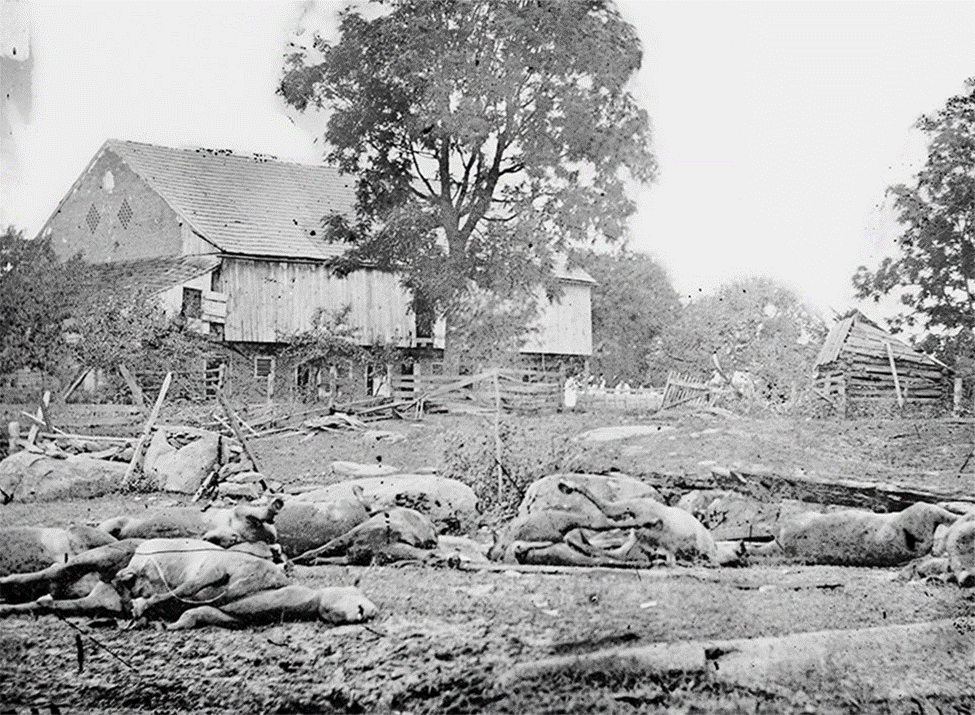
Bigelow commanded six cannons, although two of them experienced such violent after-fire recoiling against the stone wall that they were soon damaged beyond use. Bigelow ordered his men to take those cannons to the rear. As his subordinates attempted to roll the two cannons through the Trostles’ farm gate, the first cannon overturned, blocking the road and forcing the artillerists to maneuver the second cannon over the wall. Meanwhile, the 9th Massachusetts was under heavy shell fire from Confederates, who had seized control of the now-abandoned Union guns in the Peach Orchard, and were using them to deadly effect against Bigelow’s gunners. Bigleow himself was wounded in the fighting and fell from his horse. The 21st Mississippi, under Colonel D. B. Humphreys, surged forward and the farmyard dissolved into chaos as many men engaged in brutal hand-to-hand fighting, while still others desperately loaded and fired the remaining cannon into the onslaught of Rebels. Sensing defeat, Bigelow ordered a retreat and was guided to safety by Bugler Charles Reed, while five of his cannons were lost to the Mississippians. The 9th Massachusetts lost an estimated eighty of their eighty-eight horses at the Trostle farm, the mangled bodies of whom were later captured in post-battle photographs of the area.
Captain A. Judson Clark and New Jersey’s Battery B were also engaged in the fighting around the Trostle farm, posted on the front-left side of the property. They had arrived at their post early in the morning and held the position for several hours before eventually being shifted forward to try to stem the tide of Confederates advancing across the Emmitsburg Road, diagonally from the Trostle house.
Perhaps most notably, Major General Sickles himself came to observe the fighting at the Trostle farm during the three-hour afternoon onslaught. Setting up a “field headquarters” in front of the farm house, he commanded his troops from the field next to the Trostle barn. It was there that he was famously struck in the lower leg by a twelve-pound cannonball while sitting atop his horse. In an attempt to calm his subordinates who had witnessed the grievous wound, Sickles casually smoked a cigar as he was stretchered off the field; his leg would later be amputated and sent to the Army Medical Museum, and eventually to the Smithsonian for display.
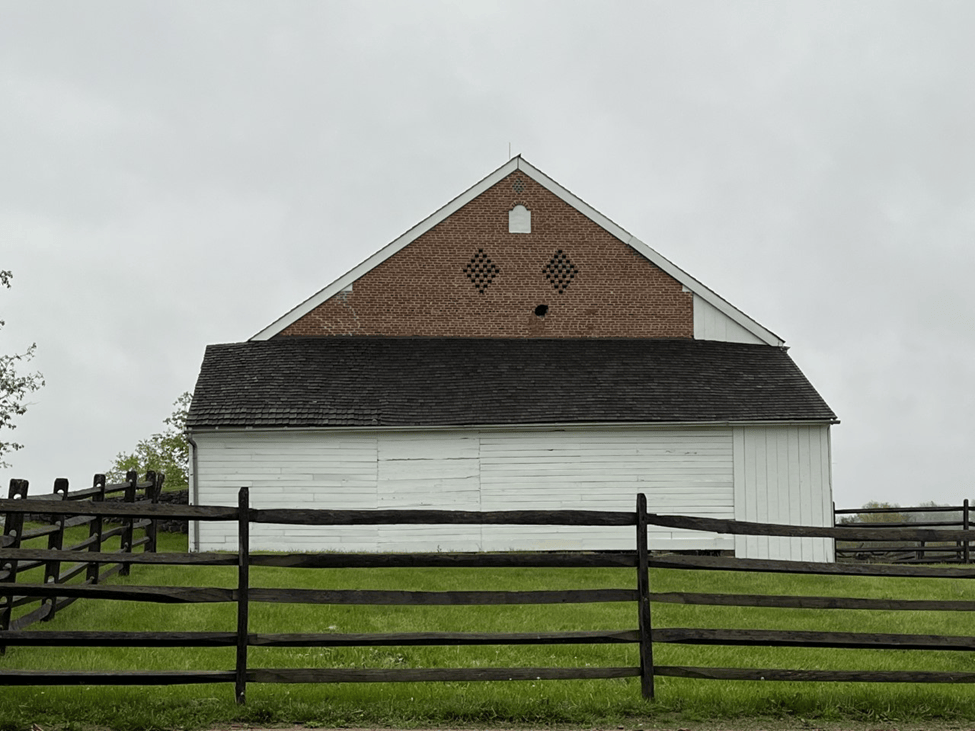
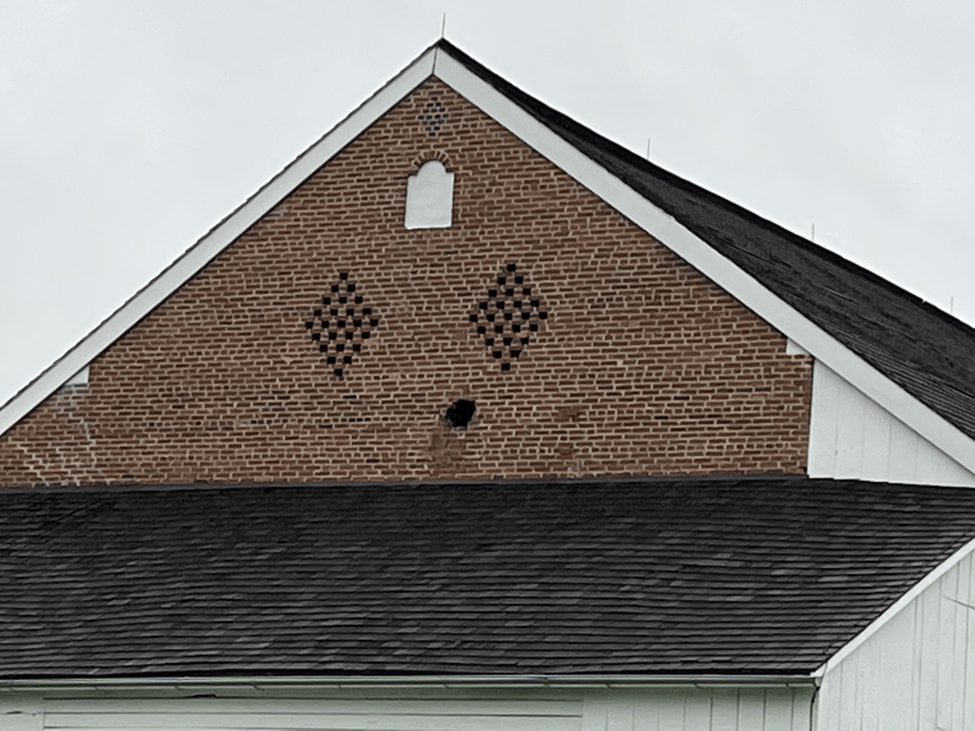
Like most other homes in the area, the Trostle farm became a field hospital after the fighting there ended on July 2nd. It would remain a hospital for the remainder of the battle and through July 4th, despite the renewal of Confederate advances bordering much of the Trostle property during the July 3rd famed “Pickett-Pettigrew” assault. Catharine and her children returned to the farm on July 6, 1863 to find complete carnage. Their yard was full of the dead—both soldiers and horses. Photographers such as Alexander Gardner were already there, documenting the scene. Additionally, their home was riddled with bullet holes and the brick barn wall bore a large hole from a cannon shell that had passed through it. Abraham and George rode out the entire battle in their home as bullets tore through the walls. They likely hid in the basement during the worst of the fighting. Despite Abraham’s intentions to protect the farm from the invaders, he was unable to save it, even with George there to help. The two of them did not stand much of a chance against the sheer destruction that could be caused by the armies. The battle delivered a devastating blow to the family’s precarious financial situation, especially as Abraham was not able to provide much help in the farm’s restoration. Aside from the bullet-riddled house and the barn that was hit by a cannonball, most of their crops were destroyed, and they were missing several necessary items like quilts, pillows, and timber. Approximately one hundred dead horses littered the farm, in addition to the dead and wounded soldiers that lay on the fields. After the battle, the family began to sort through the devastation and went to work tending to the wounded soldiers with the help of some of their neighbors, particularly the Walter family. Mary would go on to note that the already mentally ailing Abraham never really recovered from seeing the battle rage across his land in such a devastating manner.
Adding to their miseries on the farm, Peter Trostle passed away on September 11, 1863, and the property was officially listed in Catharine’s name in 1865. By then, Abraham was living in a sprawling asylum called the Harrisburg State Hospital. The hospital, which boasted seventy buildings and extensive agricultural fields to allow self-sufficiency in producing food for its inhabitants, was in operation from 1845 until 2006. Despite humane reforms to asylums in the mid-nineteenth century, they often remained institutions in which people were incarcerated for a variety of reasons without much differentiation as to their individual cases. People with mental illnesses, alcoholics, and even women whose husbands wished to divorce them, but could not, were collectively housed there. Abraham’s relocation to the Harrisburg State Hospital likely further diminished his family’s reputation amongst fellow Gettysburgians as asylums and mental illness as nineteenth-century society held a strong stigma against them. Due to Abraham’s now physical (and long-time mental) absence, most of the responsibilities of raising the Trostle children and both restoring and running the farm fell upon Catharine, further deepening the gender role-reversals that Catharine had continuously faced throughout her marriage to Abraham. By 1870, George had moved away from home, but his younger siblings were starting to come of an age where they could better assist Catharine on the farm and with restoring their battle-torn home. (Eventually, George would inherit the property after his parents’ deaths and would sell it to the federal government for $4,500 to help with the creation of Gettysburg National Military Park. Abraham passed away in 1877, with Catharine outliving him for a decade). However, in 1870, the Trostle children still at home ranged in age from a mere 10 to 17 years old; no doubt, the misfortunes plaguing their family forced them to grow up fast and abandon any shred of what may have once existed of their youthful innocence.
Years after the war, in 1875, Catharine filed a claim for $3,094.50 with the federal government on Abraham’s behalf for help covering the damages to their farm. (For perspective, the 1860 census had recorded the combined real estate and personal estate value of Abraham and the farm to be $6,700. The family lost almost half of their assets in the battle). She claimed that the damages were caused by Union soldiers, but, as was the common response to many Gettysburgians who filed damage claims, claims agent, Major George Bell replied that the inflictors of the damage could not be proved; thus, Catharine’s claim was denied. Her claim had included 16 tons of hay, 20 tons of wheat, 10 acres of oats, 10 acres of corn, 12 acres of grasses, garden vegetables, 2 quilts, 2 pillows, 2 pairs of shoes, 7 yards of carpet, 1 featherbed, 1 bridle, 20 posts, 1 saddle, 20 acres of timber, 4 cords per acre, and the use of their buildings for hospitals. Even worse, the family was never able to recover the bag of valuables that George had buried in the apple orchard. Perhaps they had somehow been uncovered amidst the shot and shell that ploughed up the land and an unsuspecting soldier happened across them in the midst of battle. Alternately, George may have simply forgotten where he buried the bag.
With Abraham’s mental health only continuing to decline in the asylum, and her damage claim rejected, the future of the farm and of the Trostle family lay largely in Catharine’s hands, as well as those of her children. They ultimately decided to leave the cannonball hole in the barn wall; perhaps it proved too difficult to remove without incurring additional damage, or perhaps it was a testament to the historic battle that their farm and family had borne witness to—and had managed to survive. In many ways, the still extant hole from that cannonball, which has since become an iconic tourist attraction for visitors to the battlefield, speaks to the larger story and spirit of Catharine Trostle and her brood—a silent reminder of the tragedy and unmendable damage inflicted on the family by both Abraham’s mental illness and the battle, but a wound that ultimately was unable to defeat the tenacious and unflappable woman at the head of the house.
The rear of the Trostle house and the stone wall that was defended by Captain Bigelow’s six cannons on July 2nd.The front of the Trostle farm house and its springhouse.A side view of the Trostle barn, with the cannonball hole from the battle that Catharine ultimately left in the wall.A closer view of the cannonball hole in the Trostle barn.The land between the Trostle barn and farmhouse, littered with dead horses after the battle (courtesy of the NPS)
By late June of 1863, alarms warning of approaching Confederate forces were nothing new for the 2,400 residents of Gettysburg. Living just ten miles from the Mason-Dixon line, small-scale raids, kidnappings of freed-people, and rumors of an imminent clash between the two great armies had long plagued the borough and its surrounding community. Nevertheless, none of these events could prepare Gettysburgians for the ferocious 3-day fight between 165,000 soldiers in early July of that year that would transform the lives and lands of Gettysburg’s civilians forever. However, these civilians’ experiences were not monolithic; while some were defined by tragedy and blight, others included remarkable episodes of perseverance, successful pragmatism, and creative profiteering. This blog series profiles the lives of diverse Gettysburgians who were forced to confront the war at their very doorsteps, each on their own terms, whose stories speak to the kaleidoscope of experiences of civilians struggling to survive, and thrive, along the Pennsylvania-Maryland border during the Civil War.
Caroline Sheads in later life, date unknown (photo courtesy of the Adams County Historical Society)
While Caroline “Carrie” S. Sheads remarked that she felt like “a coward before” the Battle of Gettysburg, her actions showed that she was a brave soul, willingly placing herself in danger to help others. As the head of a girls’ school, Oakridge Seminary, Carrie Sheads kept her students calm under fire and duress. With four brothers in the Union army, she knew the call of patriotism and sacrifice, and likely wished that she could fulfill a greater role for the Union cause. On July 1, 1863, she demonstrated her strength as a leader and her moral and physical courage in the midst of chaos.
Carrie Sheads was born in Pennsylvania around 1836 to Elias and Mary McBride Sheads. As the third-born of seven children, Carrie likely learned, early-on, how to care for her younger siblings and assumed a leadership role that would serve her well in later years as the seminary principal. She and her siblings attended school in the Gettysburg area, and their parents knew the importance of education for their young daughters and sons. Carrie would later emphasize the importance of education for her young female pupils, perhaps hoping for better opportunities for these girls to leave their mark on the world. It appears that by 1860, Carrie and her older sister, Elizabeth were working as instructors of French and English, respectively, for the Hey family in York, Pennsylvania. John Hey was a well-to-do member of the Methodist Episcopal clergy and had apparently hired the two sisters to instruct his young daughter, Mary. Although the data for the 1860 census in York places Carrie’s birth around 1840, it seems certain that this was the same person.
At some point between June 1860 and 1862, Carrie began making plans to establish her own school for girls out of her home. By March 1862, her father had finished a new home for the family, a 12-room house at present-day 331 Buford Avenue (historically known as the Chambersburg Pike). The home would be spacious enough for all of the children, but would also leave room for other boarders. Carrie likely convinced her father to use the additional space to instruct and house young women, which brought in additional money for the family. Her father, Elias, was a wheel-maker in 1850. Although the 1850 census did not record the value of his wealth, apparently he accumulated enough savings over the years to build this large house. Carrie’s father obviously believed in the value of education for his daughters if he had sent them to school to become well-versed in French and other subjects. He must have been proud of Carrie’s achievements and wanted other girls to have the same opportunities. John Hey was wealthy (his real estate had an estimated value of $22,000) and likely paid Carrie and her sister a decent salary, allowing them to save some money and build up a reputation to start their own school. Perhaps it was Carrie’s prior instruction of Hey’s daughter that ultimately inspired her to become a leader and teacher for a larger group of young girls. Her school drew young women from the local area as well as from dozens of miles away in Maryland.
The Carrie Sheads house, finished in 1862. Photo courtesy of Gettysburg Daily
As rumors of the approaching armies spread in late June 1863, students and teacher alike must have felt the uncertainty that lay ahead. On June 30, Carrie decided to give her students the day off. Did she believe that they would be safer at home? Or did she think they simply needed a break that day? At least one girl stayed home on July 1 as well, her family frightened for her safety. Why would Carrie decide to hold instruction on July 1? John Buford’s Union cavalry held the ground close by. Did she feel more at ease with their presence, or did she wish to try to maintain normalcy and calm amidst the anxieties and upsets of the war at her doorstep? Whatever her intentions may have been, the girls would soon find themselves in the midst of the conflict.
Shots rang out at 7:30 A.M. How might Carrie’s students have reacted to the sound of those first shots? What thoughts ran through Carrie’s head, who must have felt as scared as the students but could not let her face betray her fears? The safety of her pupils undoubtedly weighed heavily on her mind. Surely, the students must have tried to seek some kind of shelter within the house as artillery fire raged around them. At least two shells passed through the house, likely prompting the students to shudder and fear for their lives. The students must have wondered: Were their families safe? Were their homes still standing? How much longer would the shelling and rifle fire continue? As these thoughts and others swirled through their heads, the U.S. First Corps battled to hold their position just up the road, along Seminary Ridge that morning. By late afternoon, U.S. forces started to fall back from Seminary Ridge, and the wounded arrived on Carrie’s very doorstep.
The arrival of Confederates swiftly followed the appearance of wounded Union men. As Carrie struggled to maintain order in the chaos, a Union officer ran in. As Carrie herself remembered, Colonel Charles Wheelock of the 97th New York was “a very large man” who “could scarcely breathe,” with a Confederate officer following him in pursuit. The Confederate officer ordered Wheelock to give up his sword. However, giving up one’s sword if options to escape or fight on still existed was akin to losing one’s honor and dignity. For soldiers of the Civil War, Victorian notions about martial masculinity dictated that men must uphold their honor—and by extension, their swords—in the face of the enemy unless faced with threat of death. Wheelock refused, trying at first to break his sword, without success. Although he knew he would have to surrender, Wheelock bitterly mocked the officer, insisting, “If I had my men here, you could not take me.” In fact, by one account, Wheelock directly challenged the enemy officer’s moral courage and challenged the man’s sense of personal honor, opening his jacket and daring the Confederate, who had drawn his revolver, to shoot him.
Colonel Charles Wheelock (courtesy of Find a Grave)
As Wheelock protested, the Confederate officer’s patience was quickly dwindling. Carrie recognized that both men were unwilling to budge and that Wheelock’s life was truly in danger. Although accounts and retellings differ, it appears that initially, Carrie’s father used his middle-aged wisdom and fatherly stature to intervene in the two officers’ stand-off. Mr. Sheads was immediately shoved out of the way, and the Confederate officer took aim once again at Wheelock. In this moment, Carrie herself stepped in, putting herself in direct danger to protect the colonel. What possessed her to drop the gendered conventions of the time period that called for feminine passivity and withdrawal from instances of dangerous conflict, and instead place herself in between the two angry men? What thoughts went through her head as she suddenly became the protector of a male soldier who himself was supposed to be the protector of the homes, health, and livelihood of the Union? Was she thinking of her four brothers on the front lines? She reproached the Confederate officer, buying time as she thought of a way to spare Wheelock’s life. As she tried to persuade the men to come to an agreement and prevent further bloodshed, more Union prisoners crowded the breakfast room of the house.
With the Confederate officer now distracted, Carrie made a decision. Turning to Wheelock, she once more urged him to surrender, but pledged to save his sword, the sacred symbol of his honor. Wheelock passed his sword to her, and she smuggled it out of the Confederate’s view, hiding it in the folds of her dress. Feeling the sting of surrender, Wheelock promised Carrie that he would return for it. When the Confederate officer again demanded the sword from Wheelock, Wheelock showed his empty hands and claimed that another Union soldier had taken it. Although Carrie had helped end a dangerous stand-off, she was still incensed over the incident, and lamented the fact that he, along with scores of other brave Union men, was forced to surrender: “It was a sad sight to see them take that grey headed veteran,” she bemoaned several months later for the National Republican, a newspaper in Washington D.C.
However, once she was alone in the room with the wounded Union veterans, she revealed that the colonel’s sword was safe with her. They were overjoyed. “You should have seen the pleasure which it gave those wounded patriots (for the room was filled with them) to see their colonel’s sword safe,” she wrote. “One of them, in the midst of his sufferings, sent some one to inquire if it was safe.” To these soldiers, the loss of their commander’s sword would have been a harsh blow. The sword represented their honor, and their bravery as well. If their commander were to lose their sword, they would, collectively, feel the loss deeply. Certain symbols meant the world to these men. A man’s firearms, his sword, and the regimental colors were all sacred objects that could not be surrendered unless under threat of death. Although they were now prisoners, they still had their colonel’s sword, which was one small victory that in turn had preserved their honor; with Carrie’s intervention, the colonel also still had his life.
Like many buildings and homes in Gettysburg, Carrie’s house was converted into a makeshift hospital for about 72 Union and Confederate wounded men. According to one newspaper account, some soldiers scrawled their initials on the windowpanes, no doubt to the family’s horror upon their discovery of the graffiti. Their house remained in Confederate hands from the evening of July 1 until the Confederates’ retreat on July 4. One wonders why this close call with combat did not send the Sheads fleeing for their lives. Did they feel compelled to stay in order to protect their property? Carrie’s pupils? The Union wounded? One also wonders what other interactions the Sheads had with the Confederate soldiers during the battle. How did Carrie respond to the soldiers who may have previously fought her brothers on prior battlefields? For her family, the presence of the enemy in their own home was thus deeply personal. The Sheads undoubtedly resented that enemy troops had occupied their formerly pristine house, but little could be done to change their new reality. Thus, Carrie tried to focus her energies on tending to the wounded, directing her students in helping to nurse and care for them.
The battle damage to the house, combined with the structure’s use as a hospital, forever changed the newly built home, leaving pockmarks, bloodied sheets and floorboards, and trampled crops in the battle’s wake. Years later, Carrie’s father filed a claim with the federal government for damages. Though the house was under Confederate occupation, he tried to woo claim agents by stressing that the home had sheltered Union troops, and that much of the damage to the house was due to its use as a hospital to treat federal troops, writing, “My house was filled with wounded Union soldiers.” The house had suffered significant damage, while artillery and rifle fire had shredded “the fences, wheat, trees, and shrubbery” surrounding the house. While the date remains unclear as to when he filed the claim, it was not until 1881 that Mr. Sheads to receive any compensation in the form of a mere $180.00 in response to his family’s sacrifices and suffering.
The house still shows signs of damage from the battle. Note the artillery shell by the window (courtesy of Gettysburg Daily).
Fortunately, on July 6, Colonel Wheelock returned, much to Carrie’s and his soldiers’ delight. Although he could not walk, he somehow managed to “roll away” from the Confederate soldiers, escaping near the Maryland border. Wheelock’s return likely bolstered his wounded men’s spirits: The brave leader of the 97th New York had returned as he had promised, and Carrie dutifully returned his sword to him.
Reflecting back on her part in the battle, Carrie wrote that “every vestige of fear” that she had felt earlier, “had vanished,” replaced by a determination to do her duty to the Union army and maintain calm in the midst of danger. She had steeled herself for the chaos ahead, drawing upon her hatred for the Confederate army and her devotion to the Union. She felt “ready to meet the whole rebel army,” she wrote, likely thinking of her brothers in Union blue, fighting the same enemy. As with many women in the war, she likely had felt frustrated, earlier in the war, that she could do so little to directly fight the Confederate army while her brothers were on the front lines, risking their lives. Now she had helped save one Union officer’s life and those of countless others whose wounds she had looked after during her house’s tenure as a temporary hospital.
Carrie’s bravery was widely recognized after the battle, her story making national headlines in newspapers like the National Republican. One wonders how her brothers on the front lines reacted to the story of her courage. Pennsylvania Congressman Thaddeus Stevens was so impressed by her story that he recommended her for an appointment as a clerk in the Treasury Department in Washington, D.C., a position she accepted. Her sister, Elizabeth, was also recommended for and accepted a federal position in Washington, D.C. for her work during the battle. Despite their socio-economic success, tragedy wrecked Carrie’s family. Two of her brothers were killed in the war, and the other two were severely wounded, bringing great grief and hardship to Carrie and her family. According to one 1867 account, “the severe exertion necessary for the care of so large a number of wounded [at Gettysburg], for so long a period, resulted in the permanent injury of Miss Sheads’ health, and she has been since that time an invalid.” Although this account offers no further description of Carrie’s condition, one wonders whether the loss of her brothers exacerbated her struggles with her poor health, if this account is true. Carrie died at a relatively early age, passing away in February 1884, at only about forty-seven or forty-eight years old. Although the cause of her death is unknown, if she suffered from mental or physical disabilities because of the war, they likely contributed to her premature death.
Burial site of Carrie S. Sheads in Evergreen Cemetery, Gettysburg (courtesy of Find a Grave).
Carrie’s bravery and her actions made her a national hero. While she helped save one Union officer’s life and the lives of many wounded men, in addition to caring for her marooned pupils under fire, she sacrificed her own health in doing so. In a time of danger and bloodshed when she easily could have fled the chaos along with many of her neighbors, she instead chose to remain, and stood strong as a calm, courageous leader, defying Confederates in her own home. Though a model both of “republican womanhood” in her support of her brothers fighting on the front lines and of Victorian female domesticity in her care for her younger siblings and her pupils, Carrie was also able to instantaneously think and act outside the traditional gender roles of her time when circumstances necessitated it, and she successfully transformed herself into a protective emblem of patriotic duty and unlikely defiance in the heat of combat. Her story shows that the line between the home front and battlefield was often blurred, and that, both at Gettysburg and beyond, many civilian women like Carrie willingly put themselves in harm’s way to mediate conflict and suffering, and to do their part to save the Union.
Works Referenced
Bennett, Joan Cleary. “Women and the Battle of Gettysburg.” Hood College, May 1988. Document courtesy of Adams County Historical Society.
“Caroline Sheads.” Ancestry.com. 1850 United States Federal Census, Gettysburg, Adams, Pennsylvania [database on-line]. Lehi, UT, USA: Ancestry.com Operations, Inc., 2009.
“Carrie Sheads.” Ancestry.com. 1860 United States Federal Census, York Division 1, York, Pennsylvania [database on-line]. Provo, UT, USA: Ancestry.com Operations, Inc., 2009.
Duttera, Sharon. “Seminary Principal Saved Life of Union Officer with Quick Thinking.” The Gettysburg Times. August 20, 1983. Document courtesy of Adams County Historical Society.
“Scenes of the Battle of Gettysburg: A Model School for Young Ladies.” National Republican, Washington, D.C. November 28, 1863. Document courtesy of Adams County Historical Society.
By late June of 1863, alarms warning of approaching Confederate forces were nothing new for the 2,400 residents of Gettysburg. Living just ten miles from the Mason-Dixon line, small-scale raids, kidnappings of freed-people, and rumors of an imminent clash between the two great armies had long plagued the borough and its surrounding community. Nevertheless, none of these events could prepare Gettysburgians for the ferocious 3-day fight between 165,000 soldiers in early July of that year that would transform the lives and lands of Gettysburg’s civilians forever. However, these civilians’ experiences were not monolithic; while some were defined by tragedy and blight, others included remarkable episodes of perseverance, successful pragmatism, and creative profiteering. This blog series profiles the lives of diverse Gettysburgians who were forced to confront the war at their very doorsteps, each on their own terms, whose stories speak to the kaleidoscope of experiences of civilians struggling to survive, and thrive, along the Pennsylvania-Maryland border during the Civil War.
The Slyder house and outbuildings, alongside the monument to Vermont Companies E and H of the 2nd United States Sharpshooters. Photo credit: “Barns of the Civil War: John Slyder,” AgedWoods, posted July 20, 2017, https://www.agedwoods.com/barns-civil-war-john-slyder/” https://www.agedwoods.com/barns-civil-war-john-slyder/
Upon their return after the battle, John and Catherine Slyder must have looked despairingly upon their farm that they had called home for over a decade. A place where they had watched their children grow, a home that they had marked with their initials as their own, now lay in ruin from the destruction of war. As with many other families in Gettysburg, faced with harsh decisions to rebuild or move elsewhere, they chose to move on, selling most of their possessions and heading west to Ohio in search of a new start.
John and his wife, Catherine Study Slyder were Maryland natives and possibly moved to Gettysburg as early as 1840.[1] They attended St. James Lutheran Church in Gettysburg, celebrating their son’s baptism in 1844. They had five children in all, but by the time of the battle, likely only three children remained in the house: John D. (age 19), Hannah (16), and Isaiah (9). John and Catherine made sure that their children attended school in Gettysburg. Catherine is marked in the 1860 census as illiterate, although she is not marked as illiterate in other census data. Regardless, she still impressed upon her children the importance of education.
[1] His daughter, Matilda, was born in 1840 (age 10 in 1850 census) in Pennsylvania. The eldest son, William, was born in 1836 in Maryland.
St. James Lutheran Church in Gettysburg. Photo credit: “St. James Lutheran Church,” posted May 25, 2009, https://www.waymarking.com/waymarks/WM6FAB
In 1849, John and Catherine saw an opportunity to further themselves as independent farmers. They poured their savings into the purchase of seventy-four acres at the foot of Big Round Top. In the next year or so, they also bought another thirteen acres on the Taneytown Road. It remains unclear how much John built himself or what structures already existed on the property in 1849. In 1852, one of their sons, William, etched his initials into the two-story stone house, forever marking it as the Slyders’ home. Perhaps the house had been finished in that year. In 1850, John only had about $1,600 worth in real estate, worth about $57,000 in 2022, a modest but meager amount. He likely had to start from the ground up to establish himself as a successful farmer.
By 1860, the Slyders’ investment in their farm had played out well. Census records estimate their real estate value at $2,000 and personal estate at $800. Agricultural census data reveals their success at an even better scale: The census taker evaluated the farm’s worth at $2,500, noting that about half of the eighty-eight acres were improved and used for various purposes. They raised plenty of animals, including two horses, five dairy cows, four cattle, and sixteen pigs. They harvested multiple crops including oats, wheat, corn, potatoes, and sweet potatoes, and they picked pears and peaches from their orchard. They also built a barn, kitchen, and other structures to keep the farm and house running. No doubt the family looked upon their farm with pride, knowing that their hard labor and persistence had paid off. They likely felt assured that they had a future in Gettysburg if they kept the farm in good order and continued their hard work.
In June 1863, when news of the approaching armies became harder to ignore, the Slyders, like other Gettysburg residents, grew apprehensive. Just as they pondered their options, Union troops arrived at their very door, advising them to leave before any fighting began. The family scrambled to get a few things together, likely taking food for the journey and their valuables with them. No doubt that many thoughts about their home and their safety flashed through their minds as they wondered where to go and who to turn to. Perhaps they, as parishioners of St. James, took this moment to pray for their safety, drawing strength from their faith. Their property soon turned into a Union sharpshooters’ nest on July 2 when the skilled marksmen took refuge in the Slyders’ buildings. All too quickly, the once pastoral homestead and embodiment of a hopeful future turned into a sinister hotbed of well-executed killing. Companies E and H of the 2nd U.S. Sharpshooters slowed Hood’s Texas Brigade and Robertson’s Confederate division, of Longstreet’s Corps, as the Confederates picked their way across the rolling, boulder-strew ground up to the hotbeds of fighting along Devil’s Den and Little Round Top. Fighting also took place around the Slyder farm the next day. Union Brigadier General Elon Farnsworth led cavalry in an ill-fated charge against Confederates in the area. By the end of the battle, eighteen Confederates and three Union soldiers were laid to rest in the Slyders’ ground.[2]
[2] NPS files say three US soldiers, but historian Gregory Coco says five. On Stone Sentinels, it says that the 2nd USSS lost 5 men.
Returning home and confronted with the appalling destruction along their now blood-soaked ground, the Slyders must have raised their hands in despair. What were their options? Should they bother to rebuild? How much money should they invest in their devastated property? What did their future look like if they stayed in Gettysburg? They had suffered at least an estimated $800 worth in damage, valued at almost $18,000 in 2022. Their real estate had been valued at $2,000 in 1860, and so the cost of the damages weighed heavily upon the family. The family’s 1868 claim later emphasized the valuable livestock they had lost—cows, hogs, chickens (thirty of them)—as well as the damage to their crops and their home furnishings. In 1860, their livestock had been valued at $360. The loss of these important animals and the significant damage to their home and land played significantly into the Slyders’ decision to move elsewhere in hopes of a better future.
By October of 1863, the family decided to sell most of their possessions in a public sale—a rather degrading practice in and of itself—and left the bulk of their life and personal history behind them. They emphasized the sale of their remaining livestock as “first-rate” and “valuable,” likely hoping to use the money towards their future in Ohio. A newspaper advertisement in Gettysburg Compiler includes a long list of items for sale, ranging from wagons to farm equipment and tools to stoves to sinks. One gets the impression that it was an “everything-must-go” type of sale. Despite this heart-wrenching sale of nearly all the tools and fruits of their free labor dreams, the Slyders likely did not want to overburden themselves with bulky items on their journey and wanted to get rid of their physical baggage, as well as their mental anguish, that had been attached to the house. It was only shortly after the sale that they moved west, placing their faith in the belief that they could somehow do it all again from scratch.
The family chose to move to Johnsville (now New Lebanon), a small town just outside Dayton in southwest Ohio, although it remains unclear what attachments they had to the area. Did they know anyone in the area? Did they have relatives? Or did they find it to be good farming land? The 1870 census lists John Slyder as a “retired merchant” with $1,400 real estate and $2,730 of personal estate. He had recovered enough money to make ends meet and retire, although it is unclear of the details of his employment and recovery after Gettysburg. In 1868, he filed a damage claim, seeking compensation for the heavy losses the family had sustained. However, there was some pushback from the government, which mistakenly recorded him as merely a tenant of the farm and not the owner. The result must have deeply frustrated and aggrieved Slyder, who, like so many others, had unfairly fallen victim to the bureaucratic, error-ridden process.
In 1873, John Slyder died in Johnsville. Determined to receive some sort of compensation, Catherine continued the damage claim process, although without success. The claim was disallowed by the government in 1877, the same year that the Slyders’ house supposedly sold. Before this time, Catherine’s brother supposedly rented the house from time to time; however, the burden of upkeep and taxes on the property sure placed a significant strain on the Slyder family. While the Slyders managed to rebuild a future in a new state, they surely looked back upon Gettysburg with anguish and frustration; yet even in their personal loss, they could still take comfort in knowing that their fortunes were inextricably bound to a great victory in their nation’s history. They had sacrificed their modest farm and home for the Union.
Works Referenced
2-12 a Slyder Farm History, Structures, Etc., Vertical Files, Civilian Battlefield Files, Courtesy of Gettysburg National Military Park.
Coco, Gregory A. A Strange and Blighted Land, Gettysburg: The Aftermath of a Battle. Gettysburg: Thomas Publications, 1995.
“Farm Field to Battlefield.” National Park Service wayside interpretative marker.
Hawks, Steve A. “Battle of Gettysburg: Vermont Sharpshooters, Companies E & H.” Stone Sentinels. https://gettysburg.stonesentinels.com/union-monuments/vermont/vermont-sharpshooters-companies-e-h/. Accessed February 27, 2022.
“John Slyder.” Ancestry.com. 1850 United States Federal Censusfor Gettysburg, Adams,Pennsylvania [database on-line]. Lehi, UT, USA: Ancestry.com Operations, Inc., 2009.
“John Slyder.” Ancestry.com. 1860 United States Federal Censusfor Cumberland, Adams,Pennsylvania [database on-line]. Provo, UT, USA: Ancestry.com Operations, Inc., 2009.
“John Slyder.” Ancestry.com. 1870 United States Federal Censusfor Jackson, Montgomery,Ohio [database on-line]. Provo, UT, USA: Ancestry.com Operations, Inc., 2009.
“John Slyder.” Ancestry.com. Pennsylvania and New Jersey, U.S., Church and Town Records,1669-2013 [database on-line]. Lehi, UT, USA: Ancestry.com Operations, Inc., 2011. HistoricalSociety of Pennsylvania; Philadelphia, Pennsylvania; Historic Pennsylvania Church and Town Records; Reel: 671.
By late June of 1863, alarms warning of approaching Confederate forces were nothing new for the 2,400 residents of Gettysburg. Living just ten miles from the Mason-Dixon line, small-scale raids, kidnappings of freed-people, and rumors of an imminent clash between the two great armies had long plagued the borough and its surrounding community. Nevertheless, none of these events could prepare Gettysburgians for the ferocious 3-day fight between 165,000 soldiers in early July of that year that would transform the lives and lands of Gettysburg’s civilians forever. However, these civilians’ experiences were not monolithic; while some were defined by tragedy and blight, others included remarkable episodes of perseverance, successful pragmatism, and creative profiteering. This blog series profiles the lives of diverse Gettysburgians who were forced to confront the war at their very doorsteps, each on their own terms, whose stories speak to the kaleidoscope of experiences of civilians struggling to survive, and thrive, along the Pennsylvania-Maryland border during the Civil War.
One of the leading Democratic voices and most influential figures in the greater Gettysburg community, John Swope grew up in a wealthy family and received an excellent education, which he used to start his own lucrative medical practice. The privileges afforded to him by his youth, along with sheer luck, helped him to emerge relatively unscathed from the Battle of Gettysburg in comparison to many of his neighbors, allowing him access to several unique opportunities in the following years.
John Swope was born on December 25, 1827 in Gettysburg, Pennsylvania to George and Margaret Swope. John would be their only child. George Swope worked in Gettysburg as a dry goods merchant when John was born, but was elected President of the Gettysburg Bank in 1849, following the retirement of Margaret’s wealthy father, George Smyser, from the position. In 1850, George’s real estate was valued at $5,000; thus, not only did familial connections earn him a leadership position at the bank, but he also had reasonable wealth in his own right to justify such distinction. George embodied the free labor ideology dream, working his way up to the status of a merchant, and eventually accumulating enough wealth to purchase his own house and farm, which tenants maintained. His son would, in many ways, follow in his father’s footsteps, but ultimately come to leave an even larger political footprint upon not only the town, but also the nation.
George helped the Gettysburg Bank transition into the highly successful Gettysburg National Bank. He also served as the President and Director of The Gettysburg Railroad Company, Gettysburg Water Company, The Adams County Mutual Fire Insurance Company, and the Gettysburg and Petersburg Turnpike Company—positions which assured the Swope family’s influence over some of the most significant civic organizations in the borough. The small family moved into a newly constructed, two-story brick house at the corner of York and North Stratton Streets in 1836. The property also came with a stable, a well, and a two-acre plot of land outside of town where the Swopes would also have a small farm. This land purchase made George Swope a success in the eyes of free labor ideology proponents who would celebrate him for earning these successes through hard work and the pursuit of moral living (while likely disregarding the connections with George Smyser that helped smooth his path).
John Swope was used to sharing his family’s home with individuals from outside his nuclear family throughout his life. His grandfather, Judge Smyser, sister-in-law, Bessie L. Mile, and niece, Blanche Klinger all lived with him for varying blocks of time. Additionally, many servants also occupied the house, ensuring that the Swopes would always live in comfort. Once the top half-story was added on in 1860, the servants began living on that floor, and even had their own staircase down into the kitchen.
John boasted a highly respectable educational pedigree that set him up well for success, prosperity, and influence later in his life. He initially enrolled in Pennsylvania College in 1842, where he studied until 1844. He then transferred to Princeton University to complete his undergraduate degree, and eventually continued on to earn his M.D. from the University of Pennsylvania. His doctoral program consisted of classes that were held four months a year for two years. His degree certified him to work as both a doctor and a dentist. After graduating, Swope opened a lucrative practice in Hanover, where he worked as a physician. Hanover was the original home of George Swope, so John likely still had connections to that community.
In October of 1849, Swope married Emma Wirt, who was from Hanover. They had four children together (three of whom survived to adulthood) before her death in 1862. They began their marriage living temporarily with George and Margaret in Gettysburg before moving, in 1850, to Frederick Street in Hanover, next to the home of Emma’s father. Despite living in Hanover, John served as the Director of Gettysburg National Bank from 1852 through 1857 (his father’s post undoubtedly contributing to his appointment there).
Tragedy struck the young family in 1860 when their daughter, Emma (named after her mother) passed away at the age of two, just days after John’s thirty-third birthday. With John and his wife undoubtedly still reeling from their grief, George and Margaret persuaded the couple to move to Gettysburg in 1861, shortly after the Civil War broke out. The two generations of Swopes lived side-by-side, as George had turned his home into a duplex in 1860 by adding on a two-story brick house that adjoined the western wall of his own home. He gave the new half of the home to John as a reward for his graduation from medical school. (Interestingly, the duplex abutted the home of another of Gettysburg’s wealthiest families, the Codoris, who owned both a home in town and an ever-sprawling farm along the Emmitsburg Road). Despite living in Gettysburg, John maintained his practice in Hanover for two more years, only moving his office to Gettysburg after the battle.
Despite the death of his young daughter, between his excellent education, the initial success of his medical practice, and his growing family, John had likely felt prepared for a comfortable life of wealth and influence in Gettysburg. However, tragedy struck again in 1862 when John’s wife, passed away, leaving him with three children to raise on his own. While he would have certainly been devastated by this tragedy, John still had his parents living next door and the servants who stayed with him who could provide assistance in rearing the children, helping to ease the loss in at least a small way. A year later however, the war would come literally to his doorstep, and John would again face tragedy, this time through the widespread carnage that destroyed so many of his neighbors’ livelihoods.
A month before the two armies would collide in his home town, John registered for the draft. The newly passed Enrollment Act of 1863 had required him to do so, as he fit the age requirement of being between 20 and 45 years old (he was 35 years old at his registration). Perhaps the grieving Swope comforted himself with the thought that, if he were to be drafted, at least his service on the front lines might serve as both a physical and mental escape from the melancholies and recent tragedies that had befallen his household. Additionally, if drafted, John could provide his medical services to the soldiers in blue. Quite noticeably, however, he did not go so far to enlist, perhaps due to his Democratic political leanings which would have been at odds with the current policies of the Lincoln administration. John also likely hesitated to enlist because it would require him to leave behind his successful medical practice and his young children. If he were killed in battle, he would leave them as orphans, likely dependent on his own aging parents for support. Even if he were not killed, the medical practice he had worked his whole life to proudly bring into fruition would have to be sacrificed, or at least temporarily abandoned, thus removing a key facet of Swope’s professional identity—and leaving needy patients in the community without their reliable caretaker . Thankfully for at least one of the impending battle’s wounded, Swope was able to remain at home.
During the Battle of Gettysburg, John Swope likely hid in his basement with his family. He probably stayed at home to protect the house, as both he and his father had a large investment put into the home. For example, George’s half of the duplex alone was now worth $8,000 in 1860. Even if John could not personally keep the battle away from his home, at least he could watch over the house and try to prevent expensive items from being stolen or destroyed. He also sent a friend, Dr. J.W.C. O’Neal, to check on his parents’ farm outside of town. O’Neal was related by marriage to John, as his wife also hailed from the Wirt family. However, the mission turned out to be much more dangerous than expected, and O’Neal was captured by Brigadier General James Johnson Pettigrew’s Confederate soldiers and reportedly forced to tend to Confederate wounded during the battle. As O’Neal was coerced into providing medical services for the Confederate army, his disappearance likely left John wondering about the fate of both his friend and the farm. While luck kept him out of aiding the Confederates, he probably felt distressed and guilty for O’Neal vanishing. If John had not sent him to check on the farm, he may have been sitting safe in his own basement.
On July 1st, the fighting raged around Swope’s home in town. The Louisiana Tigers, and specifically Brigadier General Harry Hays’s Brigade of Brigadier General Jubal Early’s Division, pushed elements of the Union Eleventh Corps, commanded by Major General Oliver Howard, up North Stratton Street. The street runs parallel alongside the eastern wall of George’s half of the house. The most famous of the men killed during this struggle was likely Sergeant Amos Humiston, whose death prompted a national newspaper search for his family and famously led to the idea for the eventual creation of the National Homestead Orphanage for children of deceased soldiers in 1866. He died clutching a stereograph of his young children—children not much older than John Swope’s. Sgt. Humiston fought in bloody hand-to-hand combat in the streets, an unusual scenario for Civil War soldiers who were accustomed mostly to firing in distant lines across a field. This disorienting and terrifying struggle took place just steps from where John spent his innocent and privileged childhood—the house where he now hid in the basement with his own children for safety.
The Swope home made it through the battle, although John Swope would file a claim with the state for destruction to his property committed by Brigadier General J.E.B. Stuart’s men, which likely occurred on July 3rd when they fought at East Cavalry Field. In the claim, John likely referred to the small farm that he would ultimately inherit from George which was about two miles outside of town. In 1879, he received $133.00 for his losses—a more sizable amount than many claimants. The state of Pennsylvania only rarely compensated the claimants for losses caused by the Confederates. It is possible that John received the $133.00, while many of his neighbors received nothing, because his family enjoyed so much power and influence in both Gettysburg and Adams County. Three generations of the extended Swope family held the position of President of Gettysburg National Bank, with their control spanning more or less from 1824 until 1905. Such influence, combined with their standing as the wealthiest family in the county in 1863, may have helped John’s cause while applying for a claim, despite the family needing that money far less than their middling and poor neighbors who received nothing. Due both to the enormous financial strains that the mere prosecution of the war effort had placed upon the state and federal government, combined with free-labor fears of creating a government-dependent lower class, few families would receive any payout from the state. However, through their various lucrative enterprises in town, John Swope and his predecessors had established themselves as models of moral living and independent financial success, demonstrating both the good character and respectable work ethic of individuals who could be trusted and would likely not to become dependent on government handouts in the future, and whose continued leadership in the community was both needed and valued.
However, more immediately after the battle, Swope’s home became a field hospital. On July 11th, Lieutenant William “Willie” Pohlman of the 59th New York was brought there to recover from wounds he received during the Pickett-Pettigrew assault on July 3rd. Lieutenant Pohlman’s parents had worked as missionaries of the American Board of Foreign Missions to China and he had been born in Borneo during one of their trips. After Pohlman’s mother passed away, his father had sent both him and his sister to Albany, New York to be raised by their aunt and uncle. Pohlman’s father would die while making an ocean voyage. Despite his determination to follow his parents’ path and also become a missionary, Pohlman enlisted in the 1st New Jersey Infantry after completing his freshman year at Rutgers University.
That decision would ultimately link his fortunes fatefully to the Swope family, as in January of 1863, Pohlman was promoted to lieutenant and transferred to the 59th New York in which he would serve as an adjutant during the Battle of Gettysburg. Gettysburg would be Pohlman’s thirteenth battle of the war. During the Pickett-Pettigrew assault, Pohlman received two wounds. First, a shell fragment hit his upper left arm. He refused to go to the rear of the lines and instead told his comrades, “No, never while I have a sword arm left.” He drew his saber with his right hand to continue fighting, only for that wrist to be hit by a bullet. Pohlman again refused assistance from his men, who offered to escort him behind the Union lines to receive medical treatment; true to nineteenth-century sentimentalist views of battle, which held that even a single soldier had the power to change the course of battle if he fought courageously, Pohlman insisted that the men remain on the field, as he believed every man could make a difference in the fight. Pohlman instead found his own way behind the Union lines to the field hospital he would stay at until July 11th, when he would be brought to the Swope house to continue his recovery.
Pohlman’s and John Swope’s fortunes may have collided on July 11th for two key reasons: First, John Swope was a doctor who had been practicing for several years in Hanover by then. He could have provided key medical services to Pohlman, and to countless numbers of other wounded men. (According to Mary Pohlman, (William’s sister), he was also nursed by Eliza W. Farnham, who treated him at the original field hospital and tracked him down after he was moved to the Swope house). Additionally, Pohlman’s family was extremely wealthy, which meant he grew up in a similar socio-economic class as John Swope. Therefore, it is possible that Pohlman (or his initial caretakers) may have heard about the Swope family and thought he would be able to recover more comfortably there. After examining Pohlman, Swope called for an experienced surgeon from Baltimore (Swope usually avoided surgeries). Then, in an effort to communicate Pohlman’s fate to his loved ones and provide comfort in the chaotic weeks following the battle, he began to exchange correspondence with Mary Pohlman.
As sometimes happened with wealthy families of officers, Mary eventually sent a carriage to Pennsylvania with the aim of retrieving her brother so that he could complete his recovery within the comforts of home, under the care of his loving family. However, such was not to be his fate. Lt. Pohlman seemed to be recovering well until July 20th, when his wounds suddenly began to hemorrhage and he became confused. On July 21st, Pohlman passed away in Swope’s house, with the carriage sent by Mary to retrieve him still en route to Gettysburg. Pohlman’s body was embalmed in Gettysburg (which John probably had ordered) before being returned home to Albany for burial. John provided Polhman with the sentimentalist version of the “Good Death” that soldiers often imagined when enlisting. Not only did he provide Pohlman with excellent medical care (even going so far as to call in a surgeon from out of state), but he also made sure Pohlman rested in as much comfort as could be provided in the situation. John helped Pohlman to communicate his last wishes to Mary, which is an opportunity that most soldiers in the Civil War did not have. After Pohlman’s death, John ensured the return of his body home to Albany for a full Christian burial.
Despite John’s attempts to avoid the war (including his reluctance to enlist), the grim realities of war still found their way quite literally into his house alongside Pohlman, even after the battle raged in the streets around the home. John may have seen tending to Pohlman as satisfying his patriotic duty to his country, as he tended one of its fallen heroes. Even though he never enlisted, John could say that he contributed to the war effort, opening his home to a wounded Union officer. While doing so, John certainly thought about the impact that bringing the reality of war into his home would have on his young daughters. Even though he remembered a peaceful, innocent childhood in the Swope home, his daughters would grow up to have memories of hiding in fear for their lives in their own basement during the battle, as soldiers fought in the blood- soaked streets outside their doorstep. They would remember the once pristine, blood-soaked operating table and furniture surrounding Pohlman during his final days; they would have the memory of Pohlman’s desperate cries and struggles for life amidst his hemorrhage imprinted in their young minds forever.
Despite their grim memories of the battle, in the years following the Battle of Gettysburg, the Swope family remained prosperous, unlike many of their neighbors who struggled with significant financial losses after the battle. John’s home had survived the battle relatively unharmed, and he would eventually receive compensation for the damage it did face from his claim. John Swope remarried sometime before 1870 to Blanche Mitchell. They had three more daughters together who survived to adulthood. His post-war fortunes helped him to bounce back from the personal tragedies that had defined his life on the eve of the war. He also benefited from never having to serve on the front lines during the war itself and thus avoiding being torn away from his family to fight, unlike so many others. He may have paid a commutation fee to have someone else serve in his stead after registering for the draft, or perhaps John just benefited once again from luck and was never drafted.
Swope continued to use the post-battle years to become more actively engaged in the Gettysburg community and take advantage of numerous professional opportunities. He moved his medical practice to Gettysburg shortly after the battle, likely helping to treat additional injured. In 1879, he became the President of Gettysburg National Bank, following the death of his father, George, who had previously held the position. Additionally, John donated $5,000.00 to St. James Lutheran Church (which the family were members of) in honor of his father to help fund the construction of the church’s new bell tower. The church sat diagonally opposite the Swope House at the intersection of York and North Stratton Streets. After the church completed the bell tower’s construction, the tolling of the bell could be heard on the Swope property every Sunday morning, reminding John, and everyone else within hearing distance, of George. Having inherited George’s wealth and property, he also made significant renovations to the home to showcase his newfound wealth and thereby expand his own influence within the community. In the last census before George’s death, his combined personal estate was valued at a whopping $157,000, and his real estate at $8,000. To that end, he replaced the original eighteen-pane windows on the front of the house with four-pane windows (the larger sheets of glass were more expensive and a clear sign of “conspicuous consumption.”). He also added bump-outs to the east side of the house where George had lived. John finished his renovations by adding molding to the roofline in the front of the home, which served as a clear statement piece about his socio-economic position.
Gaining momentum from his new-found personal wealth and local prominence, in 1884, Swope ran, and was elected, to replace Democrat William A. Duncan in the United States House of Representatives. Swope moved his family to Washington D.C., where they would remain through his death. After finishing out Duncan’s term, Swope was elected for his own full term, thus solidifying the Swope family name in not only local, but also state and national political influence. However, Swope’s rapid rise within the political arena must have complicated his life within certain sectors of Gettysburg. Many of the other prominent families in the borough were Republicans whose political views would have clashed dramatically with his own (especially during the war years and those immediately preceding and succeeding them). To hold dissenting views as merely fellow voters within a community was one thing; to suddenly represent the community through an official Democratic voice in Congress was another. Nevertheless, it appears Swope’s personality and political savvy somehow enabled him to navigate these challenges remarkably smoothly, as his obituary noted that he had “filled the position with great credit to himself and his constituency.” Indeed, Swope appears to have cultivated a reputation of personal honor similar to that which had gotten his father first elected as President of the Gettysburg Bank almost forty years prior. Never one to forget his home town, no matter how great his political fortunes, while living in Washington D.C., John remained actively involved in the affairs of Gettysburg outside of the operations of the bank. He also gave back to his original college in his hometown. In 1882, he became the Vice President of the Board of Trustees of Pennsylvania College—a position he held until his death.
Despite his professional and financial successes, however, Swope suffered from poor health during the last two years of his life. Battling through numerous illnesses, Swope eventually lost most of his eyesight. He passed away in the morning on December 6, 1910, in Washington D.C., just shy of his eighty-third birthday. His former neighbors in Hanover and Gettysburg received the news of his death through telegraph. Swope was buried alongside his first wife, Emma in Evergreen Cemetery in Gettysburg on December 8, 1910.
Thanks to his family’s wealth and influence, John Swope enjoyed a largely privileged life which ultimately helped him launch a political career that extended the Swope family’s influence beyond Gettysburg to the national level. His father, George, had followed the free labor dream, climbing the socio-economic ladder and setting John up for a life of success. However, no amount of familial hard work, top-notch education, and inherited wealth could, keep tragedy from John Swope’s front door, as he struggled through the premature death of loved ones and, despite his best attempts to escape the war, brought the bloody conflict into his own front parlor. Undoubtedly changed forever by his all-too-personal encounters with death and suffering that the battle and his unexpected patient, Lt. Pohlman forced upon him, Swope nevertheless rallied in the wake of war to continue to serve the family, the community, and the nation that had nurtured him and his good fortunes since youth.
George Swope, John’s father, who established the family in Gettysburg (photo credit: https://play.google.com/books/reader?id=9StWAAAAMAAJ&pg=GBS.PA4.w.2.0.0&hl=en)Lt. William Pohlman, 59th New York Regiment. Wounded twice in the Pickett-Pettigrew Assault of July 3rd, John Swope welcomed Pohlman into his home while he recovered (photo credit: https://images.findagrave.com/photos250/photos/2000/361/5126437_977900508.jpg)Obelisk marking the burial plot of the Swope family, with each side of it dedicated to a different generation of the family. It stands in the Evergreen Cemetery in Gettysburg.The Swope family crest, featuring the imperial eagle, a golden shield representing their honor, and stars that represent their lofty ambitions. The family immigrated to Pennsylvania from Germany in 1720. (Photo Credit: https://play.google.com/books/reader?id=9StWAAAAMAAJ&pg=GBS.PA4.w.2.0.0&hl=en)The Swope House as it stands today. When John lived there, the bottom left window was the entrance to his half of the duplex. The original structure that George built in 1836 starts at the front door and continues to the corner of York and North Stratton Streets (to the right).A model of the Swope house, as it would have looked in 1863, located in the NPS’s diorama of 1863 Gettysburg in the David Wills House (Photo Credit: Ziv Carmi.
This semester, CWI Fellow Lauren Letizia ’23 is analyzing the numerous roles, cultural significance, and lasting impacts of a cross-section of Civil War photographers upon American society. While some may be familiar to avid readers of Civil War history, others represent lesser-known, but equally as important photographers whose methods, mediums, and end-products helped shape the way Americans understood and made meaning out of the war’s swath of destruction and those who participated in it. We are delighted to share her third and final piece in this series with you!
The CWI would like to express enormous thanks to Ron Perisho for his generosity in sharing the majority of the images featured in this mini-series, as well as the invaluable sources and insights he has provided to make this blog series possible!
The enormity of the American Civil War’s scope and toll upon humanity is nearly impossible for many to fully comprehend today. The Union military consisted of approximately three million soldiers while the Confederacy’s ranged from 750,000 to one million men. Four million former slaves were set free from bondage and began to pursue their previously forbidden American dream. And even for those not fighting on the front lines of battle or seeking their first taste of freedom, the Civil War altered the lives of all who lived through it, defining the nation and its population for generations. With 750,000 men dead and well over one million wounded, war-time suffering often became tragically anonymous. Mass graves, unknown burial sites, and collective memorials were the orders of the day. However, photography became an important mechanism to revive the names and faces of many participants and victims of the Civil War. One relatively little-known duet of images captures the toll of the conflict on a small town and its martial heroes.
New Hampshire photographer, J.F. Keniston and publisher, E. Lovejoy printed and sold numerous stereo-view photographs of the below-featured local unit, self-identified as the Lincoln Rifles. The photograph below was taken in Milford, New Hampshire, in 1861. The subjects number about 32 soldiers.
Courtesy of Ron Perisho’s personal Civil War photograph collection.Back of stereo view card 1861 Lincoln Rifles photograph. Courtesy of Ron Perisho’s personal Civil War photograph collection.
Milford is a small town in south-central New Hampshire near the Souhegan River. Prior to the Civil War, it was well-known for its strong abolitionist views, with many residents openly vocalizing their dissent against slavery. Because of this abolitionist enthusiasm, the town was a vital stop on the Underground Railroad. Additionally, Milford was home to some of the largest granite quarries in the United States. Milford granite was used to build the pillars of the US Treasury Department in Washington D.C. Because of the importance of granite, Milford was nicknamed “Granite Town.” Additionally, in the 19th century, Milford followed the trend of other New English states in developing a prominent textile industry. The quarries and textile mills were the main employers for Milford residents, and thus the likely place of employment for at least some of the Lincoln Rifles.
During the war, many of Milford’s residents eagerly volunteered for the Union army. According to local researcher and historian David Nelson, 196 Milford citizens served in the military and 60 were killed; 40 of those dead were never recovered to be buried in their hometown. Keniston’s 1861 photograph of the Lincoln Rifles displays the passion and patriotism of the quaint town which has eagerly turned out an entire company of sharp-looking, fresh-faced recruits who stand at attention behind a U.S. flag, ready to fight for Union and a permanent end to the scourge of slavery. Fellow townsfolk take in the patriotic scene from the background.
Likely named in honor of their immediate reply to President Lincoln’s April 15, 1861 call for 75,000 troops to help put down the southern rebellion, the Lincoln Rifles were most likely attached to the 2nd Regiment of the New Hampshire Infantry—the longest serving New Hampshire regiment during the war. The regiment was formally organized in May, 1861 and mustered out in 1865, with the vast majority of the originally three-month enlistees quickly re-upping their contracts to serve for an additional three years. The 2nd New Hampshire was engaged in the First Battle of Bull Run in 1861; the Battle of Seven Pines, the Second Battle of Manassas, and the Battle of Fredericksburg in 1862; the Battle of Gettysburg in 1863; and the Battles of Cold Harbor, Petersburg, and Fair Oaks in 1864. In 1865, the 2nd New Hampshire occupied the trenches outside of Richmond, Virginia until the Confederate evacuation in early April of 1865. Of the approximately 1,000 men who enlisted in the 2nd New Hampshire, the regiment lost a whopping 15 officers and 163 enlisted men, either killed or mortally wounded, and 6 officers and 166 men from disease.
Attached to a unit that endured some of the bloodiest battles of the entire war, the Lincoln Rifles suffered great losses during their four years on the front lines. Keniston’s second image of the unit’s survivors, taken a few years after the Civil War ended, and in the same spot as the 1861 picture, hauntingly captures that suffering. In the second image, the group numbers about 22 men.
Courtesy of Ron Perisho’s personal Civil War photograph collection.
The war veterans stare at the camera with their arms folded or tucked defiantly into their jacket pockets. They stand loosely grouped together in a far more causal way than in their formal unit photograph of 1861. Most starkly, they are missing nearly one-third of the soldiers photographed in the first year of the Civil War. Few civilians can be seen in the background, and those present appear merely to be going about their daily chores; none stand by in reverent awe of these former combatants. For them, life has moved on .
It is not known if the smaller number of men is due to a low turnout for the gathering, or if the reduced number represents the casualties that the Lincoln Rifles suffered during their service. Based on the men’s somber affect, it is most likely the latter. The men were clearly organized to re-stage their 1861 portrait, but with a specific narrative to convey. Keniston’s photograph vividly depicts the human cost of war without displaying corpses of grievous wounds . In a way, his method of photographing the civilian-dressed veterans in the same location as their initial 1861 image–without their commander in the foreground and without many of their former comrades–makes the true cost of war that much more apparent, and the long shadows of even a victorious war effort that much more haunting. Despite the grievous death toll of the war, most soldiers who served ultimately survived, living face-to-face not only with the triumph of victory, but also with the tragedies of the conflict. One wonders what these veterans thought and felt as they once again posed in front of Keniston’s camera. Did they picture the men who were no longer by their sides? Did they ponder how the war likely changed their outlook on their military service? Did they reflect back on the early-war excitement, idealism, and romance that likely swelled the hearts of many in their 1861 portrait with sadness? Cynicism? Pride? These questions and numerous others like them hint at the main message of the Lincoln Rifles’ stereo-view photographs. As the infamous Confederate cavalry officer, Nathan Bedford Forrest once stated, “War means fighting, and fighting means killing.” But, what far-reaching impacts did that killing have on those who had made it out alive?